Agricultural Micronutrients Market Size & Growth Forecast 2027–2036, By Segments (Application Mode, Type, Form, Crop Type), Regional Demand Trends (North America, Asia Pacific, Europe), Key Country Insights (U.S., Japan, South Korea, Germany, France, Italy), and Competitive Landscape
Market Size and Growth Outlook
Agricultural Micronutrients Market size was valued at USD 5.53 Billion in 2026 and is anticipated to grow at 7.53% CAGR from 2027 to 2036, reaching USD 11.43 Billion by 2036. The industry revenue for 2027 is estimated at USD 5.88 Billion.
Get more details on this report
Request Free Sample ReportAgricultural Micronutrients Market Intelligence Snapshot
Regional Market Dynamics
- Asia Pacific led in 2026 due to its extensive agricultural base, crop productivity focus, intensive cultivation, and growing adoption of balanced crop nutrition.
- North America is growing fastest as precision agriculture, targeted nutrient application, soil health management, and data-driven farming practices gain adoption.
Segment Momentum
- Soil application accounted for 68.83% of the market in 2026 because it provides uniform nutrient distribution, supports long-term micronutrient availability, and fits conventional large-scale farming practices.
- Fertigation is the fastest-growing application mode as it combines irrigation with precise nutrient delivery, improves micronutrient uptake, reduces nutrient losses, and supports precision agriculture across intensive farming operations.
Market Expansion Drivers
- Increasing soil nutrient depletion driving demand for crop productivity enhancement inputs
- Precision farming adoption enabling targeted micronutrient application and yield optimization
- Rising food security pressures increasing agricultural productivity enhancement investments
Leading Market Participants
- Leading companies in the agricultural micronutrients market include The Mosaic Company (United States), ICL Group Ltd. (Israel), Yara International ASA (Norway), Nutrien Ltd. (Canada), Haifa Group (Israel), Koch Agronomic Services (United States), Brandt Consolidated Inc. (United States), Helena Agri-Enterprises LLC (United States), Tessenderlo Kerley Inc. (United States), Coromandel International Ltd. (India)
Global Market Forecast Snapshot
Market Outlook
- 2026 Market Size: USD 5.53 Billion
- 2027 Estimated Market Size: USD 5.88 Billion
- Projected Market Size: USD 11.43 Billion by 2036
- Growth Forecast: 7.53% CAGR (2027-2036)
Regional and Segment Outlook
- Leading Regional Market: Asia Pacific
- High-Growth Regional Hub: North America
- Core Revenue Segment: Soil (Application Mode) | Zinc (Type) | Solid (Form) | Cereals and Grains (Crop Type)
- Emerging Opportunity Segment: Fertigation (Application Mode) | Manganese (Type) | Liquid (Form) | Fruits and Vegetables (Crop Type)
Market Growth Drivers and Industry Trends
Increasing soil nutrient depletion driving demand for crop productivity enhancement inputs
Declining soil fertility caused by intensive cultivation and repeated harvesting will drive the agricultural micronutrients market growth as farmers seek balanced nutrient management strategies to maintain crop health. Deficiencies of essential micronutrients can limit plant development, reduce nutrient uptake efficiency, and affect crop quality even when primary fertilizers are applied adequately. This has increased the adoption of specialized micronutrient formulations that restore soil productivity and support healthier plant growth across a wide range of agricultural systems.
Precision farming adoption enabling targeted micronutrient application and yield optimization
Advancements in precision agriculture are strengthening the agricultural micronutrients market by enabling growers to apply nutrients according to field-specific requirements rather than relying on uniform application methods. Technologies such as soil analysis, remote sensing, and data-driven farm management help identify localized nutrient deficiencies, allowing more efficient use of micronutrient products while reducing unnecessary input application. This targeted approach supports improved nutrient utilization and better crop performance across diverse cultivation conditions.
Rising food security pressures increasing agricultural productivity enhancement investments
Growing concerns over ensuring stable food supplies will propel the agricultural micronutrients market growth by encouraging investments in agricultural inputs that improve crop productivity and resource efficiency. Governments, agricultural organizations, and farming communities are placing greater emphasis on maximizing yields from existing farmland to meet increasing food demand without proportionally expanding cultivated areas. Micronutrient-based crop management practices have therefore become an important component of strategies aimed at improving plant vigor, crop quality, and overall agricultural output.
| Growth Driver | Impact on CAGR | Regulatory Influence | Geographic Relevance | Adoption Rate | Impact Timeline |
|---|---|---|---|---|---|
| Increasing soil nutrient depletion driving demand for crop productivity enhancement inputs | 2.5% | High | Asia Pacific, Latin America | High | Near Term |
| Precision farming adoption enabling targeted micronutrient application and yield optimization | 2.3% | Moderate | North America, Europe | High | Mid Term |
| Rising food security pressures increasing agricultural productivity enhancement investments | 2.1% | High | Asia Pacific, Africa | High | Mid Term |
Unlock insights tailored to your business with our bespoke market research solutions.
Click to get your customized report now.
Regional Demand Dynamics
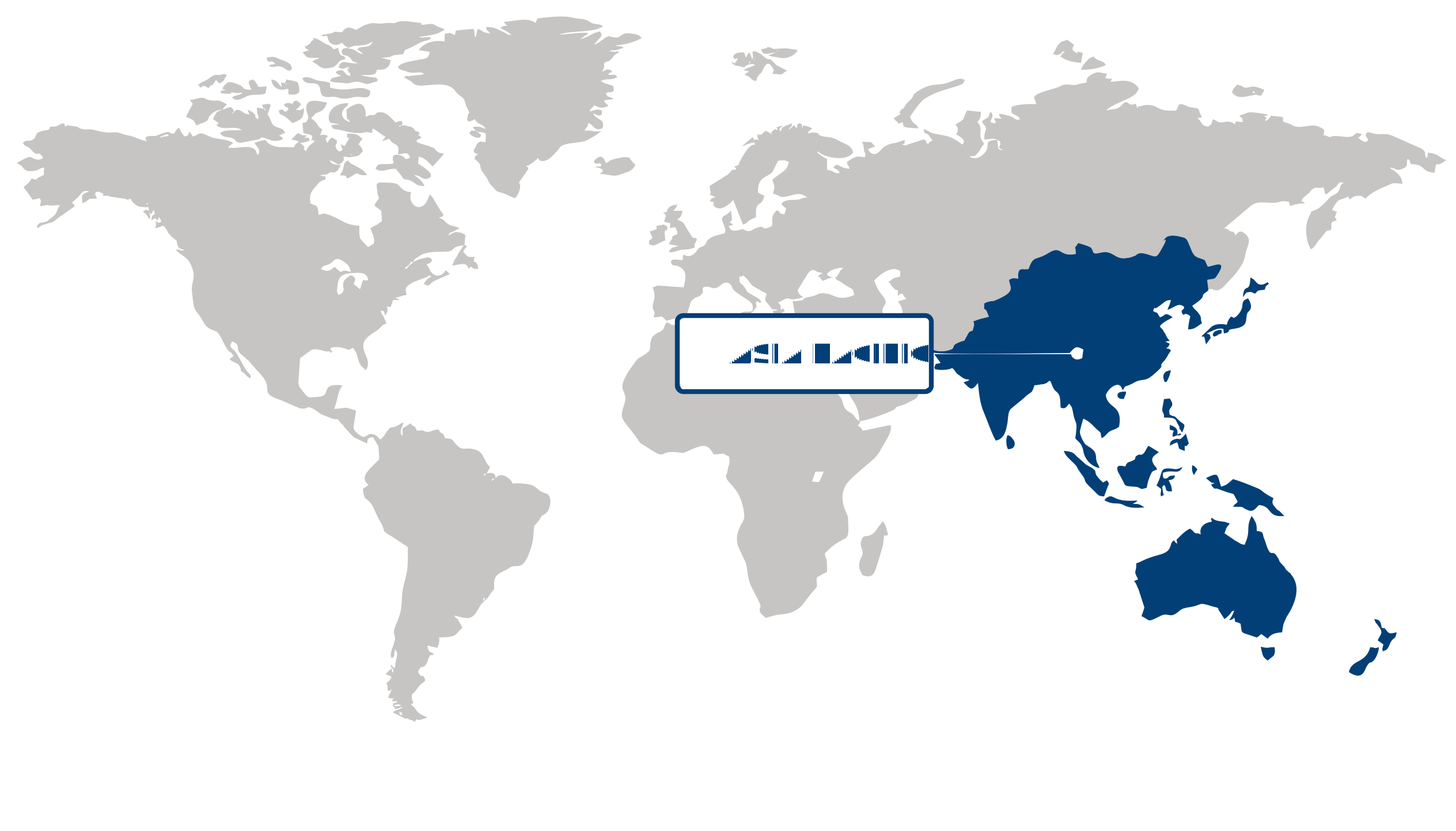
Asia Pacific (Largest Region)
The agricultural micronutrients market was dominated by Asia Pacific in 2026, supported by the region's extensive agricultural base, rising focus on crop productivity, and growing need to improve soil fertility. Intensive cultivation and increasing pressure to enhance agricultural output are encouraging farmers to adopt micronutrient-based solutions that address deficiencies and support healthier crop development. Expanding awareness of balanced crop nutrition, modernization of farming practices, and efforts to improve agricultural efficiency are expected to sustain regional demand. The presence of large farming economies and diverse crop production systems further strengthens the market's long-term potential.
North America (Fastest-Growing Region)
North America is expected to register the fastest growth, supported by increasing adoption of precision agriculture and greater emphasis on optimizing nutrient application. Farmers are increasingly focused on improving input efficiency and maintaining soil health, creating opportunities for targeted micronutrient use across different crop systems. Advancements in data-driven farming practices, growing awareness of nutrient deficiencies, and the broader shift toward more efficient agricultural management are expected to accelerate the integration of micronutrient products into modern crop production.
| Parameter | North America | Asia Pacific | Europe | Latin America | MEA |
|---|---|---|---|---|---|
| Innovation Hub i Scale Nascent Developing Advanced | |||||
| Cost-Sensitive Region i Scale Low Medium High | |||||
| Regulatory Environment i Scale Restrictive Neutral Supportive | |||||
| Demand Drivers i Scale Weak Moderate Strong | |||||
| Development Stage i Scale Emerging Developing Developed | |||||
| Adoption Rate i Scale Low Medium High | |||||
| New Entrants / Startups i Scale Sparse Moderate Dense | |||||
| Macro Indicators i Scale Weak Stable Strong |
Key Country Insights
United States 🇺🇸
Precision Nutrition PracticesThe U.S. agricultural micronutrients market is increasingly aligned with precision farming and soil health management strategies. Growers are adopting targeted micronutrient applications to improve nutrient efficiency, crop quality, and overall field productivity.
Germany 🇩🇪
Sustainable Crop NutritionGermany emphasizes agricultural micronutrients that complement sustainable farming practices and balanced nutrient management. Farmers are integrating micronutrient products with precision application technologies to optimize crop performance while supporting environmental objectives.
Japan 🇯🇵
Intensive Crop ManagementJapan focuses on agricultural micronutrients that support high-value crop cultivation under intensive production systems. Producers increasingly rely on specialized nutrient formulations to maintain crop quality and improve nutrient uptake in limited agricultural land.
South Korea 🇰🇷
High-Value Yield SupportSouth Korea is strengthening agricultural micronutrient use through precision crop management and improved fertilizer efficiency. Demand is growing for formulations that address soil nutrient deficiencies while supporting consistent crop quality across intensive farming operations.
France 🇫🇷
Balanced Soil FertilityFrance is encouraging agricultural micronutrient adoption as part of integrated nutrient management programs across major crop segments. Farmers are emphasizing balanced soil fertility and efficient nutrient utilization to improve long-term agricultural productivity.
Italy 🇮🇹
Specialty Crop NutritionItaly prioritizes agricultural micronutrients tailored to vineyards, orchards, and other specialty crops where nutrient balance directly influences quality. Growers are incorporating customized micronutrient programs to strengthen crop performance and optimize production outcomes.
Segment Leadership and Growth Trends
Agricultural Micronutrients Market Share (%), by Application Mode, 2026
Go beyond the chart, access full insights & data tables
Request Free Sample ReportApplication Mode Segment Analysis: Soil (Largest Segment) vs Fertigation (Fastest-Growing Segment)
Holding the largest share of the agricultural micronutrients market, the soil application mode accounted for 68.83% in 2026. Soil application remains the preferred approach because it enables uniform nutrient distribution across the root zone and supports sustained micronutrient availability throughout crop development. It is widely adopted across diverse cropping systems due to its compatibility with conventional farming practices, ease of large-scale application, and ability to address nutrient deficiencies over extended periods. Its effectiveness in improving soil fertility and supporting consistent crop productivity continues to reinforce its dominant position.
The fertigation application mode is expected to register the fastest growth over the forecast period as producers increasingly integrate irrigation and nutrient delivery into a single, efficient process. Fertigation enables precise application of micronutrients directly to the root zone, improving nutrient uptake while reducing losses associated with conventional methods. Growing adoption of modern irrigation systems, increasing emphasis on efficient resource utilization, and the shift toward precision agriculture are supporting stronger demand for fertigation across high-value and intensive farming operations.
Type Segment Analysis: Zinc (Largest Segment) vs Manganese (Fastest-Growing Segment)
The zinc type segment led the agricultural micronutrients market, capturing 31.33% of the market share in 2026. Zinc remains one of the most widely applied agricultural micronutrients because of its essential role in enzyme activation, protein synthesis, and healthy plant growth. Frequent zinc deficiencies across agricultural soils, coupled with the need to improve crop yield and quality, continue to encourage its widespread use in a broad range of field crops, fruits, and vegetables. Ongoing efforts to enhance soil nutrient balance and agricultural productivity further strengthen demand for zinc-based micronutrient products.
The manganese type segment is anticipated to witness the fastest growth during the forecast period owing to its increasing importance in photosynthesis, chlorophyll formation, and plant metabolic functions. Rising awareness among growers regarding balanced micronutrient management and the need to correct manganese-deficient soils is encouraging broader adoption. Expanding cultivation of high-value crops and greater focus on optimizing crop health are expected to further accelerate demand for manganese-based formulations.
Form Segment Analysis: Solid (Largest Segment) vs Liquid (Fastest-Growing Segment)
The solid form segment held the largest share of the market in 2026. Solid micronutrient formulations remain extensively used because they are easy to store, transport, and apply using conventional agricultural equipment. Their longer shelf life, suitability for bulk applications, and compatibility with various soil treatment practices make them a practical choice for large-scale farming. These advantages continue to support their widespread adoption across diverse agricultural environments.
In the agricultural micronutrients market, the liquid form segment is projected to experience the fastest growth over the forecast period. Liquid formulations offer rapid nutrient availability and are well suited for foliar spraying and precision application techniques, allowing growers to address nutrient deficiencies more efficiently. The expanding use of advanced farming technologies, increasing preference for targeted nutrient management, and rising demand for higher application efficiency are expected to drive the growth of the liquid form segment.
| Segment | Sub-Segment | Largest Segment | Fastest Growing |
|---|---|---|---|
| Application Mode | Soil, Foliar, Fertigation | Soil | Fertigation |
| Type | Zinc, Boron, Manganese, Iron, Molybdenum, Copper, Others | Zinc | Manganese |
| Form | Solid, Liquid | Solid | Liquid |
| Crop Type | Cereals and Grains, Oilseeds and Pulses, Fruits and Vegetables, Others | Cereals and Grains | Fruits and Vegetables |
Competitive Landscape and Market Positioning
Key companies in the agricultural micronutrients market:
- The Mosaic Company (United States)
- ICL Group Ltd. (Israel)
- Yara International ASA (Norway)
- Nutrien Ltd. (Canada)
- Haifa Group (Israel)
- Koch Agronomic Services (United States)
- Brandt Consolidated, Inc. (United States)
- Helena Agri-Enterprises LLC (United States)
- Tessenderlo Kerley, Inc. (United States)
- Coromandel International Ltd. (India)
Competitive intensity within the agricultural micronutrients market is increasingly driven by advances in formulation technologies that improve nutrient availability, crop-specific performance, and application efficiency under varied soil conditions. Suppliers are expanding their focus toward customized nutritional solutions that align with precision farming practices, encouraging stronger differentiation through agronomic expertise rather than standardized product offerings. As growers place greater emphasis on sustainable productivity and resource optimization, manufacturers are also investing in environmentally compatible formulations and technical advisory capabilities, reinforcing value-added services as an integral part of market competition.
| Company | Market Share | Company Revenue | Revenue CAGR (%) | Product Portfolio | Geographic Presence | Innovation / R&D Focus | Strategic Developments |
|---|---|---|---|---|---|---|---|
| The Mosaic Company (United States) | |||||||
| ICL Group Ltd. (Israel) | |||||||
| Yara International ASA (Norway) | |||||||
| Nutrien Ltd. (Canada) | |||||||
| Haifa Group (Israel) | |||||||
| Koch Agronomic Services (United States) | |||||||
| Brandt Consolidated Inc. (United States) | |||||||
| Helena Agri-Enterprises LLC (United States) | |||||||
| Tessenderlo Kerley Inc. (United States) | |||||||
| Coromandel International Ltd. (India) |
Industry Development/News
| Company Name | Date | Key Development |
|---|
Customize Your Report
Explore examples of how this report can be tailored to different research needs, including custom segments, additional topics or chapters, and related reports. Click a section of the wheel or its numbered marker to explore the available options.
Agricultural Micronutrients Market — Custom Segments
| Segment | Sub-Segment |
|---|---|
| Nutrient Source | Mineral-Based, Chelated, Organic-Based, Synthetic Complexes |
| Farming System | Conventional Farming, Organic Farming, Precision Farming, Protected Agriculture |
| Farm Size | Small Farms, Medium-Sized Farms, Large Commercial Farms |
Agricultural Micronutrients Market — Custom TOC
| Custom Chapter | Custom Details |
|---|---|
| Crop Nutrient Economics & ROI Assessment |
|
| Precision Nutrient Management Adoption |
|
| Micronutrient Supply Security & Import Dependency |
|
Need a different cut of the data?
Request Custom ResearchWhat is the current revenue of the agricultural micronutrients market?
How is the agricultural micronutrients industry size expected to evolve during the forecast period?
How is precision farming transforming micronutrient application strategies?
Why is soil nutrient depletion increasing investment in agricultural micronutrients?
Why is soil application the leading application mode in the agricultural micronutrients market?
What is fueling the growth of fertigation in the agricultural micronutrients market?
How does Asia Pacific maintain its leadership in the agricultural micronutrients market?
What is driving faster agricultural micronutrients growth in North America?
Which companies are driving growth in the agricultural micronutrients landscape?
Our Clients
"The report helped us understand emerging consumer trends in our product category. It clarified where to focus innovation for the next product launch."
LyondellBasell
"The regional forecast section was incredibly useful. We were able to identify two new potential partners in Europe thanks to the vendor mapping you included."
SABIC
"We appreciated how actionable the recommendations were. It guided us to improve supply chain resilience."
Olin Corporation
Our Research Team & Methodology
Every Fundamental Business Insights report is built by a dedicated vertical research team, validated through a structured primary-and-secondary methodology, and reviewed for accuracy before it reaches you.
Research Team Overview
Prepared by the Chemicals & Materials Research Team
Delivery
Published
Demand
Available
Support
Trust & Compliance
Research Domains
10 coverage areasResearch Intelligence
| Source | Reference |
|---|---|
| American Chemistry Council (ACC) | www.americanchemistry.com |
| European Chemical Industry Council (Cefic) | cefic.org |
| International Council of Chemical Associations (ICCA) | icca-chem.org |
| European Chemicals Agency (ECHA) | echa.europa.eu |
| U.S. Environmental Protection Agency (EPA) | www.epa.gov |
| ASTM International | www.astm.org |
| International Organization for Standardization (ISO) | www.iso.org |
| National Institute of Standards and Technology (NIST) | www.nist.gov |
| Plastics Industry Association (PLASTICS) | www.plasticsindustry.org |
| European Biplastics | www.european-bioplastics.org |
| The Adhesive and Sealant Council (ASC) | www.ascouncil.org |
| National Association of Corrosion Engineers (AMPP) | www.ampp.org |
| Society of Plastics Engineers (SPE) | www.4spe.org |
| International Fertilizer Association (IFA) | www.fertilizer.org |
| CropLife International | croplife.org |
| Packaging Europe | packagingeurope.com |
| Flexible Packaging Association (FPA) | www.flexpack.org |
| Battery Council International (BCI) | batterycouncil.org |
| International Copper Association (ICA) | internationalcopper.org |
| World Steel Association | worldsteel.org |
Research Workflow & Quality Assurance
Data Collection
Verified information gathered through primary and secondary research.
Data Triangulation
Cross-validation using multiple independent data sources.
Forecast Modelling
Market estimates developed using historical trends and analytical models.
Analyst Validation
Findings reviewed by domain experts for accuracy and consistency.
Editorial & Quality Review
Final editorial, quality, and compliance checks before publication.
Final Publication
Released after successful completion of the internal review process.
Report Coverage
📊 Market Assessment
- Market Size & Forecast
- Market Segmentation
- Regional Analysis
- Growth Drivers & Challenges
- Market Dynamics
🏢 Competitive Intelligence
- Competitive Landscape
- Company Profiles
- Competitive Benchmarking
- Mergers & Acquisitions
- Market Share Analysis or Key Company Strategies
🔍 Strategic Analysis
- Value Chain Analysis
- Porter's Five Forces
- PESTLE Analysis
- Pricing Trends
- Supply-Demand Analysis
🚀 Future Outlook
- Technology Landscape
- Regulatory Landscape
- Investment & Funding Landscape
- Emerging Opportunities
- Future Market Outlook
Have a question about this report or need a custom scope?
Request Customization