5G Wireless Ecosystem Market Size & Forecasts 2026-2035, By Segments (End User, Component), Growth Opportunities, Innovation Landscape, Regulatory Shifts, Strategic Regional Insights (U.S., Japan, China, South Korea, UK, Germany, France), and Competitive Dynamics (Huawei, Ericsson, Nokia, Samsung, ZTE)
Market Size and Growth Outlook
5G Wireless Ecosystem Market size is predicted to expand from USD 222.13 billion in 2025 to USD 6.02 trillion by 2035, with growth underpinned by a CAGR above 39.1% between 2026 and 2035. The industry revenue outlook for 2026 is USD 301.96 billion.
Get more details on this report
Request Free Sample Report5G Wireless Ecosystem Market Intelligence Snapshot
Regional Market Dynamics
Segment Momentum
Market Expansion Drivers
Leading Market Participants
Global Market Forecast Snapshot
Market Outlook
Regional and Segment Outlook
Market Growth Drivers and Industry Trends
The widespread deployment of 5G networks remains a foundational growth driver in the 5G wireless ecosystem market, underpinning all subsequent innovations. Governments like the European Union have prioritized extensive 5G infrastructure investments to boost digital connectivity as outlined in the Digital Compass 2030 plan by the European Commission. Telecom giants such as Verizon and China Mobile are expanding their 5G footprints aggressively, enabling enhanced coverage and low-latency capabilities. This infrastructure surge not only facilitates richer consumer experiences but also enables edge computing and network slicing, catalyzing new business models. Both incumbents and startups gain strategic leverage by aligning with infrastructure providers to innovate services across healthcare, smart cities, and entertainment. Moving forward, continued public-private partnerships and regulatory support will be critical in densifying 5G infrastructure, ensuring the ecosystem’s dynamic expansion remains on track.
Integration of 5G in IoT and Industrial Automation
The convergence of 5G technology with IoT and industrial automation significantly propels the 5G wireless ecosystem market by transforming manufacturing, logistics, and smart utility sectors. Entities like Siemens and Bosch are integrating 5G-enabled sensors to enhance real-time data analytics and predictive maintenance, driving operational efficiency and cost savings. Regulatory frameworks favoring industrial digitization, such as Germany’s Industrie 4.0 initiative, underscore 5G’s role in enabling massive connectivity for autonomous machines and robotics. This integration presents opportunities for both established industrial technology providers and innovative IoT startups to develop scalable, secure solutions tailored to complex industrial environments. As digital transformation intensifies, the ecosystem will increasingly prioritize interoperable, low-latency 5G applications to sustain industrial competitiveness globally.
Development of 5G-Enabled Devices and Applications
The proliferation of 5G-enabled devices and applications constitutes a critical growth driver, expanding the 5G wireless ecosystem market by enhancing consumer engagement and enabling novel use cases. Leading technology firms such as Apple and Samsung have launched 5G smartphones that leverage superior speeds for immersive gaming, VR, and streaming services, reshaping user behavior and expectations. Additionally, Qualcomm’s advancements in 5G chipsets facilitate broader device adoption across wearables and connected vehicles. This surge in device availability creates strategic openings for application developers and content providers to harness 5G’s capabilities for innovation in sectors like telemedicine and smart homes. Future growth trajectories will be shaped by seamless device integration and app ecosystem expansion, further embedding 5G connectivity into daily life and enterprise operations.
Industry Restraints:
Spectrum Allocation Conflicts
The limited availability and contested allocation of high-frequency spectrum bands significantly constrain the deployment speed and efficiency of 5G networks. Diverse national regulatory frameworks and competing demands from sectors like defense and satellite communications create fragmentation, as documented by the International Telecommunication Union (ITU). Such regulatory heterogeneity often delays licensing and increases compliance costs for telecom operators, including major players like Ericsson and Huawei. Strategic efforts to navigate these spectrum allocation conflicts require substantial lobbying and localized network customization, posing elevated entry barriers for smaller firms. Going forward, without coordinated international spectrum management, these conflicts will likely continue to impede large-scale 5G rollouts, particularly affecting seamless service expansion across borders.
Supply Chain Disruptions and Component Shortages
Supply chain vulnerabilities, particularly semiconductor shortages, critically restrain 5G infrastructure and device production. The U.S. Department of Commerce highlights ongoing chip supply constraints exacerbated by geopolitical tensions and pandemic-induced manufacturing delays. This bottleneck inflates costs and limits inventory availability for network equipment providers such as Nokia and Qualcomm. Consequently, operators experience deployment lags and heightened operational risks, disproportionately impacting smaller vendors lacking diversified suppliers. Strategic adaptations involve investing in supply chain resilience and long-term vendor partnerships, yet persistent disruptions will likely hamper the 5G ecosystem’s acceleration, forcing market participants to prioritize efficiency and resource optimization in the near term.
| Growth Driver | Impact on CAGR | Regulatory Influence | Geographic Relevance | Adoption Rate | Impact Timeline |
|---|---|---|---|---|---|
| Rollout of 5G networks and infrastructure | 10.00% | Short term (≤ 2 yrs) | North America, Asia Pacific; Spillover: Europe | High | Fast |
| Integration of 5G in IoT and industrial automation | 8.00% | Medium term (2–5 yrs) | Asia Pacific, Europe | Medium | Moderate |
| Development of 5G-enabled devices and applications | 7.00% | Long term (5+ yrs) | North America, Asia Pacific | Low | Slow |
Unlock insights tailored to your business with our bespoke market research solutions.
Click to get your customized report now.
Regional Demand Dynamics
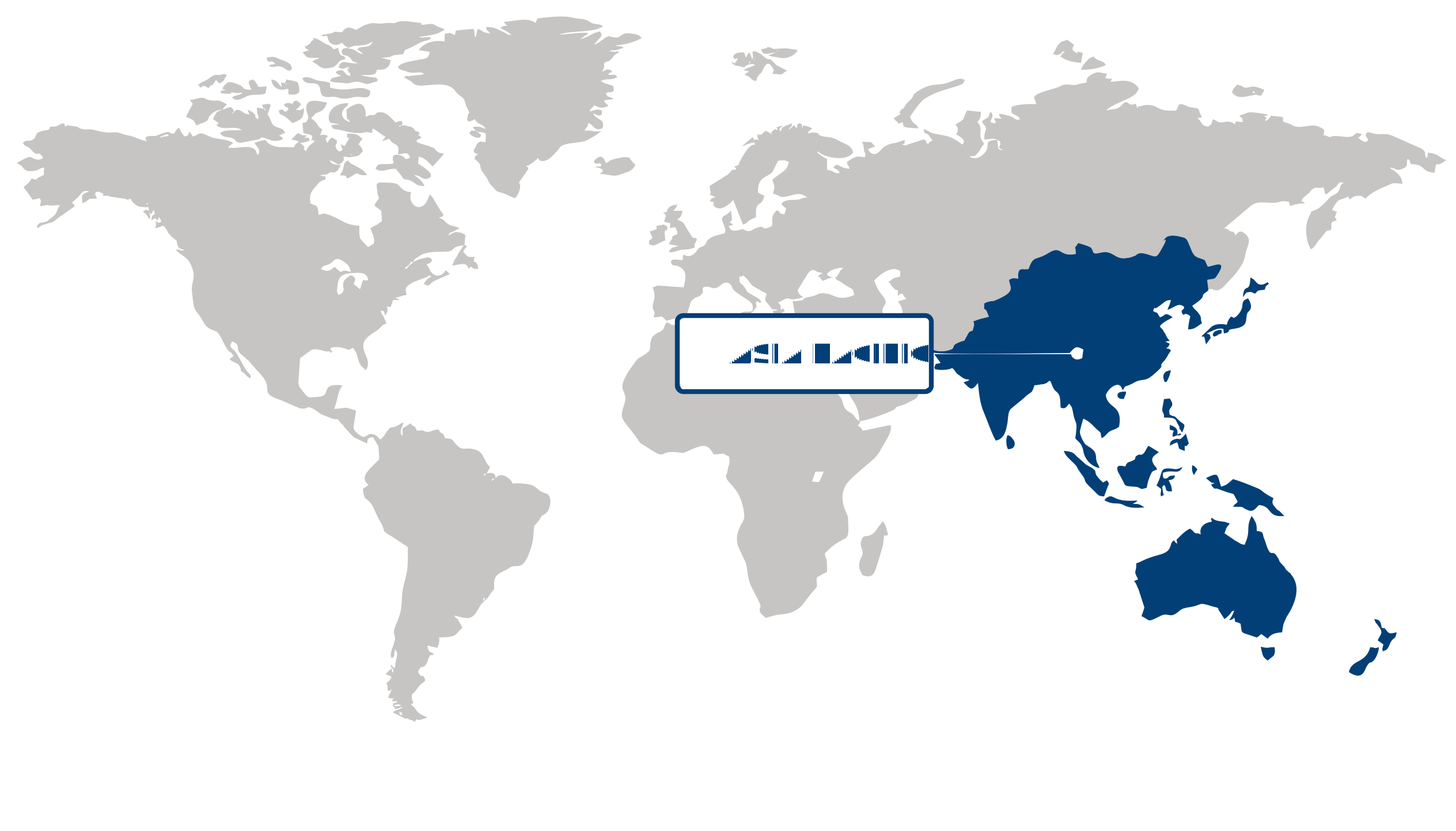
Asia Pacific captured over 41.3% of the global 5G wireless ecosystem market in 2025, solidifying its position as the largest regional player. This dominance stems from extensive investments in next-generation infrastructure across media, transportation, and manufacturing sectors, which are fueling rapid adoption and integration of 5G technologies. Countries like China and Japan are aggressively expanding smart city initiatives and Industry 4.0 applications, supported by government policy shifts and robust funding frameworks from entities like the Ministry of Industry and Information Technology of China. Additionally, the region’s massive consumer base and accelerating digital transformation create a fertile environment for innovative 5G-enabled services. These dynamics underscore Asia Pacific's competitiveness and resilience, providing investors and strategists with substantial growth opportunities as infrastructure sophistication deepens and ecosystem collaborations intensify.
China anchors the Asia Pacific 5G wireless ecosystem market with unparalleled scale in deployment and consumer uptake. Fueled by pioneering initiatives from the China Academy of Information and Communications Technology and state-led infrastructure programs, the country leads in integrating 5G within transportation networks and smart manufacturing. Strong competitive strategies among domestic telecom giants such as China Mobile and Huawei further accelerate market penetration and network density. This extensive groundwork positions China as a hub of technological innovation, reinforcing Asia Pacific’s regional leadership and underscoring strategic importance in global 5G advancement.
Japan is positioned as a pivotal hub in the Asia Pacific 5G wireless ecosystem market, leveraging its advanced manufacturing base and commitment to digital innovation. Spearheaded by the Ministry of Internal Affairs and Communications, Japan focuses on embedding 5G into media and transportation sectors, emphasizing quality and operational efficiency. Key players like NTT Docomo and Rakuten Mobile drive competitive service offerings that enhance urban experiences and industrial automation. Japan’s regulatory foresight and technology integration complement regional trends, enhancing Asia Pacific’s overall market growth potential and providing a model for sustainable infrastructure development within the 5G ecosystem.
North America Market Analysis:
North America emerged as the fastest-growing region in the 5G wireless ecosystem market, registering a remarkable CAGR of 54.74%. This rapid expansion is primarily driven by the early adoption of advanced wireless technologies and an accelerated push for digital transformation across large enterprises. The region’s robust innovation framework and extensive R&D investments, exemplified by initiatives from companies like Qualcomm and Verizon, underpin this swift market growth. Moreover, favorable regulatory environments shaped by the Federal Communications Commission (FCC) have catalyzed infrastructure development and spectrum allocation, facilitating broader 5G network deployment. North American consumers’ increasing demand for high-speed connectivity and seamless IoT integration further fuels this trend. As businesses embrace Industry 4.0 and smart technologies, North America offers substantial opportunities for stakeholders aiming to capitalize on the 5G wireless ecosystem’s transformative potential.
The U.S. plays a pivotal role in North America’s 5G wireless ecosystem market due to its status as a pioneer in adopting next-generation wireless technologies. Driven by strong consumer demand for faster, more reliable connectivity and widespread enterprise digital transformation initiatives, American telecom providers like AT&T and T-Mobile are aggressively expanding their 5G networks. The country’s regulatory agencies, such as the FCC, have implemented proactive policies to streamline spectrum licensing and promote public-private partnerships, accelerating technology rollout. Additionally, U.S. manufacturers are innovating in 5G-enabled devices and infrastructure components, positioning the market as a global enabler for 5G advancements. These dynamics reinforce the U.S. as a critical engine of growth, enhancing North America’s overall leadership in the evolving 5G wireless ecosystem.
Europe Market Trends:
Europe maintained a notable presence in the 5G wireless ecosystem market, driven by its strategic emphasis on digital transformation and sustainable connectivity. The region's robust infrastructure investments, supported by regulatory frameworks from the European Commission promoting technology harmonization and spectrum allocation, have propelled demand for advanced 5G solutions. Leading European telecom operators such as Deutsche Telekom and Vodafone are accelerating network deployments, reflecting shifting consumer preferences toward enhanced mobile experiences and enterprise digitization. Additionally, Europe’s commitment to green technologies and resilient supply chains, as underscored by the European Union’s 5G Action Plan, has fostered competitive intensity among vendors while facilitating collaboration across member states. These factors position Europe as a dynamic hub for 5G innovation, offering significant opportunities for stakeholders aiming to capitalize on expanding smart city initiatives and Industry 4.0 applications.
Germany stands as a pivotal player in the 5G wireless ecosystem market within Europe, leveraging its advanced manufacturing base and strong public-private partnerships to lead adoption efforts. The country’s Federal Network Agency has expedited spectrum auctions, fostering a competitive landscape where Deutsche Telekom, Vodafone, and Telefonica are rapidly expanding 5G coverage to meet escalating consumer and industrial demand. Germany’s focus on integrating 5G in automotive and industrial automation sectors is supported by substantial investments detailed in Deutsche Telekom's strategic announcements, reinforcing its role in driving regional supply chain modernization. This leadership facilitates Germany’s influence on European standards and cross-border connectivity, underscoring its importance in unlocking broader regional growth opportunities.
France plays a critical role in the European 5G wireless ecosystem market through its emphasis on regulatory agility and innovation-friendly policies. The French Regulatory Authority for Electronic Communications (ARCEP) has strategically balanced spectrum allocation with incentives for rural 5G expansion, catering to diverse market needs. French operators like Orange and Bouygues Telecom are advancing network rollouts, encouraged by government initiatives to stimulate digital inclusion and smart infrastructure development, as highlighted in Orange’s recent annual report. France’s blend of urban density and rural connectivity challenges drives tailored 5G applications, reinforcing its competitive edge within Europe’s evolving ecosystem. Consequently, France enhances regional momentum by fostering diverse use cases that complement and strengthen Europe's overall 5G market landscape.
| Parameter | North America | Asia Pacific | Europe | Latin America | MEA |
|---|---|---|---|---|---|
| Innovation Hub i Scale Nascent Developing Advanced | |||||
| Cost-Sensitive Region i Scale Low Medium High | |||||
| Regulatory Environment i Scale Restrictive Neutral Supportive | |||||
| Demand Drivers i Scale Weak Moderate Strong | |||||
| Development Stage i Scale Emerging Developing Developed | |||||
| Adoption Rate i Scale Low Medium High | |||||
| New Entrants / Startups i Scale Sparse Moderate Dense | |||||
| Macro Indicators i Scale Weak Stable Strong |
Segment Leadership and Growth Trends
5G Wireless Ecosystem Market Share (%), by End User, 2026
Go beyond the chart, access full insights & data tables
Request Free Sample ReportThe enterprise segment represented the largest share of the 5G wireless ecosystem market in 2025, driven by rapid adoption of private 5G networks across diverse industries. Organizations leverage these networks to enhance connectivity, enable real-time monitoring, and integrate Internet of Things (IoT) devices, fostering extensive digital transformation. This momentum aligns with evolving business preferences for scalable, secure, and low-latency communication infrastructures, underscored by workforce demands for remote and automated operations. Regulatory support from agencies such as the Federal Communications Commission (FCC) in the US for enterprise 5G spectrum allocation further accelerates deployment. Leading technology providers like Ericsson and Nokia have emphasized tailored enterprise solutions in their strategies, creating significant opportunities for both established players and startups. Given increasing digitalization and sector-specific 5G use cases, the enterprise segment is poised to maintain its strategic relevance amid evolving connectivity needs in the medium term.
Analysis by Component
Chipsets held the largest share in the 5G wireless ecosystem market in 2025, propelled by strong demand for sophisticated components capable of supporting enhanced mobile broadband and ultra-low latency applications. The critical role of advanced chipsets in enabling high-performance connectivity for smartphones, IoT devices, and enterprise digital applications underpins their market leadership. Innovations from industry leaders such as Qualcomm and MediaTek demonstrate continuous improvements in power efficiency and processing speed, satisfying rising consumer and industrial expectations. Additionally, supply chain enhancements and semiconductor manufacturing advances have improved availability and reduced costs. Strategic emphasis on chipset development positions companies to capitalize on growing device complexity and demand, sustaining competitiveness. As digital transformation and 5G adoption deepen globally, chipsets will remain foundational, ensuring this component segment's sustained prominence in the foreseeable future.
| Segment | Sub-Segment | Largest Segment | Fastest Growing |
|---|---|---|---|
| End User | Individuals, Enterprise | ||
| Component | Chipsets, Enterprise Access Equipment, Wireless Devices, Small Cell Infrastructure, Macro Base Stations, Network Switches and Routers, 5G Communication Service, Others |
Competitive Landscape and Market Positioning
The competitive landscape is marked by dynamic cooperation and calculated expansions among these key players. Huawei and Ericsson focus substantially on broadening spectrum capabilities, while Qualcomm and Intel accelerate edge computing integration. Nokia and Samsung emphasize end-to-end service portfolios, capitalizing on partnerships to augment their technology reach. Cisco, NEC, and Fujitsu prioritize interconnectivity and network security enhancements through continuous innovation, ensuring resilience and scalability. Strategic alliances and targeted advancements collectively enable these companies to sustain innovation velocity, thereby reinforcing market leadership amid evolving telecommunications demands.
Strategic / Actionable Recommendations for Regional Players
In North America, entities could benefit from strengthening collaboration with semiconductor innovators and cloud service providers to harness converging technologies and capture advanced enterprise applications. Embracing open radio access networks (Open RAN) frameworks may bolster competitive differentiation.
Asia Pacific players might consider intensifying alliances within industrial automation and smart city initiatives, leveraging 5G’s low latency and high bandwidth to expand use cases. Integrating AI-driven network management could drive operational efficiency and service customization.
European organizations are well-positioned to advance sustainable 5G deployment by engaging in cross-border research initiatives and focusing on energy-efficient infrastructure solutions. Partnering with industry verticals such as automotive and manufacturing may expand practical applications and market penetration.
| Company | Market Share | Company Revenue | Revenue CAGR (%) | Product Portfolio | Geographic Presence | Innovation / R&D Focus | Strategic Developments |
|---|---|---|---|---|---|---|---|
| No companies available. | |||||||
Industry Development/News
| Company Name | Date | Key Development |
|---|
Customize Your Report
Explore examples of how this report can be tailored to different research needs, including custom segments, additional topics or chapters, and related reports. Click a section of the wheel or its numbered marker to explore the available options.
5G Wireless Ecosystem Market — Custom Segments
| Segment | Sub-Segment |
|---|---|
| No segment data available. | |
5G Wireless Ecosystem Market — Custom TOC
| Custom Chapter | Custom Details | ||
|---|---|---|---|
| No custom TOC data available. | |||
Need a different cut of the data?
Request Custom ResearchWhat are the growth projections for the 5G wireless ecosystem industry?
What is the leading region in terms of 5G wireless ecosystem market share?
Which region shows the most rapid acceleration in the 5G wireless ecosystem sector?
Why does enterprise sub-segment dominate the end user segment of 5G wireless ecosystem sector?
How does chipsets segment fare in the 5G wireless ecosystem industry?
Who are the leading players in the 5G wireless ecosystem landscape?
Our Clients
"The team demonstrated a great understanding of our business needs, and the reports were tailored to address our specific concerns and objectives."
Infosys
"The report was up-to-date with the latest industry trends and technological advancements. The detailed competitive landscape analysis was quite helpful."
Zebra Technologies
"The data presented in the report was accurate and well-researched. I also found the market dynamics section particularly useful."
Arlo Technologies
Our Research Team & Methodology
Every Fundamental Business Insights report is built by a dedicated vertical research team, validated through a structured primary-and-secondary methodology, and reviewed for accuracy before it reaches you.
Research Team Overview
Prepared by the Smart Technologies Research Team
Delivery
Published
Demand
Available
Support
Trust & Compliance
Research Domains
10 coverage areasResearch Intelligence
| Source | Reference |
|---|---|
| National Institute of Standards and Technology (NIST) | www.nist.gov |
| International Organization for Standardization (ISO) | www.iso.org |
| Institute of Electrical and Electronics Engineers (IEEE) | www.ieee.org |
| Internet Engineering Task Force (IETF) | www.ietf.org |
| World Wide Web Consortium (W3C) | www.w3.org |
| Cloud Security Alliance (CSA) | cloudsecurityalliance.org |
| Open Source Initiative (OSI) | opensource.org |
| Linux Foundation | www.linuxfoundation.org |
| FinOps Foundation | www.finops.org |
| PCI Security Standards Council | www.pcisecuritystandards.org |
| SWIFT | www.swift.com |
| Financial Stability Board (FSB) | www.fsb.org |
| GSMA | www.gsma.com |
| International Telecommunication Union (ITU) | www.itu.int |
| OWASP Foundation | owasp.org |
| MITRE | www.mitre.org |
| World Economic Forum (WEF) | www.weforum.org |
| OECD Digital Economy | www.oecd.org/digital |
| World Bank Data | data.worldbank.org |
| U.S. Census Bureau | www.census.gov |
Research Workflow & Quality Assurance
Data Collection
Verified information gathered through primary and secondary research.
Data Triangulation
Cross-validation using multiple independent data sources.
Forecast Modelling
Market estimates developed using historical trends and analytical models.
Analyst Validation
Findings reviewed by domain experts for accuracy and consistency.
Editorial & Quality Review
Final editorial, quality, and compliance checks before publication.
Final Publication
Released after successful completion of the internal review process.
Report Coverage
📊 Market Assessment
- Market Size & Forecast
- Market Segmentation
- Regional Analysis
- Growth Drivers & Challenges
- Market Dynamics
🏢 Competitive Intelligence
- Competitive Landscape
- Company Profiles
- Competitive Benchmarking
- Mergers & Acquisitions
- Market Share Analysis or Key Company Strategies
🔍 Strategic Analysis
- Value Chain Analysis
- Porter's Five Forces
- PESTLE Analysis
- Pricing Trends
- Supply-Demand Analysis
🚀 Future Outlook
- Technology Landscape
- Regulatory Landscape
- Investment & Funding Landscape
- Emerging Opportunities
- Future Market Outlook
Have a question about this report or need a custom scope?
Request Customization