5G New Radio Market Size & Growth Forecast 2027–2036, By Segments (Operating Frequency, Architecture, Offering, Application, Industry), Regional Demand Trends (North America, Asia Pacific, Europe), Key Country Insights (U.S., Japan, South Korea, Germany, France, Italy), and Competitive Landscape
Market Size and Growth Outlook
5G New Radio Market size was valued at USD 89.8 billion in 2026 and is anticipated to grow at a 23.47% CAGR from 2027 to 2036, crossing USD 739.42 billion by 2036. The industry revenue for 2027 is calculated at USD 107.54 billion.
Get more details on this report
Request Free Sample Report5G New Radio Market Intelligence Snapshot
Regional Market Dynamics
- Asia Pacific captured a 40.28% share in 2026, supported by extensive telecom rollouts, ongoing radio infrastructure upgrades, large subscriber bases, and sustained investment in network capacity.
- North America is projected to grow at a 31.02% CAGR as operators invest in network densification, spectrum optimization, equipment upgrades, and advanced radio technologies to enhance connectivity performance.
Segment Momentum
- Sub-6 GHz held a 62.08% share in 2026 because it offers an effective balance of coverage, capacity, and deployment efficiency, making it the preferred choice for broad commercial 5G rollouts.
- Standalone (SA) is expanding fastest as operators adopt native 5G networks to support lower latency, greater flexibility, and advanced services beyond the capabilities of NSA deployments.
Market Expansion Drivers
- Rising global demand for high-speed data services accelerating 5G NR network densification.
- Open RAN adoption and cloud-native virtualization reducing deployment costs and improving interoperability.
- Expansion of private 5G networks in smart factories enabling industrial automation and logistics connectivity.
Leading Market Participants
- Prominent players in the 5G new radio market include Huawei Technologies Co., Ltd. (China), Telefonaktiebolaget LM Ericsson (Sweden), Nokia Corporation (Finland), Qualcomm Incorporated (United States), Samsung Electronics Co., Ltd. (South Korea), Intel Corporation (United States), Cisco Systems, Inc. (United States), NEC Corporation (Japan), Fujitsu Limited (Japan), Keysight Technologies, Inc. (United States).
Global Market Forecast Snapshot
Market Outlook
- 2026 Market Size: USD 89.8 billion
- 2027 Estimated Market Size: USD 107.54 billion.
- Projected Market Size: USD 739.42 billion by 2036
- Growth Forecast: 23.47% CAGR (2027-2036)
Regional and Segment Outlook
- Leading Regional Market: Asia Pacific
- High-Growth Regional Hub: North America
- Core Revenue Segment: Sub-6 GHz (Operating Frequency) | Non-Standalone (NSA) (Architecture) | Hardware (Offering) | Enhanced Mobile Broadband (eMBB) (Application) | Telecom & IT (Industry)
- Emerging Opportunity Segment: mmWave (Operating Frequency) | Standalone (SA) (Architecture) | Services (Offering) | Ultra-reliable Low-Latency Communications (URLLC) (Application) | Manufacturing (Industry)
Market Growth Drivers and Industry Trends
Rising global demand for high-speed data services accelerating 5G NR network densification
The 5G new radio market is gaining momentum as consumers, enterprises, and digital service providers increasingly require faster data transmission, lower latency, and more reliable connectivity for bandwidth-intensive applications. Growing use of video streaming, cloud-based services, connected devices, and real-time digital platforms is placing greater capacity demands on existing wireless infrastructure. Network operators are therefore increasing the deployment of 5G NR small cells, macro cells, and other radio access infrastructure to improve coverage and accommodate rising traffic volumes in densely populated and high-demand areas. Network densification also enables operators to address capacity constraints while maintaining consistent service quality across urban environments, transport hubs, commercial districts, and other locations experiencing concentrated data usage.
Open RAN adoption and cloud-native virtualization reducing deployment costs and improving interoperability
Open RAN adoption is supporting 5G new radio market growth by enabling more flexible and disaggregated network architectures that reduce dependence on tightly integrated proprietary infrastructure. The integration of cloud-native virtualization allows network functions to operate on standardized computing platforms, helping operators streamline infrastructure deployment, resource allocation, and network management. Open interfaces can also improve interoperability among equipment from different vendors, creating greater flexibility when designing and upgrading radio access networks. These capabilities are particularly relevant for operators seeking to modernize existing networks while controlling capital and operational expenditure, as virtualized and interoperable architectures can simplify network expansion and support more efficient utilization of computing and radio resources.
Expansion of private 5G networks in smart factories enabling industrial automation and logistics connectivity
The expansion of private 5G networks is creating new opportunities for the 5G new radio market as manufacturers and logistics operators seek dedicated wireless connectivity for increasingly automated facilities. Private networks can support low-latency communication between industrial machines, autonomous mobile robots, sensors, cameras, and control systems, enabling more coordinated production and material-handling processes. In smart factories, enhanced wireless reliability allows connected equipment to exchange operational data continuously, while logistics facilities can use private 5G connectivity to support automated inventory movement, asset tracking, and warehouse management. The ability to deploy localized networks tailored to specific industrial requirements is strengthening demand for 5G radio infrastructure across manufacturing and logistics environments.
| Growth Driver | Impact on CAGR | Regulatory Influence | Geographic Relevance | Adoption Rate | Impact Timeline |
|---|---|---|---|---|---|
| Rapid Deployment of 5G Networks | 12.00% | Short term (≤ 2 yrs) | Asia Pacific, North America (spillover: Europe) | Medium | Fast |
| 5G-enabled IoT & Industry Applications | 10.00% | Medium term (2–5 yrs) | North America, Europe (spillover: Asia Pacific) | Low | Moderate |
| Regulatory Spectrum Allocation Policies | 6.20% | Long term (5+ yrs) | Europe, North America (spillover: MEA) | High | Moderate |
| Rising global demand for high-speed data services accelerating 5G NR network densification | 2.40% | Moderate | North America, Asia Pacific | High | Near Term |
| Open RAN adoption and cloud-native virtualization reducing deployment costs and improving interoperability | 2.10% | Moderate | North America, Europe, Asia Pacific | High | Mid Term |
| Expansion of private 5G networks in smart factories enabling industrial automation and logistics connectivity | 1.80% | High | Asia Pacific, Europe, North America | Medium | Mid Term |
Unlock insights tailored to your business with our bespoke market research solutions.
Click to get your customized report now.
Regional Demand Dynamics
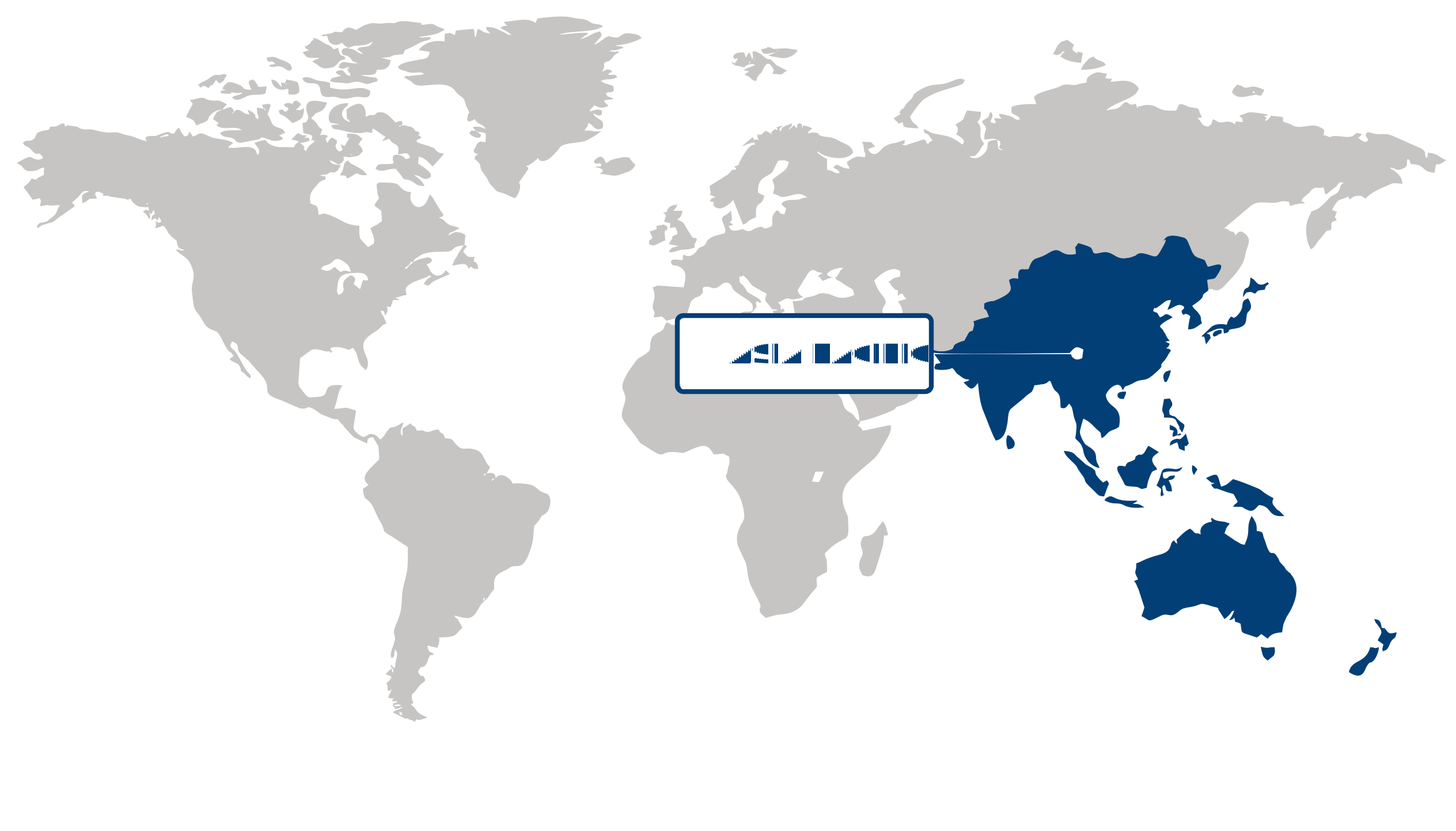
Asia Pacific (Largest Region)
Asia Pacific dominated the 5G new radio market with a 40.28% share in 2026, supported by extensive telecommunications infrastructure development, strong demand for high-speed connectivity, and rapid adoption of advanced mobile technologies. The region's large and increasingly connected population is encouraging network operators to expand 5G coverage and upgrade existing infrastructure to support growing data consumption. Industrial digitalization, smart manufacturing, connected devices, and emerging smart city initiatives are further increasing the need for reliable, low-latency wireless networks. Strong investment in telecommunications infrastructure and growing demand for enhanced mobile broadband are also accelerating deployment of 5G new radio technologies, while the development of enterprise and industrial use cases is creating additional opportunities beyond consumer connectivity.
North America (Fastest-Growing Region)
North America is the fastest-growing regional market, driven by continued network modernization and increasing demand for advanced wireless connectivity across consumer, enterprise, and industrial applications. The expansion of 5G-enabled services is encouraging investment in radio access infrastructure capable of delivering improved capacity, responsiveness, and network efficiency. Growing adoption of connected devices, private wireless networks, cloud-based applications, and industrial automation is broadening the need for advanced 5G capabilities. In addition, strong digital infrastructure and an established ecosystem for telecommunications innovation are supporting the transition toward more sophisticated network architectures. Increasing enterprise reliance on high-performance connectivity is further strengthening demand for 5G new radio solutions.
| Parameter | North America | Asia Pacific | Europe | Latin America | MEA |
|---|---|---|---|---|---|
| Innovation Hub i Scale Nascent Developing Advanced | |||||
| Cost-Sensitive Region i Scale Low Medium High | |||||
| Regulatory Environment i Scale Restrictive Neutral Supportive | |||||
| Demand Drivers i Scale Weak Moderate Strong | |||||
| Development Stage i Scale Emerging Developing Developed | |||||
| Adoption Rate i Scale Low Medium High | |||||
| New Entrants / Startups i Scale Sparse Moderate Dense | |||||
| Macro Indicators i Scale Weak Stable Strong |
Key Country Insights
Germany 🇩🇪
Industrial Connectivity PlatformGermany's 5G New Radio market is strongly influenced by manufacturing digitization and industrial automation requirements. Companies are adopting private 5G networks and low-latency connectivity solutions to support smart factories and connected production environments.
France 🇫🇷
Strategic Network DensificationFrance is concentrating on extending 5G coverage and increasing network capacity to support industrial and public sector digital initiatives. The country's telecom operators are investing in infrastructure upgrades and spectrum efficiency to enhance service delivery.
Italy 🇮🇹
Digital Transformation EnablementItaly is using 5G New Radio deployments to support enterprise modernization, smart infrastructure projects, and connected services. Market activity increasingly centers on expanding coverage and enabling industry-specific applications that require reliable high-speed connectivity.
Japan 🇯🇵
Advanced Infrastructure ModernizationJapan continues to enhance 5G New Radio capabilities to support high-density urban connectivity and digital services expansion. Network operators are emphasizing infrastructure upgrades and applications that enable intelligent transport, automation, and immersive technologies.
South Korea 🇰🇷
Next-Generation Service DeploymentSouth Korea remains focused on developing advanced consumer and enterprise applications enabled by 5G New Radio technologies. The market emphasizes network performance improvements and the commercialization of services requiring ultra-low latency and high bandwidth.
United States 🇺🇸
Enterprise Network ExpansionThe U.S. is prioritizing 5G New Radio deployments that support industrial connectivity, private networks, and high-capacity data services. Telecom operators and enterprises in the U.S. are increasingly investing in standalone architectures and advanced spectrum utilization strategies.
Segment Leadership and Growth Trends
5G New Radio Market Share (%), by Operating Frequency, 2026
Go beyond the chart, access full insights & data tables
Request Free Sample ReportOperating Frequency Segment Analysis: Sub-6 GHz (Largest Segment) vs mmWave (Fastest-Growing Segment)
The sub-6 GHz segment led the 5G new radio market with a 62.08% share in 2026, supported by its broad coverage characteristics, favorable propagation performance, and suitability for widespread network deployment. Sub-6 GHz frequencies enable operators to extend 5G services across urban, suburban, and broader geographic areas while maintaining a practical balance between coverage and capacity. Their compatibility with diverse deployment environments and role in mainstream 5G network expansion continue to support strong adoption.
The mmwave segment is expanding at a faster pace as demand increases for extremely high-capacity wireless connectivity and low-latency applications. Its ability to support substantial data throughput makes mmwave particularly relevant for dense urban environments, fixed wireless access, industrial connectivity, and other bandwidth-intensive applications. Continued network densification, development of advanced antennas, and growing requirements for high-performance connectivity are encouraging greater deployment of mmwave technologies.
Architecture Segment Analysis: Non-Standalone (NSA) (Largest Segment) vs Standalone (SA) (Fastest-Growing Segment)
Non-Standalone architecture accounted for the largest share of 63.05% in the 5G new radio market in 2026, reflecting its practical role in enabling operators to introduce 5G capabilities while leveraging existing network infrastructure. NSA deployments can support faster network transitions by combining new 5G radio access with established core network elements, reducing the need for an immediate end-to-end infrastructure replacement. This approach has supported broad early-stage 5G deployment and continues to provide an efficient pathway for network modernization.
Standalone architecture is gaining momentum as operators increasingly pursue the full capabilities of 5G networks. SA deployments provide a dedicated 5G core architecture that can enable advanced network functions, including network slicing, improved latency management, and greater support for enterprise and industrial applications. As demand shifts from enhanced mobile broadband toward more sophisticated connected use cases, the ability of SA architecture to support differentiated services is strengthening its growth prospects.
| Segment | Sub-Segment | Largest Segment | Fastest Growing |
|---|---|---|---|
| Operating Frequency | Sub-6 GHz, mmWave | Sub-6 GHz | mmWave |
| Architecture | Non-Standalone (NSA), Standalone (SA) | Non-Standalone (NSA) | Standalone (SA) |
| Offering | Hardware, Software, Services | Hardware | Services |
| Application | Enhanced Mobile Broadband (eMBB), Ultra-reliable Low-Latency Communications (URLLC), Massive Machine-type Communications (mMTC). | Enhanced Mobile Broadband (eMBB) | Ultra-reliable Low-Latency Communications (URLLC) |
| Industry | Telecom & IT, Manufacturing, Automotive, Healthcare, Retail, Others | Telecom & IT | Manufacturing |
Competitive Landscape and Market Positioning
Leading companies in the 5G new radio market:
1. Huawei Technologies Co. Ltd. (China)
2. Telefonaktiebolaget LM Ericsson (Sweden)
3. Nokia Corporation (Finland)
4. Qualcomm Incorporated (United States)
5. Samsung Electronics Co. Ltd. (South Korea)
6. Intel Corporation (United States)
7. Cisco Systems Inc. (United States)
8. NEC Corporation (Japan)
9. Fujitsu Limited (Japan)
10. Keysight Technologies Inc. (United States)
The 5G new radio market is advancing rapidly through enhanced network architecture optimization and ultra-low latency solutions. Deployment of advanced communication frameworks is enabling more efficient spectrum utilization. Strategic collaborations are supporting faster infrastructure rollout across regions. Continuous R&D efforts are focused on improving network reliability and throughput, reinforcing the competitiveness of the 5G new radio market in next-generation connectivity ecosystems.
| Company | Market Share | Company Revenue | Revenue CAGR (%) | Product Portfolio | Geographic Presence | Innovation / R&D Focus | Strategic Developments |
|---|---|---|---|---|---|---|---|
| Huawei Technologies Co. Ltd. (China) | |||||||
| Telefonaktiebolaget LM Ericsson (Sweden) | |||||||
| Nokia Corporation (Finland) | |||||||
| Qualcomm Incorporated (United States) | |||||||
| Samsung Electronics Co. Ltd. (South Korea) | |||||||
| Intel Corporation (United States) | |||||||
| Cisco Systems Inc. (United States) | |||||||
| NEC Corporation (Japan) | |||||||
| Fujitsu Limited (Japan) | |||||||
| Keysight Technologies Inc. (United States). |
Industry Development/News
| Company Name | Date | Key Development |
|---|---|---|
| Telefónica España | May-26 | Telefónica España partnered with Sateliot to extend 5G New Radio connectivity via satellite. The collaboration integrates satellite IoT capabilities with terrestrial infrastructure, enabling mission-critical network coverage for remote and underserved regions, significantly expanding the reach of operator-grade 5G services. |
| Telit Cinterion | Mar-26 | Telit Cinterion launched 5G modules based on 3GPP Release 18, specifically targeting enterprise and industrial IoT applications. This advancement facilitates the adoption of standardized 5G New Radio capabilities, improving device interoperability and enabling the next generation of industrial automation and smart manufacturing use cases. |
| OQ Technology | Feb-26 | OQ Technology secured $29 million in financing from the European Investment Bank to accelerate its direct-to-device satellite constellation. This capital injection bolsters the deployment of 5G non-terrestrial network infrastructure, aimed at providing global, scalable IoT connectivity for remote and challenging environments. |
| Ericsson | Jan-26 | Ericsson is focusing on the integration of 5G Standalone networks with network APIs to enable new positioning-based revenue streams. This strategic shift targets mobile operators by providing tools to monetize 5G New Radio infrastructure through location-aware services and enhanced enterprise connectivity offerings within the operator ecosystem. |
| ESA | Oct-25 | The European Space Agency and partners successfully demonstrated the world’s first 5G New Radio signal handover to a low Earth orbit satellite. This milestone validates the interoperability between terrestrial 5G networks and non-terrestrial assets, a critical requirement for achieving seamless, global 5G coverage expansion. |
| Space42 & Viasat | Sep-25 | Space42 and Viasat launched a joint venture, Equatys, to develop 3GPP-compliant 5G satellite connectivity. The partnership aims to build a unified platform that integrates terrestrial and satellite networks, facilitating direct-to-device connectivity for smartphones and IoT devices on a global scale. |
| EE | Sep-25 | EE expanded its 5G Standalone network and integrated ARC technology to enhance infrastructure performance. This upgrade supports advanced 5G capabilities such as network slicing and improved coverage density, strengthening the company's competitive positioning in the UK market for enterprise and consumer services. |
Customize Your Report
Explore examples of how this report can be tailored to different research needs, including custom segments, additional topics or chapters, and related reports. Click a section of the wheel or its numbered marker to explore the available options.
5G New Radio Market — Custom Segments
| Segment | Sub-Segment |
|---|---|
| Network Ownership Model | Mobile Network Operator-Owned, Enterprise-Owned, Government/Public-Owned, Neutral Host |
| Deployment Environment | Indoor, Outdoor, Private Campus, Distributed & Multi-Site |
| Spectrum Licensing Model | Licensed Spectrum, Shared Spectrum, Unlicensed Spectrum |
5G New Radio Market — Custom TOC
| Custom Chapter | Custom Details |
|---|---|
| 5G Network Deployment Roadmap |
|
| Open RAN Ecosystem Evaluation |
|
| Private 5G Use Case Landscape |
|
Need a different cut of the data?
Request Custom ResearchHow large is the 5G new radio market?
What is the expected industry size of 5G new radio by 2036?
How is the shift toward advanced 5G architectures influencing operator deployment strategies in the 5G NR market?
What role is network densification playing in the evolution of the 5G new radio market?
Why is Sub-6 GHz the leading operating frequency in the 5G new radio market?
Why is Standalone (SA) the fastest-growing architecture in the 5G new radio market?
Why does Asia Pacific lead the 5G new radio market?
What is fueling the rapid expansion of the 5G new radio market in North America?
Who holds a significant market share in the 5G new radio landscape?
Our Clients
"The team demonstrated a great understanding of our business needs, and the reports were tailored to address our specific concerns and objectives."
Infosys
"The report was up-to-date with the latest industry trends and technological advancements. The detailed competitive landscape analysis was quite helpful."
Zebra Technologies
"The data presented in the report was accurate and well-researched. I also found the market dynamics section particularly useful."
Arlo Technologies
Our Research Team & Methodology
Every Fundamental Business Insights report is built by a dedicated vertical research team, validated through a structured primary-and-secondary methodology, and reviewed for accuracy before it reaches you.
Research Team Overview
Prepared by the Smart Technologies Research Team
Delivery
Published
Demand
Available
Support
Trust & Compliance
Research Domains
10 coverage areasResearch Intelligence
| Source | Reference |
|---|---|
| National Institute of Standards and Technology (NIST) | www.nist.gov |
| International Organization for Standardization (ISO) | www.iso.org |
| Institute of Electrical and Electronics Engineers (IEEE) | www.ieee.org |
| Internet Engineering Task Force (IETF) | www.ietf.org |
| World Wide Web Consortium (W3C) | www.w3.org |
| Cloud Security Alliance (CSA) | cloudsecurityalliance.org |
| Open Source Initiative (OSI) | opensource.org |
| Linux Foundation | www.linuxfoundation.org |
| FinOps Foundation | www.finops.org |
| PCI Security Standards Council | www.pcisecuritystandards.org |
| SWIFT | www.swift.com |
| Financial Stability Board (FSB) | www.fsb.org |
| GSMA | www.gsma.com |
| International Telecommunication Union (ITU) | www.itu.int |
| OWASP Foundation | owasp.org |
| MITRE | www.mitre.org |
| World Economic Forum (WEF) | www.weforum.org |
| OECD Digital Economy | www.oecd.org/digital |
| World Bank Data | data.worldbank.org |
| U.S. Census Bureau | www.census.gov |
Research Workflow & Quality Assurance
Data Collection
Verified information gathered through primary and secondary research.
Data Triangulation
Cross-validation using multiple independent data sources.
Forecast Modelling
Market estimates developed using historical trends and analytical models.
Analyst Validation
Findings reviewed by domain experts for accuracy and consistency.
Editorial & Quality Review
Final editorial, quality, and compliance checks before publication.
Final Publication
Released after successful completion of the internal review process.
Report Coverage
📊 Market Assessment
- Market Size & Forecast
- Market Segmentation
- Regional Analysis
- Growth Drivers & Challenges
- Market Dynamics
🏢 Competitive Intelligence
- Competitive Landscape
- Company Profiles
- Competitive Benchmarking
- Mergers & Acquisitions
- Market Share Analysis or Key Company Strategies
🔍 Strategic Analysis
- Value Chain Analysis
- Porter's Five Forces
- PESTLE Analysis
- Pricing Trends
- Supply-Demand Analysis
🚀 Future Outlook
- Technology Landscape
- Regulatory Landscape
- Investment & Funding Landscape
- Emerging Opportunities
- Future Market Outlook
Have a question about this report or need a custom scope?
Request Customization