5G Femtocell Market Size & Forecasts 2026-2035, By Segments (Type, Application, End-User), Growth Opportunities, Innovation Landscape, Regulatory Shifts, Strategic Regional Insights (U.S., Japan, China, South Korea, UK, Germany, France), and Competitive Dynamics (Huawei, Nokia, Ericsson, ZTE, Cisco)
Market Size and Growth Outlook
5G Femtocell Market size is projected to grow steadily from USD 3.63 billion in 2025 to USD 10.49 billion by 2035, demonstrating a CAGR exceeding 11.2% through the forecast period (2026-2035). The 2026 revenue is estimated at USD 3.99 billion.
Get more details on this report
Request Free Sample Report5G Femtocell Market Intelligence Snapshot
Regional Market Dynamics
Segment Momentum
Market Expansion Drivers
Leading Market Participants
Global Market Forecast Snapshot
Market Outlook
Regional and Segment Outlook
Market Growth Drivers and Industry Trends
Early consumer uptake of 5G and the shift of traffic indoors are accelerating the need for localized coverage, directly expanding the 5G femtocell market as operators seek plug-and-play solutions for buildings. GSMA analysis of device and network trends and the Ericsson Mobility Report documenting rising indoor traffic both illustrate how handset penetration and usage patterns push vendors toward in‑building deployments; regulatory steps such as small‑cell siting facilitation by the Federal Communications Commission (FCC) further lower barriers. Established vendors like Ericsson and Nokia can monetize integrated indoor systems, while new entrants can specialize in low‑cost radios and neutral‑host orchestration. Given ongoing operator in‑building initiatives from Vodafone and Deutsche Telekom, demand for compact indoor solutions will remain a durable part of network densification strategies.
Deployment in enterprise and residential small cells
Growing enterprise private networks and smarter homes are turning small‑cell deployments into strategic infrastructure, enlarging the 5G femtocell market for both managed services and hardware players. GSMA reporting on private networks and enterprise digitization, combined with product activity from Nokia and Huawei (e.g., Huawei LampSite), shows vendors adapting small‑cell form factors and management stacks to meet security, latency, and IoT density requirements. Large incumbents can bundle small cells with professional services and cloud integration, while startups can capture share by offering lightweight, software‑defined small cells and OSS/BSS integrations. As corporations accelerate on‑premises 5G trials and service providers offer managed residential solutions, small‑cell deployments will increasingly be commercialized through partnership and service models.
Expansion in emerging markets and rural connectivity
Policy focus on universal service and lower‑cost rollouts in Africa, South Asia, and Latin America is driving a distinct addressable segment of the 5G femtocell market for energy‑efficient, low‑CAPEX solutions. The International Telecommunication Union (ITU) and GSMA highlight persistent coverage gaps and national broadband initiatives that favor small, rapidly deployable cells; operators such as MTN and Bharti Airtel have signaled investment priorities in broader geographic coverage. This environment creates openings for manufacturers offering low‑power hardware, local assembly, and tower‑sharing or neutral‑host business models, while incumbents can extend service portfolios with rural propositions. With ongoing regulatory support for spectrum allocation and funding mechanisms observed in multiple countries, demand for rural and emerging‑market small cells will continue to be driven by connectivity policy and operator rollout economics.
Industry Restraints:
Regulatory and Spectrum Allocation Complexities — Fragmented national and municipal rules for small-cell siting and spectrum access materially slow femtocell deployments by adding permitting timelines, conditional approvals, and variable spectrum regimes that raise project costs and operational uncertainty. The Federal Communications Commission (FCC) and Ofcom have both issued guidance that still leaves considerable local permitting discretion, while the GSMA and European Commission continue to call for harmonized spectrum policies to enable efficient 5G densification. Operators face extended rollout cycles and legal challenges that favor established vendors with regulatory experience, while new entrants confront higher compliance costs and market entry barriers. Given ongoing national security reviews, local zoning disputes, and incremental regulatory updates, these constraints will remain a gating factor in the near to medium term, incentivizing vendors to embed regulatory affairs and standardized spectrum solutions into commercial strategies.
Backhaul, Power, and Supply-Chain Constraints — Limited fiber backhaul, site power availability, and episodic semiconductor shortages constrain the practical scalability and unit economics of 5G femtocell rollouts. Ericsson and Nokia have highlighted infrastructure bottlenecks and the need for fiber or high-capacity wireless backhaul in their deployment analyses, while Qualcomm and other chipset suppliers have publicly documented supply-chain pressure that delayed 5G product deliveries. The result is higher capex and longer lead times, advantaging incumbents with integrated operator relationships and existing fiber assets, while squeezing smaller vendors and neutral-host providers. Absent rapid expansion of fiber and more resilient component supply chains, expect continued reliance on hybrid backhaul solutions and supplier diversification strategies in the near to medium term.
| Growth Driver | Impact on CAGR | Regulatory Influence | Geographic Relevance | Adoption Rate | Impact Timeline |
|---|---|---|---|---|---|
| Early 5G adoption and indoor coverage demand | 4.00% | Short term (≤ 2 yrs) | North America, Asia Pacific | Medium | Fast |
| Deployment in enterprise and residential small cells | 3.80% | Medium term (2–5 yrs) | Europe, North America | Medium | Moderate |
| Expansion in emerging markets and rural connectivity | 3.40% | Long term (5+ yrs) | Asia Pacific, Europe; Spillover: North America | Low | Slow |
Unlock insights tailored to your business with our bespoke market research solutions.
Click to get your customized report now.
Regional Demand Dynamics
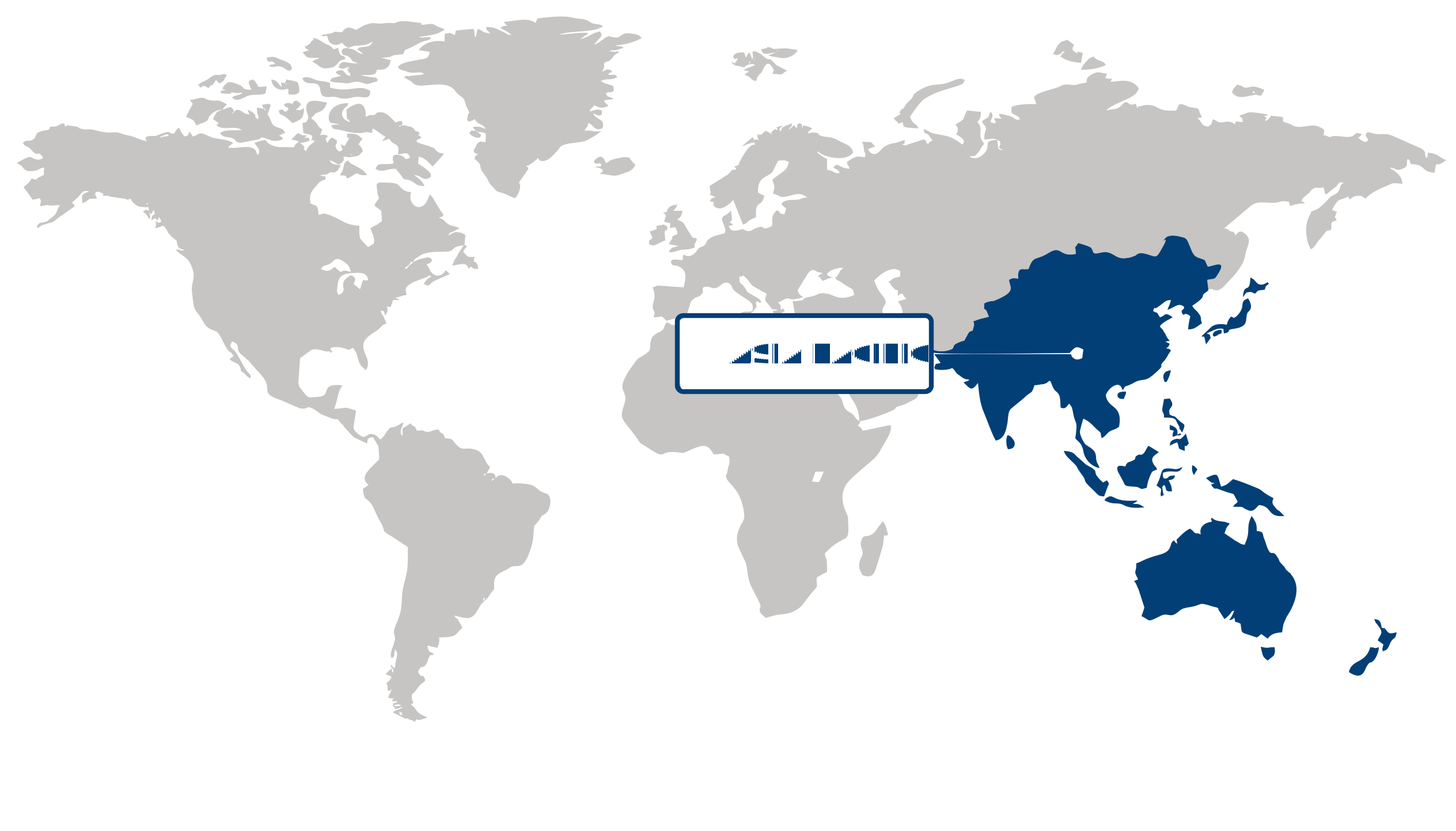
Asia Pacific captured over 42% of the 5G femtocell market in 2025 and, at a 13% CAGR, is both the largest and fastest‑growing region; this leadership is rooted in aggressive 5G rollouts and dense small‑cell deployments by major operators across the region. Operators’ capital plans and government spectrum and infrastructure incentives—visible in Ministry of Industry and Information Technology (MIIT) rollout targets in China and GSMA commentary on APAC densification—are accelerating indoor coverage solutions and vendor innovation from Huawei and Ericsson. Examples include China Mobile’s public densification statements and NTT DOCOMO’s and Rakuten Mobile’s in‑building initiatives. Given urbanization, rising indoor traffic and operator focus on quality and cost efficiency, Asia Pacific offers sustained, scalable opportunities for 5G femtocell deployments and vendor partnerships over the coming investment cycle.
Japan is positioned as a pivotal hub in Asia Pacific, and the 5G femtocell market in Japan is shaped by operator-led in‑building strategies and open‑RAN experimentation that target enterprise and residential indoor coverage. NTT DOCOMO and Rakuten Mobile have publicly detailed small‑cell and in‑building projects and Rakuten’s open RAN deployments demonstrate a vendor‑diversification play; the Ministry of Internal Affairs and Communications (MIC) spectrum and policy signals further support densification. These dynamics favor modular, software‑centric femtocell solutions and partnerships with systems integrators, reinforcing Japan’s role as a testbed for scalable commercial rollouts that feed regional product roadmaps.
China serves as the regional growth engine, and the 5G femtocell market in China is driven by nationwide densification programs and carrier scale that lower unit economics for mass deployments. China Mobile and China Telecom public announcements on network densification, coupled with MIIT’s supportive deployment frameworks and active participation from Huawei and ZTE on small‑cell portfolios, create rapid adoption channels across urban and suburban segments. For investors and strategists, China’s combination of scale, centralized policy levers and strong vendor ecosystems means fast uptake and cost competitiveness that will pull regional supply chains and standards toward APAC‑centric solutions.
North America Market Analysis:
North America held a commanding share of the 5G femtocell market, supported by dense urban and enterprise demand for reliable indoor coverage and growing investments in private 5G networks. Carrier-led indoor rollouts and multi-dwelling-unit (MDU) projects, combined with policy actions easing small-cell deployments, have concentrated commercial activity here. The Federal Communications Commission’s streamlined siting rules and advocacy from CTIA have reduced deployment friction, while enterprise offerings such as AWS Private 5G have accelerated private-network adoption in manufacturing and logistics. Regional supply-chain depth, skilled workforce pools, and strong vendor presence (including established U.S. systems integrators) further reinforce capacity to scale. These dynamics position North America to capitalize on continued indoor densification, enterprise digitalization, and edge-computing integration over the near term.
The U.S. anchors regional leadership in the 5G femtocell market, serving as the primary commercialization and innovation hub for indoor wireless solutions. U.S. carriers—Verizon Communications, AT&T, and T-Mobile US—have prioritized small-cell and in-building strategies in corporate press releases and investor updates, while the Federal Communications Commission and the National Telecommunications and Information Administration have moved to ease municipal permitting and spectrum coordination. Enterprise innovation is visible through offerings such as AWS Private 5G and mobile operator partnerships targeting campuses and industrial sites, shaping buyer preferences for managed indoor solutions. For investors and strategists, the U.S. market’s regulatory modernization and carrier-driven pilots create repeatable models that can scale across North America.
Europe Market Trends:
5G femtocell market in North America experienced moderate growth and maintained a notable presence as carriers and enterprises pursued denser indoor coverage and private-network solutions; Verizon and AT&T press releases highlight pilot deployments and enterprise offerings while the Federal Communications Commission’s CBRS framework and the National Telecommunications and Information Administration’s BEAD funding have created practical pathways for small-cell and in‑building solutions. Demand shifts toward hybrid work and fixed wireless access, supply‑chain adjustments, and vendor consolidation have shaped procurement and deployment patterns. These dynamics, evidenced by carrier announcements and regulator programs, position the region for targeted expansion in enterprise, residential densification, and rural connectivity opportunities.
5G femtocell market in the United States remains the regional innovation hub with moderate growth as major operators convert trials into commercial on‑premise and private‑network products; Federal Communications Commission CBRS policies and Verizon and AT&T press releases demonstrate how spectrum access and operator-led services enable enterprise adoption. Operational investments by carriers and vendor partnerships are shortening deployment cycles and attracting solutions providers. Strategically, the U.S. scale and regulatory clarity make it the primary entry point for vendors and investors seeking regional traction.
5G femtocell market in Canada is a measured adopter showing moderate growth driven by operator-led rollouts and government support for rural broadband; Rogers Communications and Bell Canada press releases, alongside CRTC and Innovation, Science and Economic Development Canada (ISED) spectrum and funding actions, illustrate targeted deployments for underserved areas and enterprise customers. Geographic dispersion and multi‑operator competition encourage turnkey vendor models and partner-driven installations. Canada’s focused demand profile offers strategic opportunities for specialized vendors and integrators aiming to serve rural, industrial, and multi‑dwelling segments across North America.
| Parameter | North America | Asia Pacific | Europe | Latin America | MEA |
|---|---|---|---|---|---|
| Innovation Hub i Scale Nascent Developing Advanced | |||||
| Cost-Sensitive Region i Scale Low Medium High | |||||
| Regulatory Environment i Scale Restrictive Neutral Supportive | |||||
| Demand Drivers i Scale Weak Moderate Strong | |||||
| Development Stage i Scale Emerging Developing Developed | |||||
| Adoption Rate i Scale Low Medium High | |||||
| New Entrants / Startups i Scale Sparse Moderate Dense | |||||
| Macro Indicators i Scale Weak Stable Strong |
Segment Leadership and Growth Trends
5G Femtocell Market Share (%), by Type, 2026
Go beyond the chart, access full insights & data tables
Request Free Sample ReportIU-H held largest share in 2025 of the 5G femtocell market as the leading Type segment, driven by operators prioritizing seamless handover integration in dense network environments. IU-H’s technical fit with current 5G densification strategies explains leadership, aligning with 3GPP specifications and Ericsson field trials that highlight reduced call drops and improved mobility; supply-chain alignment around IU-H interoperable modules has further lowered deployment barriers. This creates strategic openings for incumbent radio vendors and specialist integrators to offer turnkey IU-H solutions and for nimble startups to supply optimization software, and continued standardization and urban network densification indicate sustained relevance near term.
Analysis by Application
Indoor represented largest share in 2025 of the 5G femtocell market as the dominant Application segment, reflecting urgent demand for reliable in‑building coverage across homes, offices and public venues. Demand drivers cited by GSMA and operator initiatives from Verizon and AT&T emphasize quality of experience and enterprise connectivity use cases; building owners’ sustainability goals and IoT rollouts also favor indoor deployments. Opportunities include neutral‑host models, managed‑service offerings and integrated indoor DAS/small‑cell vendors, and ongoing hybrid work patterns plus smart‑building adoption suggest this segment will remain central in the near to medium term.
Analysis by End-User
Commercial dominated the 5G femtocell market in 2025 as the leading End‑User segment, supported by enterprises accelerating deployment of resilient 5G infrastructure for digital services. Enterprise demand cited in Ericsson and Deloitte analyses for private networks and digital transformation drives investment in commercial segments, with system integrators and MSPs adapting service bundles and vendors optimizing power and footprint for commercial sites. This trend opens revenue streams for established telecom suppliers and niche integrators offering verticalized solutions, and as enterprises pursue edge compute, automation and regulatory compliance, commercial segment relevance is expected to persist in the near to medium term.
| Segment | Sub-Segment | Largest Segment | Fastest Growing |
|---|---|---|---|
| Type | IMS/SIP, IU-H | ||
| Application | Outdoor, Indoor | ||
| End-User | Public Places, Residential, Commercial |
Competitive Landscape and Market Positioning
Competitive dynamics are driven by coordinated development with carriers, iterative platform rollouts and concentrated engineering investments to shrink form factor and improve power efficiency. Several vendors have expanded software capabilities and cloud-native operations into hardware offers, while others emphasize tighter silicon–software alignment to simplify vendor selection for customers. Strategic alignments with systems integrators and enterprise channels extend reach into private networks and venue-neutral hosts, and ongoing platform refinements preserve differentiation around management, security and multi-vendor interoperability.
Strategic / Actionable Recommendations for Regional Players
In markets with strong hyperscaler and semiconductor ecosystems, pursue closer engagement with cloud providers and chipset suppliers to accelerate validated reference designs; target enterprise private wireless and neutral-host venue pilots; emphasize software-defined management and advanced security to win CIO-level adoption.
In regions characterized by dense urban rollouts and operator-led scale, deepen co-creation with carriers, optimize cost-effective form factors for mass deployments, and partner with local integrators to navigate site access and regulatory nuances while ensuring backward compatibility.
In markets valuing open interfaces and industrial use cases, prioritize interoperability certifications and collaborative testing with industry consortia; align with manufacturing and logistics partners for campus trials, and strengthen compliance and data-localization capabilities to ease procurement by utilities and public-sector buyers.
| Company | Market Share | Company Revenue | Revenue CAGR (%) | Product Portfolio | Geographic Presence | Innovation / R&D Focus | Strategic Developments |
|---|---|---|---|---|---|---|---|
| No companies available. | |||||||
Industry Development/News
| Company Name | Date | Key Development |
|---|
Customize Your Report
Explore examples of how this report can be tailored to different research needs, including custom segments, additional topics or chapters, and related reports. Click a section of the wheel or its numbered marker to explore the available options.
5G Femtocell Market — Custom Segments
| Segment | Sub-Segment |
|---|---|
| No segment data available. | |
5G Femtocell Market — Custom TOC
| Custom Chapter | Custom Details | ||
|---|---|---|---|
| No custom TOC data available. | |||
Need a different cut of the data?
Request Custom ResearchHow big is the 5G femtocell market?
How is the 5G femtocell industry expected to grow over the next 10 years?
Which region captures the largest portion of the 5G femtocell market value?
What is the fastest growing region in the 5G femtocell sector?
How does IU-H segment fare in the 5G femtocell industry?
What share does indoor segment hold in the 5G femtocell sector as of 2025?
Where is the commercial segment seeing the strongest adoption within the 5G femtocell industry?
Who are the major participants shaping the 5G femtocell landscape?
Our Clients
"The team demonstrated a great understanding of our business needs, and the reports were tailored to address our specific concerns and objectives."
Infosys
"The report was up-to-date with the latest industry trends and technological advancements. The detailed competitive landscape analysis was quite helpful."
Zebra Technologies
"The data presented in the report was accurate and well-researched. I also found the market dynamics section particularly useful."
Arlo Technologies
Our Research Team & Methodology
Every Fundamental Business Insights report is built by a dedicated vertical research team, validated through a structured primary-and-secondary methodology, and reviewed for accuracy before it reaches you.
Research Team Overview
Prepared by the Smart Technologies Research Team
Delivery
Published
Demand
Available
Support
Trust & Compliance
Research Domains
10 coverage areasResearch Intelligence
| Source | Reference |
|---|---|
| National Institute of Standards and Technology (NIST) | www.nist.gov |
| International Organization for Standardization (ISO) | www.iso.org |
| Institute of Electrical and Electronics Engineers (IEEE) | www.ieee.org |
| Internet Engineering Task Force (IETF) | www.ietf.org |
| World Wide Web Consortium (W3C) | www.w3.org |
| Cloud Security Alliance (CSA) | cloudsecurityalliance.org |
| Open Source Initiative (OSI) | opensource.org |
| Linux Foundation | www.linuxfoundation.org |
| FinOps Foundation | www.finops.org |
| PCI Security Standards Council | www.pcisecuritystandards.org |
| SWIFT | www.swift.com |
| Financial Stability Board (FSB) | www.fsb.org |
| GSMA | www.gsma.com |
| International Telecommunication Union (ITU) | www.itu.int |
| OWASP Foundation | owasp.org |
| MITRE | www.mitre.org |
| World Economic Forum (WEF) | www.weforum.org |
| OECD Digital Economy | www.oecd.org/digital |
| World Bank Data | data.worldbank.org |
| U.S. Census Bureau | www.census.gov |
Research Workflow & Quality Assurance
Data Collection
Verified information gathered through primary and secondary research.
Data Triangulation
Cross-validation using multiple independent data sources.
Forecast Modelling
Market estimates developed using historical trends and analytical models.
Analyst Validation
Findings reviewed by domain experts for accuracy and consistency.
Editorial & Quality Review
Final editorial, quality, and compliance checks before publication.
Final Publication
Released after successful completion of the internal review process.
Report Coverage
📊 Market Assessment
- Market Size & Forecast
- Market Segmentation
- Regional Analysis
- Growth Drivers & Challenges
- Market Dynamics
🏢 Competitive Intelligence
- Competitive Landscape
- Company Profiles
- Competitive Benchmarking
- Mergers & Acquisitions
- Market Share Analysis or Key Company Strategies
🔍 Strategic Analysis
- Value Chain Analysis
- Porter's Five Forces
- PESTLE Analysis
- Pricing Trends
- Supply-Demand Analysis
🚀 Future Outlook
- Technology Landscape
- Regulatory Landscape
- Investment & Funding Landscape
- Emerging Opportunities
- Future Market Outlook
Have a question about this report or need a custom scope?
Request Customization