5G Chipset Market Size & Forecasts 2026-2035, By Segments (Frequency, Application, Component, End-Use), Growth Opportunities, Innovation Landscape, Regulatory Shifts, Strategic Regional Insights (U.S., Japan, China, South Korea, UK, Germany, France), and Competitive Dynamics (Qualcomm, MediaTek, Samsung, Intel, Huawei)
Market Size and Growth Outlook
5G Chipset Market size is predicted to expand from USD 29.03 billion in 2025 to USD 203.52 billion by 2035, with growth underpinned by a CAGR above 21.5% between 2026 and 2035. The industry revenue outlook for 2026 is USD 34.71 billion.
Get more details on this report
Request Free Sample Report5G Chipset Market Intelligence Snapshot
Regional Market Dynamics
Segment Momentum
Market Expansion Drivers
Leading Market Participants
Global Market Forecast Snapshot
Market Outlook
Regional and Segment Outlook
Market Growth Drivers and Industry Trends
Widespread network rollouts by operators such as AT&T, China Mobile and documented trends in the Ericsson Mobility Report and GSMA Intelligence are converting coverage investments into steady device and infrastructure demand, directly expanding the 5G chipset market. Increased consumer uptake of data-heavy services and enterprise private-network pilots shifts design priorities toward power efficiency and cost-per-bit, affecting sourcing and supply-chain choices. Established semiconductor suppliers can leverage scale and operator partnerships, while new entrants can target niche segments—industrial gateways or fixed wireless access—with reference designs. As operators continue spectrum deployments and densification, chipset vendors that align roadmap cadence with carrier rollouts will capture predictable volume and design wins.
Technological advancements in high-speed 5G chipsets
Progress in modem-RF integration, mmWave implementations and on-chip AI announced by Qualcomm, MediaTek and Samsung Electronics is raising performance baselines and shaping device differentiation across the 5G chipset market. These innovations respond to user demand for low-latency applications and manufacturers’ need to manage thermal and power constraints, prompting closer collaboration between handset OEMs and silicon designers. Incumbent leaders can monetize IP and system-level solutions, while startups and fabless challengers can pursue optimized designs for wearables, IoT and private networks. Continued vendor announcements and design wins will make chipset roadmap leadership a sustained strategic advantage.
Standardization and regulatory frameworks for 5G technology
Ongoing releases from 3GPP, spectrum and policy actions by the ITU and national regulators such as the FCC and the European Commission, plus deployment guidance from China’s Ministry of Industry and Information Technology, are setting interoperability and security baselines that govern the 5G chipset market. Clear standards reduce fragmentation and lower integration risk for OEMs, while regulatory moves on spectrum and supply-chain security create compliance requirements and procurement levers. Large vendors can leverage certification programs and regulatory relationships; newer entrants can differentiate through rapid standards alignment and targeted compliance solutions. As 3GPP releases and regulator-led spectrum allocations continue, standards-compliant chipset offerings will determine access to global commercial deployments.
Industry Restraints:
Export Controls and Geopolitical Fragmentation
Export controls by national authorities have materially constrained the 5G chipset market by fragmenting global supply chains and raising compliance costs for designers and foundries. Measures by the U.S. Department of Commerce’s Bureau of Industry and Security (BIS), including Huawei’s placement on the Entity List and subsequent restrictions on advanced logic exports, forced TAIWAN SEMICONDUCTOR MANUFACTURING COMPANY (TSMC) to cut shipments to Huawei, illustrating how policy actions interrupt wafer supply and product roadmaps. Established vendors with deep legal and procurement teams can re-route sourcing and secure exemptions; smaller entrants and fabless startups face elevated entry barriers, longer time‑to‑market, and capital strain. Expect continued segmentation over the near‑to‑medium term as governments prioritize strategic control, driving more regionalized design-for-compliance and long‑term offtake contracts.
Foundry Capacity Constraints and Advanced-node Supply Bottlenecks
Limited advanced-node capacity at leading foundries constrains 5G chipset development by lengthening lead times and increasing unit costs as chipmakers compete with high‑growth AI and HPC demand. TAIWAN SEMICONDUCTOR MANUFACTURING COMPANY (TSMC) and Samsung Foundry have publicly announced major capacity investments, yet previous shortages and wafer allocation prioritization during 2020–22 show how constrained capacity disrupts product ramps. Incumbent chipset suppliers with preferential foundry partnerships (for example, Apple/TSMC or Qualcomm/TSMC relationships) are better positioned to secure scarce masks and slots; new entrants and ODMs encounter steep nonrecurring engineering (NRE) and longer procurement cycles. Over the near term, capacity expansion will moderate but not eliminate pressure, preserving advantage for firms that lock in long‑term foundry agreements or pursue vertical integration.
| Growth Driver | Impact on CAGR | Regulatory Influence | Geographic Relevance | Adoption Rate | Impact Timeline |
|---|---|---|---|---|---|
| Deployment of 5G networks driving chipset demand | 8.00% | Short term (≤ 2 yrs) | Asia Pacific, North America | Medium | Fast |
| Technological advancements in high-speed 5G chipsets | 7.00% | Medium term (2–5 yrs) | Europe, Asia Pacific | Low | Moderate |
| Standardization and regulatory frameworks for 5G technology | 6.50% | Long term (5+ yrs) | North America, Europe | High | Slow |
Unlock insights tailored to your business with our bespoke market research solutions.
Click to get your customized report now.
Regional Demand Dynamics
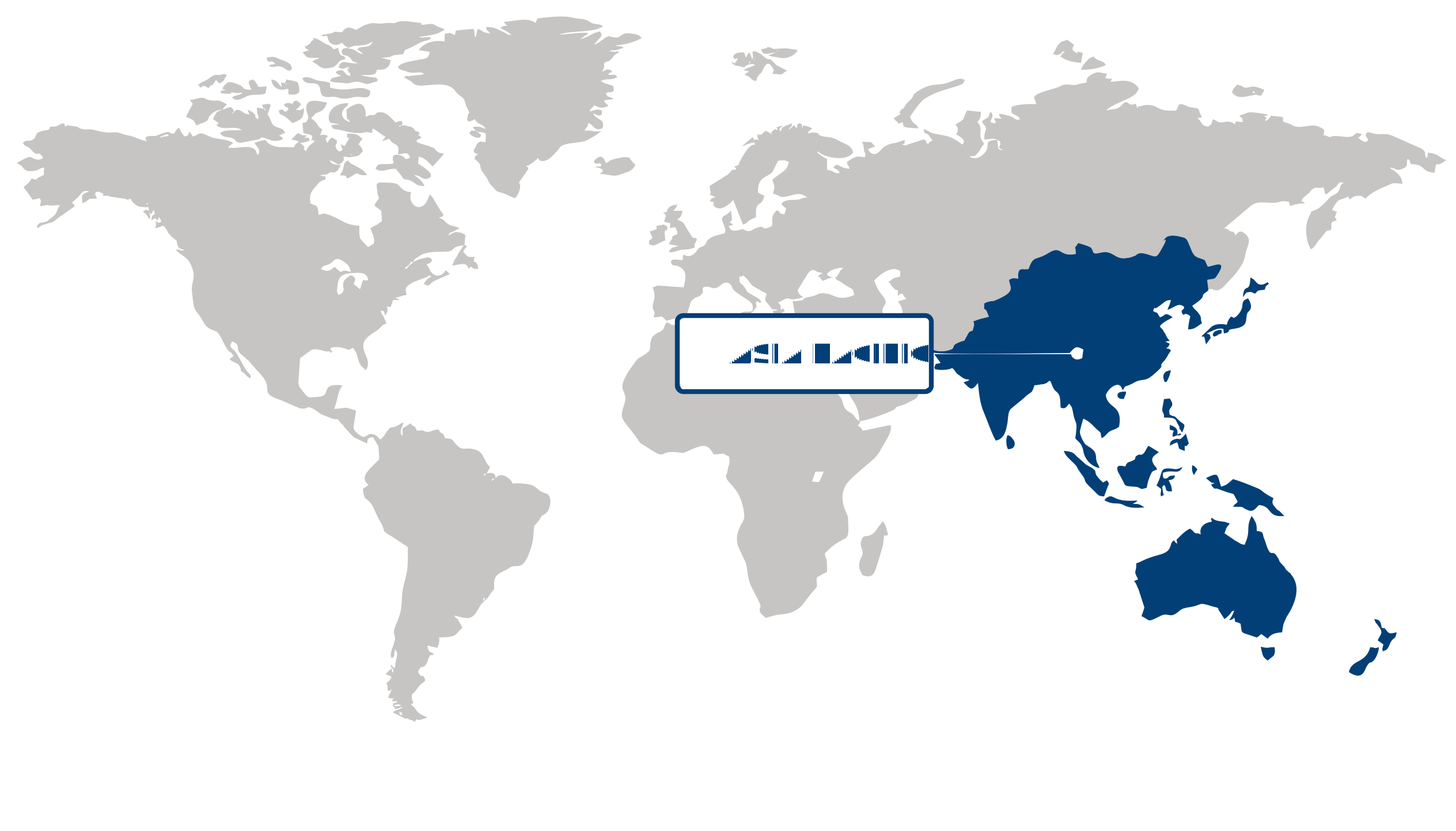
5G chipset market in Asia Pacific captured 39.48% of the global market in 2025 and, with a 31.7% CAGR, is the largest and fastest‑growing region driven by early 5G adoption and massive infrastructure investment in China. This leadership reflects large-scale carrier rollouts, urban densification, and strong device demand; for example, the Ministry of Industry and Information Technology (MIIT) reporting rapid base‑station expansions and GSMA Intelligence highlighting regional 5G subscription growth. Suppliers such as Huawei and ZTE have publicly documented network deployments that underpin chipset volume and innovation. Ahead, Asia Pacific offers scale economics and diverse verticals (consumer, enterprise, industrial) that create sustained opportunity for chipset differentiation and localization.
Japan is positioned as a pivotal hub in Asia Pacific for the 5G chipset market, providing a premium device and enterprise testing ground where advanced features are monetized. Japanese operators—NTT Docomo, KDDI, SoftBank and Rakuten Mobile—have announced upgrades and private‑network pilots that accelerate demand for low‑latency, high‑reliability chipsets, while the Ministry of Internal Affairs and Communications (MIC) supports spectrum and trial frameworks. Strong consumer willingness to pay for premium handsets and close OEM‑operator collaboration make Japan an ideal market for validating high‑performance and energy‑efficient designs, informing regional go‑to‑market strategies.
China anchors the Asia Pacific market for the 5G chipset market, led directly by nationwide early adoption and the scale of telecom CAPEX. China Mobile and China Telecom investment plans and MIIT policy support have driven mass deployments; Huawei and China’s large OEMs have publicly detailed extensive 5G rollouts that boost local chipset volumes and ecosystem depth. Intense competitive dynamics and supply‑chain clustering enable rapid cost reduction and iterative R&D, creating opportunities for vendors that can partner locally on integration, compliance, and large‑volume production to serve both domestic and regional demand.
North America Market Analysis:
North America held a substantial share of the 5G chipset market, driven by deep vendor ecosystems, sizable carrier capital spending, and robust enterprise demand; Qualcomm Inc.’s ongoing chipset roadmap, Verizon Communications and AT&T Inc. network densification announcements, and U.S. Department of Commerce CHIPS Act support together illustrate the region’s scale and resilience. Strong consumer uptake of 5G-capable handsets and accelerating private-network trials by enterprises have concentrated buyer power and elevated feature expectations, while local supply-chain initiatives and talent pools sustain innovation. Evidence from Qualcomm press releases, Verizon Communications deployment updates, and Federal Communications Commission auction records underscores current momentum. This confluence of demand, policy support, and technical capability positions North America for continued opportunity in premium and specialized 5G chipset segments.
The U.S. remains the primary engine within North America for the 5G chipset market, reflecting the largest commercial and enterprise spend and the densest carrier competition. Actions by the Federal Communications Commission on mid-band and C-band spectrum, Verizon Communications and T-Mobile US rollout strategies, and collaborations between Qualcomm Inc. and handset OEMs such as Apple Inc. shape procurement and product design choices uniquely in the U.S. Heightened focus on secure supply chains and CHIPS Act incentives from the U.S. Department of Commerce steer sourcing and local-capacity investments, while demand from cloud providers and automotive OEMs drives differentiated chipset requirements. Strategic implication: U.S. policy and buyer sophistication amplify regional demand for higher-performance, secure, and vertically integrated 5G chipset solutions.
Europe Market Trends:
North America held a commanding share of the 5G chipset market, anchored by rapid urban rollouts, sizable carrier capital expenditure and strong OEM device cycles; the FCC’s C-band auction outcomes and deployment updates, CTIA’s reporting on operator investment levels, Qualcomm’s Snapdragon X-series announcements and Verizon’s C-band live-site press releases collectively illustrate sustained commercial momentum and ecosystem scale, creating fertile ground for chipset differentiation in mmWave, sub‑6 GHz and integrated AI-modem features and signaling continued supplier opportunity across consumer and enterprise segments.
The United States is the primary engine of the 5G chipset market, where large‑scale carrier programs and a dense device ecosystem accelerate demand; FCC deployment data, AT&T and T‑Mobile network expansion press releases and Qualcomm’s U.S. partner ecosystem examples show how volume, early enterprise trials and premium handset adoption concentrate R&D and volume sourcing decisions in the U.S., reinforcing regional supply‑chain advantages and strategic scale for chipset vendors.
Canada plays a strategic, growing role in the 5G chipset market, with government spectrum policy and operator focus shaping differentiated opportunities; Innovation, Science and Economic Development Canada (ISED) spectrum auctions, Rogers and Bell 5G program announcements and industry collaborations on rural and industrial use cases demonstrate a push toward enterprise, IoT and automotive trials, offering chipset suppliers niche commercial pathways that complement U.S. scale and strengthen North American market breadth.
| Parameter | North America | Asia Pacific | Europe | Latin America | MEA |
|---|---|---|---|---|---|
| Innovation Hub i Scale Nascent Developing Advanced | |||||
| Cost-Sensitive Region i Scale Low Medium High | |||||
| Regulatory Environment i Scale Restrictive Neutral Supportive | |||||
| Demand Drivers i Scale Weak Moderate Strong | |||||
| Development Stage i Scale Emerging Developing Developed | |||||
| Adoption Rate i Scale Low Medium High | |||||
| New Entrants / Startups i Scale Sparse Moderate Dense | |||||
| Macro Indicators i Scale Weak Stable Strong |
Segment Leadership and Growth Trends
5G Chipset Market Share (%), by Frequency, 2026
Go beyond the chart, access full insights & data tables
Request Free Sample ReportSub-6 GHz dominated the 5G chipset market in 2025, as its better propagation characteristics and reuse of existing macro-cell infrastructure enabled the widest commercial coverage; this leadership is underpinned by continued macro‑cell upgrades and mid‑band allocations highlighted in the Ericsson Mobility Report and by Federal Communications Commission C‑band clearing actions. Customer preference for broad indoor/outdoor coverage, carrier rollout economics and established supply chains favor incumbents while opening design and integration opportunities for regional vendors; operators and vendors such as Nokia can leverage this segment for scalable upgrades, and spectrum policy momentum suggests Sub-6 GHz will remain central in the near to medium term.
Analysis by Application
5G Devices represented largest share in the 5G chipset market in 2025 driven by massive adoption of 5G‑enabled smartphones and consumer devices, a trend documented by GSMA Intelligence and affirmed by Apple and Samsung Electronics product announcements. Consumer demand patterns, software ecosystem shifts and device-led digital transformation have accelerated chipset integration and handset OEM partnerships; this creates strategic advantage for established chipset suppliers and niche entrants targeting IoT and CPE. As device innovation, standards evolution in 3GPP and expanding app ecosystems persist, 5G Devices will stay a primary growth anchor.
Analysis by Component
RFIC held largest share in the 5G chipset market in 2025 because network deployments required high‑performance RF front‑end chipsets, a dynamic reflected in Qualcomm press releases and product briefs from Skyworks Solutions and Broadcom describing RF front‑end enhancements. Improvements in power efficiency, antenna integration, and vendor manufacturing relationships have raised barriers but also created white‑space for specialized suppliers; incumbents can scale volume while fabless innovators pursue differentiated RF solutions. Given ongoing network densification, energy and spectral efficiency priorities, and active 3GPP feature releases, RFICs will remain strategically essential in the near to medium term.
| Segment | Sub-Segment | Largest Segment | Fastest Growing |
|---|---|---|---|
| Frequency | Sub-6 GHz, Between 26 and 39 GHz, 39 GHz and Above | ||
| Application | Customer Premises Equipment, 5G Devices, Network & Infrastructure Equipment | ||
| Component | MM Wave IC, RFIC, Cellular IC, ASIC | ||
| End-Use | Consumer Electronics, Safety & Surveillance, Energy & Utilities, Automotive & Transportation, Retail, Healthcare |
Competitive Landscape and Market Positioning
The competitive environment is characterized by intensified capability consolidation and faster product cadence among the top vendors. Several have deepened OEM and carrier engineering ties while folding complementary assets to broaden platform scope; others have accelerated next-generation modem and integrated RF subsystems alongside deeper on-chip AI support. These moves elevate technical differentiation, raise entry thresholds for smaller suppliers, and shift competition toward integrated solutions that address device, infrastructure, and edge-compute requirements simultaneously.
Strategic / Actionable Recommendations for Regional Players
In North America, focus on leveraging IP strengths and AI-acceleration within modem and baseband stacks while securing resilient foundry and packaging arrangements; align more closely with hyperscalers and tier-1 OEMs to embed differentiated silicon into premium device and infrastructure segments.
In Asia Pacific, emphasize scalable cost-performance platforms and tighter alignment with local device manufacturers and carriers; expand system-level co-development and volume partnerships to capture mainstream smartphone and fixed-wireless access opportunities while protecting supply continuity.
In Europe, prioritize industrial and automotive interfaces and compliance-led system integration; deepen technical ties with automotive OEMs, private-network integrators, and industrial equipment suppliers to exploit demand for deterministic connectivity and specialized edge compute.
| Company | Market Share | Company Revenue | Revenue CAGR (%) | Product Portfolio | Geographic Presence | Innovation / R&D Focus | Strategic Developments |
|---|---|---|---|---|---|---|---|
| No companies available. | |||||||
Industry Development/News
| Company Name | Date | Key Development |
|---|
Customize Your Report
Explore examples of how this report can be tailored to different research needs, including custom segments, additional topics or chapters, and related reports. Click a section of the wheel or its numbered marker to explore the available options.
5G Chipset Market — Custom Segments
| Segment | Sub-Segment |
|---|---|
| No segment data available. | |
5G Chipset Market — Custom TOC
| Custom Chapter | Custom Details | ||
|---|---|---|---|
| No custom TOC data available. | |||
Need a different cut of the data?
Request Custom ResearchWhat is the market valuation of 5G chipset?
What are the growth projections for the 5G chipset industry?
Which region shows the largest market footprint in the 5G chipset market?
Where has the 5G chipset sector recorded the sharpest year-over-year increase?
Which is the largest sub-segment within the frequency segment for 5G chipset industry?
Why does 5G devices sub-segment dominate the application segment of 5G chipset sector?
How does RFIC segment fare in the 5G chipset industry?
What share does consumer electronics segment hold in the 5G chipset sector as of 2025?
Which companies dominate the 5G chipset landscape?
Our Clients
"Working with FBI has been a good experience. The market report provided a holistic view, covering everything from emerging trends to potential risks."
Semtech Corporation
"The experience was highly positive. The team showcased remarkable flexibility in adapting to our specific needs and delivered report that perfectly aligned with all our requirements."
TSMC
"What really stood out to me was how clearly and promptly the Fundamental Business Insights team communicated throughout. It made the collaboration feel effortless."
NXP Semiconductors
Our Research Team & Methodology
Every Fundamental Business Insights report is built by a dedicated vertical research team, validated through a structured primary-and-secondary methodology, and reviewed for accuracy before it reaches you.
Research Team Overview
Prepared by the Electronics & Semiconductors Research Team
Delivery
Published
Demand
Available
Support
Trust & Compliance
Research Domains
10 coverage areasResearch Intelligence
| Source | Reference |
|---|---|
| Semiconductor Industry Association (SIA) | www.semiconductors.org |
| SEMI | www.semi.org |
| JEDEC Solid State Technology Association | www.jedec.org |
| IEEE | www.ieee.org |
| IPC – Association Connecting Electronics Industries | www.ipc.org |
| International Electrotechnical Commission (IEC) | www.iec.ch |
| International Organization for Standardization (ISO) | www.iso.org |
| U.S. Bureau of Industry and Security (BIS) | www.bis.gov |
| U.S. Patent and Trademark Office (USPTO) | www.uspto.gov |
| European Patent Office (EPO) | www.epo.org |
| Taiwan Semiconductor Industry Association (TSIA) | www.tsia.org.tw |
| World Semiconductor Trade Statistics (WSTS) | www.wsts.org |
| International Energy Agency (IEA) | www.iea.org |
| GSMA | www.gsma.com |
| 3GPP | www.3gpp.org |
| ITU (International Telecommunication Union) | www.itu.int |
| Omdia (public insights) | omdia.tech.informa.com |
| Display Supply Chain Consultants (DSCC) | www.displaysupplychain.com |
| U.S. Department of Energy (DOE) | www.energy.gov |
| NIST (National Institute of Standards and Technology) | www.nist.gov |
Research Workflow & Quality Assurance
Data Collection
Verified information gathered through primary and secondary research.
Data Triangulation
Cross-validation using multiple independent data sources.
Forecast Modelling
Market estimates developed using historical trends and analytical models.
Analyst Validation
Findings reviewed by domain experts for accuracy and consistency.
Editorial & Quality Review
Final editorial, quality, and compliance checks before publication.
Final Publication
Released after successful completion of the internal review process.
Report Coverage
📊 Market Assessment
- Market Size & Forecast
- Market Segmentation
- Regional Analysis
- Growth Drivers & Challenges
- Market Dynamics
🏢 Competitive Intelligence
- Competitive Landscape
- Company Profiles
- Competitive Benchmarking
- Mergers & Acquisitions
- Market Share Analysis or Key Company Strategies
🔍 Strategic Analysis
- Value Chain Analysis
- Porter's Five Forces
- PESTLE Analysis
- Pricing Trends
- Supply-Demand Analysis
🚀 Future Outlook
- Technology Landscape
- Regulatory Landscape
- Investment & Funding Landscape
- Emerging Opportunities
- Future Market Outlook
Have a question about this report or need a custom scope?
Request Customization