5G Applications and Services Market Size & Forecasts 2026-2035, By Segments (End-User, Communication Type, Industry Vertical), Growth Opportunities, Innovation Landscape, Regulatory Shifts, Strategic Regional Insights (U.S., Japan, China, South Korea, UK, Germany, France), and Competitive Dynamics (Qualcomm, Ericsson, Nokia, Huawei, Samsung)
Market Size and Growth Outlook
5G Applications and Services Market size is predicted to expand from USD 116.05 billion in 2025 to USD 1.56 trillion by 2035, with growth underpinned by a CAGR above 29.7% between 2026 and 2035. The industry revenue outlook for 2026 is USD 147.72 billion.
Get more details on this report
Request Free Sample Report5G Applications and Services Market Intelligence Snapshot
Regional Market Dynamics
Segment Momentum
Market Expansion Drivers
Leading Market Participants
Global Market Forecast Snapshot
Market Outlook
Regional and Segment Outlook
Market Growth Drivers and Industry Trends
The rapid deployment of 5G networks underpins the evolution of the 5G applications and services market by enabling unprecedented connectivity speeds and low latency critical for advanced applications. Governments and telecom giants like Verizon and China Mobile have aggressively expanded their 5G infrastructure, responding to increasing demand for high-bandwidth services such as augmented reality and autonomous vehicles. This widespread network availability fosters innovation across sectors, allowing both incumbents and startups to develop differentiated offerings leveraging real-time data processing and edge computing. Strategically, companies investing in network densification and interoperability standards can capture early adopter segments and enterprise partnerships. Continued infrastructural rollout, particularly in urban and industrial zones, signals persistent opportunities for scaling sophisticated 5G-driven use cases, enhancing competitive positioning as ecosystems mature.
Adoption of 5G-Enabled Enterprise and IoT Solutions
Enterprise adoption of 5G-enabled IoT services is a pivotal growth driver in the 5G applications and services market, reflecting a shift toward digital transformation across industries such as manufacturing, logistics, and healthcare. Organizations like Siemens and Cisco emphasize 5G’s role in unlocking real-time asset management, predictive maintenance, and enhanced supply chain visibility. Regulatory frameworks encouraging secure data exchange and industry-specific digital standards further accelerate adoption, while smaller firms benefit from SaaS and connectivity-as-a-service models. This environment encourages solution providers and systems integrators to devise customizable IoT packages tuned to vertical-specific needs. The ongoing integration of 5G with AI and cloud platforms foregrounds new horizons for enterprise productivity gains, enhancing competitive differentiation amid accelerating industry 4.0 deployments.
Surge in Consumer and Industrial 5G Application Development
The burgeoning landscape of consumer and industrial use cases is propelling growth in the 5G applications and services market by broadening demand beyond basic connectivity to immersive experiences and automated operations. Product launches from companies like Samsung and Ericsson spotlight enhanced mobile gaming, smart city initiatives, and remote industrial controls powered by 5G-enabled devices. This consumer-driven demand, coupled with industrial adoption for robotics and real-time monitoring, spurs a dynamic ecosystem of app developers, hardware manufacturers, and service providers. Innovation cycles are shortening as markets embrace customizable and scalable solutions, creating entry points for nimble startups and diversification for incumbents. Ongoing cultural shifts toward digital engagement and environmental monitoring reinforce 5G’s role as a foundational technology, underpinning sustained expansion in diverse sectors.
Industry Restraints:
Network Infrastructure and Spectrum Allocation Challenges
The 5G applications and services market faces significant constraints from uneven network infrastructure maturity and spectrum allocation complexities, which hamper seamless technology adoption. Many regions, particularly in emerging markets, endure delays in rolling out dense 5G networks due to costly infrastructure investments and spectrum licensing delays. The International Telecommunication Union (ITU) highlights that spectrum availability remains uneven globally, creating operational inefficiencies and limiting service providers’ abilities to deliver consistent 5G coverage and low-latency applications. This fragmented landscape imposes barriers for new entrants struggling to secure spectrum rights and scale infrastructure, while incumbents face cost overruns and slowed monetization. Strategically, companies must navigate regulatory fragmentation and invest heavily in infrastructure partnerships to remain competitive. Given ongoing policy negotiations and infrastructure deployment lag, this restraint will continue restricting 5G applications’ broad market penetration through the near to medium term.
Data Privacy and Security Regulations
Stringent and evolving data privacy and security regulations pose a critical restraint on the growth of 5G applications and services by complicating compliance frameworks and raising operational risks. The European Data Protection Board (EDPB) stresses that 5G’s extensive data flows amplify vulnerabilities, prompting regulators globally, including the U.S. Federal Communications Commission (FCC), to enforce tighter controls on user data handling and network security. This regulatory environment increases compliance costs and delays time-to-market for innovative 5G solutions, particularly for startups with limited legal resources and technology providers aiming for cross-border services. Market participants must invest disproportionately in cybersecurity measures and regulatory intelligence to mitigate breach risks and avoid sanctions. As governments continue to refine digital sovereignty policies amid rising geopolitical tensions, data privacy and security compliance will remain a critical hurdle shaping market strategies and slowing service rollout in the foreseeable future.
| Growth Driver | Impact on CAGR | Regulatory Influence | Geographic Relevance | Adoption Rate | Impact Timeline |
|---|---|---|---|---|---|
| Deployment of 5G networks supporting advanced applications | 8.00% | Short term (≤ 2 yrs) | North America, Asia Pacific; Spillover: Europe | High | Fast |
| Adoption of 5G-enabled services in enterprise and IoT | 7.50% | Medium term (2–5 yrs) | Asia Pacific, Europe | Medium | Moderate |
| Growth in consumer and industrial 5G applications | 6.00% | Long term (5+ yrs) | North America, Asia Pacific | Low | Slow |
Unlock insights tailored to your business with our bespoke market research solutions.
Click to get your customized report now.
Regional Demand Dynamics
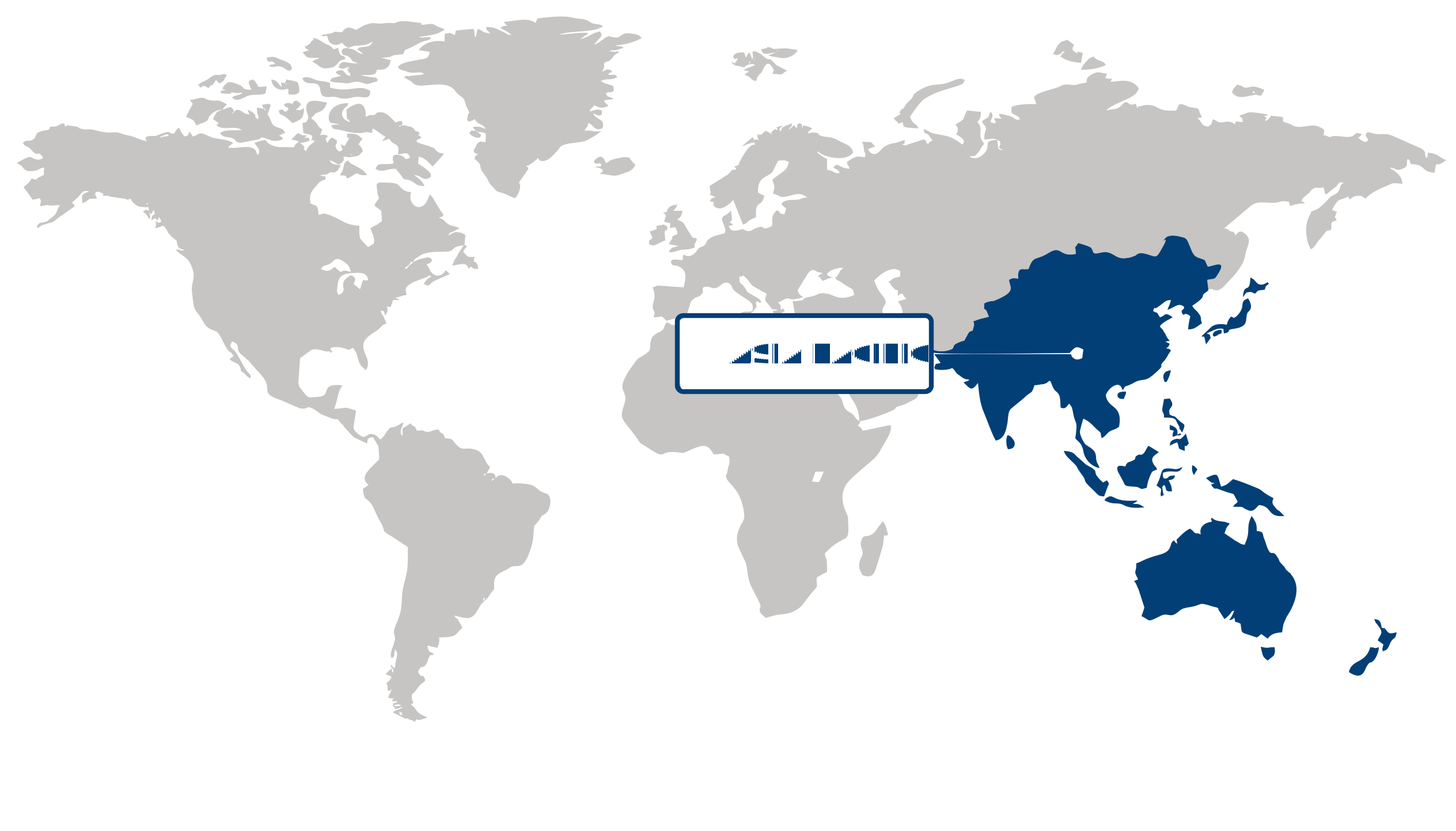
The Asia Pacific region dominated the global 5G applications and services market in 2025, capturing approximately 41.3% of the market share. This leading position is primarily driven by massive investments in network infrastructure by major regional service providers such as China Mobile and NTT Docomo. The region's robust economic resilience and advancing digital transformation have fostered an environment where consumer and industrial demand for 5G-enabled innovations is rapidly increasing. Additionally, policy frameworks across countries like China emphasize smart city initiatives and industrial IoT integration, further accelerating adoption. For instance, the Ministry of Industry and Information Technology (MIIT) in China continues to support extensive 5G network expansions. These combined factors position Asia Pacific as not only the largest but an increasingly vital market for innovative 5G applications, offering substantial opportunities for investors and technology providers capitalizing on evolving digital ecosystems.
Japan plays a pivotal role in the Asia Pacific 5G applications and services market by leveraging its advanced technological infrastructure and strategic collaborations. Japanese operators such as SoftBank and KDDI are heavily investing in expanding 5G coverage, driven by high consumer uptake and governmental initiatives like the Ministry of Internal Affairs and Communications’ promotion of digital innovation. The country’s focus on integrating 5G with autonomous vehicles and smart manufacturing highlights a unique path toward diversified 5G use cases, reinforced by culturally ingrained tech adoption. This dynamic underscores Japan’s importance in reinforcing Asia Pacific’s leadership while offering a blueprint for mature market applications, thereby enhancing regional growth prospects comprehensively.
China anchors the Asia Pacific 5G applications and services market through unprecedented scale and investment in network infrastructure. Leading providers like China Telecom and China Unicom have aggressively expanded 5G networks, supported by government policies emphasizing digital economy growth and infrastructure modernization. The National Development and Reform Commission’s backing of 5G-powered digital industries fosters increasing demand across urban and rural areas, reflecting a broad consumer and enterprise engagement unmatched globally. This extensive ecosystem, combining supply chain strength and innovation capacity, consolidates China’s essential role in driving regional market expansion. Consequently, China’s trajectory highlights Asia Pacific’s capacity to sustain dominance in the 5G market through large-scale application deployment and infrastructural leadership.
North America Market Analysis:
North America emerged as the fastest-growing region in the 5G applications and services market, registering a robust CAGR of 41.58%. This rapid expansion is primarily driven by the swift adoption of 5G-enabled edge computing and autonomous systems, which are transforming industries ranging from manufacturing to transportation. The region’s advanced digital infrastructure and strong investment in innovation foster a conducive environment for integrating 5G technologies with AI and IoT, enhancing real-time data processing and automation capabilities. For instance, Verizon’s recent launch of ultra-low latency edge computing platforms exemplifies this trend, reflecting the shifting enterprise demand for faster, more reliable connectivity. Furthermore, regulatory support from the Federal Communications Commission (FCC) and strategic public-private partnerships emphasize sustainable technology deployment, amplifying North America’s competitive edge. Looking ahead, ongoing advancements and diversified applications position the region as a key hub for disruptive 5G services, offering substantial opportunities for investors and technology developers.
The U.S. plays a pivotal role within North America’s 5G applications and services market, spearheading the uptake of edge computing and autonomous systems. American companies, backed by regulatory frameworks from the FCC, focus heavily on integrating 5G into smart cities, autonomous vehicles, and industrial automation. For example, AT&T’s collaboration with major automotive manufacturers to develop 5G-enabled connected vehicle ecosystems highlights rapidly evolving consumer preferences and technological innovation. Additionally, strong venture capital inflows into 5G startups underscore a dynamic market landscape that drives continuous improvement in service quality and use case diversification. This robust environment not only accelerates domestic 5G adoption but also solidifies the U.S.’s strategic importance in advancing North America’s leadership in next-generation applications and services.
Europe Market Trends:
Europe held a substantial share in the 5G applications and services market, driven by its advanced digital infrastructure and robust regulatory frameworks fostering innovation. The region’s diverse consumer base and increasing investments in smart city projects have spurred demand for efficient connectivity solutions. Recent initiatives by the European Union, such as the Digital Europe Programme, emphasize sustainable digital transformation, amplifying adoption of 5G-enabled services across industries. Technological progress in edge computing and IoT integration, supported by collaborative ventures between telecom operators and tech firms, has enhanced operational capabilities. European market players, including Ericsson and Nokia, benefit from a well-established supply chain ecosystem and skilled workforce that sustain competitive intensity. With continuous policy support to harmonize spectrum allocation and promote cybersecurity, Europe stands poised for further expansion in 5G applications, presenting significant opportunities for stakeholders aiming to capitalize on evolving consumer and enterprise trends.
Germany plays a pivotal role in the 5G applications and services market within Europe, underpinned by strong governmental backing and early infrastructure deployment. The country’s emphasis on Industry 4.0 adoption has accelerated demand for 5G-enabled automation and smart manufacturing solutions, as highlighted in Deutsche Telekom’s recent network expansion reports. Furthermore, regulatory clarity from the Bundesnetzagentur ensures efficient spectrum management, attracting multiple operators to enhance coverage and quality. Consumer preference in Germany towards connected mobility and digital healthcare has also been growing steadily, fostering diverse use cases. This dynamic positions Germany as a strategic hub for innovation and commercial rollout, which in turn strengthens Europe’s overall market momentum in 5G applications and services.
France maintains notable presence in the 5G applications and services market, propelled by a culture of digital innovation and supportive public policies. The government’s “France 2030” plan emphasizes investment in digital technologies, including 5G infrastructure, to boost economic recovery and resilience post-pandemic. Orange and Bouygues Telecom have actively expanded 5G networks, targeting smart city deployments and augmented reality applications for consumer engagement. Additionally, France’s regulatory approach facilitates cooperation between mobile operators and industry verticals, enhancing service diversity and adoption rates. This environment fosters competitive ecosystems and supports talent development critical to sustaining growth. Consequently, France contributes significantly to the region’s attractiveness for investors and businesses pursuing advanced 5G applications and services.
| Parameter | North America | Asia Pacific | Europe | Latin America | MEA |
|---|---|---|---|---|---|
| Innovation Hub i Scale Nascent Developing Advanced | |||||
| Cost-Sensitive Region i Scale Low Medium High | |||||
| Regulatory Environment i Scale Restrictive Neutral Supportive | |||||
| Demand Drivers i Scale Weak Moderate Strong | |||||
| Development Stage i Scale Emerging Developing Developed | |||||
| Adoption Rate i Scale Low Medium High | |||||
| New Entrants / Startups i Scale Sparse Moderate Dense | |||||
| Macro Indicators i Scale Weak Stable Strong |
Segment Leadership and Growth Trends
5G Applications and Services Market Share (%), by End-User, 2026
Go beyond the chart, access full insights & data tables
Request Free Sample ReportThe commercial segment held the largest share of the 5G applications and services market in 2025, reflecting the rapid expansion of business adoption for these technologies. This leadership stems from enterprises prioritizing digital transformation initiatives that leverage high-speed, low-latency 5G networks to enable critical use cases such as augmented reality (AR), virtual reality (VR), and Internet of Things (IoT) deployments. Leading technology firms like Ericsson have documented significant traction in commercial 5G rollouts aimed at improving operational efficiency and customer engagement. Additionally, competitive dynamics drive businesses to adopt 5G to support increasingly data-intensive workflows and innovative service models. This segment offers strategic advantages for both incumbents expanding enterprise solutions and startups developing specialized industrial 5G applications. Given ongoing investments in network infrastructure and growing demand for immersive digital experiences, the commercial end-user segment is poised to sustain its prominence in the near to medium term.
Analysis by Communication Type
Enhanced Mobile Broadband (eMBB) represented the largest share in the 5G applications and services market by communication type, fueled by the surging demand for high-speed connectivity and data-intensive applications such as video streaming, AR, and VR. The segment’s dominance aligns with evolving consumer preferences for seamless multimedia experiences and increasing enterprise adoption of remote collaboration tools. Regulatory bodies like the Federal Communications Commission (FCC) have facilitated broad spectrum allocations to support eMBB, encouraging service providers like Verizon to expand 5G coverage and capacity. Supply chain improvements in semiconductor technology and network infrastructure have also lowered deployment barriers, bolstering competitive differentiation through superior user experiences. For established mobile network operators and emerging edge computing firms, eMBB presents extensive opportunities to capture diversified revenue streams. As content consumption and immersive digital services continue to grow, the eMBB segment is expected to remain a critical driver within the 5G applications and services market.
Analysis by Industry Vertical
The telecommunications segment dominated the 5G applications and services market with the largest share in 2025, driven by escalating demand for ultra-fast data speeds, ultra-low latency, and heightened network reliability essential for next-generation telecommunications applications. This leadership is supported by the strategic imperative among global telecom operators like China Mobile to upgrade legacy networks and expand 5G-enabled services, including network slicing and massive IoT connectivity. Policy milestones from international regulatory authorities, such as the European Telecommunications Standards Institute (ETSI), have streamlined standards, further accelerating telecommunications sector adoption. The evolving workforce landscape emphasizing digital skills and innovation readiness complements this growth. This segment presents significant opportunities for hardware suppliers and software developers targeting telecommunications infrastructure modernization. Given the central role of telecom networks in supporting digital economies and emerging technologies, the telecommunications industry vertical is expected to retain its leading position in the foreseeable future.
| Segment | Sub-Segment | Largest Segment | Fastest Growing |
|---|---|---|---|
| End-User | Residential, Commercial, Industrial | ||
| Communication Type | Enhanced Mobile Broadband, Ultra-Reliable Low Latency Communications, Massive Machine Type Communications, Fixed Wireless Access, Others | ||
| Industry Vertical | Telecommunications, Automotive, Government, Media and Entertainment, Consumer Electronics, Banking, Energy and Utilities, Others |
Competitive Landscape and Market Positioning
The competitive landscape features a dynamic interplay of alliances and product innovations that continuously reshape market hierarchies. Collaboration among chipset developers and network operators accelerates adoption and ecosystem maturity. Mergers and acquisitions enhance portfolio breadth, enabling comprehensive 5G application suites. Investment in advanced R&D fosters breakthrough capabilities such as edge computing and AI integration, which refine user experiences and operational efficiencies. Frequent product launches tailored to industry verticals bolster differentiation while strategic partnerships expand geographic reach and technological depth, collectively reinforcing competitive positions and driving market evolution.
Strategic / Actionable Recommendations for Regional Players
North American stakeholders should deepen synergy with technology pioneers and expand 5G-enabled solutions targeting enterprises and IoT ecosystems. Leveraging AI and edge computing can create disruptive services that address high-value verticals such as manufacturing and healthcare.
In the Asia Pacific, capitalizing on the rapid industrial digitalization and smart city initiatives by forming cross-sector collaborations will yield competitive advantages. Embracing localized innovations and fostering interoperability standards can accelerate market penetration across diverse economies.
European market participants are advised to strengthen alliances focused on sustainability and network security while investing in advanced 5G applications aligned with regulatory frameworks. Focusing on automotive, energy, and public safety segments with tailored service offerings will enhance differentiation and customer loyalty.
| Company | Market Share | Company Revenue | Revenue CAGR (%) | Product Portfolio | Geographic Presence | Innovation / R&D Focus | Strategic Developments |
|---|---|---|---|---|---|---|---|
| No companies available. | |||||||
Industry Development/News
| Company Name | Date | Key Development |
|---|
Customize Your Report
Explore examples of how this report can be tailored to different research needs, including custom segments, additional topics or chapters, and related reports. Click a section of the wheel or its numbered marker to explore the available options.
5G Applications and Services Market — Custom Segments
| Segment | Sub-Segment |
|---|---|
| No segment data available. | |
5G Applications and Services Market — Custom TOC
| Custom Chapter | Custom Details | ||
|---|---|---|---|
| No custom TOC data available. | |||
Need a different cut of the data?
Request Custom ResearchWhat are the growth projections for the 5G applications and services industry?
Which region shows the largest market footprint in the 5G applications and services market?
Which region is experiencing the fastest growth in the 5G applications and services sector?
Which is the largest sub-segment within the end-user segment for 5G applications and services industry?
Why does enhanced mobile broadband sub-segment dominate the communication type segment of 5G applications and services sector?
How does telecommunications segment fare in the 5G applications and services industry?
Which companies dominate the 5G applications and services landscape?
Our Clients
"The team demonstrated a great understanding of our business needs, and the reports were tailored to address our specific concerns and objectives."
Infosys
"The report was up-to-date with the latest industry trends and technological advancements. The detailed competitive landscape analysis was quite helpful."
Zebra Technologies
"The data presented in the report was accurate and well-researched. I also found the market dynamics section particularly useful."
Arlo Technologies
Our Research Team & Methodology
Every Fundamental Business Insights report is built by a dedicated vertical research team, validated through a structured primary-and-secondary methodology, and reviewed for accuracy before it reaches you.
Research Team Overview
Prepared by the Smart Technologies Research Team
Delivery
Published
Demand
Available
Support
Trust & Compliance
Research Domains
10 coverage areasResearch Intelligence
| Source | Reference |
|---|---|
| National Institute of Standards and Technology (NIST) | www.nist.gov |
| International Organization for Standardization (ISO) | www.iso.org |
| Institute of Electrical and Electronics Engineers (IEEE) | www.ieee.org |
| Internet Engineering Task Force (IETF) | www.ietf.org |
| World Wide Web Consortium (W3C) | www.w3.org |
| Cloud Security Alliance (CSA) | cloudsecurityalliance.org |
| Open Source Initiative (OSI) | opensource.org |
| Linux Foundation | www.linuxfoundation.org |
| FinOps Foundation | www.finops.org |
| PCI Security Standards Council | www.pcisecuritystandards.org |
| SWIFT | www.swift.com |
| Financial Stability Board (FSB) | www.fsb.org |
| GSMA | www.gsma.com |
| International Telecommunication Union (ITU) | www.itu.int |
| OWASP Foundation | owasp.org |
| MITRE | www.mitre.org |
| World Economic Forum (WEF) | www.weforum.org |
| OECD Digital Economy | www.oecd.org/digital |
| World Bank Data | data.worldbank.org |
| U.S. Census Bureau | www.census.gov |
Research Workflow & Quality Assurance
Data Collection
Verified information gathered through primary and secondary research.
Data Triangulation
Cross-validation using multiple independent data sources.
Forecast Modelling
Market estimates developed using historical trends and analytical models.
Analyst Validation
Findings reviewed by domain experts for accuracy and consistency.
Editorial & Quality Review
Final editorial, quality, and compliance checks before publication.
Final Publication
Released after successful completion of the internal review process.
Report Coverage
📊 Market Assessment
- Market Size & Forecast
- Market Segmentation
- Regional Analysis
- Growth Drivers & Challenges
- Market Dynamics
🏢 Competitive Intelligence
- Competitive Landscape
- Company Profiles
- Competitive Benchmarking
- Mergers & Acquisitions
- Market Share Analysis or Key Company Strategies
🔍 Strategic Analysis
- Value Chain Analysis
- Porter's Five Forces
- PESTLE Analysis
- Pricing Trends
- Supply-Demand Analysis
🚀 Future Outlook
- Technology Landscape
- Regulatory Landscape
- Investment & Funding Landscape
- Emerging Opportunities
- Future Market Outlook
Have a question about this report or need a custom scope?
Request Customization