3D Printed Jewelry Market Size & Growth Forecast 2027–2036, By Segments (Distribution Channel, Product), Regional Demand Trends (North America, Asia Pacific, Europe), Key Country Insights (U.S., Japan, South Korea, Germany, France, Italy), and Competitive Landscape
Market Size and Growth Outlook
3D Printed Jewelry Market size was worth USD 1.43 billion in 2026 and is poised to grow at a 18.91% CAGR between 2027 and 2036, reaching USD 8.08 billion by 2036. The industry revenue for 2027 is assessed at USD 1.66 billion.
Get more details on this report
Request Free Sample Report3D Printed Jewelry Market Intelligence Snapshot
Regional Market Dynamics
- Asia Pacific accounted for 40.28% of the market in 2026, supported by concentrated jewelry manufacturing, rapid prototyping capabilities, and widespread adoption of additive manufacturing for customized production.
- North America is projected to grow at a 22.06% CAGR as brands and designers increasingly adopt 3D printing to accelerate customization, shorten development cycles, and launch products faster.
Segment Momentum
- Rings lead with a 35.83% share due to steady demand across gifting and personal wear. 3D printing enables precise customization, intricate detailing, and efficient size personalization.
- Online channels are the fastest-growing due to wider design access and customization convenience. They support direct-to-consumer models and enable rapid discovery of personalized jewelry collections globally.
Market Expansion Drivers
- Rising consumer demand for personalized and customized jewelry accelerating 3D printed design adoption.
- Advancements in additive manufacturing materials enabling complex and high-precision jewelry production.
- Growing independent designer ecosystem leveraging low-cost 3D printing for rapid jewelry prototyping.
Leading Market Participants
- Major companies in the 3D printed jewelry market include Stratasys Ltd. (Israel), Materialise NV (Belgium), Shapeways Holdings, Inc. (United States), EnvisionTEC GmbH (Germany), Nervous System, Inc. (United States), Imaginarium India Pvt. Ltd. (India), MIRAKIN Co., Ltd. (Japan), RADIAN Jewelry (United States), OLA Creative Ltd. (United Kingdom), Diana Law Printed Accessories (United States).
Global Market Forecast Snapshot
Market Outlook
- 2026 Market Size: USD 1.43 billion
- 2027 Estimated Market Size: USD 1.66 billion.
- Projected Market Size: USD 8.08 billion by 2036
- Growth Forecast: 18.91% CAGR (2027-2036)
Regional and Segment Outlook
- Leading Regional Market: Asia Pacific
- High-Growth Regional Hub: North America
- Core Revenue Segment: Offline (Distribution Channel) | Ring (Product)
- Emerging Opportunity Segment: Online (Distribution Channel) | Necklace (Product)
Market Growth Drivers and Industry Trends
Rising consumer demand for personalized and customized jewelry accelerating 3D printed design adoption
Rising demand for personalized products will accelerate 3D printed jewelry market growth by enabling designers and manufacturers to produce highly customized pieces with greater flexibility than conventional production methods. Digital design tools allow customers to influence dimensions, shapes, patterns, inscriptions, and other aesthetic details while enabling manufacturers to translate individualized concepts into physical products efficiently. This capability is particularly valuable for bespoke jewelry, where unique designs and small production runs can be created without requiring extensive tooling or lengthy preparation associated with traditional manufacturing processes.
Advancements in additive manufacturing materials enabling complex and high-precision jewelry production
Advancements in additive manufacturing materials are expanding the capabilities of the 3D printed jewelry market by supporting finer details, intricate geometries, and more precise production outcomes. Improvements in printable materials and processing techniques allow jewelry designers to experiment with complex structures that can be difficult or inefficient to produce through conventional fabrication. Enhanced material characteristics can also improve surface quality, dimensional consistency, and suitability for finishing processes, giving manufacturers greater freedom to develop intricate rings, pendants, earrings, and other decorative pieces while reducing material waste during prototyping.
Growing independent designer ecosystem leveraging low-cost 3D printing for rapid jewelry prototyping
The expansion of independent jewelry designers and small creative businesses will boost 3D printed jewelry market adoption as accessible 3D printing technologies reduce barriers to experimentation and product development. Designers can create digital models, produce physical prototypes quickly, evaluate proportions and aesthetics, and refine designs before committing to larger-scale production. This iterative approach reduces reliance on expensive tooling and enables smaller businesses to introduce distinctive collections, test niche concepts, and respond more quickly to changing customer preferences, while digital workflows allow designs to be stored, modified, and reproduced with greater ease.
| Growth Driver | Impact on CAGR | Regulatory Influence | Geographic Relevance | Adoption Rate | Impact Timeline |
|---|---|---|---|---|---|
| Rising consumer demand for personalized and customized jewelry accelerating 3D printed design adoption | 2.40% | Low | North America, Europe | High | Near Term |
| Advancements in additive manufacturing materials enabling complex and high-precision jewelry production | 2.10% | Low | Asia Pacific, North America | High | Near Term |
| Growing independent designer ecosystem leveraging low-cost 3D printing for rapid jewelry prototyping | 1.80% | Low | Europe, Asia Pacific | High | Mid Term |
Unlock insights tailored to your business with our bespoke market research solutions.
Click to get your customized report now.
Regional Demand Dynamics
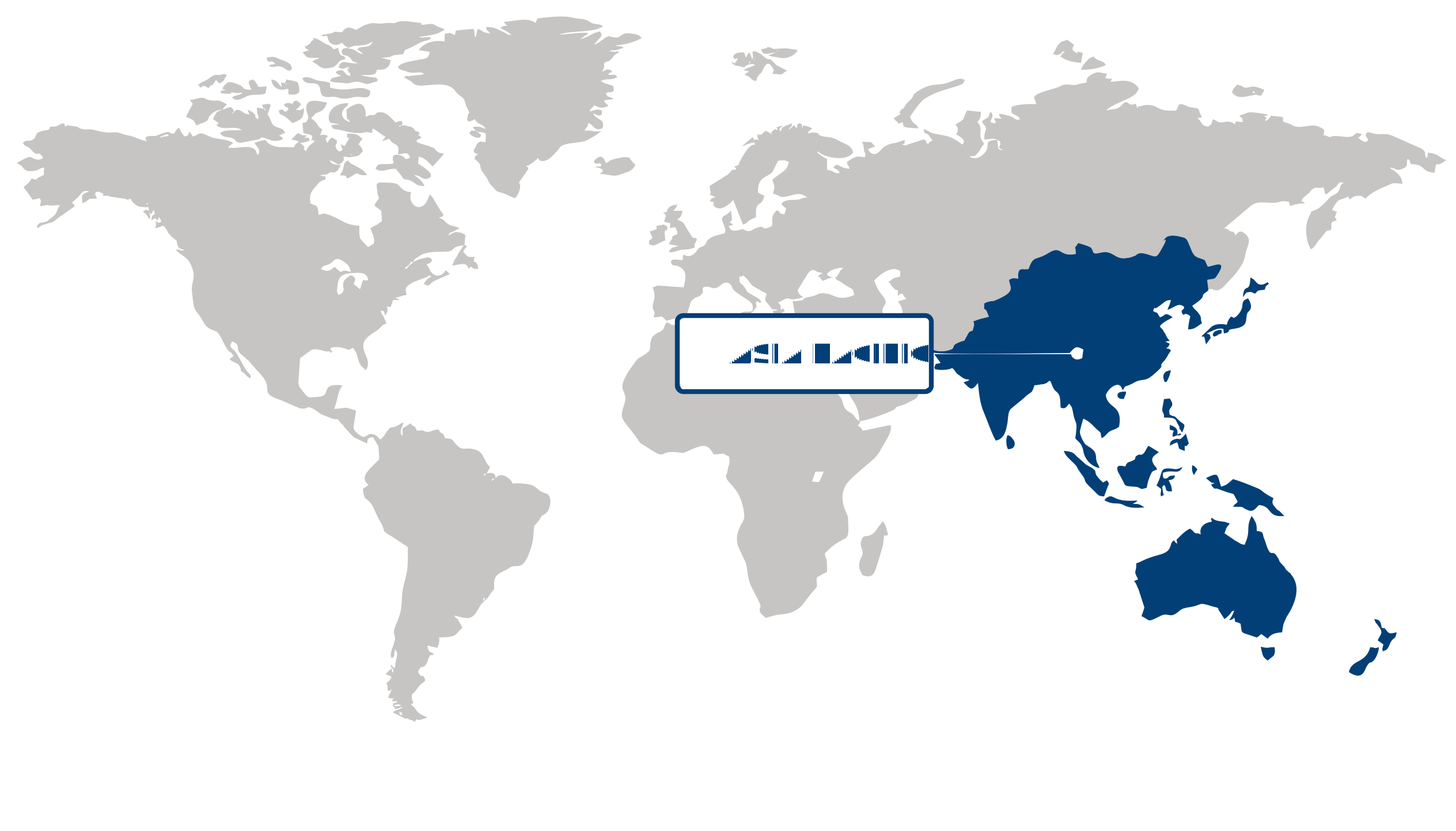
Asia Pacific (Largest Region)
Asia Pacific held the largest share of the 3D printed jewelry market in 2026, with a 40.28% share, supported by the region’s established jewelry manufacturing base, skilled design capabilities, and growing adoption of digital production technologies. The integration of three-dimensional modeling, computer-aided design, and additive manufacturing enables jewelry producers to develop intricate forms, customized designs, and prototypes with greater flexibility than conventional production methods. Expanding demand for personalized jewelry is further encouraging digital manufacturing, particularly as consumers seek distinctive designs and greater customization. The region’s strong jewelry trade, developing technology infrastructure, and increasing interest among manufacturers in reducing material waste and improving production efficiency are reinforcing the adoption of 3D printing across the jewelry value chain.
North America (Fastest-Growing Region)
North America is the fastest-growing region, driven by increasing consumer interest in personalized and digitally designed jewelry and greater acceptance of additive manufacturing within the creative and luxury-goods industries. Jewelry designers and manufacturers are using 3D printing to accelerate prototyping, experiment with complex geometries, and produce customized pieces while improving design flexibility. Digital commerce is also supporting the trend by making personalized jewelry concepts more accessible to consumers and enabling designs to move efficiently from digital models to physical products. In addition, growing awareness of production efficiency and material optimization is encouraging businesses to explore additive techniques as an alternative or complement to traditional manufacturing. Continued technological development and rising demand for distinctive, made-to-order products are expected to sustain the region’s rapid market expansion.
| Parameter | North America | Asia Pacific | Europe | Latin America | MEA |
|---|---|---|---|---|---|
| Innovation Hub i Scale Nascent Developing Advanced | |||||
| Cost-Sensitive Region i Scale Low Medium High | |||||
| Regulatory Environment i Scale Restrictive Neutral Supportive | |||||
| Demand Drivers i Scale Weak Moderate Strong | |||||
| Development Stage i Scale Emerging Developing Developed | |||||
| Adoption Rate i Scale Low Medium High | |||||
| New Entrants / Startups i Scale Sparse Moderate Dense | |||||
| Macro Indicators i Scale Weak Stable Strong |
Key Country Insights
Germany 🇩🇪
Precision Manufacturing ApplicationsGermany is applying 3D printing technologies to create highly detailed jewelry pieces with improved production efficiency. German jewelry manufacturers are integrating digital design and additive manufacturing tools to support bespoke production and complex geometries.
France 🇫🇷
Luxury Craft ModernizationFrance is integrating 3D printing into luxury jewelry production to support prototyping and intricate customization. French jewelry houses are increasingly combining traditional craftsmanship with additive manufacturing to create exclusive designs and optimize production flexibility.
Italy 🇮🇹
Artisan Design EnhancementItaly is adopting 3D printing technologies to complement its established jewelry craftsmanship and enable more intricate design capabilities. Italian manufacturers are using digital tools to shorten development cycles while preserving high-value artisanal finishing processes.
Japan 🇯🇵
Boutique Design IntegrationJapan is using 3D printing to blend intricate craftsmanship with modern jewelry design requirements. Designers in Japan are adopting additive manufacturing to produce limited-edition pieces and experiment with complex forms that are difficult to achieve through traditional techniques.
South Korea 🇰🇷
Fashion-Driven PersonalizationSouth Korea is embracing 3D printed jewelry as consumers seek unique accessories aligned with fast-changing fashion trends. Jewelry startups and designers in South Korea are utilizing digital fabrication to deliver customized products with shorter development timelines.
United States 🇺🇸
Custom Design EcosystemThe U.S. market is leveraging 3D printing to deliver personalized and small-batch jewelry collections with shorter design cycles. Jewelry brands in the U.S. are increasingly using digital manufacturing to support online customization services and rapid prototyping capabilities.
Segment Leadership and Growth Trends
3D Printed Jewelry Market Share (%), by Distribution Channel, 2026
Go beyond the chart, access full insights & data tables
Request Free Sample ReportDistribution Channel Segment Analysis: Offline (Largest Segment) vs Online (Fastest-Growing Segment)
Offline segment dominated the 3D printed jewelry market with a 66.54% share in 2026, supported by consumers' continued preference for physically examining jewelry before purchase. Offline retail allows buyers to assess the finish, design precision, material appearance, and overall craftsmanship of 3D printed pieces while receiving personalized assistance during selection. The tactile nature of jewelry purchasing remains particularly important for products involving customized designs and aesthetic details. Established retail networks also provide greater opportunities for direct customer engagement, product demonstrations, and trust-building, supporting the segment's strong position.
Online is the fastest-growing distribution channel, driven by increasing consumer acceptance of digital jewelry purchasing and the convenience offered by e-commerce platforms. Online channels allow customers to explore a broader assortment of designs, compare styles, and access customized products without geographic limitations. The digital nature of 3D printing also aligns well with online customization, enabling consumers to select or modify designs before production. Growing adoption of digital shopping and rising interest in personalized jewelry are therefore creating favorable conditions for continued expansion of online sales.
Product Segment Analysis: Ring (Largest Segment) vs Necklace (Fastest-Growing Segment)
Ring segment held the largest share of the 3D printed jewelry market, accounting for 35.83% in 2026, reflecting the strong suitability of rings for customized and digitally designed jewelry production. Rings can accommodate intricate patterns, personalized shapes, engraved elements, and individualized sizing, making them particularly compatible with the design flexibility offered by 3D printing. Consumer interest in distinctive and personalized accessories further supports demand for digitally manufactured rings. In addition, the ability to rapidly develop and reproduce complex ring designs strengthens the appeal of 3D printing for both bespoke and fashion-oriented applications.
Necklace is the fastest-growing product segment, supported by increasing demand for distinctive designs, customization, and visually expressive accessories. The flexibility of 3D printing enables designers to develop complex geometries, lightweight structures, and unconventional forms that can differentiate necklaces from traditionally manufactured products. Growing consumer interest in personalized fashion and digitally enabled design is expanding the addressable opportunity for 3D printed necklaces. The ability to translate intricate digital concepts into customized physical pieces is further encouraging adoption within this product category.
| Segment | Sub-Segment | Largest Segment | Fastest Growing |
|---|---|---|---|
| Distribution Channel | Online, Offline | Offline | Online |
| Product | Necklace, Ring, Earring, Bracelet, Others | Ring | Necklace |
Competitive Landscape and Market Positioning
Top players in the 3D printed jewelry market:
1. Stratasys Ltd. (Israel)
2. Materialise NV (Belgium)
3. Shapeways Holdings Inc. (United States)
4. EnvisionTEC GmbH (Germany)
5. Nervous System Inc. (United States)
6. Imaginarium India Pvt. Ltd. (India)
7. MIRAKIN Co. Ltd. (Japan)
8. RADIAN Jewelry (United States)
9. OLA Creative Ltd. (United Kingdom)
10. Diana Law Printed Accessories (United States)
Personalization trends are strongly influencing design evolution in the 3D printed jewelry market. In the 3D printed jewelry market, intricate design flexibility and rapid customization are enhancing creative expression.
| Company | Market Share | Company Revenue | Revenue CAGR (%) | Product Portfolio | Geographic Presence | Innovation / R&D Focus | Strategic Developments |
|---|---|---|---|---|---|---|---|
| Stratasys Ltd. (Israel) | |||||||
| Materialise NV (Belgium) | |||||||
| Shapeways Holdings Inc. (United States) | |||||||
| EnvisionTEC GmbH (Germany) | |||||||
| Nervous System Inc. (United States) | |||||||
| Imaginarium India Pvt. Ltd. (India) | |||||||
| MIRAKIN Co. Ltd. (Japan) | |||||||
| RADIAN Jewelry (United States) | |||||||
| OLA Creative Ltd. (United Kingdom) | |||||||
| Diana Law Printed Accessories (United States). |
Industry Development/News
| Company Name | Date | Key Development |
|---|---|---|
| Maeve Gillies | Nov-25 | Maeve Gillies launched the Tùsaire collection, a platinum jewelry line developed using 3D printing technology in collaboration with Platinum Guild International. The collection demonstrates the application of additive manufacturing in high-end platinum jewelry production, enabling more complex designs and reinforcing the adoption of advanced digital manufacturing techniques in luxury jewelry fabrication. |
| Christian Tse and Formula 3D | Oct-22 | Christian Tse and Formula 3D partnered with Desktop Metal to introduce 3D-printed 925 sterling silver jewelry. The collaboration integrates industrial additive manufacturing into jewelry production, enabling direct digital fabrication of precious metal designs and supporting broader adoption of 3D printing in fine jewelry manufacturing workflows. |
| LACE by Jenny Wu | Nov-21 | LACE by Jenny Wu launched a 3D-printed carbon fiber jewelry collection in collaboration with Impossible Objects, featuring earrings and bracelets produced using composite additive manufacturing. The development highlights early adoption of advanced 3D printing materials in jewelry design, expanding material innovation beyond traditional metals in the sector. |
Customize Your Report
Explore examples of how this report can be tailored to different research needs, including custom segments, additional topics or chapters, and related reports. Click a section of the wheel or its numbered marker to explore the available options.
3D Printed Jewelry Market — Custom Segments
| Segment | Sub-Segment |
|---|---|
| Printing Technology | Stereolithography (SLA), Selective Laser Sintering (SLS), Direct Metal Laser Sintering (DMLS), Fused Deposition Modeling (FDM), Other Technologies |
| Material Type | Precious Metals, Base Metals, Resins & Polymers, Ceramics, Other Materials |
| Customer Segment | Mass-Market Consumers, Premium Consumers, Luxury Consumers, Custom & Bespoke Buyers |
3D Printed Jewelry Market — Custom TOC
| Custom Chapter | Custom Details |
|---|---|
| Luxury Brand Adoption and Personalization Strategy |
|
| Digital Jewelry Commerce Evolution |
|
| Custom Manufacturing Business Model Benchmarking |
|
Need a different cut of the data?
Request Custom ResearchWhat is the market size of 3D printed jewelry?
How is the 3D printed jewelry industry projected to perform over the next decade?
How is rising demand for personalized jewelry influencing adoption of 3D printing in design and production workflows?
What role are advancements in additive manufacturing materials playing in expanding jewelry design complexity?
Why do rings dominate the 3D printed jewelry market?
How is the online channel reshaping the 3D printed jewelry market?
What supports Asia Pacific's leadership in the 3D printed jewelry market?
Why is North America the fastest-growing regional market for 3D printed jewelry?
Which organizations are considered leaders in the 3D printed jewelry landscape?
Our Clients
"The report provided us with a clear direction, and the level of detail was beyond what we expected. I would definitely recommend their services to others."
Haier Appliances
"The collaboration with Fundamental Business Insights has added significant value to our decision-making process, and we look forward to continuing this partnership for our future market research requirements."
Luxottica Group S.p.A.
"The team at FBI delivered an exceptional research report. The insights on industry innovations were particularly impressive and added a lot of value to the overall report."
Nike
Our Research Team & Methodology
Every Fundamental Business Insights report is built by a dedicated vertical research team, validated through a structured primary-and-secondary methodology, and reviewed for accuracy before it reaches you.
Research Team Overview
Prepared by the Consumer Goods & Services Research Team
Delivery
Published
Demand
Available
Support
Trust & Compliance
Research Domains
10 coverage areasResearch Intelligence
| Source | Reference |
|---|---|
| International Organization for Standardization (ISO) | www.iso.org |
| ASTM International | www.astm.org |
| U.S. Consumer Product Safety Commission (CPSC) | www.cpsc.gov |
| European Commission – Consumer Safety | ec.europa.eu/safety-gate |
| Consumer Technology Association (CTA) | www.cta.tech |
| National Retail Federation (NRF) | nrf.com |
| World Retail Congress | www.worldretailcongress.com |
| World Travel & Tourism Council (WTTC) | wttc.org |
| UN Tourism | www.unwto.org |
| Personal Care Products Council (PCPC) | www.personalcarecouncil.org |
| Cosmetics Europe | cosmeticseurope.eu |
| International Housewares Association (IHA) | www.housewares.org |
| American Apparel & Footwear Association (AAFA) | www.aafaglobal.org |
| World Federation of the Sporting Goods Industry (WFSGI) | wfsgi.org |
| Juvenile Products Manufacturers Association (JPMA) | www.jpma.org |
| Pet Industry Joint Advisory Council (PIJAC) | pijac.org |
| International Council of Toy Industries (ICTI) | www.toy-icti.org |
| International Association of Amusement Parks and Attractions (IAAPA) | iaapa.org |
| Organisation for Economic Co-operation and Development (OECD) | www.oecd.org |
| World Bank Data | data.worldbank.org |
Research Workflow & Quality Assurance
Data Collection
Verified information gathered through primary and secondary research.
Data Triangulation
Cross-validation using multiple independent data sources.
Forecast Modelling
Market estimates developed using historical trends and analytical models.
Analyst Validation
Findings reviewed by domain experts for accuracy and consistency.
Editorial & Quality Review
Final editorial, quality, and compliance checks before publication.
Final Publication
Released after successful completion of the internal review process.
Report Coverage
📊 Market Assessment
- Market Size & Forecast
- Market Segmentation
- Regional Analysis
- Growth Drivers & Challenges
- Market Dynamics
🏢 Competitive Intelligence
- Competitive Landscape
- Company Profiles
- Competitive Benchmarking
- Mergers & Acquisitions
- Market Share Analysis or Key Company Strategies
🔍 Strategic Analysis
- Value Chain Analysis
- Porter's Five Forces
- PESTLE Analysis
- Pricing Trends
- Supply-Demand Analysis
🚀 Future Outlook
- Technology Landscape
- Regulatory Landscape
- Investment & Funding Landscape
- Emerging Opportunities
- Future Market Outlook
Have a question about this report or need a custom scope?
Request Customization