Offshore Wind Market Size & Growth Forecast 2027–2036, By Segments (Installation, Capacity, Water Depth), Regional Demand Trends (North America, Asia Pacific, Europe), Key Country Insights (U.S., Japan, South Korea, Germany, France, Italy), and Competitive Landscape
Market Size and Growth Outlook
Offshore Wind Market size was estimated at USD 45.2 billion in 2026 and is projected to grow at a 10.36% CAGR from 2027 to 2036, exceeding USD 121.13 billion by 2036. The industry revenue for 2027 is assessed at USD 49.14 billion.
Get more details on this report
Request Free Sample ReportOffshore Wind Market Intelligence Snapshot
Regional Market Dynamics
- Europe held a 50.57% market share in 2026, supported by a mature installation ecosystem, strong transmission infrastructure, established suppliers, and extensive offshore project experience.
- Asia Pacific is projected to grow at a 9.04% CAGR as countries expand offshore capacity, invest in port infrastructure, and strengthen domestic manufacturing for turbine deployment.
Segment Momentum
- Fixed Structure captured a 60.47% share in 2026 because proven engineering practices, established supply chains, and lower execution risk make it the preferred option for suitable offshore locations.
- Above 5 MW is both the largest and fastest-growing capacity segment, holding a 46.31% share in 2026 as larger turbines improve project efficiency and reduce the number of installations required.
Market Expansion Drivers
- Government-backed decarbonization investments driving large-scale offshore wind capacity expansion projects.
- Floating wind technology enabling deeper water installations and higher energy yield development.
- Corporate PPAs and green hydrogen integration expanding offshore wind financing and storage models.
Leading Market Participants
- Leading players in the offshore wind market include Vestas Wind Systems A/S (Denmark), Siemens Gamesa Renewable Energy, S.A. (Spain), GE Vernova Inc. (United States), Nordex SE (Germany), Shanghai Electric Wind Power Group Co., Ltd. (China), Doosan Enerbility Co., Ltd. (South Korea), Hitachi, Ltd. (Japan), Schneider Electric SE (France), Zhejiang Windey Co., Ltd. (China), Taiyuan Heavy Industry Co., Ltd. (China).
Global Market Forecast Snapshot
Market Outlook
- 2026 Market Size: USD 45.2 billion
- 2027 Estimated Market Size: USD 49.14 billion.
- Projected Market Size: USD 121.13 billion by 2036
- Growth Forecast: 10.36% CAGR (2027-2036)
Regional and Segment Outlook
- Leading Regional Market: Europe
- High-Growth Regional Hub: Asia Pacific
- Core Revenue Segment: Fixed Structure (Installation) | Above 5 MW (Capacity) | Shallow Water (<30 M Depth) (Water Depth)
- Emerging Opportunity Segment: Floating Structure (Installation) | Above 5 MW (Capacity) | Deepwater (More Than 60 M Depth) (Water Depth)
Market Growth Drivers and Industry Trends
Government-backed decarbonization investments driving large-scale offshore wind capacity expansion projects
Government-supported investments in energy transition infrastructure will drive the offshore wind market growth by creating stronger conditions for large-scale project development and deployment. Decarbonization policies and efforts to diversify electricity generation are encouraging the development of renewable power sources capable of supplying substantial volumes of electricity while reducing dependence on carbon-intensive generation. Offshore wind benefits from strong and relatively consistent wind resources available in suitable marine locations, making it attractive for countries seeking to expand renewable generation capacity near major electricity demand centers. Public-sector support through investment programs, development frameworks, and renewable energy initiatives can also improve project visibility and encourage greater participation across the offshore wind supply chain, including project development, equipment manufacturing, installation, and marine services.
Floating wind technology enabling deeper water installations and higher energy yield development
Advances in floating wind technology are opening new development opportunities and will propel the offshore wind market growth by allowing turbines to be deployed in deeper waters that are less suitable for conventional fixed-bottom foundations. Floating platforms can expand the geographic range available for offshore wind projects, particularly in regions where seabed conditions or water depths constrain fixed installations. Access to stronger offshore wind resources can also improve the potential energy output of projects while enabling development farther from densely populated coastlines. Continued progress in floating foundations, anchoring systems, installation techniques, and marine operations is helping address technical requirements associated with deep-water deployment, creating additional pathways for offshore wind development in markets with limited shallow-water resources.
Corporate PPAs and green hydrogen integration expanding offshore wind financing and storage models
Growing interest in long-term renewable electricity procurement will support offshore wind market growth as corporate power purchase agreements provide project developers with mechanisms for securing revenue commitments from electricity-intensive users. Corporate PPAs can strengthen the commercial case for offshore wind projects by linking renewable generation with the decarbonization objectives of businesses seeking more predictable access to clean electricity. At the same time, integrating offshore wind with green hydrogen production creates an additional pathway for using renewable power when electricity generation exceeds immediate grid demand. Hydrogen production can connect offshore renewable generation with industrial energy requirements and longer-duration energy storage concepts, broadening the potential value proposition of offshore wind projects beyond direct electricity supply.
| Growth Driver | Impact on CAGR | Regulatory Influence | Geographic Relevance | Adoption Rate | Impact Timeline |
|---|---|---|---|---|---|
| Rising global investments in offshore wind projects | 3.10% | Short term (≤ 2 yrs) | Europe, Asia Pacific (spillover: North America) | High | Fast |
| Technological advancements in turbines & floating platforms | 2.80% | Medium term (2–5 yrs) | North America, Europe (spillover: Asia Pacific) | Medium | Moderate |
| Government policies & carbon-neutral targets | 2.10% | Long term (5+ yrs) | Europe, North America (spillover: Asia Pacific) | High | Slow |
| Government-backed decarbonization investments driving large-scale offshore wind capacity expansion projects | 2.50% | High | Europe, Asia Pacific | High | Near Term |
| Floating wind technology enabling deeper water installations and higher energy yield development | 2.10% | Moderate | Asia Pacific, North America | Medium | Mid Term |
| Corporate PPAs and green hydrogen integration expanding offshore wind financing and storage models | 1.90% | Moderate | Europe, North America | Emerging | Long Term |
Unlock insights tailored to your business with our bespoke market research solutions.
Click to get your customized report now.
Regional Demand Dynamics
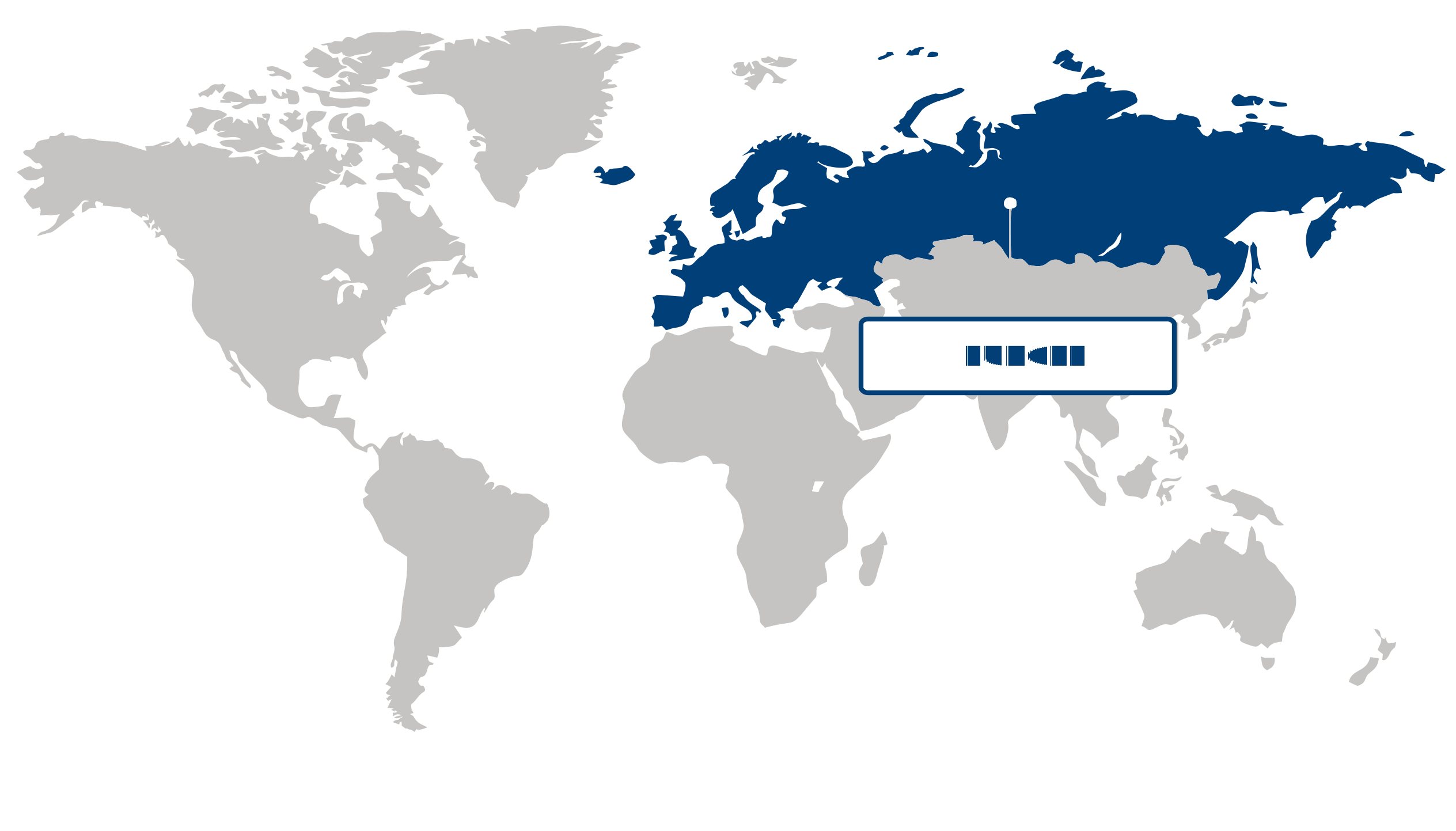
Europe (Largest Region)
Europe held the largest share of the offshore wind market at 50.57% in 2026, underpinned by strong renewable energy policies, established offshore development expertise, and sustained efforts to reduce dependence on fossil fuels. Governments across the region are prioritizing grid decarbonization and renewable power expansion, creating a favorable environment for large-scale offshore projects. Mature maritime infrastructure, established supply chains, and extensive experience with offshore engineering are supporting project development and operational capabilities. Increasing integration of offshore generation into broader electricity systems, together with continued investment in grid modernization and clean-energy infrastructure, is reinforcing Europe’s leadership.
Asia Pacific (Fastest-Growing Region)
Asia Pacific is the fastest-growing regional market as governments and utilities increasingly pursue offshore wind to diversify energy supplies and support decarbonization objectives. Rapid industrialization, rising electricity demand, and extensive coastal areas are creating significant opportunities for offshore generation. Investments in port infrastructure, transmission networks, turbine deployment capabilities, and domestic renewable-energy supply chains are strengthening the region’s capacity to develop projects at scale. Growing policy support for clean electricity and efforts to reduce emissions from power generation are further accelerating interest in offshore wind across major coastal economies.
| Parameter | North America | Asia Pacific | Europe | Latin America | MEA |
|---|---|---|---|---|---|
| Innovation Hub i Scale Nascent Developing Advanced | |||||
| Cost-Sensitive Region i Scale Low Medium High | |||||
| Regulatory Environment i Scale Restrictive Neutral Supportive | |||||
| Demand Drivers i Scale Weak Moderate Strong | |||||
| Development Stage i Scale Emerging Developing Developed | |||||
| Adoption Rate i Scale Low Medium High | |||||
| New Entrants / Startups i Scale Sparse Moderate Dense | |||||
| Macro Indicators i Scale Weak Stable Strong |
Key Country Insights
Germany 🇩🇪
Grid Integration ExpertiseGermany continues expanding offshore wind through coordinated transmission planning and established engineering capabilities. German stakeholders focus on integrating additional offshore capacity while strengthening turbine technology and supporting infrastructure.
France 🇫🇷
Atlantic Offshore ExpansionFrance continues developing offshore wind capacity along its Atlantic and Channel coastlines through competitive project awards. French developers focus on balancing environmental considerations with efficient construction and grid connection planning.
Italy 🇮🇹
Emerging Offshore DeploymentItaly is evaluating offshore wind opportunities, particularly floating installations suited to deeper coastal waters. Italian energy companies emphasize technology partnerships and infrastructure planning to support commercially viable offshore projects.
Japan 🇯🇵
Floating Wind AdoptionJapan emphasizes floating offshore wind projects to utilize deep-water coastal resources. Japanese developers invest in demonstration projects, marine engineering expertise, and grid connectivity to support long-term offshore deployment.
South Korea 🇰🇷
Marine Engineering CapabilitySouth Korea leverages its shipbuilding and offshore engineering strengths to expand offshore wind development. South Korean companies prioritize domestic component manufacturing and floating platform technologies for future project deployment.
United States 🇺🇸
Coastal Project DevelopmentThe U.S. offshore wind market is advancing through large-scale coastal developments supported by grid upgrades and domestic supply chain investments. Project developers in the U.S. prioritize local manufacturing capacity and efficient project execution.
Segment Leadership and Growth Trends
Offshore Wind Market Share (%), by Installation, 2026
Go beyond the chart, access full insights & data tables
Request Free Sample ReportInstallation Segment Analysis: Fixed Structure (Largest Segment) vs Floating Structure (Fastest-Growing Segment)
The offshore wind market was led by the fixed structure segment, which accounted for a 60.47% share in 2026. Fixed structures remain widely adopted because they provide established foundations for offshore turbines in suitable water depths and benefit from mature installation, engineering, and maintenance practices. Their proven structural performance and compatibility with existing offshore wind development capabilities continue to support deployment, particularly as demand for large-scale renewable power generation expands. The availability of established supply chains and project expertise further reinforces the segment's position in the market.
Floating structures represent the fastest-growing installation segment, supported by the expansion of offshore wind development into deeper waters where fixed foundations become less practical. Floating technology enables turbines to be positioned farther from shore and in locations with stronger and more consistent wind resources, broadening the geographic potential of offshore wind generation. Continued technological advancement in floating platforms, together with growing interest in accessing previously unsuitable offshore areas, is strengthening the commercial prospects of this installation approach.
Capacity Segment Analysis: Above 5 MW (Largest & Fastest-Growing Segment)
The above 5 MW segment held a 46.31% share in 2026 and represented both the largest and fastest-growing capacity category in the offshore wind market. Its strong position reflects the industry's increasing preference for higher-capacity turbines that can generate greater electricity output from individual offshore installations. Larger turbines can improve project productivity while helping developers optimize valuable offshore sites, making them increasingly attractive as the scale of wind projects expands. The continued development of more powerful turbine technologies, combined with efforts to improve generation efficiency and project economics, is accelerating adoption of the above 5 MW segment.
| Segment | Sub-Segment | Largest Segment | Fastest Growing |
|---|---|---|---|
| Installation | Fixed Structure, Floating Structure | Fixed Structure | Floating Structure |
| Capacity | Up to 3 MW, 3 MW to 5 MW, Above 5 MW | Above 5 MW | Above 5 MW |
| Water Depth | Shallow Water (<30 M Depth), Transitional Water (30-60 M Depth), Deepwater (More Than 60 M Depth) | Shallow Water (<30 M Depth) | Deepwater (More Than 60 M Depth) |
Competitive Landscape and Market Positioning
Key companies in the offshore wind market:
1. Vestas Wind Systems A/S (Denmark)
2. Siemens Gamesa Renewable Energy S.A. (Spain)
3. GE Vernova Inc. (United States)
4. Nordex SE (Germany)
5. Shanghai Electric Wind Power Group Co. Ltd. (China)
6. Doosan Enerbility Co. Ltd. (South Korea)
7. Hitachi Ltd. (Japan)
8. Schneider Electric SE (France)
9. Zhejiang Windey Co. Ltd. (China)
10. Taiyuan Heavy Industry Co. Ltd. (China)
The offshore wind market is accelerating through large-scale renewable deployment and turbine efficiency improvements. Technological advancements are enhancing energy output and installation capabilities. Collaborative development efforts are supporting infrastructure expansion. The offshore wind market is increasingly central to global clean energy transition strategies.
| Company | Market Share | Company Revenue | Revenue CAGR (%) | Product Portfolio | Geographic Presence | Innovation / R&D Focus | Strategic Developments |
|---|---|---|---|---|---|---|---|
| Vestas Wind Systems A/S (Denmark) | |||||||
| Siemens Gamesa Renewable Energy S.A. (Spain) | |||||||
| GE Vernova Inc. (United States) | |||||||
| Nordex SE (Germany) | |||||||
| Shanghai Electric Wind Power Group Co. Ltd. (China) | |||||||
| Doosan Enerbility Co. Ltd. (South Korea) | |||||||
| Hitachi Ltd. (Japan) | |||||||
| Schneider Electric SE (France) | |||||||
| Zhejiang Windey Co. Ltd. (China) | |||||||
| Taiyuan Heavy Industry Co. Ltd. (China). |
Industry Development/News
| Company Name | Date | Key Development |
|---|---|---|
| TotalEnergies | Mar-26 | TotalEnergies reached a settlement with the U.S. Department of the Interior to relinquish its Carolina Long Bay and New York Bight offshore wind leases. This move signifies a strategic exit from planned U.S. offshore projects, with the company opting to reallocate capital toward alternative energy investments, specifically natural gas initiatives. |
| RWE | Sep-25 | RWE, in partnership with TotalEnergies, was selected to operate France’s Centre Manche 2 offshore wind tender. Representing an estimated €4.5 billion investment, this project reinforces the expansion of large-scale offshore wind capacity in the French market and includes long-term commitments to regional job creation and infrastructure development. |
| bp | Aug-25 | bp and JERA established a joint venture, JERA Nex bp, to consolidate their respective offshore wind asset portfolios. The new entity manages a net potential generating capacity of approximately 13 GW, creating a major global platform designed to scale renewable energy development and unify operational structures for large-scale projects. |
| National Grid | May-25 | National Grid recognized a significant write-down on its U.S. offshore wind assets, citing persistent financial and market challenges. This adjustment reflects heightened pressure on project economics, driven by evolving regulatory landscapes, rising capital costs, and increased uncertainty surrounding the long-term viability of offshore wind developments in the United States. |
| Mitsui O.S.K. Lines | May-25 | Mitsui O.S.K. Lines entered the offshore wind sector by joining a Taiwan-based project during the construction phase. This strategic move marks the company’s expansion into renewable energy infrastructure, providing an opportunity for direct operational involvement in large-scale offshore wind project execution within the Asia-Pacific region. |
| Sunly | Apr-25 | Sunly formed a strategic partnership with Deep Wind Offshore and Valorem Group to develop offshore wind capacity in Estonia. The collaboration aims to advance early-stage planning and execution of renewable energy infrastructure in the Baltic Sea, fostering international cooperation for cross-border offshore wind development. |
| Shell | Feb-25 | Shell exited its Atlantic Shores offshore wind joint venture with EDF Renewables, recording an impairment on the investment. This withdrawal highlights a broader strategic reassessment of offshore wind portfolios, reflecting shifting project economics and the company's internal shift toward prioritizing assets with more favorable financial returns. |
| Dominion Energy | Oct-24 | Dominion Energy finalized the sale of a 50% noncontrolling stake in the Coastal Virginia Offshore Wind project to Stonepeak. While Dominion retains full operational control over construction and long-term project management, the transaction provides essential capital support to finance the large-scale development and execution of the facility. |
| Sumitomo Corporation | Aug-24 | Sumitomo Corporation invested in EEW Offshore Wind EU Holding, a major manufacturer of monopiles for bottom-fixed offshore wind foundations. This investment enhances Sumitomo's footprint in the offshore wind supply chain and supports the global scalability of critical manufacturing infrastructure required for large-scale offshore wind deployment. |
| Siemens Gamesa | Feb-23 | Siemens Gamesa announced plans to construct a $500 million offshore nacelle manufacturing facility at the Port of Coeymans, New York. The project, expected to generate over 420 direct jobs, represents a significant investment in the U.S. offshore wind supply chain and localized production capacity for the North American market. |
Customize Your Report
Explore examples of how this report can be tailored to different research needs, including custom segments, additional topics or chapters, and related reports. Click a section of the wheel or its numbered marker to explore the available options.
Offshore Wind Market — Custom Segments
| Segment | Sub-Segment |
|---|---|
| Project Development Stage | Development & Planning, Construction, Operational, Repowering & Extension |
| Ownership Model | Utility-Owned, Independent Power Producer-Owned, Joint Venture-Owned, Government/Public-Owned |
| Power Offtake Model | Merchant Power, Corporate Power Purchase Agreements, Utility Power Purchase Agreements, Government-Backed Contracts |
Offshore Wind Market — Custom TOC
| Custom Chapter | Custom Details |
|---|---|
| Offshore Wind Investment Landscape |
|
| Floating Wind Commercialization Outlook |
|
| Supply Chain Localization Strategy |
|
Need a different cut of the data?
Request Custom ResearchHow much is the offshore wind market worth?
What is the anticipated CAGR of the offshore wind industry?
How are government-led decarbonization programs shaping long-term investment and project pipelines in the offshore wind market?
What role is floating wind technology playing in expanding offshore wind development opportunities?
Why are fixed structures the leading installation segment in the offshore wind market?
Which capacity segment is growing the fastest in the offshore wind market?
Why is Europe the largest offshore wind market?
What factors are accelerating offshore wind growth in Asia Pacific?
What are the key competitors in the offshore wind landscape?
Our Clients
"The information presented in the report was genuinely insightful. The data was clear and easy to understand, which made it much easier to interpret the findings."
Amara Raja Group
"The responsiveness and professionalism exhibited by the team were exemplary. They were readily available to address queries, provide clarifications, and offer additional insights."
ONGC
"The reports offered a comprehensive analysis of various segments within the market. The detailed insights into market trends, and regulatory landscapes were excellent."
TotalEnergies
Our Research Team & Methodology
Every Fundamental Business Insights report is built by a dedicated vertical research team, validated through a structured primary-and-secondary methodology, and reviewed for accuracy before it reaches you.
Research Team Overview
Prepared by the Energy & Power Research Team
Delivery
Published
Demand
Available
Support
Trust & Compliance
Research Domains
10 coverage areasResearch Intelligence
| Source | Reference |
|---|---|
| International Energy Agency (IEA) | www.iea.org |
| U.S. Energy Information Administration (EIA) | www.eia.gov |
| International Renewable Energy Agency (IRENA) | www.irena.org |
| International Electrotechnical Commission (IEC) | www.iec.ch |
| International Organization for Standardization (ISO) | www.iso.org |
| IEEE | www.ieee.org |
| CIGRE (International Council on Large Electric Systems) | www.cigre.org |
| World Energy Council (WEC) | www.worldenergy.org |
| U.S. Department of Energy (DOE) | www.energy.gov |
| International Atomic Energy Agency (IAEA) | www.iaea.org |
| American Petroleum Institute (API) | www.api.org |
| Society of Petroleum Engineers (SPE) | www.spe.org |
| Hydrogen Council | hydrogencouncil.com |
| Battery Council International (BCI) | batterycouncil.org |
| Global Wind Energy Council (GWEC) | gwec.net |
| SolarPower Europe | www.solarpowereurope.org |
| World Bioenergy Association (WBA) | worldbioenergy.org |
| International Hydropower Association (IHA) | www.hydropower.org |
| Edison Electric Institute (EEI) | www.eei.org |
| National Renewable Energy Laboratory (NREL) | www.nrel.gov |
Research Workflow & Quality Assurance
Data Collection
Verified information gathered through primary and secondary research.
Data Triangulation
Cross-validation using multiple independent data sources.
Forecast Modelling
Market estimates developed using historical trends and analytical models.
Analyst Validation
Findings reviewed by domain experts for accuracy and consistency.
Editorial & Quality Review
Final editorial, quality, and compliance checks before publication.
Final Publication
Released after successful completion of the internal review process.
Report Coverage
📊 Market Assessment
- Market Size & Forecast
- Market Segmentation
- Regional Analysis
- Growth Drivers & Challenges
- Market Dynamics
🏢 Competitive Intelligence
- Competitive Landscape
- Company Profiles
- Competitive Benchmarking
- Mergers & Acquisitions
- Market Share Analysis or Key Company Strategies
🔍 Strategic Analysis
- Value Chain Analysis
- Porter's Five Forces
- PESTLE Analysis
- Pricing Trends
- Supply-Demand Analysis
🚀 Future Outlook
- Technology Landscape
- Regulatory Landscape
- Investment & Funding Landscape
- Emerging Opportunities
- Future Market Outlook
Have a question about this report or need a custom scope?
Request Customization