Next-Generation Batteries Market Size & Growth Forecast 2027–2036, By Segments (Technology, Application), Regional Demand Trends (North America, Asia Pacific, Europe), Key Country Insights (U.S., Japan, South Korea, Germany, France, Italy), and Competitive Landscape
Market Size and Growth Outlook
Next-Generation Batteries Market size was estimated at USD 2.2 billion in 2026 and is projected to grow at a 7.98% CAGR from 2027 to 2036, reaching USD 4.74 billion by 2036. The industry revenue for 2027 is assessed at USD 2.35 billion.
Get more details on this report
Request Free Sample ReportNext-Generation Batteries Market Intelligence Snapshot
Regional Market Dynamics
- Asia Pacific leads due to dense battery manufacturing base, integrated electronics and EV supply chains, and large-scale capacity expansion that enables efficient production and strong downstream demand alignment.
- Asia Pacific growth is driven by tightly connected industrial networks, rapid commercialization, and scaling of new battery chemistries across EV and electronics applications, supporting a 9.61% CAGR outlook.
Segment Momentum
- Solid-state batteries held a 54.08% market share in 2026, driven by demand for safer, higher-performance energy storage with improved energy density, thermal stability, and reliability for advanced electrification needs.
- Electric Vehicles accounted for 61.28% of the market in 2026 and remain the fastest-growing application because battery performance directly influences driving range, charging expectations, safety, and overall vehicle adoption.
Market Expansion Drivers
- Expanding electric vehicle production accelerating demand for high-density advanced battery technologies.
- Rising renewable energy deployment increasing investments in grid-scale energy storage systems.
- Scaling domestic battery manufacturing initiatives strengthening regional supply chain resilience.
Leading Market Participants
- Key players in the next-generation batteries market include Panasonic Holdings Corporation (Japan), LG Chem Ltd. (South Korea), Hitachi, Ltd. (Japan), Amprius Technologies, Inc. (United States), Ambri Inc. (United States), Sion Power Corporation (United States), Mitsubishi Chemical Group Corporation (Japan), Envia Systems, Inc. (United States), Phinergy Ltd. (Israel), QuantumScape Corporation (United States).
Global Market Forecast Snapshot
Market Outlook
- 2026 Market Size: USD 2.2 billion
- 2027 Estimated Market Size: USD 2.35 billion.
- Projected Market Size: USD 4.74 billion by 2036
- Growth Forecast: 7.98% CAGR (2027-2036)
Regional and Segment Outlook
- Leading Regional Market: Asia Pacific
- High-Growth Regional Hub: Asia Pacific
- Core Revenue Segment: Solid-State Batteries (Technology) | Electric Vehicles (EVs) (Application)
- Emerging Opportunity Segment: Solid-State Batteries (Technology) | Electric Vehicles (EVs) (Application)
Market Growth Drivers and Industry Trends
Expanding electric vehicle production accelerating demand for high-density advanced battery technologies
Automakers are increasing electric vehicle production, creating greater requirements for batteries that combine high energy density, performance, safety, and efficient use of available space. The next-generation batteries market will grow as advanced battery technologies address the need for improved energy storage capabilities across increasingly sophisticated EV platforms. Greater emphasis on driving range, charging performance, and battery efficiency is encouraging manufacturers to evaluate technologies beyond conventional battery architectures.
Rising renewable energy deployment increasing investments in grid-scale energy storage systems
The expansion of renewable power generation is increasing the need for energy storage technologies that can manage fluctuations in electricity supply and improve grid flexibility. Rising deployment of solar and wind infrastructure will drive the next-generation batteries market as grid-scale storage requires advanced systems capable of storing electricity and releasing it when generation conditions change. Demand for reliable storage also supports investment in battery technologies designed for extended operating cycles and large-scale energy management.
Scaling domestic battery manufacturing initiatives strengthening regional supply chain resilience
Governments and industry stakeholders are increasingly supporting domestic battery manufacturing to reduce dependence on concentrated international supply chains. These initiatives will boost the next-generation batteries market by encouraging regional investments in production facilities, material processing, and supporting battery technologies. Greater localization of manufacturing also strengthens access to critical battery components while helping producers establish more resilient supply networks for rapidly expanding energy storage and electric mobility applications.
| Growth Driver | Impact on CAGR | Regulatory Influence | Geographic Relevance | Adoption Rate | Impact Timeline |
|---|---|---|---|---|---|
| Expanding electric vehicle production accelerating demand for high-density advanced battery technologies | 2.00% | High | Asia Pacific, Europe, North America | High | Near Term |
| Rising renewable energy deployment increasing investments in grid-scale energy storage systems | 1.80% | Moderate | North America, Europe, Asia Pacific | High | Mid Term |
| Scaling domestic battery manufacturing initiatives strengthening regional supply chain resilience | 1.40% | High | Asia Pacific, North America | Emerging | Mid Term |
Unlock insights tailored to your business with our bespoke market research solutions.
Click to get your customized report now.
Regional Demand Dynamics
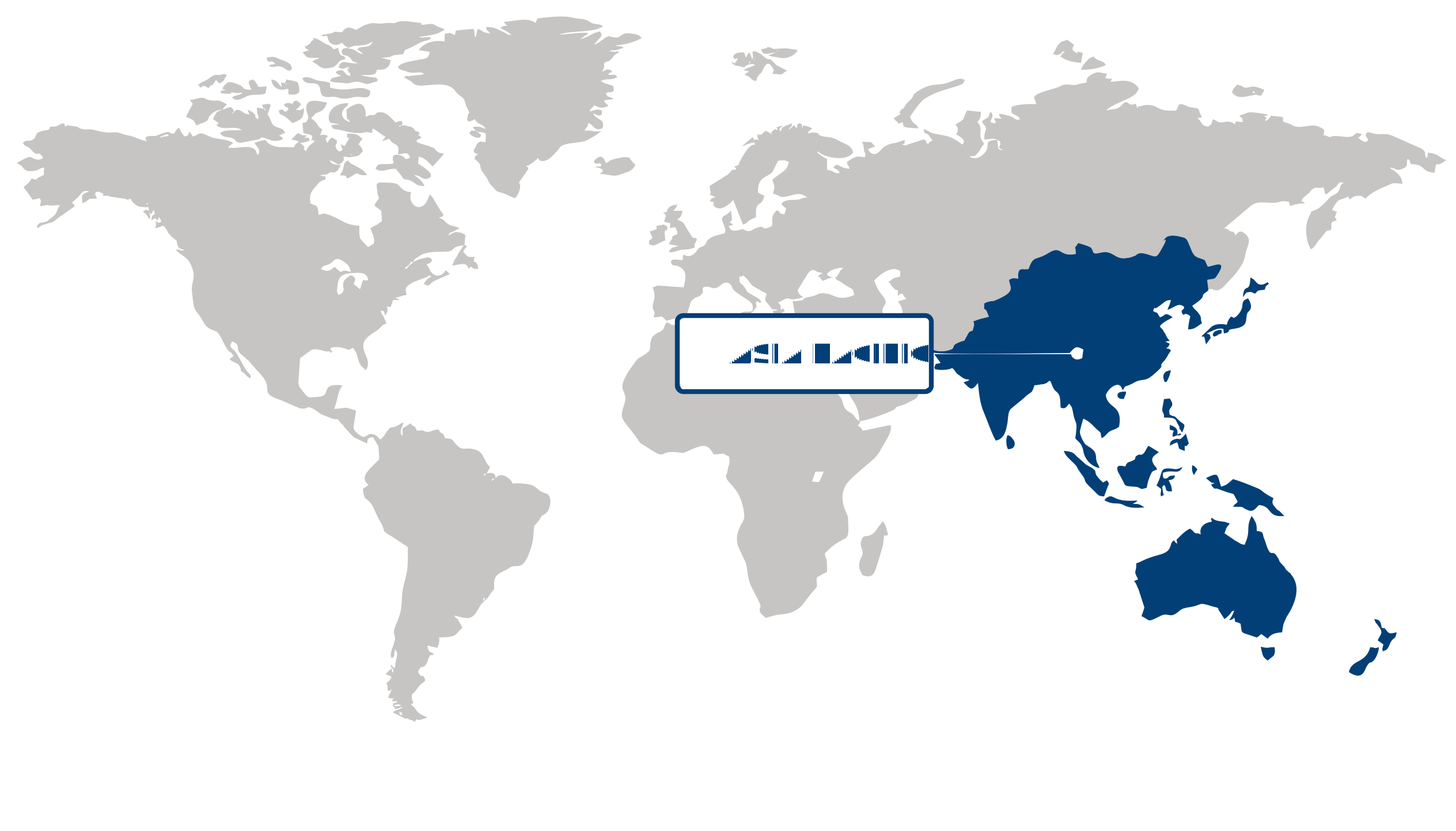
Asia Pacific (Largest & Fastest-Growing Region)
The Asia Pacific region held the largest share in 2026 in the next-generation batteries market and is also the fastest-growing regional market, benefiting from its extensive battery manufacturing ecosystem and strong activity across electric mobility, consumer electronics, and energy storage applications. Significant technological development, expanding research and development capabilities, and continued investment in advanced cell chemistries are supporting the transition toward higher-performance battery technologies. Growing demand for improved energy density, charging efficiency, safety, and battery longevity is encouraging manufacturers and technology developers to accelerate commercialization efforts. The region's integrated manufacturing infrastructure and expanding clean-energy ecosystem further strengthen its position in next-generation battery development and adoption.
| Parameter | North America | Asia Pacific | Europe | Latin America | MEA |
|---|---|---|---|---|---|
| Innovation Hub i Scale Nascent Developing Advanced | |||||
| Cost-Sensitive Region i Scale Low Medium High | |||||
| Regulatory Environment i Scale Restrictive Neutral Supportive | |||||
| Demand Drivers i Scale Weak Moderate Strong | |||||
| Development Stage i Scale Emerging Developing Developed | |||||
| Adoption Rate i Scale Low Medium High | |||||
| New Entrants / Startups i Scale Sparse Moderate Dense | |||||
| Macro Indicators i Scale Weak Stable Strong |
Key Country Insights
Germany 🇩🇪
Automotive Battery InnovationGermany advances next-generation battery development by integrating new cell technologies into its automotive manufacturing ecosystem. German companies focus on improving energy density, manufacturing scalability, and compatibility with future electric vehicle platforms.
France 🇫🇷
Sustainable Battery EcosystemFrance supports next-generation batteries through investments in sustainable manufacturing, research partnerships, and localized production capabilities. French initiatives encourage greater integration between battery developers, mobility manufacturers, and clean energy industries.
Italy 🇮🇹
Industrial Technology AdoptionItaly expands participation in the next-generation batteries market by strengthening advanced manufacturing capabilities and collaborative research activities. Italian companies increasingly explore specialized battery applications supporting industrial equipment and sustainable mobility solutions.
Japan 🇯🇵
Materials Engineering ExcellenceJapan leverages expertise in advanced materials to develop next-generation batteries with improved safety, durability, and performance. Strong collaboration between component suppliers and battery manufacturers supports continuous refinement of innovative cell designs.
South Korea 🇰🇷
Scalable Battery ManufacturingSouth Korea prioritizes scaling next-generation battery production while integrating advanced chemistries into established manufacturing facilities. Domestic companies continue investing in process innovation to improve commercial readiness and production efficiency.
United States 🇺🇸
Advanced Cell CommercializationThe U.S. next-generation batteries market emphasizes commercialization of advanced chemistries through collaboration between manufacturers, research institutions, and automotive companies. Domestic investment continues to strengthen pilot-scale production and localized battery supply chains.
Segment Leadership and Growth Trends
Next-Generation Batteries Market Share (%), by Technology, 2026
Go beyond the chart, access full insights & data tables
Request Free Sample ReportTechnology Segment Analysis: Solid-State Batteries (Largest & Fastest-Growing Segment)
Solid-State batteries dominated the next-generation batteries market with a 54.08% share in 2026, while also representing the fastest-growing technology segment. Their leading position is supported by the potential to deliver enhanced safety, higher energy density, and improved battery performance compared with conventional battery architectures. The replacement of liquid electrolytes with solid-state materials can reduce risks associated with leakage and thermal instability while enabling more compact cell designs. Continued advances in solid electrolyte materials, cell engineering, and manufacturing processes are strengthening the commercial potential of solid-state technology across applications requiring higher energy performance and improved safety.
Application Segment Analysis: Electric Vehicles (EVs) (Largest & Fastest-Growing Segment)
Electric vehicles (EVs) accounted for the largest share of the next-generation batteries market at 61.28% in 2026 and are also the fastest-growing application segment. The strong position of EVs is driven by the industry's need for batteries that can provide greater driving range, improved safety, faster charging potential, and longer operating life. Next-generation battery technologies are increasingly being developed to address these performance requirements while supporting the broader transition toward electrified transportation. Rising investment in EV platforms, continued development of advanced battery architectures, and growing emphasis on improving vehicle efficiency are reinforcing demand for next-generation battery solutions.
| Segment | Sub-Segment | Largest Segment | Fastest Growing |
|---|---|---|---|
| Technology | Lithium-Sulfur Batteries, Solid-State Batteries, Lithium-air Batteries, Flow Batteries | Solid-State Batteries | Solid-State Batteries |
| Application | Electric Vehicles (EVs), Consumer Electronics, Energy Storage Systems (ESS), Aerospace and Defense | Electric Vehicles (EVs) | Electric Vehicles (EVs) |
Competitive Landscape and Market Positioning
Top players in the next-generation batteries market:
1. Panasonic Holdings Corporation (Japan)
2. LG Chem Ltd. (South Korea)
3. Hitachi Ltd. (Japan)
4. Amprius Technologies Inc. (United States)
5. Ambri Inc. (United States)
6. Sion Power Corporation (United States)
7. Mitsubishi Chemical Group Corporation (Japan)
8. Envia Systems Inc. (United States)
9. Phinergy Ltd. (Israel)
10. QuantumScape Corporation (United States)
The next-generation batteries market is witnessing rapid progress as industries prioritize high-capacity and fast-charging energy storage technologies. Investments in advanced battery chemistries, solid-state designs, and supply chain optimization are accelerating commercialization efforts across automotive and renewable energy sectors. Increasing demand for longer battery life and enhanced safety features is further driving research activity within the market.
| Company | Market Share | Company Revenue | Revenue CAGR (%) | Product Portfolio | Geographic Presence | Innovation / R&D Focus | Strategic Developments |
|---|---|---|---|---|---|---|---|
| Panasonic Holdings Corporation (Japan) | |||||||
| LG Chem Ltd. (South Korea) | |||||||
| Hitachi Ltd. (Japan) | |||||||
| Amprius Technologies Inc. (United States) | |||||||
| Ambri Inc. (United States) | |||||||
| Sion Power Corporation (United States) | |||||||
| Mitsubishi Chemical Group Corporation (Japan) | |||||||
| Envia Systems Inc. (United States) | |||||||
| Phinergy Ltd. (Israel) | |||||||
| QuantumScape Corporation (United States). |
Industry Development/News
| Company Name | Date | Key Development |
|---|---|---|
| Pure Lithium New Energy | May-26 | Pure Lithium New Energy completed a Pre-A+ financing round totaling tens of millions of yuan to advance the commercialization of its all-solid-state batteries. The capital injection supports the full utilization of its existing 500MWh production line and the ongoing construction of a new GWh-scale manufacturing facility. |
| Samsung SDI | May-26 | Samsung SDI allocated over 1 trillion won toward facility expansions and research activities during the first quarter of 2026. This aggressive capital expenditure strategy prioritizes next-generation battery technology infrastructure despite a broader cyclical slowdown in global electric vehicle battery demand. |
| TeraWatt Technology | Apr-26 | TeraWatt Technology secured an undisclosed Series C funding round backed by global energy investors. The capital will be deployed to accelerate international expansion and scale the commercialization of its proprietary next-generation battery technologies, enhancing its competitive position in advanced energy markets. |
| QuantumScape | Feb-26 | QuantumScape launched its 'Eagle' solid-state battery production line, reaching a critical manufacturing milestone. The line is designed to advance the commercialization process by providing a scalable production framework for the company's solid-state cell technology. |
| Idemitsu Kosan | Mar-25 | Idemitsu Kosan initiated development of a large-scale lithium sulfide production facility. The specialized manufacturing site is designed to mass-produce critical solid electrolyte materials necessary to support Toyota's upcoming commercial solid-state electric vehicle battery programs. |
| Honda Motor Co., Ltd. | Nov-24 | Honda unveiled a dedicated demonstration production line for all-solid-state batteries in Sakura City, Japan. The facility handles verification, testing, and operational scale-up activities required to establish future mass production processes for next-generation electric vehicles. |
| Adden Energy | Oct-24 | Adden Energy secured $15 million in Series A funding to scale the manufacturing of its lithium-metal solid-state batteries. The company intends to allocate the capital toward building a new roll-to-roll pilot manufacturing line in Massachusetts, enhancing commercial scalability. |
| Addionics | Jul-24 | Addionics raised $39 million in a Series B funding round led by General Motors. The investment aims to expand the commercial deployment of its chemistry-agnostic 3D current collector battery manufacturing technology, which is engineered to reduce manufacturing costs and improve production efficiency. |
| Morrow Batteries ASA | Mar-24 | Morrow Batteries secured 345 million NOK in funding through the Important Projects of Common European Interest program. The financial backing is allocated to advance the development of next-generation battery chemistries and scale up industrial manufacturing capabilities within Europe. |
| Addionics | Feb-24 | Addionics announced a planned $400 million investment to establish next-generation battery component factories in the United States. Initial production at the manufacturing facilities is projected to commence in 2027, substantially bolstering the company's long-term domestic supply chain footprint. |
Customize Your Report
Explore examples of how this report can be tailored to different research needs, including custom segments, additional topics or chapters, and related reports. Click a section of the wheel or its numbered marker to explore the available options.
Next-Generation Batteries Market — Custom Segments
| Segment | Sub-Segment |
|---|---|
| Battery Form Factor | Cylindrical, Prismatic, Pouch, Other Form Factors |
| Commercialization Stage | Laboratory & Prototype, Pilot Production, Early Commercialization, Mass Commercialization |
| Manufacturing Scale | Laboratory Scale, Pilot Scale, Commercial Scale, Gigafactory Scale |
Next-Generation Batteries Market — Custom TOC
| Custom Chapter | Custom Details |
|---|---|
| Battery Commercialization Roadmap |
|
| OEM Technology Adoption Analysis |
|
| Manufacturing Scale-Up Readiness |
|
Need a different cut of the data?
Request Custom ResearchHow large is the next-generation batteries market?
What is the anticipated CAGR of the next-generation batteries industry?
How is expanding electric vehicle production reshaping technology adoption in the next-generation batteries market?
Why are domestic battery manufacturing initiatives becoming strategically important for market growth?
Why do solid-state batteries lead the next-generation batteries market?
What makes electric vehicles the fastest-growing application for next-generation batteries?
Why does Asia Pacific dominate the next-generation batteries market?
What is driving growth momentum in Asia Pacific next-generation batteries market?
Who holds a significant market share in the next-generation batteries landscape?
Our Clients
"The information presented in the report was genuinely insightful. The data was clear and easy to understand, which made it much easier to interpret the findings."
Amara Raja Group
"The responsiveness and professionalism exhibited by the team were exemplary. They were readily available to address queries, provide clarifications, and offer additional insights."
ONGC
"The reports offered a comprehensive analysis of various segments within the market. The detailed insights into market trends, and regulatory landscapes were excellent."
TotalEnergies
Our Research Team & Methodology
Every Fundamental Business Insights report is built by a dedicated vertical research team, validated through a structured primary-and-secondary methodology, and reviewed for accuracy before it reaches you.
Research Team Overview
Prepared by the Energy & Power Research Team
Delivery
Published
Demand
Available
Support
Trust & Compliance
Research Domains
10 coverage areasResearch Intelligence
| Source | Reference |
|---|---|
| International Energy Agency (IEA) | www.iea.org |
| U.S. Energy Information Administration (EIA) | www.eia.gov |
| International Renewable Energy Agency (IRENA) | www.irena.org |
| International Electrotechnical Commission (IEC) | www.iec.ch |
| International Organization for Standardization (ISO) | www.iso.org |
| IEEE | www.ieee.org |
| CIGRE (International Council on Large Electric Systems) | www.cigre.org |
| World Energy Council (WEC) | www.worldenergy.org |
| U.S. Department of Energy (DOE) | www.energy.gov |
| International Atomic Energy Agency (IAEA) | www.iaea.org |
| American Petroleum Institute (API) | www.api.org |
| Society of Petroleum Engineers (SPE) | www.spe.org |
| Hydrogen Council | hydrogencouncil.com |
| Battery Council International (BCI) | batterycouncil.org |
| Global Wind Energy Council (GWEC) | gwec.net |
| SolarPower Europe | www.solarpowereurope.org |
| World Bioenergy Association (WBA) | worldbioenergy.org |
| International Hydropower Association (IHA) | www.hydropower.org |
| Edison Electric Institute (EEI) | www.eei.org |
| National Renewable Energy Laboratory (NREL) | www.nrel.gov |
Research Workflow & Quality Assurance
Data Collection
Verified information gathered through primary and secondary research.
Data Triangulation
Cross-validation using multiple independent data sources.
Forecast Modelling
Market estimates developed using historical trends and analytical models.
Analyst Validation
Findings reviewed by domain experts for accuracy and consistency.
Editorial & Quality Review
Final editorial, quality, and compliance checks before publication.
Final Publication
Released after successful completion of the internal review process.
Report Coverage
📊 Market Assessment
- Market Size & Forecast
- Market Segmentation
- Regional Analysis
- Growth Drivers & Challenges
- Market Dynamics
🏢 Competitive Intelligence
- Competitive Landscape
- Company Profiles
- Competitive Benchmarking
- Mergers & Acquisitions
- Market Share Analysis or Key Company Strategies
🔍 Strategic Analysis
- Value Chain Analysis
- Porter's Five Forces
- PESTLE Analysis
- Pricing Trends
- Supply-Demand Analysis
🚀 Future Outlook
- Technology Landscape
- Regulatory Landscape
- Investment & Funding Landscape
- Emerging Opportunities
- Future Market Outlook
Have a question about this report or need a custom scope?
Request Customization