Micro-Mobility Market Size & Growth Forecast 2027–2036, By Segments (Propulsion, Type, Business Model, Sharing, Age), Regional Demand Trends (North America, Asia Pacific, Europe), Key Country Insights (U.S., Japan, South Korea, Germany, France, Italy), and Competitive Landscape
Market Size and Growth Outlook
Micro-Mobility Market size was over USD 100.98 Billion in 2026 and is likely to grow at 13.52% CAGR between 2027 and 2036, crossing USD 358.89 Billion by 2036. The industry revenue for 2027 is calculated at USD 112.79 Billion.
Get more details on this report
Request Free Sample ReportMicro-Mobility Market Intelligence Snapshot
Regional Market Dynamics
- Asia Pacific held 49.08% of the market in 2026, supported by dense urban populations, public transport expansion, smart-city investment, and demand for convenient short-distance mobility.
- North America is expected to grow fastest as shared and electric mobility adoption expands alongside cycling lanes, charging facilities, digital platforms, and fleet management improvements.
Segment Momentum
- Electric propulsion held a 72% share in 2026, driven by energy-efficient, low-emission transportation demand and improvements in batteries, charging, and vehicle performance.
- B2B is the fastest-growing business model as organizations adopt fleet-based mobility solutions for transportation, delivery, and operational efficiency improvements.
Market Expansion Drivers
- Increasing consumer demand for convenient on-demand urban transportation solutions driving adoption
- Surge in startup and corporate investments expanding shared mobility infrastructure networks
- Rising smart city initiatives integrating micro-mobility into urban transportation ecosystems
Leading Market Participants
- Leading companies in the micro-mobility market include Lime (United States), Bird Global, Inc. (United States), Tier Mobility SE (Germany), Voi Technology AB (Sweden), Segway-Ninebot (China), Xiaomi Corporation (China), Yamaha Motor Co., Ltd. (Japan), Dott B.V. (Netherlands), Bolt Technology OÜ (Estonia), Razor USA LLC (United States)
Global Market Forecast Snapshot
Market Outlook
- 2026 Market Size: USD 100.98 Billion
- 2027 Estimated Market Size: USD 112.79 Billion
- Projected Market Size: USD 358.89 Billion by 2036
- Growth Forecast: 13.52% CAGR (2027-2036)
Regional and Segment Outlook
- Leading Regional Market: Asia Pacific
- High-Growth Regional Hub: North America
- Core Revenue Segment: Electric (Propulsion) | Bicycles (Type) | B2C (Business Model) | Dock-less (Sharing) | 15-30 (Age)
- Emerging Opportunity Segment: Electric (Propulsion) | Kick-bike (Type) | B2B (Business Model) | Dock-less (Sharing) | 31-50 (Age)
Market Growth Drivers and Industry Trends
Increasing consumer demand for convenient on-demand urban transportation solutions driving adoption
Increasing consumer preference for convenient, flexible travel options will drive the micro-mobility market as commuters seek alternatives to private vehicles and fixed-route public transportation for short urban journeys. Shared bicycles, e-scooters, and other lightweight mobility services allow users to access transportation through mobile platforms, select vehicles near their location, and pay based on actual usage, reducing the friction associated with short-distance trips. Their suitability for first- and last-mile connectivity also enables commuters to bridge gaps between residential areas, transit stations, workplaces, and commercial districts without relying on a personal car. Growing congestion, limited parking availability, and demand for faster point-to-point travel further strengthen the appeal of compact mobility options in densely populated urban environments.
Surge in startup and corporate investments expanding shared mobility infrastructure networks
Rising investment from startups and established corporations is expanding the infrastructure supporting the micro-mobility market, with capital directed toward vehicle fleets, charging and battery-swapping systems, digital booking platforms, parking facilities, and fleet-management technologies. Greater availability of funding enables operators to increase vehicle coverage across high-demand locations while improving maintenance, rebalancing, and service reliability. Corporate participation also encourages integration with public transit systems, mobility-as-a-service platforms, and payment ecosystems, making shared mobility easier to access through connected urban transportation services. As operators achieve broader geographic coverage and strengthen fleet utilization, cities can support more consistent availability of short-distance transportation options across commercial, residential, and transit-oriented areas.
Rising smart city initiatives integrating micro-mobility into urban transportation ecosystems
Smart city initiatives are incorporating micro-mobility into broader transportation planning by connecting shared bicycles, scooters, digital transit platforms, intelligent traffic systems, and urban infrastructure. Municipal authorities increasingly view these services as tools for improving first- and last-mile connectivity while reducing pressure on congested roads and parking networks. Dedicated lanes, designated parking zones, geofenced operating areas, and connected traffic infrastructure can improve safety and operational efficiency while giving operators clearer frameworks for deployment. Integration with real-time mobility data also allows cities and service providers to monitor travel patterns, optimize vehicle placement, and coordinate micro-mobility services with public transit schedules, strengthening their role within multimodal urban transportation networks.
| Growth Driver | Impact on CAGR | Regulatory Influence | Geographic Relevance | Adoption Rate | Impact Timeline |
|---|---|---|---|---|---|
| Increasing consumer demand for convenient on-demand urban transportation solutions driving adoption | 2.4% | Low | North America, Europe | High | Near Term |
| Surge in startup and corporate investments expanding shared mobility infrastructure networks | 2.1% | Moderate | Asia Pacific, North America | High | Near Term |
| Rising smart city initiatives integrating micro-mobility into urban transportation ecosystems | 1.8% | Moderate | Europe, Asia Pacific | Emerging | Mid Term |
Unlock insights tailored to your business with our bespoke market research solutions.
Click to get your customized report now.
Regional Demand Dynamics
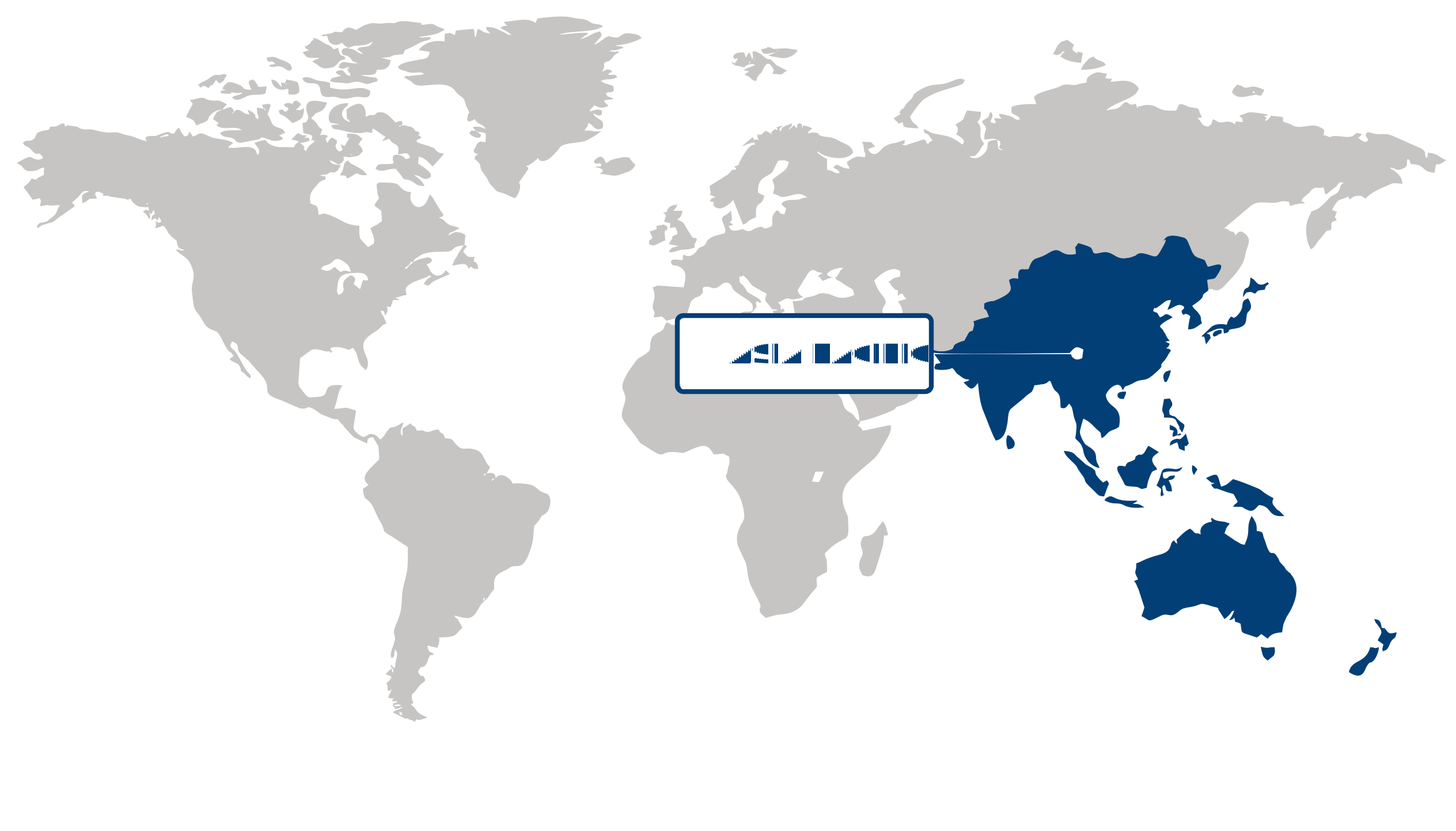
Asia Pacific (Largest Region)
Asia Pacific accounted for the largest share of the micro-mobility market at 49.08% in 2026, driven by dense urban populations, expanding public transportation networks, and growing demand for convenient solutions for short-distance travel. Electric scooters, bicycles, and other lightweight mobility options are increasingly being integrated into urban transportation systems as cities seek to address congestion, parking limitations, and last-mile connectivity challenges. Government support for cleaner transportation, investments in smart-city infrastructure, and increasing smartphone-based access to shared mobility services are also supporting regional adoption.
North America (Fastest-Growing Region)
North America is expected to register the fastest growth, supported by increasing demand for flexible urban transportation and greater acceptance of shared and electric mobility solutions. Growing emphasis on reducing traffic congestion and transportation-related emissions is encouraging municipalities and mobility operators to expand micro-mobility infrastructure. Improvements in dedicated cycling lanes, charging facilities, digital booking platforms, and fleet management technologies are enhancing user accessibility and operational efficiency, while changing consumer preferences toward convenient alternatives for short urban journeys are creating further growth opportunities.
| Parameter | North America | Asia Pacific | Europe | Latin America | MEA |
|---|---|---|---|---|---|
| Innovation Hub i Scale Nascent Developing Advanced | |||||
| Cost-Sensitive Region i Scale Low Medium High | |||||
| Regulatory Environment i Scale Restrictive Neutral Supportive | |||||
| Demand Drivers i Scale Weak Moderate Strong | |||||
| Development Stage i Scale Emerging Developing Developed | |||||
| Adoption Rate i Scale Low Medium High | |||||
| New Entrants / Startups i Scale Sparse Moderate Dense | |||||
| Macro Indicators i Scale Weak Stable Strong |
Key Country Insights
United States 🇺🇸
Urban Mobility ExpansionThe U.S. micro-mobility market continues evolving through shared mobility services and privately owned electric scooters and bicycles. Cities across the U.S. increasingly prioritize infrastructure improvements and fleet management technologies that enhance user safety and operational efficiency.
Germany 🇩🇪
Integrated Transport NetworksGermany advances micro-mobility by connecting shared bicycles and electric scooters with established public transportation systems. German mobility providers focus on seamless digital integration and durable vehicle fleets that improve urban transportation flexibility.
Japan 🇯🇵
Compact Urban MobilityJapan adopts micro-mobility solutions that complement dense urban transport networks and support convenient short-distance travel. Operators in Japan prioritize compact vehicle designs and reliable service models that align with highly organized city infrastructure.
South Korea 🇰🇷
Smart Mobility PlatformsSouth Korea integrates micro-mobility services with digital mobility ecosystems and smart city initiatives. Service providers in South Korea continue improving connected fleet management and user experience through advanced mobile platforms and data-driven operations.
France 🇫🇷
Shared Mobility AdoptionFrance promotes micro-mobility through expanding shared bicycle and electric scooter networks in major urban centers. French operators increasingly optimize fleet deployment and charging strategies to improve service availability and operational efficiency.
Italy 🇮🇹
Tourism and Urban MobilityItaly applies micro-mobility solutions across cities where daily commuting and tourism create demand for flexible transportation options. Municipalities and operators in Italy continue strengthening infrastructure and service coverage to encourage wider adoption of sustainable urban mobility.
Segment Leadership and Growth Trends
Micro-Mobility Market Share (%), by Propulsion, 2026
Go beyond the chart, access full insights & data tables
Request Free Sample ReportPropulsion Segment Analysis: Electric (Largest & Fastest-Growing Segment)
The micro-mobility market was led by the electric propulsion segment, which accounted for a 72% share in 2026 while also emerging as the fastest-growing propulsion category. Electric propulsion has gained widespread adoption because it provides convenient, energy-efficient, and low-emission transportation for short-distance travel in urban environments. Improvements in battery technology, charging infrastructure, and vehicle performance have enhanced user experience while supporting greater adoption across shared mobility services and privately owned vehicles. Increasing emphasis on sustainable transportation and urban congestion reduction continues to strengthen the growth outlook for electric-powered micro-mobility solutions.
Type Segment Analysis: Bicycles (Largest Segment) vs Kick-bike (Fastest-Growing Segment)
The bicycles segment held the largest share of the market in 2026 due to their broad consumer acceptance, versatility, and suitability for both personal commuting and recreational use. Bicycles benefit from well-established infrastructure, widespread availability, and increasing integration with electric propulsion technologies, making them a preferred option for environmentally conscious transportation. Their ability to support affordable and efficient urban mobility continues to reinforce the segment's leadership.
The micro-mobility market is witnessing the fastest growth in the kick-bike segment as consumers increasingly seek compact, lightweight, and convenient transportation solutions for short urban trips. Kick-bikes are gaining popularity because they are easy to maneuver, require minimal parking space, and integrate effectively with multimodal transportation networks. Expanding shared mobility services and increasing investment in urban mobility infrastructure are further supporting growth in this segment.
Business Model Segment Analysis: B2C (Largest Segment) vs B2B (Fastest-Growing Segment)
Holding the largest share of the micro-mobility market, the B2C segment dominated in 2026 as direct consumer ownership and personal use of bicycles, e-scooters, and other micro-mobility vehicles continued to expand. Rising interest in flexible commuting options, sustainable transportation, and cost-effective mobility solutions has encouraged widespread adoption among individual users. Consumer demand for convenient urban transportation remains a key factor supporting the segment's leading position.
The B2B segment represents the fastest-growing business model as organizations increasingly integrate micro-mobility solutions into corporate transportation, delivery services, tourism, and fleet operations. Businesses are adopting shared fleets and dedicated mobility services to improve operational efficiency while reducing transportation costs and environmental impact. The growing commercialization of fleet-based mobility solutions is expected to drive sustained expansion within this segment.
| Segment | Sub-Segment | Largest Segment | Fastest Growing |
|---|---|---|---|
| Propulsion | Pedal Assist, Electric | Electric | Electric |
| Type | Kick-bike, Skateboard, Hoverboard, Bicycles | Bicycles | Kick-bike |
| Business Model | B2B, B2C | B2C | B2B |
| Sharing | Docked, Dock-less | Dock-less | Dock-less |
| Age | 15-30, 31-50, Above 50 | 15-30 | 31-50 |
Competitive Landscape and Market Positioning
Leading companies in the micro-mobility market:
- Lime (United States)
- Bird Global, Inc. (United States)
- Tier Mobility SE (Germany)
- Voi Technology AB (Sweden)
- Segway-Ninebot (China)
- Xiaomi Corporation (China)
- Yamaha Motor Co., Ltd. (Japan)
- Dott B.V. (Netherlands)
- Bolt Technology OÜ (Estonia)
- Razor USA LLC (United States)
The micro-mobility market is evolving through competition centered on service reliability, technology integration, and the ability to adapt mobility solutions to changing urban transportation needs. Participants are increasingly differentiating through operational efficiency, digital platforms, vehicle design improvements, and flexible service models that enhance user convenience and accessibility. The market is also seeing greater emphasis on ecosystem development, as providers seek to strengthen their positions through integration with broader urban mobility networks rather than competing solely on individual vehicle offerings. As cities prioritize sustainable transportation alternatives, competitive advantage is increasingly linked to scalability, regulatory adaptability, and the ability to deliver seamless mobility experiences.
| Company | Market Share | Company Revenue | Revenue CAGR (%) | Product Portfolio | Geographic Presence | Innovation / R&D Focus | Strategic Developments |
|---|---|---|---|---|---|---|---|
| Lime (United States) | |||||||
| Bird Global Inc. (United States) | |||||||
| Tier Mobility SE (Germany) | |||||||
| Voi Technology AB (Sweden) | |||||||
| Segway-Ninebot (China) | |||||||
| Xiaomi Corporation (China) | |||||||
| Yamaha Motor Co. Ltd. (Japan) | |||||||
| Dott B.V. (Netherlands) | |||||||
| Bolt Technology OÜ (Estonia) | |||||||
| Razor USA LLC (United States) |
Industry Development/News
| Company Name | Date | Key Development |
|---|---|---|
| Moving Tech Innovations | Mar-26 | Moving Tech Innovations acquired Netherlands-based Automicle, marking its formal entry into the European micro-mobility sector. The strategic acquisition supports the international expansion of its zero-commission, open mobility platforms to scale regional operations. |
| CEiiA | Mar-26 | CEiiA partnered with Micro and AMFI to develop next-generation microcars and industrialize the BEN vehicle platform in Turin. The collaboration directly enhances regional manufacturing capabilities and technology adoption for urban micro-mobility architectures. |
| MVL | Jan-26 | MVL announced plans to invest USD 100 million to expand its TADA mobility platform in the United States. The international growth strategy includes a targeted launch in New York, establishing a significant foothold in the North American ride-hailing and micro-mobility sector. |
| Dott | Oct-25 | Dott secured USD 85 million in new funding to support its ongoing growth initiatives. The capital injection is strategically positioned to strengthen the company's competitive positioning and operational footprint as market rivalry intensifies across the European micro-mobility landscape. |
| EXELmoto | Oct-25 | EXELmoto partnered with Delhivery to enter the commercial B2B logistics segment. The initiative establishes a dedicated commercial division and deploys customized electric bikes to transform last-mile delivery networks and supply chain operations. |
| iGoWise Mobility | Oct-25 | iGoWise Mobility raised ₹8.2 crore in a funding round to accelerate the commercial launch of its smart electric trike platform. The capital supports production scaling and commercialization within the expanding Indian micro-mobility market. |
| ATOM Mobility | Jun-25 | ATOM Mobility completed the strategic acquisition of ScootAPI, expanding its core platform capabilities. The transaction deepens its technological infrastructure and ecosystem scalability within the global micro-mobility software market. |
| VisionEdgeOne | Apr-25 | VisionEdgeOne completed the acquisition of Inurba Mobility from Sherpa Capital and Moventia. This strategic transaction significantly consolidates the company's market access and competitive positioning within the European micro-mobility value chain. |
| Hyundai Motor Company | Jan-25 | Hyundai Motor Company entered into a strategic collaboration with TVS Motor Company to jointly engineer last-mile mobility solutions in India. The partnership leverages Hyundai's design capabilities and TVS's manufacturing footprint to scale electric three-wheeler production. |
| Zen Mobility | May-24 | Zen Mobility inaugurated a new manufacturing facility in Manesar dedicated to the production of Zen Micro Pods. The facility expansion substantially scales the company's domestic manufacturing capacity for specialized last-mile and short-haul logistics solutions. |
Customize Your Report
Explore examples of how this report can be tailored to different research needs, including custom segments, additional topics or chapters, and related reports. Click a section of the wheel or its numbered marker to explore the available options.
Micro-Mobility Market — Custom Segments
| Segment | Sub-Segment |
|---|---|
| Usage Purpose | Personal Transportation, Commuting, Last-Mile Connectivity, Recreational Use, Commercial Delivery |
| Charging Infrastructure | Home Charging, Public Charging Stations, Battery-Swapping Stations, Workplace/Commercial Charging |
| Purchase Price Range | Economy, Mid-Range, Premium |
Micro-Mobility Market — Custom TOC
| Custom Chapter | Custom Details |
|---|---|
| Urban Mobility Adoption Benchmarking |
|
| Shared Mobility Business Model Assessment |
|
| Charging and Parking Infrastructure Readiness |
|
Need a different cut of the data?
Request Custom ResearchHow big is the micro-mobility market?
What is the expected industry size of micro-mobility by 2036?
What factors are accelerating adoption of micro-mobility services in urban transportation?
How are investments and smart city initiatives expanding the micro-mobility market?
Why does electric propulsion dominate the micro-mobility market?
How is the B2B segment expanding the micro-mobility market?
Why does Asia Pacific lead the micro-mobility market?
How is North America creating growth opportunities in micro-mobility?
Who are the major participants shaping the micro-mobility landscape?
Our Clients
"The team surpassed our expectations with the report depth. The actionable insights provided proved crucial in navigating market challenges."
Tata Motors
"We found the report to be very informative. The expertise and attention to market nuances significantly influenced our business direction."
DENSO Corporation
"The consumer survey findings were quite good. We now have a clearer picture of the customer churning and retention strategy."
HL Mando
Our Research Team & Methodology
Every Fundamental Business Insights report is built by a dedicated vertical research team, validated through a structured primary-and-secondary methodology, and reviewed for accuracy before it reaches you.
Research Team Overview
Prepared by the Automotive & Transportation Research Team
Delivery
Published
Demand
Available
Support
Trust & Compliance
Research Domains
10 coverage areasResearch Intelligence
| Source | Reference |
|---|---|
| International Organization of Motor Vehicle Manufacturers (OICA) | www.oica.net |
| SAE International | www.sae.org |
| International Energy Agency (IEA) | www.iea.org |
| International Transport Forum (ITF) | www.itf-oecd.org |
| International Road Federation (IRF) | www.irf.global |
| International Organization for Standardization (ISO) | www.iso.org |
| United Nations Economic Commission for Europe (UNECE) | unece.org |
| National Highway Traffic Safety Administration (NHTSA) | www.nhtsa.gov |
| U.S. Department of Transportation (USDOT) | www.transportation.gov |
| European Automobile Manufacturers' Association (ACEA) | www.acea.auto |
| Society of Indian Automobile Manufacturers (SIAM) | www.siam.in |
| International Air Transport Association (IATA) | www.iata.org |
| International Civil Aviation Organization (ICAO) | www.icao.int |
| International Maritime Organization (IMO) | www.imo.org |
| International Union of Railways (UIC) | uic.org |
| American Public Transportation Association (APTA) | www.apta.com |
| International Federation of Robotics (IFR) | ifr.org |
| CharIN | www.charin.global |
| World Shipping Council | www.worldshipping.org |
| International Federation of Freight Forwarders Associations (FIATA) | fiata.org |
Research Workflow & Quality Assurance
Data Collection
Verified information gathered through primary and secondary research.
Data Triangulation
Cross-validation using multiple independent data sources.
Forecast Modelling
Market estimates developed using historical trends and analytical models.
Analyst Validation
Findings reviewed by domain experts for accuracy and consistency.
Editorial & Quality Review
Final editorial, quality, and compliance checks before publication.
Final Publication
Released after successful completion of the internal review process.
Report Coverage
📊 Market Assessment
- Market Size & Forecast
- Market Segmentation
- Regional Analysis
- Growth Drivers & Challenges
- Market Dynamics
🏢 Competitive Intelligence
- Competitive Landscape
- Company Profiles
- Competitive Benchmarking
- Mergers & Acquisitions
- Market Share Analysis or Key Company Strategies
🔍 Strategic Analysis
- Value Chain Analysis
- Porter's Five Forces
- PESTLE Analysis
- Pricing Trends
- Supply-Demand Analysis
🚀 Future Outlook
- Technology Landscape
- Regulatory Landscape
- Investment & Funding Landscape
- Emerging Opportunities
- Future Market Outlook
Have a question about this report or need a custom scope?
Request Customization