Lithium-ion Battery Binders Market Size & Growth Forecast 2027–2036, By Segments (Type, Material, Application), Regional Demand Trends (North America, Asia Pacific, Europe), Key Country Insights (U.S., Japan, South Korea, Germany, France, Italy), and Competitive Landscape
Market Size and Growth Outlook
Lithium-ion Battery Binders Market size was valued at USD 3.17 billion in 2026 and is anticipated to grow at a 18.62% CAGR from 2027 to 2036, attaining USD 17.48 billion by 2036. The industry revenue for 2027 is estimated at USD 3.67 billion.
Get more details on this report
Request Free Sample ReportLithium-ion Battery Binders Market Intelligence Snapshot
Regional Market Dynamics
- Asia Pacific led the market in 2026 due to its concentrated battery manufacturing base, integrated EV and energy storage supply chains, and sustained demand from high-volume cell production.
- North America is projected to grow at a 20.27% CAGR, driven by domestic battery manufacturing expansion, localized supply chains, and rising investment in battery materials and electrode production.
Segment Momentum
- Cathode binders held the largest market share in 2026 because they are essential for electrode integrity, coating stability, reliable slurry processing, and long-cycle battery performance in commercial-scale manufacturing.
- Styrene Butadiene Copolymer is growing fastest as manufacturers optimize anode designs, seeking improved processing efficiency, stronger electrode resilience, and better support for evolving battery performance requirements.
Market Expansion Drivers
- Expanding electric vehicle production increasing demand for high-performance lithium-ion battery binders.
- Renewable energy storage expansion driving adoption of durable and efficient binder materials.
- Increasing investment in eco-friendly battery chemistries accelerating development of sustainable binder technologies.
Leading Market Participants
- Major players in the lithium-ion battery binders market include Arkema S.A. (France), BASF SE (Germany), LG Chem Ltd. (South Korea), Solvay S.A. (Belgium), DuPont de Nemours, Inc. (United States), Kureha Corporation (Japan), Zeon Corporation (Japan), Daikin Industries, Ltd. (Japan), Toray Industries, Inc. (Japan), Resonac Holdings Corporation (Japan).
Global Market Forecast Snapshot
Market Outlook
- 2026 Market Size: USD 3.17 billion
- 2027 Estimated Market Size: USD 3.67 billion.
- Projected Market Size: USD 17.48 billion by 2036
- Growth Forecast: 18.62% CAGR (2027-2036)
Regional and Segment Outlook
- Leading Regional Market: Asia Pacific
- High-Growth Regional Hub: North America
- Core Revenue Segment: Cathode (Type) | Polyvinylidene Fluoride (Material) | Automotive (Application)
- Emerging Opportunity Segment: Anode (Type) | Styrene Butadiene Copolymer (Material) | Energy Storage (Application)
Market Growth Drivers and Industry Trends
Expanding electric vehicle production increasing demand for high-performance lithium-ion battery binders
The continued expansion of electric vehicle production will drive the lithium-ion battery binders market growth as manufacturers require battery components capable of supporting reliable electrode performance, structural integrity, and long-term cycling stability. Binders play an important role in maintaining adhesion between active materials and current collectors while helping electrodes withstand repeated charging and discharging. As vehicle manufacturers and battery producers pursue higher energy density, improved durability, and efficient production processes, demand is increasing for binder materials that can accommodate evolving electrode formulations and demanding operating conditions.
Renewable energy storage expansion driving adoption of durable and efficient binder materials
The growing deployment of renewable power generation is increasing the need for energy storage systems that can efficiently manage intermittent electricity supply, thereby supporting the lithium-ion battery binders market growth. Stationary storage applications require batteries capable of repeated cycling while maintaining electrode stability over extended operating periods, placing greater emphasis on material durability and processing performance. Binder technologies that provide strong particle adhesion, mechanical resilience, and compatibility with different electrode materials can help battery manufacturers develop storage systems suited to demanding grid and renewable energy applications.
Increasing investment in eco-friendly battery chemistries accelerating development of sustainable binder technologies
Investment in more environmentally responsible battery technologies is encouraging material innovation, with sustainable approaches increasingly influencing the lithium-ion battery binders market growth. Battery manufacturers and material developers are exploring binder solutions that can reduce environmental impacts associated with production, processing, and end-of-life management while maintaining the functional properties required for efficient electrode fabrication. This shift is supporting research into lower-impact materials, improved processing methods, and binder chemistries that can provide suitable adhesion and mechanical stability without compromising battery performance.
| Growth Driver | Impact on CAGR | Regulatory Influence | Geographic Relevance | Adoption Rate | Impact Timeline |
|---|---|---|---|---|---|
| Expanding electric vehicle production increasing demand for high-performance lithium-ion battery binders | 2.00% | High | Asia Pacific, Europe, North America | High | Near Term |
| Renewable energy storage expansion driving adoption of durable and efficient binder materials | 1.80% | Moderate | Asia Pacific, North America | High | Mid Term |
| Increasing investment in eco-friendly battery chemistries accelerating development of sustainable binder technologies | 1.50% | High | Europe, Asia Pacific | Medium | Long Term |
Unlock insights tailored to your business with our bespoke market research solutions.
Click to get your customized report now.
Regional Demand Dynamics
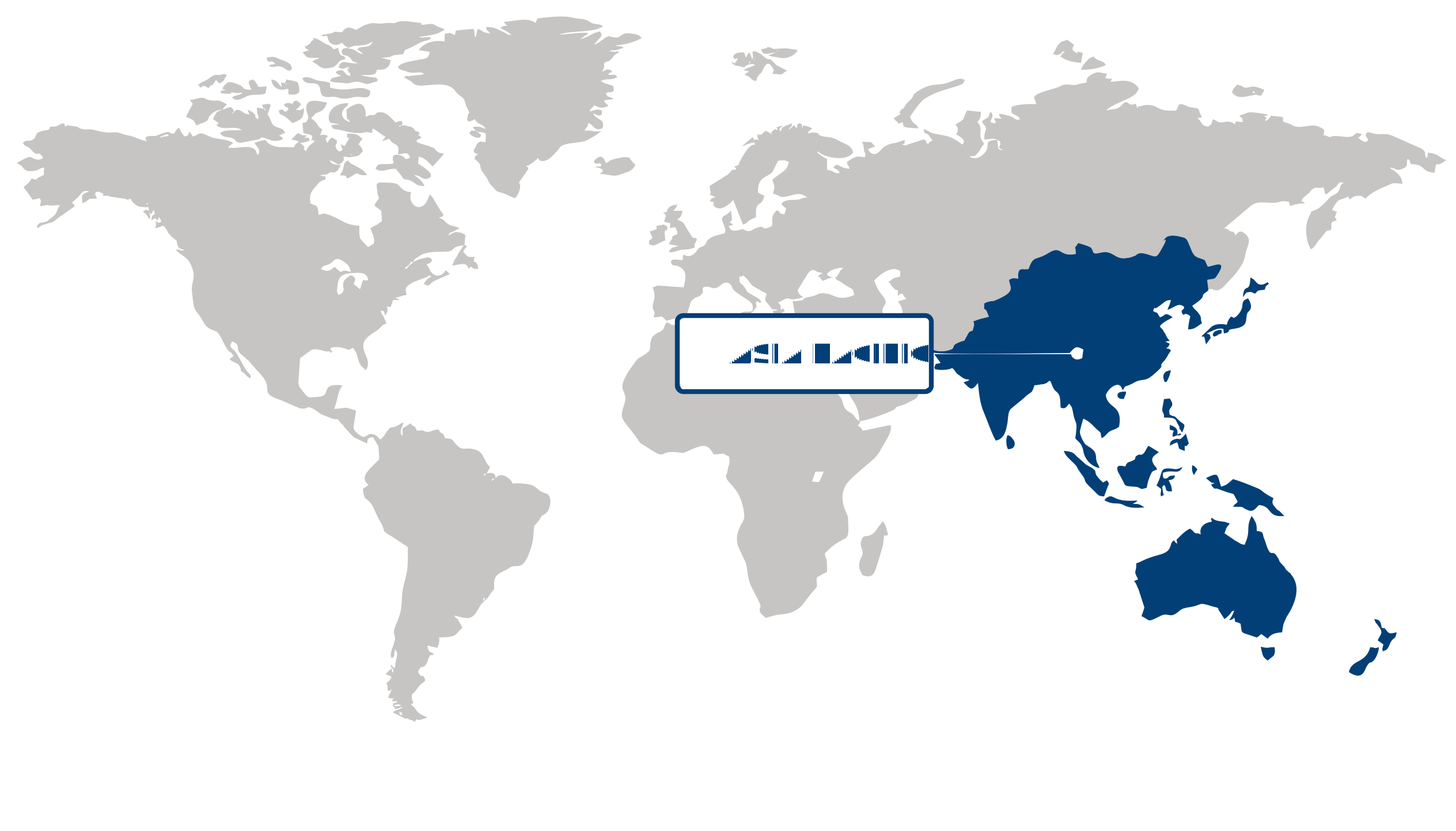
Asia Pacific (Largest Region)
The Asia Pacific lithium-ion battery binders market accounted for the largest share in 2026, supported by the region's extensive battery manufacturing ecosystem and strong demand for energy storage technologies. Concentrated production of batteries and their associated components creates a favorable environment for binder suppliers, while continued expansion of electric mobility and renewable energy storage increases demand for high-performance electrode materials. Ongoing improvements in battery manufacturing processes and increasing emphasis on energy density, durability, and safety are also supporting the adoption of advanced binder formulations.
North America (Fastest-Growing Region)
North America is emerging as the fastest-growing region as investments in domestic battery manufacturing and energy storage infrastructure strengthen demand for specialized battery materials. The expansion of electric vehicle supply chains and growing deployment of grid-scale energy storage are encouraging local sourcing and technological development across the battery ecosystem. Greater emphasis on battery performance, manufacturing resilience, and advanced material technologies is further creating opportunities for lithium-ion battery binders in the region.
| Parameter | North America | Asia Pacific | Europe | Latin America | MEA |
|---|---|---|---|---|---|
| Innovation Hub i Scale Nascent Developing Advanced | |||||
| Cost-Sensitive Region i Scale Low Medium High | |||||
| Regulatory Environment i Scale Restrictive Neutral Supportive | |||||
| Demand Drivers i Scale Weak Moderate Strong | |||||
| Development Stage i Scale Emerging Developing Developed | |||||
| Adoption Rate i Scale Low Medium High | |||||
| New Entrants / Startups i Scale Sparse Moderate Dense | |||||
| Macro Indicators i Scale Weak Stable Strong |
Key Country Insights
Germany 🇩🇪
Cell Manufacturing IntegrationGermany emphasizes battery binders that align with expanding domestic cell manufacturing and automotive electrification. Material suppliers focus on process consistency, sustainability, and compatibility with next-generation electrode production technologies.
France 🇫🇷
Sustainable Battery MaterialsFrance encourages lithium-ion battery binder solutions that complement regional battery manufacturing and sustainability objectives. Companies increasingly evaluate water-based and environmentally responsible binder formulations for future production requirements.
Italy 🇮🇹
Specialty Component SupplyItaly supports the lithium-ion battery binders market through specialized material development for industrial and mobility applications. Domestic suppliers focus on reliable binder performance that meets evolving battery manufacturing and quality expectations.
Japan 🇯🇵
Precision Material DevelopmentJapan focuses on developing high-purity lithium-ion battery binders that enhance electrode stability and long-term performance. Manufacturers invest in specialized polymer technologies to support premium battery applications across automotive and electronics sectors.
South Korea 🇰🇷
High-Volume Production SupportSouth Korea advances binder technologies that enable efficient large-scale battery manufacturing while maintaining product quality. Local producers emphasize formulations that improve electrode adhesion and streamline high-throughput production lines.
United States 🇺🇸
Advanced Materials InnovationThe U.S. prioritizes high-performance lithium-ion battery binders that improve energy density, cycle life, and manufacturing efficiency. Collaboration between battery developers and material suppliers supports the adoption of advanced binder chemistries for electric vehicles and energy storage applications.
Segment Leadership and Growth Trends
Lithium-ion Battery Binders Market Share (%), by Type, 2026
Go beyond the chart, access full insights & data tables
Request Free Sample ReportType Segment Analysis: Cathode (Largest Segment) vs Anode (Fastest-Growing Segment)
Cathode applications accounted for the largest share of the lithium-ion battery binders market in 2026, reflecting the critical role of binders in maintaining electrode integrity and supporting stable battery manufacturing. Binders help hold active materials together and maintain adhesion within the cathode structure, contributing to mechanical stability and consistent electrode performance. Growing demand for lithium-ion batteries across electric mobility, energy storage, and portable electronics continues to support substantial binder requirements for cathode production.
The anode segment is expanding at the fastest pace as battery manufacturers increasingly optimize anode materials and electrode structures to improve energy density, durability, and charging performance. The development of advanced anode chemistries and evolving electrode formulations is creating greater demand for binder systems capable of maintaining structural integrity under demanding cycling conditions. Continued innovation in battery materials is therefore broadening opportunities for specialized binders in anode applications.
Material Segment Analysis: Polyvinylidene Fluoride (Largest Segment) vs Styrene Butadiene Copolymer (Fastest-Growing Segment)
Polyvinylidene fluoride held the largest share of the lithium-ion battery binders market in 2026, supported by its strong adhesion, chemical stability, and compatibility with demanding battery electrode environments. These characteristics make the material particularly valuable for maintaining electrode cohesion and supporting reliable battery manufacturing. Its established use in lithium-ion battery production and compatibility with cathode formulations continue to reinforce its leading position.
Styrene butadiene copolymer is the fastest-growing material segment as battery manufacturers increasingly seek binder solutions suited to evolving anode technologies and water-based electrode processing. Its flexibility and adhesion characteristics can support electrode integrity while enabling formulation approaches that differ from conventional solvent-based systems. Growing attention to manufacturing efficiency, material sustainability, and advanced battery chemistries is encouraging wider adoption of styrene butadiene copolymer binders.
| Segment | Sub-Segment | Largest Segment | Fastest Growing |
|---|---|---|---|
| Type | Cathode, Anode | Cathode | Anode |
| Material | Polyvinylidene Fluoride, Carboxymethyl Cellulose, Polymethyl Methacrylate, Styrene Butadiene Copolymer, Others | Polyvinylidene Fluoride | Styrene Butadiene Copolymer |
| Application | Energy Storage, Automotive, Consumer Electronics, Industrial, Others | Automotive | Energy Storage |
Competitive Landscape and Market Positioning
Prominent players in the lithium-ion battery binders market:
1. Arkema S.A. (France)
2. BASF SE (Germany)
3. LG Chem Ltd. (South Korea)
4. Solvay S.A. (Belgium)
5. DuPont de Nemours Inc. (United States)
6. Kureha Corporation (Japan)
7. Zeon Corporation (Japan)
8. Daikin Industries Ltd. (Japan)
9. Toray Industries Inc. (Japan)
10. Resonac Holdings Corporation (Japan)
Energy storage advancement is shaping the lithium-ion battery binders market, where performance stability is a key requirement. The lithium-ion battery binders market is evolving through improved material formulations that enhance cycle life and efficiency. Expanding electric mobility applications are driving innovation demand. Continuous development is strengthening battery performance reliability.
| Company | Market Share | Company Revenue | Revenue CAGR (%) | Product Portfolio | Geographic Presence | Innovation / R&D Focus | Strategic Developments |
|---|---|---|---|---|---|---|---|
| Arkema S.A. (France) | |||||||
| BASF SE (Germany) | |||||||
| LG Chem Ltd. (South Korea) | |||||||
| Solvay S.A. (Belgium) | |||||||
| DuPont de Nemours Inc. (United States) | |||||||
| Kureha Corporation (Japan) | |||||||
| Zeon Corporation (Japan) | |||||||
| Daikin Industries Ltd. (Japan) | |||||||
| Toray Industries Inc. (Japan) | |||||||
| Resonac Holdings Corporation (Japan). |
Industry Development/News
| Company Name | Date | Key Development |
|---|---|---|
| Arkema | May-24 | Arkema entered a strategic partnership with ProLogium to develop advanced specialty materials for lithium-ion batteries, targeting improvements in safety, performance, and lifespan. The collaboration is particularly focused on applications in electric vehicles and energy storage systems, strengthening Arkema’s positioning within high-performance battery materials and binder-related innovation ecosystems. |
| AM Batteries | Apr-24 | AM Batteries and Zeon Corporation formed a partnership to develop dry battery electrode technologies using advanced binder systems. The initiative targets improved energy density and reduced environmental impact in lithium-ion batteries, supporting next-generation electrode manufacturing approaches designed to enhance performance efficiency and accelerate adoption in electric vehicle and energy storage applications. |
| BASF SE | May-23 | BASF SE announced investment in new production assets for anode binders used in lithium-ion batteries. The investment expands manufacturing capacity for high-performance binder materials aimed at improving battery efficiency, durability, and cycle life, reinforcing BASF’s strategic focus on scaling advanced materials production for growing electric mobility and energy storage demand. |
| Fujian Blue Ocean & Black Stone Technology Co., Ltd. | Dec-22 | Fujian Blue Ocean & Black Stone Technology Co., Ltd. launched the BATTBOND binder product range for international markets, including cathode and anode binder solutions. The initiative supports expanded commercial reach beyond China and strengthens the company’s positioning in the global lithium-ion battery materials supply chain through diversified binder offerings. |
| BASF SE | Jun-22 | BASF SE expanded its Licity anode binder portfolio for lithium-ion battery manufacturing, introducing upgraded styrene-butadiene rubber formulations. The enhanced binders are designed to improve battery capacity, extend charge-discharge cycle life, and reduce charging time, reflecting incremental but commercially relevant improvements in binder-driven battery performance optimization. |
| Arkema | Jun-21 | Arkema introduced renewable PVDF-based Kynar CTO binder grades for lithium-ion battery applications, manufactured initially at its Pierre-Bénite facility in France. The development supports increased sustainability in battery materials while maintaining performance requirements for electrode binding applications in energy storage and electric mobility systems. |
Customize Your Report
Explore examples of how this report can be tailored to different research needs, including custom segments, additional topics or chapters, and related reports. Click a section of the wheel or its numbered marker to explore the available options.
Lithium-ion Battery Binders Market — Custom Segments
| Segment | Sub-Segment |
|---|---|
| Battery Chemistry | Lithium Nickel Manganese Cobalt Oxide (NMC), Lithium Iron Phosphate (LFP), Lithium Cobalt Oxide (LCO), Lithium Nickel Cobalt Aluminum Oxide (NCA), Other Chemistries |
| Electrode Manufacturing Process | Solvent-Based Processing, Water-Based Processing, Dry Electrode Processing |
| Battery Cell Format | Cylindrical, Prismatic, Pouch |
Lithium-ion Battery Binders Market — Custom TOC
| Custom Chapter | Custom Details |
|---|---|
| Next-Generation Binder Technology Roadmap |
|
| Electric Vehicle Supply Chain Opportunities |
|
| Battery Recycling and Circular Economy Outlook |
|
Need a different cut of the data?
Request Custom ResearchWhat is the market valuation of lithium-ion battery binders?
How much is the lithium-ion battery binders industry expected to grow by 2036?
How is expanding electric vehicle production reshaping performance expectations for lithium-ion battery binders?
How is the shift toward sustainable battery chemistries influencing binder technology development?
Why do cathode binders lead the lithium-ion battery binders market?
Why is Styrene Butadiene Copolymer the fastest-growing material in the lithium-ion battery binders market?
Why does Asia Pacific lead the lithium-ion battery binders market?
Why is North America the fastest-growing region in the lithium-ion battery binders market?
Which companies dominate the lithium-ion battery binders landscape?
Our Clients
"The information presented in the report was genuinely insightful. The data was clear and easy to understand, which made it much easier to interpret the findings."
Amara Raja Group
"The responsiveness and professionalism exhibited by the team were exemplary. They were readily available to address queries, provide clarifications, and offer additional insights."
ONGC
"The reports offered a comprehensive analysis of various segments within the market. The detailed insights into market trends, and regulatory landscapes were excellent."
TotalEnergies
Our Research Team & Methodology
Every Fundamental Business Insights report is built by a dedicated vertical research team, validated through a structured primary-and-secondary methodology, and reviewed for accuracy before it reaches you.
Research Team Overview
Prepared by the Energy & Power Research Team
Delivery
Published
Demand
Available
Support
Trust & Compliance
Research Domains
10 coverage areasResearch Intelligence
| Source | Reference |
|---|---|
| International Energy Agency (IEA) | www.iea.org |
| U.S. Energy Information Administration (EIA) | www.eia.gov |
| International Renewable Energy Agency (IRENA) | www.irena.org |
| International Electrotechnical Commission (IEC) | www.iec.ch |
| International Organization for Standardization (ISO) | www.iso.org |
| IEEE | www.ieee.org |
| CIGRE (International Council on Large Electric Systems) | www.cigre.org |
| World Energy Council (WEC) | www.worldenergy.org |
| U.S. Department of Energy (DOE) | www.energy.gov |
| International Atomic Energy Agency (IAEA) | www.iaea.org |
| American Petroleum Institute (API) | www.api.org |
| Society of Petroleum Engineers (SPE) | www.spe.org |
| Hydrogen Council | hydrogencouncil.com |
| Battery Council International (BCI) | batterycouncil.org |
| Global Wind Energy Council (GWEC) | gwec.net |
| SolarPower Europe | www.solarpowereurope.org |
| World Bioenergy Association (WBA) | worldbioenergy.org |
| International Hydropower Association (IHA) | www.hydropower.org |
| Edison Electric Institute (EEI) | www.eei.org |
| National Renewable Energy Laboratory (NREL) | www.nrel.gov |
Research Workflow & Quality Assurance
Data Collection
Verified information gathered through primary and secondary research.
Data Triangulation
Cross-validation using multiple independent data sources.
Forecast Modelling
Market estimates developed using historical trends and analytical models.
Analyst Validation
Findings reviewed by domain experts for accuracy and consistency.
Editorial & Quality Review
Final editorial, quality, and compliance checks before publication.
Final Publication
Released after successful completion of the internal review process.
Report Coverage
📊 Market Assessment
- Market Size & Forecast
- Market Segmentation
- Regional Analysis
- Growth Drivers & Challenges
- Market Dynamics
🏢 Competitive Intelligence
- Competitive Landscape
- Company Profiles
- Competitive Benchmarking
- Mergers & Acquisitions
- Market Share Analysis or Key Company Strategies
🔍 Strategic Analysis
- Value Chain Analysis
- Porter's Five Forces
- PESTLE Analysis
- Pricing Trends
- Supply-Demand Analysis
🚀 Future Outlook
- Technology Landscape
- Regulatory Landscape
- Investment & Funding Landscape
- Emerging Opportunities
- Future Market Outlook
Have a question about this report or need a custom scope?
Request Customization