Food & Grocery Retail Market Size & Growth Forecast 2027–2036, By Segments (Distribution Channel, Product), Regional Demand Trends (North America, Asia Pacific, Europe), Key Country Insights (U.S., Japan, South Korea, Germany, France, Italy), and Competitive Landscape
Market Size and Growth Outlook
Food & Grocery Retail Market size stood at USD 12.95 trillion in 2026 and is predicted to grow at a 3.04% CAGR from 2027 to 2036, exceeding USD 17.47 trillion by 2036. The industry revenue for 2027 is assessed at USD 13.28 trillion.
Get more details on this report
Request Free Sample ReportFood & Grocery Retail Market Intelligence Snapshot
Regional Market Dynamics
- Asia Pacific leads with 38.80% share due to its large consumer base, dense urban populations, high-frequency grocery demand, and strong mix of traditional and modern retail channels.
- Europe is growing at 3.76% CAGR due to e-commerce integration, convenience-led shopping trends, and retailer focus on improving delivery efficiency and private-label expansion.
Segment Momentum
- Supermarkets and hypermarkets lead because they offer broad product assortments, immediate availability, and convenient one-stop shopping for routine grocery purchases, supporting consistent consumer demand.
- Beverages are the fastest-growing product segment due to rising demand across everyday consumption, convenience purchases, and impulse buying, making them well suited to evolving retail shopping patterns.
Market Expansion Drivers
- Omnichannel grocery retail digitalization integrating e-commerce with physical store delivery ecosystems.
- Pandemic-driven home cooking surge and stockpiling accelerating online grocery demand and supply chain restructuring.
- Rapid expansion of quick commerce platforms enabling ultra-fast grocery delivery in urban markets.
Leading Market Participants
- Leading players in the food & grocery retail market include Walmart Inc. (United States), Amazon.com, Inc. (United States), Costco Wholesale Corporation (United States), The Kroger Co. (United States), Schwarz Gruppe (Germany), Aldi Einkauf SE & Co. oHG (Germany), Carrefour S.A. (France), 7-Eleven, Inc. (United States), AEON Co., Ltd. (Japan), Target Corporation (United States).
Global Market Forecast Snapshot
Market Outlook
- 2026 Market Size: USD 12.95 trillion
- 2027 Estimated Market Size: USD 13.28 trillion.
- Projected Market Size: USD 17.47 trillion by 2036
- Growth Forecast: 3.04% CAGR (2027-2036)
Regional and Segment Outlook
- Leading Regional Market: Asia Pacific
- High-Growth Regional Hub: Europe
- Core Revenue Segment: Supermarkets & Hypermarkets (Distribution Channel) | Fresh Food (Product)
- Emerging Opportunity Segment: Online (Distribution Channel) | Beverages (Product)
Market Growth Drivers and Industry Trends
Omnichannel grocery retail digitalization integrating e-commerce with physical store delivery ecosystems
Digital transformation across grocery retail is strengthening the food & grocery retail market by connecting online ordering channels with physical stores, fulfillment operations, and last-mile delivery networks. Retailers are increasingly integrating digital storefronts with existing store infrastructure so consumers can browse products, place orders, select delivery or collection options, and receive more consistent service across channels. This model allows physical stores to function as fulfillment points while digital systems support inventory visibility, order processing, customer engagement, and delivery coordination. Greater integration between e-commerce and traditional retail operations is also enabling retailers to respond more effectively to changing shopping preferences without relying exclusively on a single sales channel.
Pandemic-driven home cooking surge and stockpiling accelerating online grocery demand and supply chain restructuring
Changes in household purchasing behavior following the pandemic period have supported stronger online grocery adoption, contributing to the development of the food & grocery retail market through increased digital ordering and evolving fulfillment requirements. Greater reliance on home cooking and household stockpiling encouraged consumers to purchase a wider range of groceries through online channels, including everyday staples and packaged food products. Retailers and suppliers have consequently had to strengthen inventory planning, warehousing, order fulfillment, and delivery capabilities to accommodate changing demand patterns. The resulting restructuring of grocery supply chains has encouraged greater use of digital systems for coordinating product availability, replenishment, and customer orders.
Rapid expansion of quick commerce platforms enabling ultra-fast grocery delivery in urban markets
The rapid growth of quick commerce services is reshaping consumer expectations for convenience and delivery speed, creating additional demand within the food & grocery retail market in densely populated urban areas. These platforms rely on localized fulfillment networks, strategically positioned inventory, digital ordering systems, and coordinated last-mile operations to deliver groceries within short timeframes. Consumers seeking immediate access to household essentials are increasingly attracted to the convenience of ordering smaller and more frequent baskets rather than relying solely on periodic supermarket trips. The expansion of compact fulfillment facilities and technology-enabled delivery operations is also changing how retailers manage urban inventory and serve time-sensitive grocery purchases.
| Growth Driver | Impact on CAGR | Regulatory Influence | Geographic Relevance | Adoption Rate | Impact Timeline |
|---|---|---|---|---|---|
| Omnichannel grocery retail digitalization integrating e-commerce with physical store delivery ecosystems | 2.00% | Moderate | North America, Europe, Asia Pacific | High | Near Term |
| Pandemic-driven home cooking surge and stockpiling accelerating online grocery demand and supply chain restructuring | 1.50% | Moderate | North America, Europe, Asia Pacific | High | Mid Term |
| Rapid expansion of quick commerce platforms enabling ultra-fast grocery delivery in urban markets | 1.00% | Moderate | Asia Pacific, Middle East & Africa | High | Near Term |
Unlock insights tailored to your business with our bespoke market research solutions.
Click to get your customized report now.
Regional Demand Dynamics
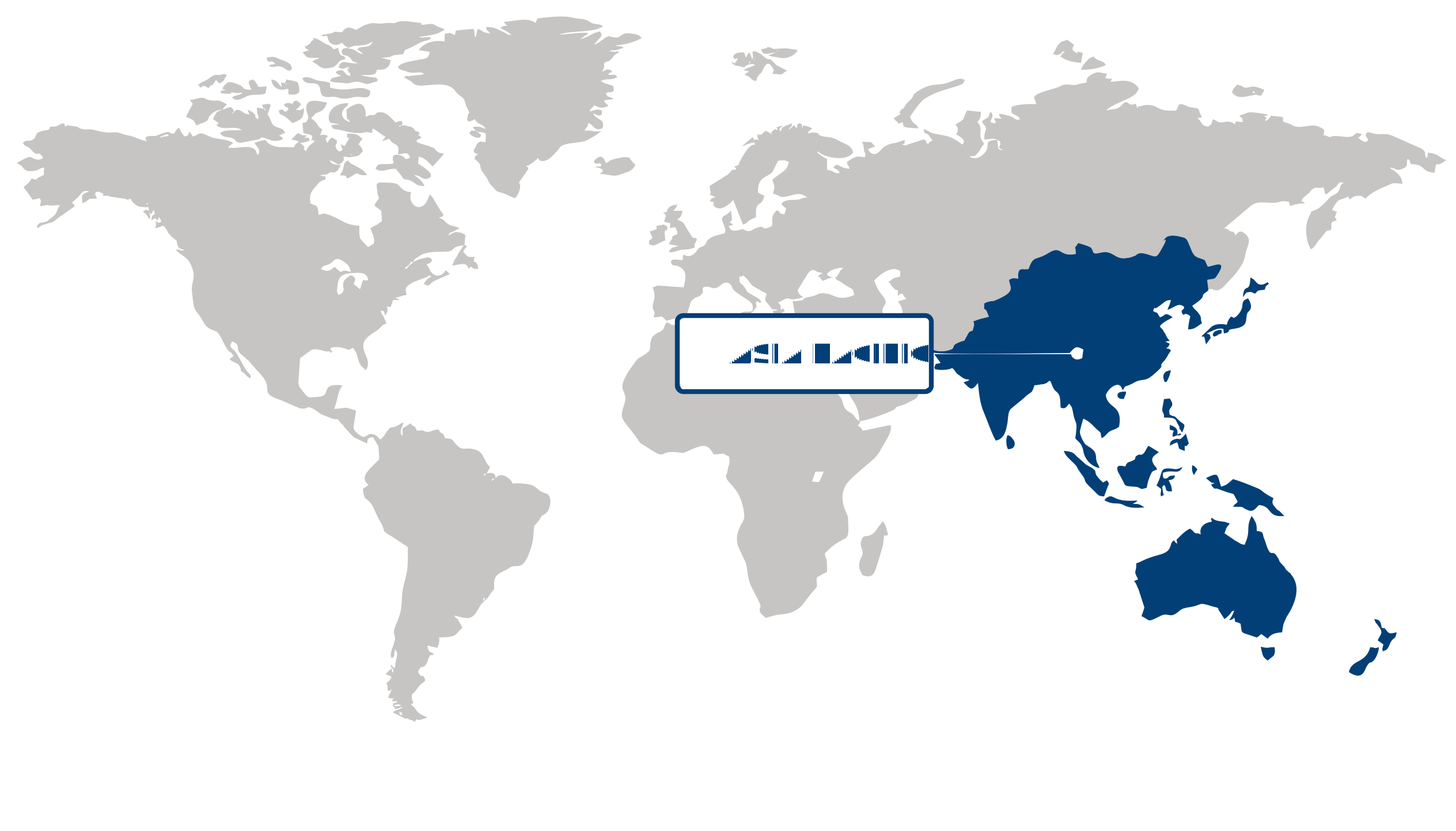
Asia Pacific (Largest Region)
Asia Pacific held the largest share of the food & grocery retail market at 38.80% in 2026, driven by its large consumer base, expanding urban population, and diverse demand for packaged, fresh, and convenience-oriented food products. Rapid urbanization is reshaping shopping habits, with consumers increasingly seeking accessible retail formats and convenient purchasing options. The expansion of organized retail and digital commerce is also improving product availability and enabling retailers to serve consumers through integrated online and offline channels. Rising household consumption, evolving dietary preferences, and growing demand for premium and convenience products are further supporting the region’s substantial market position.
Europe (Fastest-Growing Region)
Europe is positioned as the fastest-growing region, supported by changing consumer expectations around product quality, sustainability, convenience, and transparency. Retailers are adapting their offerings and operating models to address greater interest in healthier food choices, locally sourced products, environmentally responsible packaging, and efficient shopping experiences. The continued development of online grocery and omnichannel retail is creating additional avenues for market expansion, while established cold-chain and distribution infrastructure supports broader product availability. Regulatory attention to food quality, packaging sustainability, and supply-chain standards is also encouraging retailers to modernize operations and differentiate their product portfolios.
| Parameter | North America | Asia Pacific | Europe | Latin America | MEA |
|---|---|---|---|---|---|
| Innovation Hub i Scale Nascent Developing Advanced | |||||
| Cost-Sensitive Region i Scale Low Medium High | |||||
| Regulatory Environment i Scale Restrictive Neutral Supportive | |||||
| Demand Drivers i Scale Weak Moderate Strong | |||||
| Development Stage i Scale Emerging Developing Developed | |||||
| Adoption Rate i Scale Low Medium High | |||||
| New Entrants / Startups i Scale Sparse Moderate Dense | |||||
| Macro Indicators i Scale Weak Stable Strong |
Key Country Insights
Germany 🇩🇪
Value-Oriented Retail MixGermany emphasizes efficient retail operations while balancing price competitiveness with growing consumer demand for sustainable and private-label products. Grocery retailers continue enhancing digital shopping capabilities alongside established store networks.
France 🇫🇷
Fresh Food EmphasisFrance maintains strong demand for high-quality fresh produce and locally sourced food within modern grocery retail formats. Retailers are expanding omnichannel services while reinforcing sustainability initiatives and transparent product sourcing.
Italy 🇮🇹
Regional Product DifferentiationItaly's food & grocery retail market continues emphasizing regional food specialties and fresh product offerings alongside expanding digital retail channels. Retailers are enhancing supply chain efficiency while responding to consumer preferences for authentic and locally sourced products.
Japan 🇯🇵
Convenience-Led RetailingJapan relies on highly efficient convenience stores and supermarkets that respond to changing household preferences with fresh, ready-to-eat, and smaller-portion offerings. Retailers continue investing in digital services and logistics to strengthen customer experience.
South Korea 🇰🇷
Digital Commerce IntegrationSouth Korea combines advanced e-commerce capabilities with modern grocery retail formats to meet expectations for speed and convenience. Retailers continue expanding rapid delivery, mobile shopping, and data-driven merchandising to strengthen consumer engagement.
United States 🇺🇸
Omnichannel Grocery ExpansionThe U.S. food & grocery retail market continues integrating physical stores with digital ordering, home delivery, and pickup services. Retailers are investing in automation, personalized promotions, and supply chain optimization to improve customer convenience and operational efficiency.
Segment Leadership and Growth Trends
Food & Grocery Retail Market Share (%), by Distribution Channel, 2026
Go beyond the chart, access full insights & data tables
Request Free Sample ReportDistribution Channel Segment Analysis: Supermarkets & Hypermarkets (Largest Segment) vs Online (Fastest-Growing Segment)
The supermarkets & hypermarkets segment held the largest share of the food & grocery retail market in 2026, supported by their ability to provide consumers with broad product assortments, convenient one-stop shopping, and immediate access to fresh, packaged, and household grocery products. These formats benefit from established consumer purchasing habits and their capacity to combine food and everyday essentials within a single retail environment. Their physical presence also allows shoppers to evaluate products directly, particularly fresh and perishable items where quality, appearance, and freshness influence purchasing decisions. Supermarkets and hypermarkets continue to strengthen their position by improving store layouts, expanding private-label offerings, enhancing convenience, and integrating digital services with physical retail operations, helping them remain an important channel for routine grocery purchases.
Online is emerging as the fastest-growing distribution channel as consumers increasingly prioritize convenience, flexible ordering, home delivery, and reduced shopping time. Digital grocery platforms enable shoppers to compare products, access a wider assortment, and place orders without visiting a physical store, making online purchasing particularly attractive for recurring household needs. Improvements in delivery infrastructure, digital payment adoption, personalized recommendations, and mobile shopping experiences are further supporting channel expansion. The increasing integration of online ordering with traditional retail networks is also creating more seamless omnichannel experiences, allowing retailers to combine physical stores with digital fulfillment capabilities and strengthening the long-term growth potential of online grocery shopping.
Product Segment Analysis: Fresh Food (Largest Segment) vs Beverages (Fastest-Growing Segment)
Fresh food represented the largest product segment in the food & grocery retail market in 2026, reflecting the essential role of fruits, vegetables, meat, dairy products, bakery items, and other perishable goods in routine household consumption. Demand for fresh food is closely linked to everyday dietary requirements, while increasing consumer attention to nutrition, freshness, product quality, and healthier eating habits continues to support its importance within grocery purchasing. Retailers are also placing greater emphasis on efficient cold-chain management, attractive product presentation, convenient packaging, and reliable replenishment to maintain freshness and minimize waste. The recurring nature of fresh food purchases provides retailers with consistent customer traffic and reinforces the segment's leading market position.
The beverages segment is expected to experience the fastest growth, supported by expanding consumer demand for convenient hydration products and increasingly diverse beverage choices. Changing lifestyles are encouraging consumers to seek products that align with preferences for convenience, refreshment, wellness, and different consumption occasions. Retailers are responding by broadening beverage assortments across supermarkets, convenience-oriented formats, and digital channels, giving consumers greater access to both everyday and specialized beverage products. The increasing prominence of beverages in impulse purchases, on-the-go consumption, and home stocking is also creating additional opportunities for the segment, while online grocery platforms are making product discovery and repeat purchasing more convenient.
| Segment | Sub-Segment | Largest Segment | Fastest Growing |
|---|---|---|---|
| Distribution Channel | Supermarkets & Hypermarkets, Convenience Stores, Departmental Stores & Clubs, Online | Supermarkets & Hypermarkets | Online |
| Product | Fresh Food, Frozen Food, Food Cupboard, Beverages, Cleaning & Household, Others | Fresh Food | Beverages |
Competitive Landscape and Market Positioning
Key companies in the food & grocery retail market:
1. Walmart Inc. (United States)
2. Amazon.com Inc. (United States)
3. Costco Wholesale Corporation (United States)
4. The Kroger Co. (United States)
5. Schwarz Gruppe (Germany)
6. Aldi Einkauf SE & Co. oHG (Germany)
7. Carrefour S.A. (France)
8. 7-Eleven Inc. (United States)
9. AEON Co. Ltd. (Japan)
10. Target Corporation (United States)
The food & grocery retail market is transforming due to shifting consumer preferences and digital shopping growth. The food & grocery retail market is increasingly focusing on supply chain optimization and personalized shopping experiences. Sustainability and technology-driven retail models are reshaping competitive dynamics.
| Company | Market Share | Company Revenue | Revenue CAGR (%) | Product Portfolio | Geographic Presence | Innovation / R&D Focus | Strategic Developments |
|---|---|---|---|---|---|---|---|
| Walmart Inc. (United States) | |||||||
| Amazon.com Inc. (United States) | |||||||
| Costco Wholesale Corporation (United States) | |||||||
| The Kroger Co. (United States) | |||||||
| Schwarz Gruppe (Germany) | |||||||
| Aldi Einkauf SE & Co. oHG (Germany) | |||||||
| Carrefour S.A. (France) | |||||||
| 7-Eleven Inc. (United States) | |||||||
| AEON Co. Ltd. (Japan) | |||||||
| Target Corporation (United States). |
Industry Development/News
| Company Name | Date | Key Development |
|---|---|---|
| Kroger Co. | Sep-23 | Kroger Co. entered a binding agreement with C&S Wholesale Grocers for the divestiture of selected stores, distribution centers, offices, and private label brands as part of its planned merger with Albertsons Companies. The transaction reflects a major restructuring of retail and supply chain assets intended to satisfy regulatory requirements and optimize store network configuration in the U.S. grocery retail market. |
| C&S Wholesale Grocers, LLC | Sep-23 | C&S Wholesale Grocers agreed to acquire 413 grocery stores, eight distribution centers, and two offices from assets being divested under the Kroger–Albertsons merger transaction. The acquisition significantly expands its retail and logistics footprint in the U.S. grocery supply chain, strengthening its role as a key wholesale and distribution intermediary in food retail infrastructure. |
| Kroger Co.; Albertsons Companies Inc.; C&S Wholesale Grocers, LLC | Sep-23 | Kroger and Albertsons entered a binding divestiture agreement with C&S Wholesale Grocers as part of their planned merger process, involving the sale of selected stores, banners, distribution centers, offices, and private-label brands. In parallel, C&S Wholesale Grocers committed to acquiring 413 stores, eight distribution centers, and two offices, reshaping asset ownership across the U.S. grocery retail and wholesale supply chain. |
Customize Your Report
Explore examples of how this report can be tailored to different research needs, including custom segments, additional topics or chapters, and related reports. Click a section of the wheel or its numbered marker to explore the available options.
Food & Grocery Retail Market — Custom Segments
| Segment | Sub-Segment |
|---|---|
| Shopping Mission | Routine Grocery Shopping, Top-Up Shopping, Planned Stock-Up Shopping, Immediate-Consumption Shopping |
| Pricing Tier | Economy, Mid-Range, Premium, Luxury |
| Consumer Income Group | Low-Income Consumers, Middle-Income Consumers, Upper-Middle-Income Consumers, High-Income Consumers |
Food & Grocery Retail Market — Custom TOC
| Custom Chapter | Custom Details |
|---|---|
| Omnichannel Grocery Transformation Strategies |
|
| Grocery Supply Chain Resilience Strategies |
|
| Retail Technology Adoption Roadmap |
|
Need a different cut of the data?
Request Custom ResearchWhat is the market valuation of food & grocery retail?
What is the forecasted size of the food & grocery retail industry?
How is omnichannel integration reshaping consumer purchasing behavior in food & grocery retail?
How are quick commerce models influencing competitive dynamics in urban grocery retail?
Why do supermarkets and hypermarkets dominate the food & grocery retail market?
Which product segment is growing the fastest in the food & grocery retail market?
Why is Asia Pacific the largest region in the food & grocery retail market?
What is driving growth in Europe in the food & grocery retail market?
Which companies dominate the food & grocery retail landscape?
Our Clients
"The report provided a thorough look at market trends, technological advancements, and the competitive landscape. The depth of insights was really valuable."
ITC Limited
"We would highly recommend Fundamental Business Insights & Consulting to anyone looking for reliable, detailed, and comprehensive market research in the Food industry."
Tyson Foods
"The clarity and presentation of the information were commendable. The report was delivered timely, which made the overall experience smooth and convenient."
Mondelēz International
Our Research Team & Methodology
Every Fundamental Business Insights report is built by a dedicated vertical research team, validated through a structured primary-and-secondary methodology, and reviewed for accuracy before it reaches you.
Research Team Overview
Prepared by the Food & Beverage Research Team
Delivery
Published
Demand
Available
Support
Trust & Compliance
Research Domains
10 coverage areasResearch Intelligence
| Source | Reference |
|---|---|
| Food and Agriculture Organization (FAO) | www.fao.org |
| World Health Organization (WHO) | www.who.int |
| U.S. Food & Drug Administration (FDA) | www.fda.gov |
| European Food Safety Authority (EFSA) | www.efsa.europa.eu |
| U.S. Department of Agriculture (USDA) | www.usda.gov |
| Codex Alimentarius Commission | www.fao.org/fao-who-codexalimentarius |
| International Organization for Standardization (ISO) | www.iso.org |
| AOAC INTERNATIONAL | www.aoac.org |
| Institute of Food Technologists (IFT) | www.ift.org |
| International Dairy Foods Association (IDFA) | www.idfa.org |
| International Sweeteners Association (ISA) | www.sweeteners.org |
| International Probiotics Association (IPA) | internationalprobiotics.org |
| Good Food Institute (GFI) | gfi.org |
| American Feed Industry Association (AFIA) | www.afia.org |
| International Feed Industry Federation (IFIF) | ifif.org |
| Specialty Food Association (SFA) | www.specialtyfood.com |
| Brewers Association | www.brewersassociation.org |
| International Bottled Water Association (IBWA) | bottledwater.org |
| International Alliance for Dietary/Food Supplement Associations (IADSA) | www.iadsa.org |
| OECD Agriculture & Food | www.oecd.org/agriculture |
Research Workflow & Quality Assurance
Data Collection
Verified information gathered through primary and secondary research.
Data Triangulation
Cross-validation using multiple independent data sources.
Forecast Modelling
Market estimates developed using historical trends and analytical models.
Analyst Validation
Findings reviewed by domain experts for accuracy and consistency.
Editorial & Quality Review
Final editorial, quality, and compliance checks before publication.
Final Publication
Released after successful completion of the internal review process.
Report Coverage
📊 Market Assessment
- Market Size & Forecast
- Market Segmentation
- Regional Analysis
- Growth Drivers & Challenges
- Market Dynamics
🏢 Competitive Intelligence
- Competitive Landscape
- Company Profiles
- Competitive Benchmarking
- Mergers & Acquisitions
- Market Share Analysis or Key Company Strategies
🔍 Strategic Analysis
- Value Chain Analysis
- Porter's Five Forces
- PESTLE Analysis
- Pricing Trends
- Supply-Demand Analysis
🚀 Future Outlook
- Technology Landscape
- Regulatory Landscape
- Investment & Funding Landscape
- Emerging Opportunities
- Future Market Outlook
Have a question about this report or need a custom scope?
Request Customization