Foaming Agent Market Size & Forecasts 2026-2035, By Segments (Type, Formulation, Application, End-Use Industry), Growth Opportunities, Innovation Landscape, Regulatory Shifts, Strategic Regional Insights (U.S., Japan, China, South Korea, UK, Germany, France), and Competitive Dynamics (BASF, The Dow Chemical Company, AkzoNobel, Clariant, Wacker Chemie)
Market Size and Growth Outlook
Foaming Agent Market size is set to grow from USD 1.95 billion in 2025 to USD 3.18 billion by 2035, reflecting a CAGR greater than 5% through 2026-2035. Industry revenues in 2026 are estimated at USD 2.04 billion.
Get more details on this report
Request Free Sample ReportFoaming Agent Market Intelligence Snapshot
Regional Market Dynamics
Segment Momentum
Market Expansion Drivers
Leading Market Participants
Global Market Forecast Snapshot
Market Outlook
Regional and Segment Outlook
Market Growth Drivers and Industry Trends
The steady expansion of new-build and retrofit construction activity is a primary growth driver for the foaming agent market, as seen in policy and program signals from the European Commission’s Energy Performance of Buildings Directive and the U.S. Department of Energy’s Building Technologies Office, both prioritizing improved thermal envelopes. Shifts in consumer preferences toward energy-efficient homes and corporate sustainability targets are increasing demand for insulated panels and spray foams. Established chemical suppliers can extend value by integrating formulation and application services, while specialist contractors and material innovators can capture retrofit niches. Given ongoing regulatory tightening and building-stock renovation programs, demand tied to construction and insulation applications will remain a structurally important source of growth.
Development of High-Performance Foaming Agents
Advances in formulation chemistry and performance requirements are reshaping the foaming agent market, evidenced by product and R&D commitments from BASF, The Dow Chemical Company, and Huntsman toward next-generation foam systems and low-emissions chemistries. Regulatory pressure from the European Chemicals Agency (ECHA) and the U.S. Environmental Protection Agency encourages substitution of high-global-warming-potential and high-VOC components, accelerating development of specialty, low-GWP foaming agents. Incumbents with scale can monetize performance upgrades through premium product lines and technical support, while agile entrants can differentiate via bio-based or niche formulations. Observable investment in alternative chemistries and regulatory scrutiny make high-performance innovation a competitive imperative.
Expansion of Industrial and Residential Insulation Projects in Emerging Markets
Rapid urbanization and infrastructure financing in Asia, Africa, and Latin America are expanding demand drivers for the foaming agent market, supported by programs and financing from the World Bank, Asian Development Bank, and national initiatives such as India’s Ministry of Housing and Urban Affairs urban missions. Rising construction of residential and industrial facilities in these regions raises demand for cost-effective, thermally efficient insulation solutions. Multinational producers can pursue localized production and joint ventures to secure supply chains and meet local standards, while local manufacturers and distributors can scale quickly by targeting retrofit and rural electrification projects. With continued public and multilateral investment in housing and industry, emerging-market insulation projects will be a durable avenue for market expansion.
Industry Restraints:
Regulatory and Environmental Compliance Burdens
Stringent chemical and greenhouse‑gas rules increase formulation complexity and time‑to‑market for foaming agents, forcing reformulation away from legacy blowing agents and additives. Evidence: the Montreal Protocol’s Kigali Amendment drives HFC phase‑down policies, while the European Chemicals Agency (ECHA) and the U.S. Environmental Protection Agency (EPA) apply registration, restrictions, and reporting that affect product portfolios; manufacturers such as Honeywell and Dow have publicly shifted investment toward low‑GWP HFO alternatives in response. Strategically, incumbents with R&D scale can absorb compliance costs and secure premium positions, whereas smaller entrants face higher regulatory entry barriers and longer approval timelines. Looking ahead, continued tightening under ECHA and ongoing HFC phase‑downs will sustain reformulation pressure, favoring vertically integrated or innovation‑focused players in the near to medium term.
Feedstock Price Volatility and Supply Constraints
Dependence on petrochemical feedstocks and global energy swings constrains capacity planning and margins for foaming‑agent producers, creating operational inefficiencies and intermittent shortages. Evidence: the International Energy Agency (IEA) and S&P Global have documented price spikes and supply tightness in ethylene/propylene markets, and the American Chemistry Council (ACC) has highlighted downstream chemical supply‑chain disruptions; BASF and Huntsman have cited raw‑material headwinds in quarterly communications. Strategically, producers with integrated feedstock access (e.g., BASF) attain resilience, while specialty producers and new entrants face margin pressure and inventory risk. In the near to medium term, persistent geopolitical and energy market volatility will keep feedstock risk elevated, accelerating interest in feedstock diversification and contractual hedging.
| Growth Driver | Impact on CAGR | Regulatory Influence | Geographic Relevance | Adoption Rate | Impact Timeline |
|---|---|---|---|---|---|
| Growth of construction and insulation applications | 1.80% | Short term (≤ 2 yrs) | North America, Europe; Spillover: Asia Pacific | Medium | Fast |
| Development of high-performance foaming agents | 1.90% | Medium term (2–5 yrs) | Europe, Asia Pacific | Medium | Moderate |
| Expansion of industrial and residential insulation projects in emerging markets | 1.30% | Long term (5+ yrs) | Asia Pacific, Latin America; Spillover: MEA | Low | Moderate |
Unlock insights tailored to your business with our bespoke market research solutions.
Click to get your customized report now.
Regional Demand Dynamics
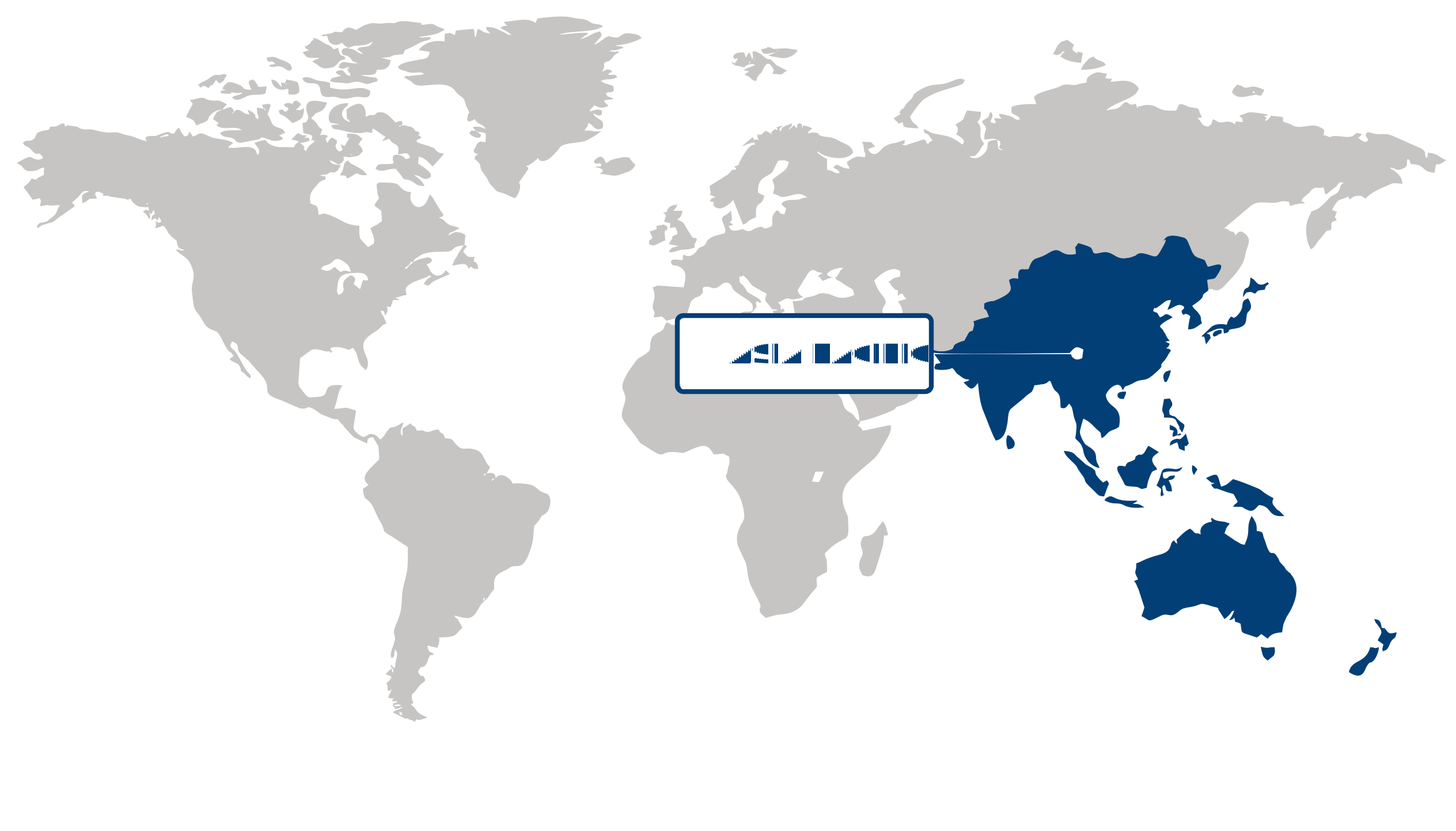
Captured nearly half of the global foaming agent market with a 47% share in 2025, Asia Pacific is the largest regional market, driven principally by rapid industrialization and strong expansion in automotive and packaging sectors. High-volume vehicle production in China and demand for efficient, lightweight packaging across consumer goods and foodservice underpin consumption; this is reflected in output and trade data from the National Bureau of Statistics of China and vehicle production figures from the China Association of Automobile Manufacturers (CAAM). Multinational suppliers such as Tetra Pak and Amcor citing capacity expansion in the region and investments by Toyota Motor Corporation illustrate both demand pull and supplier responses. Given continued industrial investment, rising per-capita consumption and policy support for manufacturing, Asia Pacific presents sustained, high-opportunity use cases for specialty and scale foaming solutions.
China anchors the Asia Pacific foaming agent market as the production and consumption powerhouse, where scale-driven industrialization and domestic automotive OEM growth create strong upstream demand. Rapid output growth recorded by the China Association of Automobile Manufacturers (CAAM) and industrial expansion tracked by the National Bureau of Statistics of China are mirrored by large domestic OEMs such as SAIC Motor and BYD increasing local procurement, prompting regional chemical suppliers to optimize logistics and formulation portfolios. Policy nudges from the Ministry of Industry and Information Technology (MIIT) that favor advanced manufacturing and local supply chains further concentrate demand in China, making it a strategic sourcing and scale-production center that supports broader regional supply and innovation.
Japan is positioned as a pivotal hub in the Asia Pacific foaming agent market, where high-value automotive and precision packaging requirements drive demand for engineered and specialty chemistries. Japan Automobile Manufacturers Association (JAMA) data on vehicle production and Ministry of Economy, Trade and Industry (METI) initiatives on industrial digitalization and sustainability highlight a market prioritizing material performance, consistency and environmental compliance; major OEMs such as Toyota Motor Corporation and Honda Motor Co., Ltd. often require tightly specified formulations. These quality and sustainability expectations create niche opportunities for premium foaming agents and technical partnerships, reinforcing regional leadership by supplying high-margin applications and advanced R&D collaboration that complement volume-focused players elsewhere in Asia Pacific.
North America Market Analysis:
North America emerged as the fastest-growing region in the foaming agent market, registering a CAGR of 5.6%. Growth is anchored in advanced manufacturing capacity and tightening insulation regulations, which are driving adoption of low‑GWP blowing agents and investment in scale‑up. The U.S. Department of Energy (DOE) advanced manufacturing initiatives and the Environmental Protection Agency’s (EPA) AIM Act implementation are accelerating reformulation and production modernization; International Code Council (ICC) updates to energy codes are lifting demand for higher‑performance insulation. Suppliers such as Dow Inc., BASF SE and Huntsman Corporation are expanding North American capacity and launching alternative chemistries, while automation and digital quality controls reduce unit costs. These dynamics position the region for strong retrofit, construction and industrial foam opportunities.
The U.S. is the primary engine for North America's foaming agent market, where federal regulation and concentrated manufacturing expertise converge to shape demand and innovation. EPA enforcement of the AIM Act and incentive programs from the DOE Building Technologies Office are prompting formulators to commercialize low‑GWP solutions; Dow Inc. and BASF SE have publicly signaled investments and product rollouts targeting these requirements. State energy code adoption and municipal retrofit programs amplify commercial and residential uptake, and automotive and appliance manufacturers in U.S. supply chains prefer precision, high‑quality foam systems produced locally. Strategic implication: U.S. regulatory rigor and industrial capability accelerate product validation and scale, reinforcing North American leadership and export potential.
Europe Market Trends:
Europe maintained a substantial share of the foaming agent market, anchored by a mix of advanced manufacturing, strong end-use demand in personal care and construction, and accelerating substitution toward bio-based and low-impact chemistries. Evidence includes regulatory momentum from the European Chemicals Agency (ECHA) under REACH and policy drivers in the European Commission’s Green Deal, corporate innovation announcements such as BASF SE press releases on sustainable surfactant lines and Clariant press releases highlighting bio-based surfactants, and trade data trends reported by Eurostat showing resilient chemical output. Supply-chain investments and digital process upgrades by players like Evonik Industries AG further support consistent availability and product differentiation. Given this convergence of regulation, buyer preference, and supplier innovation, Europe presents substantial near-term opportunities for differentiated, compliance-ready foaming solutions.
Germany plays a leading manufacturing and innovation role in the foaming agent market, leveraging deep specialty-chemical capabilities and industrial-scale production. Domestic leaders such as BASF SE and Henkel AG & Co. KGaA have published product and sustainability updates that reflect demand for lower-impact foaming agents, and the Verband der Chemischen Industrie (VCI) has documented capital investment trends that support capacity modernization. Research partnerships reported by Fraunhofer-Gesellschaft illustrate applied development of milder surfactants and process efficiencies. These factors create a competitive advantage for scale, rapid commercialization, and exportable formulations, making Germany a regional anchor for reliable supply and technical leadership.
France serves as a strategic adopter and market-shaper in the foaming agent market, where strong consumer brands and policy incentives accelerate uptake of sustainable chemistries. Arkema press releases and ADEME (Agence de la transition écologique) programs signal active support for bio-based materials, while commitments from cosmetics leaders such as L’Oréal (sustainability reports) demonstrate buyer-driven demand for gentle, traceable foaming agents. French industrial policy and cluster support enable faster pilot-to-market pathways for specialty producers. Strategically, France’s policy-led adoption and influential end-users can de-risk product validation and help scale sustainable foaming solutions across Europe.
| Parameter | North America | Asia Pacific | Europe | Latin America | MEA |
|---|---|---|---|---|---|
| Innovation Hub i Scale Nascent Developing Advanced | |||||
| Cost-Sensitive Region i Scale Low Medium High | |||||
| Regulatory Environment i Scale Restrictive Neutral Supportive | |||||
| Demand Drivers i Scale Weak Moderate Strong | |||||
| Development Stage i Scale Emerging Developing Developed | |||||
| Adoption Rate i Scale Low Medium High | |||||
| New Entrants / Startups i Scale Sparse Moderate Dense | |||||
| Macro Indicators i Scale Weak Stable Strong |
Segment Leadership and Growth Trends
Foaming Agent Market Share (%), by Type, 2026
Go beyond the chart, access full insights & data tables
Request Free Sample ReportChemical Foaming Agents dominated the foaming agent market with the largest share in 2025. This leadership reflects strong demand for lightweight materials across automotive, construction and packaging value chains, where chemical blowing agents enable complex cellular structures and component integration; automakers such as Volkswagen and Ford have publicly emphasized lightweighting programs that favor such chemistries, and suppliers like BASF and The Dow Chemical Company feature chemical foaming systems in their product literature. Customer preference for high-performance, easily integrated solutions, evolving OEM specifications, and tier‑1 supplier collaborations sustain demand, creating openings for established formulators to deepen technical service and for agile entrants to offer lower‑emissions or bio‑derived chemistries. Given ongoing regulatory and OEM focus on weight reduction and thermal performance, this segment should remain strategically important in the near to medium term.
Analysis by Formulation
Solid Foaming Agents represented largest share of the foaming agent market in 2025. The preference for solids is driven by enhanced stability and ease of handling in industrial settings—factors highlighted in workplace safety guidance from the U.S. Occupational Safety and Health Administration (OSHA) and reflected in supplier product notes from companies such as Huntsman and BASF—reducing storage, transport and dosing complexity for manufacturers. Operational efficiencies, automation readiness, and rising demand for consistent, lower‑risk inputs in construction and plastics processing favor solid formats, while sustainability considerations and tighter supply chains create opportunities for specialty suppliers to offer engineered pellets and pre‑blended packages. Continued emphasis on safer, lean manufacturing and regulatory scrutiny of handling practices indicate solid formulations will retain strong relevance shortly.
Analysis by Application
Polyurethane Foams held largest share of the foaming agent market in 2025. Growth is propelled by demand for energy‑efficient insulation and lightweight components, a trend underscored by International Energy Agency (IEA) analyses on building efficiency and by product deployments from Kingspan and Owens Corning that leverage polyurethane systems for thermal performance. Customer and regulatory drives for lower operational carbon in buildings, coupled with manufacturers’ preference for scalable, high‑R‑value materials and supply‑side innovations in foam chemistry, favor continued uptake; this creates strategic openings for chemical suppliers to co‑develop system solutions with insulation manufacturers and for startups to commercialize recycled or low‑global‑warming‑potential technologies. With building codes tightening and retrofit markets expanding, polyurethane applications are positioned to stay central in the near to medium term.
| Segment | Sub-Segment | Largest Segment | Fastest Growing |
|---|---|---|---|
| Type | Chemical Foaming Agents, Physical Foaming Agents | ||
| Formulation | Solid Foaming Agents, Liquid Foaming Agents | ||
| Application | Polyurethane Foams, Polystyrene Foams, PVC Foams, Rubber Foams, Others | ||
| End-Use Industry | Construction, Automotive, Packaging, Furniture, Textiles, Others |
Competitive Landscape and Market Positioning
The competitive environment is characterized by purposeful reshaping of portfolios and capability enhancement across the top players. Many have expanded technical centers and regional production footprints while refining formulation suites to address lower-emission and bio-derived preferences, and are introducing application-specific chemistries for insulation, packaging, and consumer products. Cross-industry linkages with OEMs and downstream formulators have tightened, and digital tools for faster formulation development and process optimization are being adopted to accelerate customer qualification. These moves are narrowing differentiation to service, sustainability credentials, and application depth rather than basic commodity supply alone.
Strategic / Actionable Recommendations for Regional Players
North America: Build closer commercial links with equipment makers and large foam processors to streamline qualification cycles, and prioritize local pilot capacity to shorten time-to-market. Emphasize digital formulation support and technical training for converters, while selectively broadening portfolios toward building insulation and specialty automotive foams to capture demand for higher-performance systems.
Asia Pacific: Strengthen partnerships with regional formulators and construction materials groups to gain market access, and scale technical-service hubs that support rapid localization of formulations. Focus on cost-competitive bio-based variants and turnkey supply arrangements for high-growth building and packaging applications, leveraging local sourcing to improve responsiveness.
Europe: Double down on low-emission and renewable-based chemistries and engage proactively with standards organizations and large institutional buyers to align product credentials with regulatory expectations. Offer retrofit-compatible solutions and circularity-oriented value propositions for industrial customers, and collaborate with material-system integrators to demonstrate lifecycle advantages.
| Company | Market Share | Company Revenue | Revenue CAGR (%) | Product Portfolio | Geographic Presence | Innovation / R&D Focus | Strategic Developments |
|---|---|---|---|---|---|---|---|
| No companies available. | |||||||
Industry Development/News
| Company Name | Date | Key Development |
|---|
Customize Your Report
Explore examples of how this report can be tailored to different research needs, including custom segments, additional topics or chapters, and related reports. Click a section of the wheel or its numbered marker to explore the available options.
Foaming Agent Market — Custom Segments
| Segment | Sub-Segment |
|---|---|
| No segment data available. | |
Foaming Agent Market — Custom TOC
| Custom Chapter | Custom Details | ||
|---|---|---|---|
| No custom TOC data available. | |||
Need a different cut of the data?
Request Custom ResearchHow much is the foaming agent market worth?
How is the foaming agent industry projected to perform over the next decade?
Which global region commands the highest percentage of the foaming agent market?
Where has the foaming agent sector recorded the sharpest year-over-year increase?
How much is the chemical foaming agents segment expected to grow in the foaming agent industry beyond 2025?
What factors give solid foaming agents segment a competitive edge in the foaming agent sector?
Which is the largest sub-segment within the application segment for foaming agent industry?
Why does construction sub-segment dominate the end-use industry segment of foaming agent sector?
What are the key competitors in the foaming agent landscape?
Our Clients
"The report helped us understand emerging consumer trends in our product category. It clarified where to focus innovation for the next product launch."
LyondellBasell
"The regional forecast section was incredibly useful. We were able to identify two new potential partners in Europe thanks to the vendor mapping you included."
SABIC
"We appreciated how actionable the recommendations were. It guided us to improve supply chain resilience."
Olin Corporation
Our Research Team & Methodology
Every Fundamental Business Insights report is built by a dedicated vertical research team, validated through a structured primary-and-secondary methodology, and reviewed for accuracy before it reaches you.
Research Team Overview
Prepared by the Chemicals & Materials Research Team
Delivery
Published
Demand
Available
Support
Trust & Compliance
Research Domains
10 coverage areasResearch Intelligence
| Source | Reference |
|---|---|
| American Chemistry Council (ACC) | www.americanchemistry.com |
| European Chemical Industry Council (Cefic) | cefic.org |
| International Council of Chemical Associations (ICCA) | icca-chem.org |
| European Chemicals Agency (ECHA) | echa.europa.eu |
| U.S. Environmental Protection Agency (EPA) | www.epa.gov |
| ASTM International | www.astm.org |
| International Organization for Standardization (ISO) | www.iso.org |
| National Institute of Standards and Technology (NIST) | www.nist.gov |
| Plastics Industry Association (PLASTICS) | www.plasticsindustry.org |
| European Biplastics | www.european-bioplastics.org |
| The Adhesive and Sealant Council (ASC) | www.ascouncil.org |
| National Association of Corrosion Engineers (AMPP) | www.ampp.org |
| Society of Plastics Engineers (SPE) | www.4spe.org |
| International Fertilizer Association (IFA) | www.fertilizer.org |
| CropLife International | croplife.org |
| Packaging Europe | packagingeurope.com |
| Flexible Packaging Association (FPA) | www.flexpack.org |
| Battery Council International (BCI) | batterycouncil.org |
| International Copper Association (ICA) | internationalcopper.org |
| World Steel Association | worldsteel.org |
Research Workflow & Quality Assurance
Data Collection
Verified information gathered through primary and secondary research.
Data Triangulation
Cross-validation using multiple independent data sources.
Forecast Modelling
Market estimates developed using historical trends and analytical models.
Analyst Validation
Findings reviewed by domain experts for accuracy and consistency.
Editorial & Quality Review
Final editorial, quality, and compliance checks before publication.
Final Publication
Released after successful completion of the internal review process.
Report Coverage
📊 Market Assessment
- Market Size & Forecast
- Market Segmentation
- Regional Analysis
- Growth Drivers & Challenges
- Market Dynamics
🏢 Competitive Intelligence
- Competitive Landscape
- Company Profiles
- Competitive Benchmarking
- Mergers & Acquisitions
- Market Share Analysis or Key Company Strategies
🔍 Strategic Analysis
- Value Chain Analysis
- Porter's Five Forces
- PESTLE Analysis
- Pricing Trends
- Supply-Demand Analysis
🚀 Future Outlook
- Technology Landscape
- Regulatory Landscape
- Investment & Funding Landscape
- Emerging Opportunities
- Future Market Outlook
Have a question about this report or need a custom scope?
Request Customization