Consumer IoT Market Size & Growth Forecast 2027–2036, By Segments (Component, Connectivity Technology, Application), Regional Demand Trends (North America, Asia Pacific, Europe), Key Country Insights (U.S., Japan, South Korea, Germany, France, Italy), and Competitive Landscape
Market Size and Growth Outlook
Consumer IoT Market size was assessed at USD 321.7 billion in 2026 and is poised to grow at a 11.97% CAGR between 2027 and 2036, crossing USD 996.48 billion by 2036. The industry revenue for 2027 is calculated at USD 354.13 billion.
Get more details on this report
Request Free Sample ReportConsumer IoT Market Intelligence Snapshot
Regional Market Dynamics
- Asia Pacific held a 44.52% market share in 2026, driven by a large connected-device user base and widespread adoption of smart homes, wearables, and consumer electronics.
- Asia Pacific is projected to grow at a 14% CAGR as connected device ecosystems expand, enabling manufacturers to introduce new services and features into highly engaged digital markets.
Segment Momentum
- Hardware captured 39.93% of the market in 2026 because every connected deployment relies on sensors, processors, gateways, and devices, while ongoing upgrades and replacement cycles sustain demand.
- Wired connectivity is growing fastest as users increasingly prioritize stable, low-latency, uninterrupted connections for performance-sensitive and always-on consumer IoT applications where reliability outweighs mobility.
Market Expansion Drivers
- Rapid expansion of interconnected smart home and wearable ecosystems driving device adoption.
- Integration of AI, edge computing, and generative intelligence enhancing device autonomy.
- Rising demand for interoperable, always-on connectivity across consumer digital ecosystems.
Leading Market Participants
- Top companies in the consumer IoT market include Amazon.com, Inc. (United States), Apple Inc. (United States), Samsung Electronics Co., Ltd. (South Korea), Microsoft Corporation (United States), Huawei Technologies Co., Ltd. (China), Intel Corporation (United States), Cisco Systems, Inc. (United States), Honeywell International Inc. (United States), International Business Machines Corporation (United States), Sony Group Corporation (Japan).
Global Market Forecast Snapshot
Market Outlook
- 2026 Market Size: USD 321.7 billion
- 2027 Estimated Market Size: USD 354.13 billion.
- Projected Market Size: USD 996.48 billion by 2036
- Growth Forecast: 11.97% CAGR (2027-2036)
Regional and Segment Outlook
- Leading Regional Market: Asia Pacific
- High-Growth Regional Hub: Asia Pacific
- Core Revenue Segment: Hardware (Component) | Wireless (Connectivity Technology) | Consumer Electronics (Application)
- Emerging Opportunity Segment: Services (Component) | Wired (Connectivity Technology) | Wearable Devices (Application)
Market Growth Drivers and Industry Trends
Rapid expansion of interconnected smart home and wearable ecosystems driving device adoption
The rapid expansion of interconnected smart home and wearable ecosystems is strengthening the consumer IoT market by increasing the range of connected devices used in everyday activities. As consumers adopt more smart appliances, home systems, and wearable technologies, the growing device ecosystem creates greater demand for connected solutions that can communicate and operate across multiple applications. This broader adoption also supports more integrated consumer experiences, encouraging households to incorporate connected technologies into daily routines and digital lifestyles.
Integration of AI, edge computing, and generative intelligence enhancing device autonomy
Integration of AI, edge computing, and generative intelligence is transforming the consumer IoT market by enabling connected devices to process information more efficiently and operate with greater autonomy. These technologies support more responsive device behavior by bringing intelligence closer to the point of use while generative capabilities can enhance how devices interpret and respond to consumer interactions. Greater device intelligence also expands the practical functionality of connected products across consumer applications.
Rising demand for interoperable, always-on connectivity across consumer digital ecosystems
Rising demand for interoperable, always-on connectivity is shaping the consumer IoT market as users increasingly expect connected devices and digital services to function seamlessly across broader ecosystems. Interoperability reduces friction between different consumer technologies, while continuous connectivity supports consistent access to device functions and services. This shift encourages greater integration among connected products and strengthens demand for solutions capable of maintaining reliable communication across diverse consumer environments.
| Growth Driver | Impact on CAGR | Regulatory Influence | Geographic Relevance | Adoption Rate | Impact Timeline |
|---|---|---|---|---|---|
| Rapid expansion of interconnected smart home and wearable ecosystems driving device adoption | 3.20% | Moderate | Asia Pacific, North America | High | Near Term |
| Integration of AI, edge computing, and generative intelligence enhancing device autonomy | 3.50% | High | Global | High | Mid Term |
| Rising demand for interoperable, always-on connectivity across consumer digital ecosystems | 2.80% | Moderate | Asia Pacific, Europe | High | Near Term |
Unlock insights tailored to your business with our bespoke market research solutions.
Click to get your customized report now.
Regional Demand Dynamics
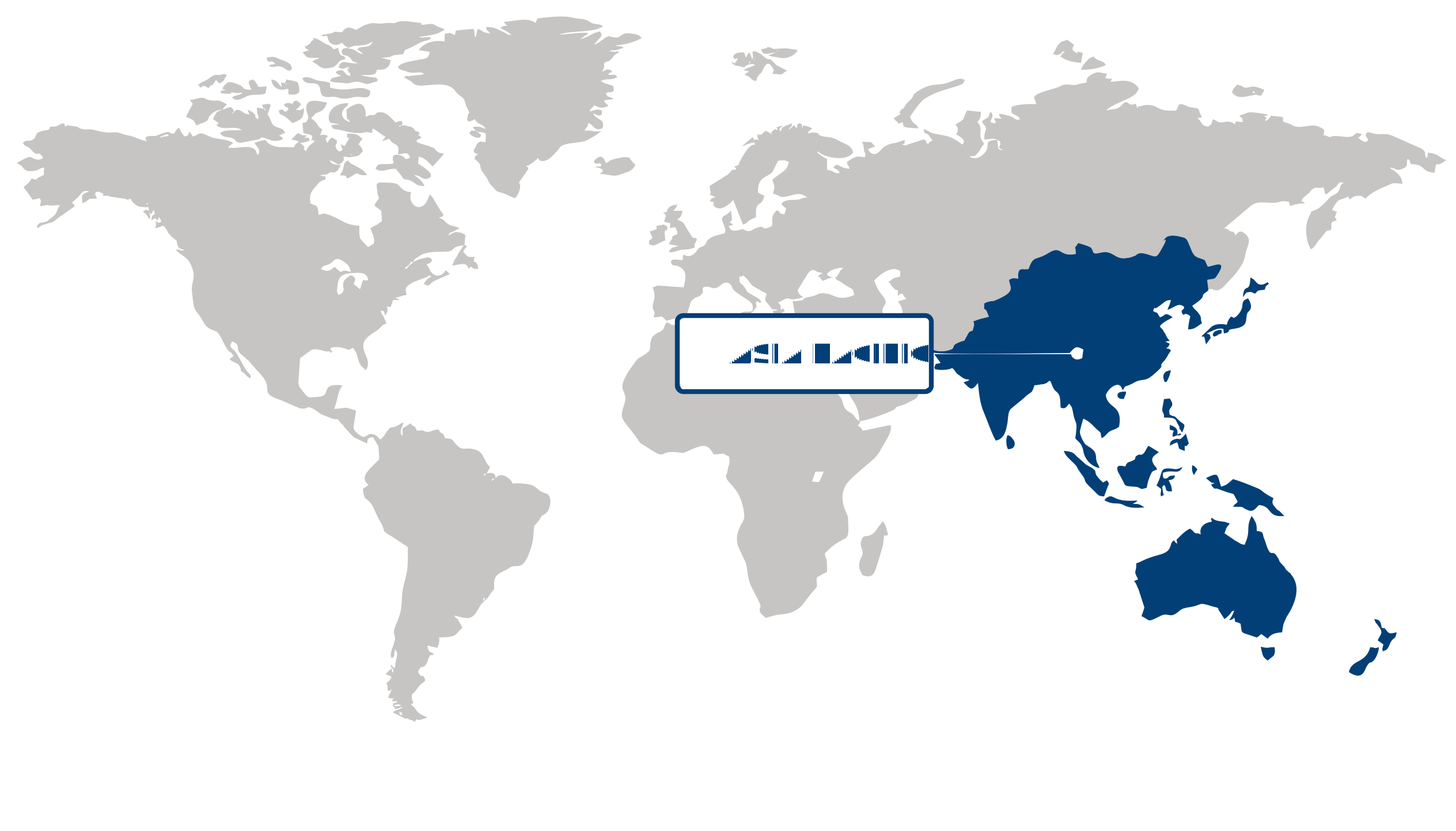
Asia Pacific (Largest & Fastest-Growing Region)
The Asia Pacific consumer IoT market accounted for the largest share of 44.52% in 2026 and is also the fastest-growing regional market, supported by rapid digitalization, expanding smartphone and connected-device adoption, and rising consumer interest in intelligent everyday technologies. Growing urban populations and the development of digitally enabled residential environments are creating favorable conditions for connected appliances, wearable devices, home security solutions, and other IoT applications. The region's expanding electronics manufacturing ecosystem also supports product availability and innovation, while improving broadband connectivity, mobile networks, and cloud infrastructure enable more seamless interaction among connected devices. Rising disposable incomes and increasing familiarity with app-based services are further encouraging households to adopt connected products that provide convenience, energy management, personalization, and remote monitoring capabilities.
| Parameter | North America | Asia Pacific | Europe | Latin America | MEA |
|---|---|---|---|---|---|
| Innovation Hub i Scale Nascent Developing Advanced | |||||
| Cost-Sensitive Region i Scale Low Medium High | |||||
| Regulatory Environment i Scale Restrictive Neutral Supportive | |||||
| Demand Drivers i Scale Weak Moderate Strong | |||||
| Development Stage i Scale Emerging Developing Developed | |||||
| Adoption Rate i Scale Low Medium High | |||||
| New Entrants / Startups i Scale Sparse Moderate Dense | |||||
| Macro Indicators i Scale Weak Stable Strong |
Key Country Insights
Germany 🇩🇪
Secure Smart LivingGermany places significant emphasis on consumer IoT solutions that combine convenience with robust data privacy and device security. German households increasingly adopt connected energy management, home automation, and intelligent appliance technologies.
France 🇫🇷
Energy-Conscious ConnectivityFrance is adopting consumer IoT devices that improve residential energy efficiency, comfort, and home security. French consumers increasingly evaluate connected products based on usability, privacy protection, and compatibility with existing smart home platforms.
Italy 🇮🇹
Practical Smart Home AdoptionItaly is expanding consumer IoT deployment through connected appliances, lighting, and home monitoring systems. Italian households increasingly favor affordable, user-friendly devices that simplify daily routines while improving energy management.
Japan 🇯🇵
Intelligent Lifestyle IntegrationJapan continues expanding consumer IoT adoption through smart appliances, home automation, and connected healthcare devices. Japanese consumers value reliable, space-efficient technologies that integrate naturally into everyday living environments.
South Korea 🇰🇷
Hyperconnected Digital EcosystemsSouth Korea advances consumer IoT adoption through high-speed connectivity and widespread smart device usage. South Korean consumers increasingly expect AI-enabled features, seamless cross-device experiences, and continuous software enhancements.
United States 🇺🇸
Connected Home InnovationThe U.S. consumer IoT market is shaped by strong adoption of smart home ecosystems, connected security, and voice-enabled devices. Consumers increasingly prioritize interoperability, cybersecurity, and seamless integration across multiple connected products.
Segment Leadership and Growth Trends
Consumer IoT Market Share (%), by Component, 2026
Go beyond the chart, access full insights & data tables
Request Free Sample ReportComponent Segment Analysis: Hardware (Largest Segment) vs Services (Fastest-Growing Segment)
Hardware accounted for the largest share of the consumer IoT market in 2026, representing 39.93% of the market. Consumer IoT ecosystems depend on connected devices and physical components to enable functions such as monitoring, automation, communication, and remote control. Increasing integration of smart capabilities into everyday consumer products, together with demand for connected home and personal devices, continues to underpin hardware adoption and establishes it as the foundation of IoT deployments.
Services are expanding at the fastest pace as consumers increasingly require solutions that extend beyond device ownership toward installation, maintenance, connectivity management, data processing, and ongoing support. As connected ecosystems become more sophisticated, service capabilities play a greater role in ensuring seamless device operation and interoperability. The shift toward recurring, software-enabled, and managed IoT experiences is therefore strengthening demand for consumer IoT services.
Connectivity Technology Segment Analysis: Wireless (Largest Segment) vs Wired (Fastest-Growing Segment)
Wireless connectivity held the largest share of the consumer IoT market in 2026, reflecting the strong suitability of wireless technologies for flexible and convenient consumer applications. Wireless connections enable devices to communicate without extensive physical cabling, supporting easy installation, mobility, and integration across connected environments. Their broad applicability across smart appliances, home devices, wearable technologies, and personal electronics continues to sustain their leading position.
The wired connectivity segment is growing at the fastest pace as certain consumer applications increasingly require stable, secure, and reliable data transmission. Wired connections can provide consistent performance in environments where uninterrupted connectivity and reduced interference are priorities. Growing deployment of connected systems that demand dependable communication, particularly in more permanent installations, is supporting renewed interest in wired connectivity.
| Segment | Sub-Segment | Largest Segment | Fastest Growing |
|---|---|---|---|
| Component | Hardware, Software, Services | Hardware | Services |
| Connectivity Technology | Wired, Wireless | Wireless | Wired |
| Application | Consumer Electronics, Healthcare, Wearable Devices, Automotive | Consumer Electronics | Wearable Devices |
Competitive Landscape and Market Positioning
Leading companies in the consumer IoT market:
1. Amazon.com Inc. (United States)
2. Apple Inc. (United States)
3. Samsung Electronics Co. Ltd. (South Korea)
4. Microsoft Corporation (United States)
5. Huawei Technologies Co. Ltd. (China)
6. Intel Corporation (United States)
7. Cisco Systems Inc. (United States)
8. Honeywell International Inc. (United States)
9. International Business Machines Corporation (United States)
10. Sony Group Corporation (Japan)
The consumer IoT market is rapidly evolving with increasing integration of smart and connected devices across daily life. Advancements in interoperability and automation are enhancing user convenience and system intelligence. Strategic collaborations are expanding ecosystem connectivity and platform compatibility. The consumer IoT market continues to grow through accelerated digital transformation and device convergence.
| Company | Market Share | Company Revenue | Revenue CAGR (%) | Product Portfolio | Geographic Presence | Innovation / R&D Focus | Strategic Developments |
|---|---|---|---|---|---|---|---|
| Amazon.com Inc. (United States) | |||||||
| Apple Inc. (United States) | |||||||
| Samsung Electronics Co. Ltd. (South Korea) | |||||||
| Microsoft Corporation (United States) | |||||||
| Huawei Technologies Co. Ltd. (China) | |||||||
| Intel Corporation (United States) | |||||||
| Cisco Systems Inc. (United States) | |||||||
| Honeywell International Inc. (United States) | |||||||
| International Business Machines Corporation (United States) | |||||||
| Sony Group Corporation (Japan). |
Industry Development/News
| Company Name | Date | Key Development |
|---|---|---|
| Jun-26 | Google integrated Skylo’s commercial NTN satellite services into the Pixel 10 and the new Pixel Watch 4. This deployment introduces standalone emergency messaging capabilities to consumer mobile and wearable devices, enhancing connectivity resilience and enabling critical communication functions in off-grid environments. | |
| Morse Micro | Jun-26 | Morse Micro released the MM8108 Wi-Fi HaLow SoC, a high-efficiency chip engineered to extend the range and connectivity scalability of IoT devices. The launch strengthens the wireless infrastructure available for consumer IoT ecosystems, addressing critical performance requirements for low-power, long-range smart home and industrial connectivity. |
| FCC | Jun-26 | The FCC launched the U.S. Cyber Trust Mark, a voluntary cybersecurity labeling program for wireless consumer IoT products. The initiative establishes standardized security transparency requirements to mitigate device vulnerabilities, aiming to bolster consumer confidence and elevate industry-wide cybersecurity compliance baselines for connected hardware. |
| Xona Space Systems | Jun-26 | Xona Space Systems successfully launched its first production-class satellite, marking a critical milestone in the development of a commercial low-Earth orbit (LEO) positioning, navigation, and timing (PNT) service. This infrastructure expansion provides the precision and resilience necessary to support next-generation IoT location-based services and device positioning. |
| Skylo | Jun-26 | Skylo expanded its non-terrestrial network (NTN) satellite infrastructure through new partnerships to support 2-way emergency messaging. By enabling satellite-based connectivity on consumer hardware, Skylo is effectively bridging gaps in traditional terrestrial networks, enhancing the global reach of IoT emergency response and mission-critical communication services. |
| Microsoft | Jun-26 | Microsoft expanded the Defender for IoT platform, centralizing security operations for diverse enterprise and operational technology environments. The update improves threat detection and device monitoring capabilities within security operations center (SOC) workflows, providing a cohesive management layer for the increasingly complex attack surfaces found in connected IoT systems. |
| e& | Jun-26 | e& announced a refined global techco strategy centered on 5G Advanced, AI, and cloud-native infrastructure. The initiative aims to enhance the underlying digital backbone of its international IoT operations, providing the required network capacity and intelligence to support a broader, more resilient ecosystem of connected services. |
| Apple | Oct-25 | Apple introduced integrated Thread protocol support in the M5-powered iPad Pro, establishing the device as a more capable smart home hub. This architectural shift facilitates native interoperability with diverse IoT ecosystems, reflecting a strategic expansion of Apple's smart home connectivity footprint and strengthening the iPad’s utility within integrated, multi-device residential environments. |
| Cisco Systems, Inc. | Sep-25 | Cisco Systems and Tata Communications partnered to integrate the MOVE eSIM orchestration platform into the Cisco IoT Control Center. This collaboration streamlines global connectivity management and network deployment for connected devices, providing a unified framework that accelerates the scalability of IoT ecosystems for global operators and enterprises. |
| Huawei | Sep-25 | Huawei released its latest wearable lineup, including the HUAWEI WATCH GT 6 Series and WATCH D2, featuring the new TruSense system. These devices offer advanced sensor integration and enhanced outdoor positioning capabilities, demonstrating a commitment to high-precision health monitoring and specialized tracking features that drive technological differentiation in the consumer wearable market. |
Customize Your Report
Explore examples of how this report can be tailored to different research needs, including custom segments, additional topics or chapters, and related reports. Click a section of the wheel or its numbered marker to explore the available options.
Consumer IoT Market — Custom Segments
| Segment | Sub-Segment |
|---|---|
| Device Category | Smart Home Devices, Wearable Devices, Connected Appliances, Smart Entertainment Devices, Smart Security Devices |
| User Demographics | Children & Teenagers, Young Adults, Middle-Aged Adults, Older Adults |
| Deployment Model | Standalone Devices, Integrated Ecosystems, Subscription-Based Connected Services |
Consumer IoT Market — Custom TOC
| Custom Chapter | Custom Details |
|---|---|
| Connected Lifestyle Consumer Adoption Assessment |
|
| Cross-Platform Ecosystem Interoperability Landscape |
|
| Smart Device Subscription and Services Opportunity |
|
Need a different cut of the data?
Request Custom ResearchWhat is the market size of consumer IoT?
What is the expected industry size of consumer IoT by 2036?
How is the expansion of smart home and wearable ecosystems influencing consumer IoT purchasing patterns?
Why are services becoming a key growth driver in the consumer IoT market?
Why is Hardware the largest component segment in the consumer IoT market?
Why is Wired the fastest-growing connectivity technology in the consumer IoT market?
Why does Asia Pacific lead the consumer IoT market?
What supports Asia Pacific's rapid expansion in the consumer IoT market?
Which organizations are considered leaders in the consumer IoT landscape?
Our Clients
"The team demonstrated a great understanding of our business needs, and the reports were tailored to address our specific concerns and objectives."
Infosys
"The report was up-to-date with the latest industry trends and technological advancements. The detailed competitive landscape analysis was quite helpful."
Zebra Technologies
"The data presented in the report was accurate and well-researched. I also found the market dynamics section particularly useful."
Arlo Technologies
Our Research Team & Methodology
Every Fundamental Business Insights report is built by a dedicated vertical research team, validated through a structured primary-and-secondary methodology, and reviewed for accuracy before it reaches you.
Research Team Overview
Prepared by the Smart Technologies Research Team
Delivery
Published
Demand
Available
Support
Trust & Compliance
Research Domains
10 coverage areasResearch Intelligence
| Source | Reference |
|---|---|
| National Institute of Standards and Technology (NIST) | www.nist.gov |
| International Organization for Standardization (ISO) | www.iso.org |
| Institute of Electrical and Electronics Engineers (IEEE) | www.ieee.org |
| Internet Engineering Task Force (IETF) | www.ietf.org |
| World Wide Web Consortium (W3C) | www.w3.org |
| Cloud Security Alliance (CSA) | cloudsecurityalliance.org |
| Open Source Initiative (OSI) | opensource.org |
| Linux Foundation | www.linuxfoundation.org |
| FinOps Foundation | www.finops.org |
| PCI Security Standards Council | www.pcisecuritystandards.org |
| SWIFT | www.swift.com |
| Financial Stability Board (FSB) | www.fsb.org |
| GSMA | www.gsma.com |
| International Telecommunication Union (ITU) | www.itu.int |
| OWASP Foundation | owasp.org |
| MITRE | www.mitre.org |
| World Economic Forum (WEF) | www.weforum.org |
| OECD Digital Economy | www.oecd.org/digital |
| World Bank Data | data.worldbank.org |
| U.S. Census Bureau | www.census.gov |
Research Workflow & Quality Assurance
Data Collection
Verified information gathered through primary and secondary research.
Data Triangulation
Cross-validation using multiple independent data sources.
Forecast Modelling
Market estimates developed using historical trends and analytical models.
Analyst Validation
Findings reviewed by domain experts for accuracy and consistency.
Editorial & Quality Review
Final editorial, quality, and compliance checks before publication.
Final Publication
Released after successful completion of the internal review process.
Report Coverage
📊 Market Assessment
- Market Size & Forecast
- Market Segmentation
- Regional Analysis
- Growth Drivers & Challenges
- Market Dynamics
🏢 Competitive Intelligence
- Competitive Landscape
- Company Profiles
- Competitive Benchmarking
- Mergers & Acquisitions
- Market Share Analysis or Key Company Strategies
🔍 Strategic Analysis
- Value Chain Analysis
- Porter's Five Forces
- PESTLE Analysis
- Pricing Trends
- Supply-Demand Analysis
🚀 Future Outlook
- Technology Landscape
- Regulatory Landscape
- Investment & Funding Landscape
- Emerging Opportunities
- Future Market Outlook
Have a question about this report or need a custom scope?
Request Customization