Wind Turbine Composite Materials Market Size & Growth Forecast 2027–2036, By Segments (Fiber Type, Application, Technology), Regional Demand Trends (North America, Asia Pacific, Europe), Key Country Insights (U.S., Japan, South Korea, Germany, France, Italy), and Competitive Landscape
Market Size and Growth Outlook
Wind Turbine Composite Materials Market size was worth USD 15.92 Billion in 2026 and is expected to grow at 6.89% CAGR between 2027 and 2036, surpassing USD 31 Billion by 2036. The industry revenue for 2027 is assessed at USD 16.85 Billion.
Get more details on this report
Request Free Sample ReportWind Turbine Composite Materials Market Intelligence Snapshot
Regional Market Dynamics
- Asia Pacific held the largest share in 2026, supported by extensive renewable energy deployment, wind infrastructure expansion, manufacturing capabilities, and onshore and offshore projects.
- Europe is the fastest-growing region, driven by offshore wind deployment, fleet modernization, decarbonization efforts, next-generation turbines, and replacement of aging infrastructure.
Segment Momentum
- Glass fiber accounted for 61.73% of the market in 2026 and remains the fastest-growing fiber type due to its strength, durability, corrosion resistance, cost efficiency, and suitability for large wind turbine components.
- Wind blades held 71.62% of the market in 2026 and also represent the fastest-growing application, driven by the need for lightweight, durable composite materials that support efficient energy generation and larger turbine designs.
Market Expansion Drivers
- Rising renewable energy deployment accelerating demand for lightweight turbine blades
- Advancements in composite material engineering improving turbine efficiency and durability
- Cost optimization in wind energy infrastructure increasing composite material substitution rates
Leading Market Participants
- Major players in the wind turbine composite materials market include Hexcel Corporation (United States), Owens Corning (United States), SGL Carbon SE (Germany), Teijin Limited (Japan), Mitsubishi Chemical Group Corporation (Japan), Gurit Holding AG (Switzerland), SABIC (Saudi Arabia), Huntsman Corporation (United States), Syensqo (Belgium)
Global Market Forecast Snapshot
Market Outlook
- 2026 Market Size: USD 15.92 Billion
- 2027 Estimated Market Size: USD 16.85 Billion
- Projected Market Size: USD 31 Billion by 2036
- Growth Forecast: 6.89% CAGR (2027-2036)
Regional and Segment Outlook
- Leading Regional Market: Asia Pacific
- High-Growth Regional Hub: Europe
- Core Revenue Segment: Glass Fiber (Fiber Type) | Wind Blades (Application) | Vacuum Injection Molding (Technology)
- Emerging Opportunity Segment: Glass Fiber (Fiber Type) | Wind Blades (Application) | Vacuum Injection Molding (Technology)
Market Growth Drivers and Industry Trends
Rising renewable energy deployment accelerating demand for lightweight turbine blades
The accelerating deployment of wind power projects across onshore and offshore locations is increasing the need for turbine components that maximize energy generation while maintaining structural reliability. The wind turbine composite materials market growth is driven by rising demand for lightweight blades that enable larger rotor diameters, improve aerodynamic performance, and reduce mechanical stress on supporting structures. Composite materials also facilitate the production of longer blades with high strength-to-weight characteristics, allowing turbine manufacturers to improve power capture while simplifying transportation and installation requirements.
Advancements in composite material engineering improving turbine efficiency and durability
Continuous innovation in composite engineering is enabling manufacturers to develop materials with enhanced mechanical properties, greater fatigue resistance, and improved environmental durability for demanding wind energy applications. These advancements will propel the wind turbine composite materials market growth by supporting the production of blades capable of operating efficiently under varying wind conditions and prolonged exposure to harsh environments. Improved resin systems, fiber reinforcements, and manufacturing processes also contribute to longer service life and reduced maintenance requirements throughout the operational lifespan of wind turbines.
Cost optimization in wind energy infrastructure increasing composite material substitution rates
Project developers are placing greater emphasis on reducing lifecycle costs while maintaining high operational efficiency across wind energy installations. As cost optimization becomes a central investment priority, the wind turbine composite materials market benefits from increasing substitution of conventional materials with advanced composites that offer lower weight, improved corrosion resistance, and greater design flexibility. These characteristics help reduce transportation, installation, and maintenance complexities while supporting more efficient turbine designs for large-scale renewable energy projects.
| Growth Driver | Impact on CAGR | Regulatory Influence | Geographic Relevance | Adoption Rate | Impact Timeline |
|---|---|---|---|---|---|
| Rising renewable energy deployment accelerating demand for lightweight turbine blades | 2% | High | Europe, Asia Pacific | High | Near Term |
| Advancements in composite material engineering improving turbine efficiency and durability | 1.7% | Moderate | North America, Europe | High | Mid Term |
| Cost optimization in wind energy infrastructure increasing composite material substitution rates | 1.5% | Moderate | Asia Pacific, Latin America | High | Mid Term |
Unlock insights tailored to your business with our bespoke market research solutions.
Click to get your customized report now.
Regional Demand Dynamics
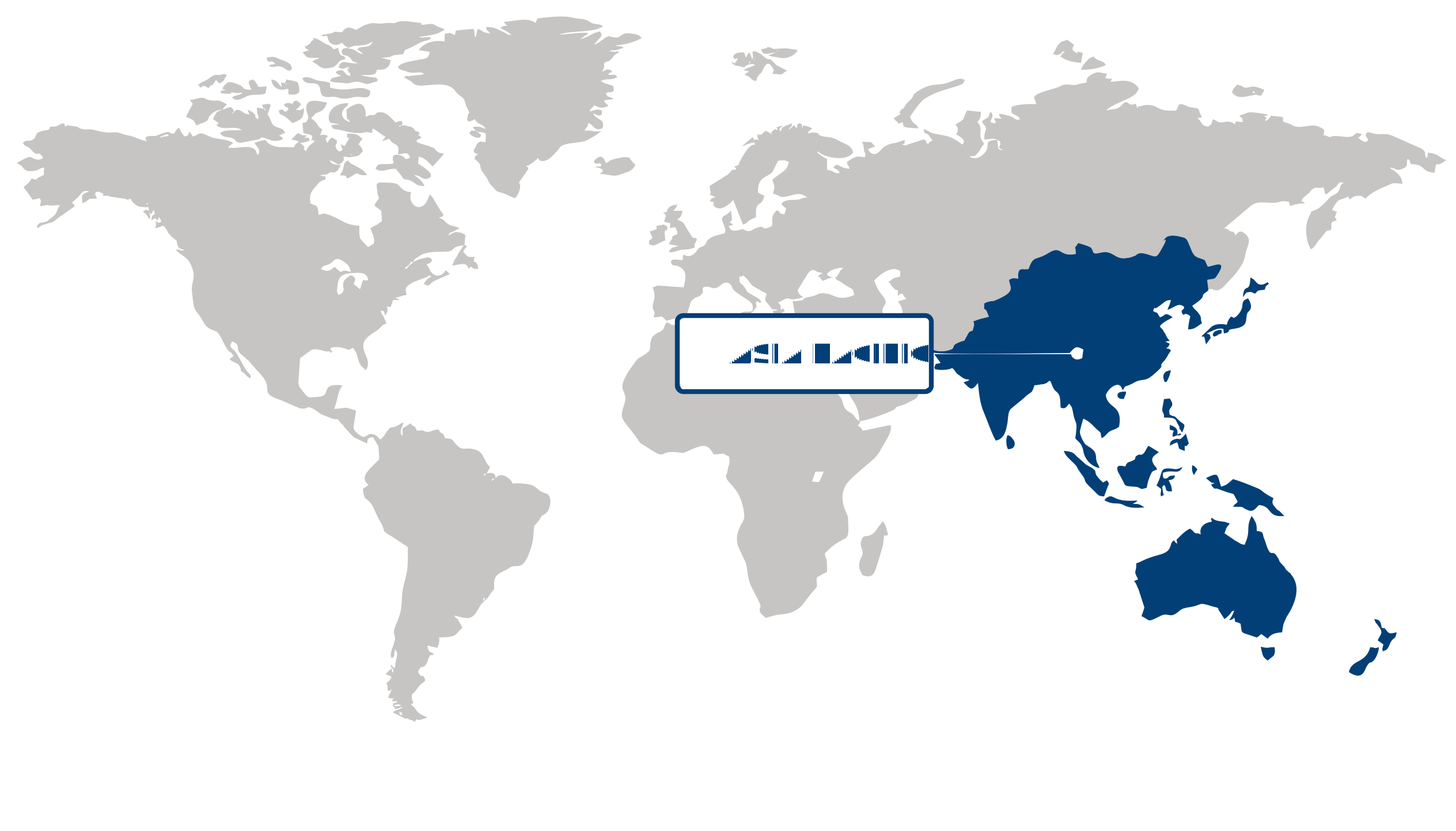
Asia Pacific (Largest Region)
Asia Pacific accounted for the largest share of the wind turbine composite materials market in 2026, reflecting the region's extensive renewable energy deployment and strong expansion of wind power infrastructure. Large-scale investments in wind generation, particularly across rapidly developing energy markets, are supporting demand for lightweight and durable composite materials used in turbine blades and other components. The region's established manufacturing capabilities, expanding industrial base, and focus on increasing domestic renewable energy capacity further reinforce its market position. Continued development of both onshore and offshore wind projects is also creating sustained requirements for advanced composite technologies.
Europe (Fastest-Growing Region)
Europe is positioned as the fastest-growing regional market, supported by its strong commitment to renewable energy expansion and the continued modernization of its wind power fleet. Increasing deployment of offshore wind projects is creating demand for high-performance composite materials capable of meeting demanding structural and operational requirements. The region's focus on decarbonizing electricity generation, improving turbine efficiency, and advancing wind technology is encouraging innovation in composite material design. Investment in next-generation turbines and replacement of aging infrastructure is expected to further strengthen demand across the regional market.
| Parameter | North America | Asia Pacific | Europe | Latin America | MEA |
|---|---|---|---|---|---|
| Innovation Hub i Scale Nascent Developing Advanced | |||||
| Cost-Sensitive Region i Scale Low Medium High | |||||
| Regulatory Environment i Scale Restrictive Neutral Supportive | |||||
| Demand Drivers i Scale Weak Moderate Strong | |||||
| Development Stage i Scale Emerging Developing Developed | |||||
| Adoption Rate i Scale Low Medium High | |||||
| New Entrants / Startups i Scale Sparse Moderate Dense | |||||
| Macro Indicators i Scale Weak Stable Strong |
Key Country Insights
United States 🇺🇸
Advanced Blade MaterialsThe U.S. wind turbine composite materials market is emphasizing lightweight, high-strength materials that improve blade durability and manufacturing efficiency. Suppliers are expanding material innovation and production capabilities to support larger turbine designs and streamlined fabrication processes.
Germany 🇩🇪
Composite Engineering ExpertiseGermany is strengthening the use of advanced composite materials to enhance turbine blade reliability and structural performance. Manufacturers are prioritizing material optimization, automated production technologies, and sustainable composite solutions for wind energy applications.
Japan 🇯🇵
Lightweight Material InnovationJapan is focusing on composite material development that supports efficient wind turbine performance in diverse operating environments. Companies are investing in advanced resin systems, improved fiber technologies, and manufacturing precision to enhance blade quality.
South Korea 🇰🇷
Manufacturing Capability ExpansionSouth Korea is expanding composite material production for wind turbine components through investments in advanced fabrication technologies. Market participants are prioritizing scalable manufacturing, material durability, and collaboration with turbine manufacturers to improve production efficiency.
France 🇫🇷
Renewable Component IntegrationFrance is encouraging the use of advanced composite materials that improve wind turbine blade performance and operational reliability. The market is focusing on material innovation, efficient production methods, and partnerships supporting renewable energy equipment manufacturing.
Italy 🇮🇹
Composite Supply DevelopmentItaly is reinforcing its composite materials capabilities to support domestic and regional wind turbine manufacturing activities. Producers are concentrating on high-performance material processing, quality assurance, and specialized composite solutions for blade applications.
Segment Leadership and Growth Trends
Wind Turbine Composite Materials Market Share (%), by Fiber Type, 2026
Go beyond the chart, access full insights & data tables
Request Free Sample ReportFiber Type Segment Analysis: Glass Fiber (Largest & Fastest-Growing Segment)
The wind turbine composite materials market was led by the glass fiber segment, accounting for 61.73% of the market share in 2026, while also representing the fastest-growing fiber type. Glass fiber remains the preferred reinforcement material because it offers an effective combination of mechanical strength, durability, corrosion resistance, and cost efficiency for wind turbine components. Its widespread use in manufacturing large structural parts and compatibility with established production processes continue to strengthen demand. Rising investments in renewable energy infrastructure and increasing deployment of larger wind turbines further reinforce the segment's dominant position.
Application Segment Analysis: Wind Blades (Largest & Fastest-Growing Segment)
The wind turbine composite materials market was dominated by the wind blades segment, which held 71.62% of the market share in 2026 while also emerging as the fastest-growing application. Composite materials are extensively used in blade manufacturing because they provide the high strength-to-weight ratio, fatigue resistance, and structural integrity required for efficient energy generation. Growing demand for longer and more efficient turbine blades, together with ongoing advancements in blade design and manufacturing technologies, continues to drive strong adoption of composite materials within this segment.
Technology Segment Analysis: Vacuum Injection Molding (Largest & Fastest-Growing Segment)
Holding 46.96% of the market share in 2026, vacuum injection molding was the largest technology segment and also the fastest-growing. In the wind turbine composite materials market, this manufacturing technology is widely adopted because it enables precise resin distribution, consistent product quality, and efficient production of large composite structures. The process supports improved structural performance while reducing material waste and manufacturing defects. Increasing emphasis on high-quality turbine components, production efficiency, and scalable manufacturing capabilities continues to strengthen the adoption of vacuum injection molding across the industry.
| Segment | Sub-Segment | Largest Segment | Fastest Growing |
|---|---|---|---|
| Fiber Type | Glass Fiber, Carbon Fiber, Others | Glass Fiber | Glass Fiber |
| Application | Wind Blades, Nacelles, Others | Wind Blades | Wind Blades |
| Technology | Vacuum Injection Molding, Prepreg, Hand Lay-Up, Other | Vacuum Injection Molding | Vacuum Injection Molding |
Competitive Landscape and Market Positioning
Major players in the wind turbine composite materials market:
- Hexcel Corporation (United States)
- Owens Corning (United States)
- SGL Carbon SE (Germany)
- Teijin Limited (Japan)
- Mitsubishi Chemical Group Corporation (Japan)
- Gurit Holding AG (Switzerland)
- SABIC (Saudi Arabia)
- Huntsman Corporation (United States)
- Syensqo (Belgium)
Competitive positioning is increasingly shaped by the ability to supply advanced composite solutions that enable larger, lighter, and more durable turbine components capable of supporting evolving wind energy designs. Material developers are directing greater effort toward improving fatigue resistance, manufacturing consistency, and processing efficiency, as turbine manufacturers place growing emphasis on reducing lifecycle costs and enhancing operational reliability. This has intensified the importance of close technical collaboration across the value chain, with suppliers adapting material formulations and production capabilities to meet increasingly specialized engineering requirements. At the same time, regional manufacturing capacity and resilient raw material sourcing have become more influential in determining market competitiveness as project developers seek dependable supply for expanding installation pipelines.
| Company | Market Share | Company Revenue | Revenue CAGR (%) | Product Portfolio | Geographic Presence | Innovation / R&D Focus | Strategic Developments |
|---|---|---|---|---|---|---|---|
| Hexcel Corporation (United States) | |||||||
| Owens Corning (United States) | |||||||
| SGL Carbon SE (Germany) | |||||||
| Teijin Limited (Japan) | |||||||
| Mitsubishi Chemical Group Corporation (Japan) | |||||||
| Gurit Holding AG (Switzerland) | |||||||
| SABIC (Saudi Arabia) | |||||||
| Huntsman Corporation (United States) | |||||||
| Syensqo (Belgium) |
Industry Development/News
| Company Name | Date | Key Development |
|---|
Customize Your Report
Explore examples of how this report can be tailored to different research needs, including custom segments, additional topics or chapters, and related reports. Click a section of the wheel or its numbered marker to explore the available options.
Wind Turbine Composite Materials Market — Custom Segments
| Segment | Sub-Segment |
|---|---|
| Turbine Capacity Class | Below 2 MW, 2–5 MW, 5–10 MW, Above 10 MW |
| Deployment Environment | Onshore Wind, Fixed-Bottom Offshore Wind, Floating Offshore Wind |
| Manufacturing Component Supply Model | In-House Manufacturing, Tier 1 Component Suppliers, Independent Composite Component Suppliers |
Wind Turbine Composite Materials Market — Custom TOC
| Custom Chapter | Custom Details |
|---|---|
| Blade Material Circularity |
|
| Next-Generation Blade Materials |
|
| Composite Supply Chain Resilience |
|
Need a different cut of the data?
Request Custom ResearchHow large is the wind turbine composite materials market?
How is the wind turbine composite materials industry projected to perform over the next decade?
How are lightweight composite materials improving wind turbine performance?
Why is composite material innovation accelerating adoption in wind energy infrastructure?
Why does glass fiber dominate the wind turbine composite materials market?
Which application segment leads the wind turbine composite materials market?
What supports Asia Pacific’s leadership in wind turbine composite materials?
Why is Europe expected to grow fastest in this market?
Who holds a significant market share in the wind turbine composite materials landscape?
Our Clients
"The information presented in the report was genuinely insightful. The data was clear and easy to understand, which made it much easier to interpret the findings."
Amara Raja Group
"The responsiveness and professionalism exhibited by the team were exemplary. They were readily available to address queries, provide clarifications, and offer additional insights."
ONGC
"The reports offered a comprehensive analysis of various segments within the market. The detailed insights into market trends, and regulatory landscapes were excellent."
TotalEnergies
Our Research Team & Methodology
Every Fundamental Business Insights report is built by a dedicated vertical research team, validated through a structured primary-and-secondary methodology, and reviewed for accuracy before it reaches you.
Research Team Overview
Prepared by the Energy & Power Research Team
Delivery
Published
Demand
Available
Support
Trust & Compliance
Research Domains
10 coverage areasResearch Intelligence
| Source | Reference |
|---|---|
| International Energy Agency (IEA) | www.iea.org |
| U.S. Energy Information Administration (EIA) | www.eia.gov |
| International Renewable Energy Agency (IRENA) | www.irena.org |
| International Electrotechnical Commission (IEC) | www.iec.ch |
| International Organization for Standardization (ISO) | www.iso.org |
| IEEE | www.ieee.org |
| CIGRE (International Council on Large Electric Systems) | www.cigre.org |
| World Energy Council (WEC) | www.worldenergy.org |
| U.S. Department of Energy (DOE) | www.energy.gov |
| International Atomic Energy Agency (IAEA) | www.iaea.org |
| American Petroleum Institute (API) | www.api.org |
| Society of Petroleum Engineers (SPE) | www.spe.org |
| Hydrogen Council | hydrogencouncil.com |
| Battery Council International (BCI) | batterycouncil.org |
| Global Wind Energy Council (GWEC) | gwec.net |
| SolarPower Europe | www.solarpowereurope.org |
| World Bioenergy Association (WBA) | worldbioenergy.org |
| International Hydropower Association (IHA) | www.hydropower.org |
| Edison Electric Institute (EEI) | www.eei.org |
| National Renewable Energy Laboratory (NREL) | www.nrel.gov |
Research Workflow & Quality Assurance
Data Collection
Verified information gathered through primary and secondary research.
Data Triangulation
Cross-validation using multiple independent data sources.
Forecast Modelling
Market estimates developed using historical trends and analytical models.
Analyst Validation
Findings reviewed by domain experts for accuracy and consistency.
Editorial & Quality Review
Final editorial, quality, and compliance checks before publication.
Final Publication
Released after successful completion of the internal review process.
Report Coverage
📊 Market Assessment
- Market Size & Forecast
- Market Segmentation
- Regional Analysis
- Growth Drivers & Challenges
- Market Dynamics
🏢 Competitive Intelligence
- Competitive Landscape
- Company Profiles
- Competitive Benchmarking
- Mergers & Acquisitions
- Market Share Analysis or Key Company Strategies
🔍 Strategic Analysis
- Value Chain Analysis
- Porter's Five Forces
- PESTLE Analysis
- Pricing Trends
- Supply-Demand Analysis
🚀 Future Outlook
- Technology Landscape
- Regulatory Landscape
- Investment & Funding Landscape
- Emerging Opportunities
- Future Market Outlook
Have a question about this report or need a custom scope?
Request Customization