Sorting Machines Market Size & Growth Forecast 2027–2036, By Segments (Product Type, End Use), Regional Demand Trends (North America, Asia Pacific, Europe), Key Country Insights (U.S., Japan, South Korea, Germany, France, Italy), and Competitive Landscape
Market Size and Growth Outlook
Sorting Machines Market size was valued at USD 4.6 billion in 2026 and is projected to grow at a 5.8% CAGR from 2027 to 2036, crossing USD 8.08 billion by 2036. The industry revenue for 2027 is estimated at USD 4.82 billion.
Get more details on this report
Request Free Sample ReportSorting Machines Market Intelligence Snapshot
Regional Market Dynamics
- Europe leads due to advanced industrial automation, widespread use in manufacturing, logistics, and recycling, and strong replacement demand for higher-speed, sensor-based sorting systems.
- Asia Pacific grows at 6.89% CAGR driven by industrialization, expanding warehousing and logistics networks, and rising adoption of automated sorting systems to handle higher throughput.
Segment Momentum
- Optical Sorters held a 60.27% share in 2026 because they support high-throughput inspection, quality control, and efficient product separation across a wide range of industrial processing applications.
- Waste Recycling is expanding fastest as facilities increasingly adopt automated sorting to improve material recovery, processing efficiency, and sorting accuracy when handling complex mixed waste streams.
Market Expansion Drivers
- Expanding food processing automation increasing demand for optical and weight-based sorting systems.
- Rapid e-commerce fulfillment expansion accelerating deployment of high-volume automated sorting infrastructure.
- Rising smart factory investments driving AI-enabled industrial sorting equipment modernization.
Leading Market Participants
- Prominent players in the sorting machines market include TOMRA Systems ASA (Norway), Bühler Group (Switzerland), Dematic (United States), Sesotec GmbH (Germany), Satake Corporation (Japan), GREEFA (Netherlands), Cimbria A/S (Denmark), National Recovery Technologies, LLC (United States), Raytec Vision S.p.A. (Italy).
Global Market Forecast Snapshot
Market Outlook
- 2026 Market Size: USD 4.6 billion
- 2027 Estimated Market Size: USD 4.82 billion.
- Projected Market Size: USD 8.08 billion by 2036
- Growth Forecast: 5.8% CAGR (2027-2036)
Regional and Segment Outlook
- Leading Regional Market: Europe
- High-Growth Regional Hub: Asia Pacific
- Core Revenue Segment: Optical Sorter (Product Type) | Food & Beverage Industry (End Use)
- Emerging Opportunity Segment: Weight Sorter (Product Type) | Waste Recycling (End Use)
Market Growth Drivers and Industry Trends
Expanding food processing automation increasing demand for optical and weight-based sorting systems
Food processors are increasingly automating inspection and material-handling operations to improve consistency, product quality, and production efficiency across processing lines. This trend will drive the sorting machines market growth as processors adopt optical sorting technologies capable of identifying differences in color, shape, size, and visible defects, alongside weight-based systems for accurate separation and classification. Automated sorting also helps reduce dependence on manual inspection and supports consistent handling of high-volume food products, including applications where contamination or quality variation must be identified rapidly.
Rapid e-commerce fulfillment expansion accelerating deployment of high-volume automated sorting infrastructure
The growing complexity of online order fulfillment is increasing the need for automated systems that can process, identify, route, and organize large volumes of parcels with minimal manual intervention. For the sorting machines market, expanding e-commerce fulfillment operations are creating demand for high-throughput sorting infrastructure that can support faster order processing and accurate distribution across multiple destinations. Automated conveyors, scanning systems, and sorting mechanisms enable fulfillment centers to handle diverse parcel sizes and shipment flows while reducing bottlenecks associated with labor-intensive manual sorting.
Rising smart factory investments driving AI-enabled industrial sorting equipment modernization
Manufacturers are investing in connected production environments that use automation, data analytics, machine vision, and artificial intelligence to improve operational control. These investments will propel the sorting machines market as industrial facilities modernize conventional sorting equipment with AI-enabled systems capable of recognizing materials, detecting irregularities, and adjusting sorting decisions based on real-time production data. Integration with broader factory automation networks also allows sorting operations to become more responsive and measurable, supporting consistent material classification and reducing inefficiencies within manufacturing workflows.
| Growth Driver | Impact on CAGR | Regulatory Influence | Geographic Relevance | Adoption Rate | Impact Timeline |
|---|---|---|---|---|---|
| Expanding food processing automation increasing demand for optical and weight-based sorting systems | 2.00% | Moderate | Europe, Asia Pacific | High | Near Term |
| Rapid e-commerce fulfillment expansion accelerating deployment of high-volume automated sorting infrastructure | 1.80% | Low | North America, Asia Pacific | High | Near Term |
| Rising smart factory investments driving AI-enabled industrial sorting equipment modernization | 1.40% | Moderate | Europe, Asia Pacific | Medium | Mid Term |
Unlock insights tailored to your business with our bespoke market research solutions.
Click to get your customized report now.
Regional Demand Dynamics
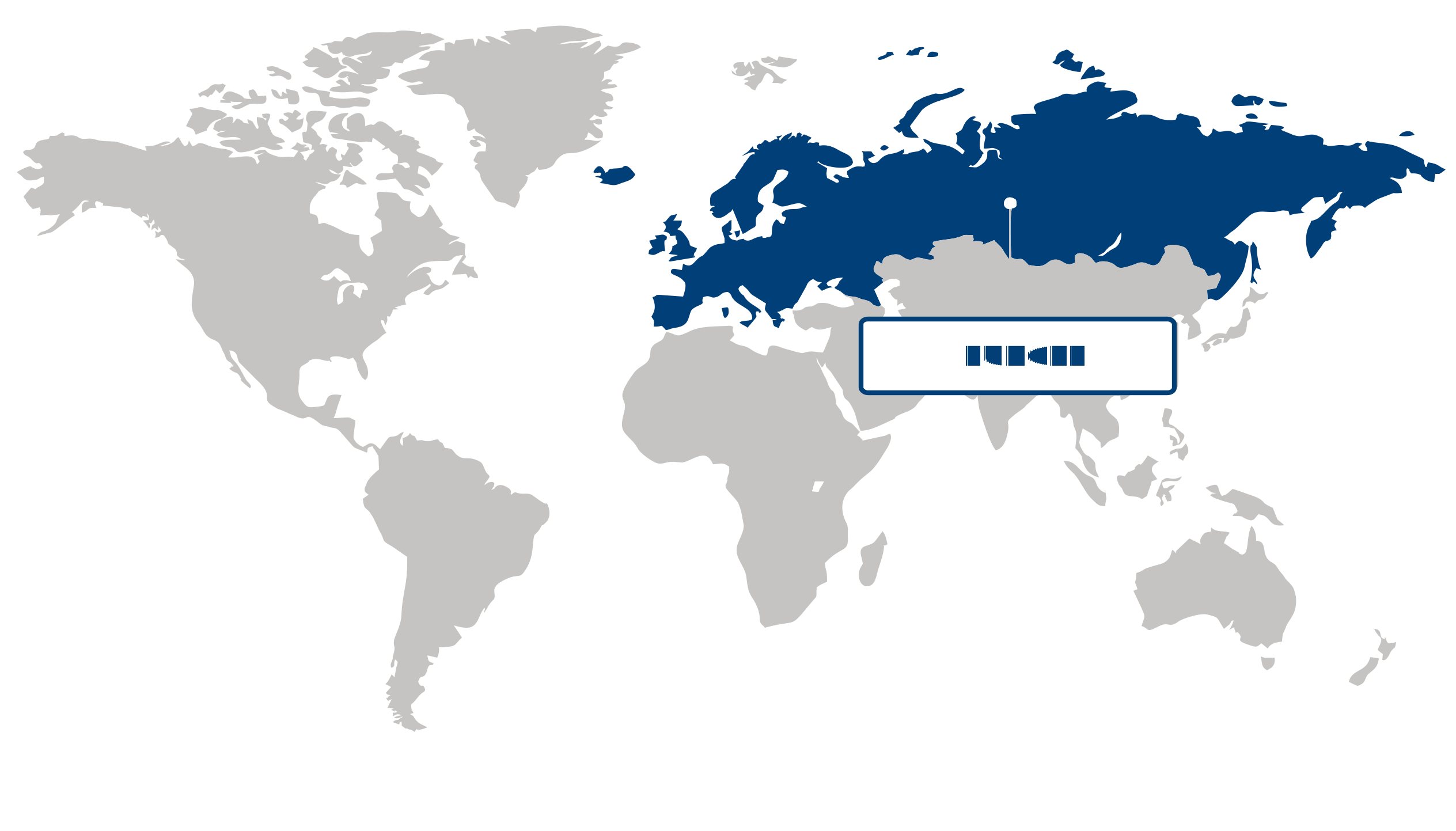
Europe (Largest Region)
Europe accounted for the largest share of the sorting machines market in 2026, supported by advanced industrial automation, sophisticated recycling infrastructure, and strong adoption of technologies designed to improve material handling efficiency. The region's emphasis on resource recovery, waste reduction, and sustainable manufacturing is encouraging investment in automated sorting solutions across recycling, food processing, mining, and logistics applications. Mature industrial systems and increasing demand for accurate, high-speed separation are further supporting deployment, while sustainability-focused policies are reinforcing the need for efficient sorting and recovery processes.
Asia Pacific (Fastest-Growing Region)
Asia Pacific is experiencing the fastest growth as industrialization, manufacturing expansion, and infrastructure development increase demand for automated material separation technologies. Rising waste generation and growing investments in recycling facilities are creating opportunities for advanced sorting systems, particularly as governments and industries place greater emphasis on resource efficiency. Expansion of food processing, mining, logistics, and packaging industries is also broadening the range of applications. Increasing automation and modernization of production facilities are further encouraging manufacturers to adopt sorting equipment that can improve throughput, consistency, and operational efficiency.
| Parameter | North America | Asia Pacific | Europe | Latin America | MEA |
|---|---|---|---|---|---|
| Innovation Hub i Scale Nascent Developing Advanced | |||||
| Cost-Sensitive Region i Scale Low Medium High | |||||
| Regulatory Environment i Scale Restrictive Neutral Supportive | |||||
| Demand Drivers i Scale Weak Moderate Strong | |||||
| Development Stage i Scale Emerging Developing Developed | |||||
| Adoption Rate i Scale Low Medium High | |||||
| New Entrants / Startups i Scale Sparse Moderate Dense | |||||
| Macro Indicators i Scale Weak Stable Strong |
Key Country Insights
Germany 🇩🇪
Industrial Automation IntegrationGermany prioritizes sorting machines that integrate with advanced manufacturing and warehouse automation systems. German industries focus on precision sorting, operational reliability, and digital process optimization to improve efficiency across industrial production and material handling applications.
France 🇫🇷
Recycling Process OptimizationFrance emphasizes sorting machines that strengthen recycling efficiency and resource recovery initiatives. French operators increasingly adopt automated systems capable of improving material separation accuracy while supporting evolving waste management and industrial processing requirements.
Italy 🇮🇹
Flexible Industrial HandlingItaly adopts sorting machines that support diverse manufacturing, packaging, and food processing operations. Italian companies prioritize adaptable automation solutions that improve product handling efficiency while accommodating varied production volumes and operational requirements.
Japan 🇯🇵
Precision Sorting TechnologyJapan advances the sorting machines market through compact, high-accuracy equipment designed for manufacturing and food processing environments. Japanese businesses emphasize consistent product quality, automation, and equipment reliability to support efficient production workflows.
South Korea 🇰🇷
Smart Logistics AutomationSouth Korea expands the use of sorting machines as logistics providers and manufacturers modernize distribution infrastructure. Businesses prioritize AI-enabled sorting, real-time monitoring, and automated handling systems that improve operational responsiveness and warehouse productivity.
United States 🇺🇸
Automated Processing EfficiencyThe U.S. sorting machines market is driven by demand for automated handling across logistics, food processing, and recycling operations. Companies invest in intelligent sorting technologies that improve throughput, reduce manual intervention, and support increasingly complex distribution requirements.
Segment Leadership and Growth Trends
Sorting Machines Market Share (%), by Product Type, 2026
Go beyond the chart, access full insights & data tables
Request Free Sample ReportProduct Type Segment Analysis: Optical Sorter (Largest Segment) vs Weight Sorter (Fastest-Growing Segment)
The optical sorter segment dominated the sorting machines market with a 60.27% share in 2026, supported by its ability to identify and separate materials based on visual characteristics such as color, shape, size, and surface attributes. Optical sorting improves product consistency and processing efficiency while reducing the need for manual inspection, making it valuable across food processing, recycling, and other material-handling operations. Increasing automation and the need for higher sorting accuracy are reinforcing the segment's leading position.
The weight sorter segment is the fastest-growing product type, driven by increasing demand for precise classification based on product mass and the need to maintain consistency in automated processing operations. Weight-based sorting can help manufacturers improve quality control, optimize packaging processes, and identify products that fall outside desired specifications. The broader shift toward automated production and tighter quality requirements is supporting increased adoption of weight sorting technologies.
End Use Segment Analysis: Food & Beverage Industry (Largest Segment) vs Waste Recycling (Fastest-Growing Segment)
The food & beverage industry accounted for the largest share of the sorting machines market, reaching 43.14% in 2026, due to the industry's strong need for consistent product quality, efficient processing, and removal of unwanted materials. Automated sorting systems can help classify food products according to physical characteristics while improving throughput and reducing dependence on manual inspection. Increasing emphasis on food safety, product uniformity, and process automation continues to sustain demand for advanced sorting equipment in this industry.
Waste recycling is the fastest-growing end-use segment, supported by increasing efforts to improve material recovery and make recycling processes more efficient. Automated sorting technologies can separate recyclable materials more accurately, helping processing facilities improve the quality and usability of recovered resources. Growing environmental awareness, efforts to reduce landfill dependence, and the transition toward more circular resource-management practices are creating strong opportunities for sorting machines in recycling applications.
:::
| Segment | Sub-Segment | Largest Segment | Fastest Growing |
|---|---|---|---|
| Product Type | Optical Sorter, Weight Sorter, Others | Optical Sorter | Weight Sorter |
| End Use | Food & Beverage Industry, Pharmaceutical, Waste Recycling, Mining, Others | Food & Beverage Industry | Waste Recycling |
Competitive Landscape and Market Positioning
Leading companies in the sorting machines market:
1. TOMRA Systems ASA (Norway)
2. Bühler Group (Switzerland)
3. Dematic (United States)
4. Sesotec GmbH (Germany)
5. Satake Corporation (Japan)
6. GREEFA (Netherlands)
7. Cimbria A/S (Denmark)
8. National Recovery Technologies LLC (United States)
9. Raytec Vision S.p.A. (Italy)
The sorting machines market is being shaped by increasing demand for automated systems capable of improving accuracy, throughput, and resource optimization across industrial applications. Investments in advanced sensor technologies and AI-enabled sorting solutions are helping improve operational efficiency while reducing waste generation. The growing emphasis on eco-friendly processing systems is further encouraging the development of energy-efficient and sustainable sorting technologies.
| Company | Market Share | Company Revenue | Revenue CAGR (%) | Product Portfolio | Geographic Presence | Innovation / R&D Focus | Strategic Developments |
|---|---|---|---|---|---|---|---|
| TOMRA Systems ASA (Norway) | |||||||
| Bühler Group (Switzerland) | |||||||
| Dematic (United States) | |||||||
| Sesotec GmbH (Germany) | |||||||
| Satake Corporation (Japan) | |||||||
| GREEFA (Netherlands) | |||||||
| Cimbria A/S (Denmark) | |||||||
| National Recovery Technologies LLC (United States) | |||||||
| Raytec Vision S.p.A. (Italy). |
Industry Development/News
| Company Name | Date | Key Development |
|---|---|---|
| Kimco | Feb-26 | Kimco modernized its processing infrastructure by deploying a fully integrated line featuring six new optical sorting machines. This capital investment represents a significant upgrade to the facility's technical throughput and operational efficiency, reflecting a shift toward higher-capacity, automated sorting systems. |
| Pellenc ST | Nov-25 | Pellenc ST supplied advanced optical sorting hardware and its AISEE artificial intelligence analyzer to a French materials recovery facility. The deployment demonstrates the integration of machine learning into standard sorting workflows to enhance automated material identification and overall throughput performance. |
| Steinert | Sep-25 | Steinert expanded its smart sorting portfolio with new capabilities targeting complex waste streams, specifically flexible packaging and black plastics. The technological development strengthens the ability of recycling operators to recover high-value materials from historically difficult-to-process waste flows. |
| Conservit | Jul-25 | Conservit executed an operational expansion by integrating additional STEINERT sorting equipment into its existing facility. The investment serves to modernize its material recovery capabilities, allowing the company to process more complex waste streams and broaden its overall recycling service offerings. |
| Tomra Recycling | Apr-25 | Tomra Recycling partnered with Doğa PET to deploy sensor-based sorting solutions for PET recycling in Türkiye. The integration of this technology enables the production of high-purity recycled PET materials, directly supporting circular economy requirements for food-grade and textile applications. |
| ISO Horti | Feb-25 | ISO Horti merged with TTA to consolidate technology development efforts. This strategic combination aims to accelerate innovation in horticultural automation and expand the companies' collective capabilities in advanced sorting solutions for global growers. |
| Visar Sorting | Aug-24 | Visar Sorting introduced a specialized optical sorter designed for the seed potato market. This development marks an expansion of the company’s high-precision sorting technology into specific agricultural processing segments, enhancing quality control and output consistency for seed producers. |
| Dematic | Apr-24 | Dematic established a regional office in Riyadh, Saudi Arabia, to address rising demand for logistics automation. The expansion strengthens the company's regional service and project management capabilities, positioning it to provide automated sorting solutions across e-commerce and pharmaceutical sectors. |
| DHL Express | Mar-24 | DHL Express inaugurated an automated shipment sorting hub in New Delhi, capable of processing 2,000 pieces per hour. The investment incorporates advanced sorting machinery, resulting in a targeted 30% increase in facility productivity and enhanced parcel processing efficiency. |
| Recology | Jan-24 | Recology launched a high-tech materials recovery facility in Santa Rosa, California, following a $35 million investment. The facility leverages advanced automated sorting technologies to significantly increase regional processing capacity and improve overall material recovery rates for recycling operations. |
Customize Your Report
Explore examples of how this report can be tailored to different research needs, including custom segments, additional topics or chapters, and related reports. Click a section of the wheel or its numbered marker to explore the available options.
Sorting Machines Market — Custom Segments
| Segment | Sub-Segment |
|---|---|
| Sorting Technology | Optical Sorting, Magnetic Sorting, Eddy Current Sorting, X-Ray Sorting, Laser Sorting |
| Automation Level | Semi-Automated, Fully Automated, AI-Enabled Autonomous |
| Processing Capacity | Low Capacity, Medium Capacity, High Capacity |
Sorting Machines Market — Custom TOC
| Custom Chapter | Custom Details |
|---|---|
| Automation Investment Opportunity Assessment |
|
| End-User Plant Modernization Roadmap |
|
| Total Cost of Ownership Benchmark |
|
Need a different cut of the data?
Request Custom ResearchHow much is the sorting machines market worth?
How will the sorting machines industry grow in terms of size and CAGR by 2036?
How is automation in food processing driving demand for advanced sorting systems in the sorting machines market?
Why is smart factory modernization accelerating adoption of AI-enabled sorting machines?
Why do Optical Sorters lead the sorting machines market?
Why is Waste Recycling the fastest-growing end-use segment?
Why does Europe lead the sorting machines market?
What is driving Asia Pacific growth in the sorting machines market?
What are the key competitors in the sorting machines landscape?
Our Clients
"The team at Fundamental Business Insights & Consulting demonstrated a commitment to excellence, not only in the quality of the report but also in their client-centric approach."
FANUC
"The level of detail in the market segmentation provided were particularly noteworthy. The detailed country-level insights were also very helpful."
B&R Industrial Automation GmbH
"The consultant took the time to understand our specific business objectives, ensuring that the reports were tailored to address our unique challenges and opportunities."
KUKA SE & Co. KGaA
Our Research Team & Methodology
Every Fundamental Business Insights report is built by a dedicated vertical research team, validated through a structured primary-and-secondary methodology, and reviewed for accuracy before it reaches you.
Research Team Overview
Prepared by the Industrial Automation & Equipment Research Team
Delivery
Published
Demand
Available
Support
Trust & Compliance
Research Domains
10 coverage areasResearch Intelligence
| Source | Reference |
|---|---|
| International Society of Automation (ISA) | www.isa.org |
| International Organization for Standardization (ISO) | www.iso.org |
| National Institute of Standards and Technology (NIST) | www.nist.gov |
| IEEE | www.ieee.org |
| VDMA (German Mechanical Engineering Industry Association) | www.vdma.org |
| Association for Advancing Automation (A3) | www.automate.org |
| International Federation of Robotics (IFR) | ifr.org |
| ASME (American Society of Mechanical Engineers) | www.asme.org |
| ASHRAE | www.ashrae.org |
| American Society of Heating, Refrigerating and Air-Conditioning Engineers (ASHRAE) | www.ashrae.org |
| Material Handling Industry (MHI) | www.mhi.org |
| OSHA (Occupational Safety and Health Administration) | www.osha.gov |
| National Fire Protection Association (NFPA) | www.nfpa.org |
| ASTM International | www.astm.org |
| International Electrotechnical Commission (IEC) | www.iec.ch |
| Open Process Automation Forum (The Open Group) | www.opengroup.org/open-process-automation-forum |
| AGMA (American Gear Manufacturers Association) | www.agma.org |
| Association of Equipment Manufacturers (AEM) | www.aem.org |
| Food and Agriculture Organization (FAO) | www.fao.org |
| International Labour Organization (ILO) | www.ilo.org |
Research Workflow & Quality Assurance
Data Collection
Verified information gathered through primary and secondary research.
Data Triangulation
Cross-validation using multiple independent data sources.
Forecast Modelling
Market estimates developed using historical trends and analytical models.
Analyst Validation
Findings reviewed by domain experts for accuracy and consistency.
Editorial & Quality Review
Final editorial, quality, and compliance checks before publication.
Final Publication
Released after successful completion of the internal review process.
Report Coverage
📊 Market Assessment
- Market Size & Forecast
- Market Segmentation
- Regional Analysis
- Growth Drivers & Challenges
- Market Dynamics
🏢 Competitive Intelligence
- Competitive Landscape
- Company Profiles
- Competitive Benchmarking
- Mergers & Acquisitions
- Market Share Analysis or Key Company Strategies
🔍 Strategic Analysis
- Value Chain Analysis
- Porter's Five Forces
- PESTLE Analysis
- Pricing Trends
- Supply-Demand Analysis
🚀 Future Outlook
- Technology Landscape
- Regulatory Landscape
- Investment & Funding Landscape
- Emerging Opportunities
- Future Market Outlook
Have a question about this report or need a custom scope?
Request Customization