Reverse Factoring Market Size & Growth Forecast 2027–2036, By Segments (Financial Institution, End Use, Category), Regional Demand Trends (North America, Asia Pacific, Europe), Key Country Insights (U.S., Japan, South Korea, Germany, France, Italy), and Competitive Landscape
Market Size and Growth Outlook
Reverse Factoring Market size stood at USD 723.97 Billion in 2026 and is predicted to grow at 10.6% CAGR from 2027 to 2036, crossing USD 1.98 Trillion by 2036. The industry revenue for 2027 is assessed at USD 789.13 Billion.
Get more details on this report
Request Free Sample ReportReverse Factoring Market Intelligence Snapshot
Regional Market Dynamics
- Europe held a 51.94% share in 2026, supported by mature financial infrastructure, established supplier networks, digital platforms, and strong focus on working capital efficiency.
- Expanding manufacturing, complex supply chains, digital financial services, and demand for supplier liquidity solutions are strengthening adoption across the region.
Segment Momentum
- Banks held a 73.92% market share in 2026 due to their strong financial resources, established credit assessment capabilities, extensive corporate networks, and ability to deliver large-scale supplier financing programs with competitive terms.
- The international category is the fastest-growing segment as expanding cross-border trade and global supplier networks increase demand for financing solutions that improve liquidity and streamline payments across multiple jurisdictions.
Market Expansion Drivers
- Rising working capital optimization needs driving corporate adoption of reverse factoring solutions
- Growth in supply chain finance digitization accelerating online reverse factoring platform adoption
- Increasing SME financing constraints boosting demand for alternative trade finance mechanisms
Leading Market Participants
- Major companies in the reverse factoring market include JPMorgan Chase & Co. (USA), Citigroup Inc. (USA), HSBC Holdings plc (United Kingdom), Bank of America Corporation (USA), Barclays plc (United Kingdom), Deutsche Bank AG (Germany), Axis Bank Ltd. (India), PrimeRevenue, Inc. (USA), Drip Capital Inc. (USA), Standard Chartered plc (United Kingdom)
Global Market Forecast Snapshot
Market Outlook
- 2026 Market Size: USD 723.97 Billion
- 2027 Estimated Market Size: USD 789.13 Billion
- Projected Market Size: USD 1.98 Trillion by 2036
- Growth Forecast: 10.6% CAGR (2027-2036)
Regional and Segment Outlook
- Leading Regional Market: Europe
- High-Growth Regional Hub: Asia Pacific
- Core Revenue Segment: Banks (Financial Institution) | Manufacturing (End Use) | Domestic (Category)
- Emerging Opportunity Segment: Non-banking Financial Institutions (Financial Institution) | Information Technology (End Use) | International (Category)
Market Growth Drivers and Industry Trends
Rising working capital optimization needs driving corporate adoption of reverse factoring solutions
Businesses are increasingly seeking financial strategies that improve liquidity without disrupting supplier relationships or extending operational risk. The reverse factoring market growth is driven by organizations using supplier finance programs to optimize cash flow while enabling suppliers to receive early payments through financial institutions. This approach strengthens supply chain resilience by balancing buyer payment terms with supplier liquidity needs, allowing enterprises to improve balance sheet efficiency while maintaining stable procurement operations and fostering stronger commercial partnerships.
Growth in supply chain finance digitization accelerating online reverse factoring platform adoption
Digital transformation across financial services is streamlining supply chain finance by replacing manual documentation with integrated online platforms that enhance transaction visibility and processing speed. As digital ecosystems mature, the reverse factoring market benefits from cloud-based solutions that automate invoice validation, payment approvals, and financing workflows for buyers, suppliers, and financial institutions. Improved transparency, faster onboarding, and seamless integration with enterprise resource planning systems are encouraging wider adoption of digital reverse factoring platforms across global supply chains.
Increasing SME financing constraints boosting demand for alternative trade finance mechanisms
Limited access to affordable working capital continues to challenge small and medium-sized enterprises, particularly those supplying large corporate buyers with extended payment cycles. This environment will propel the reverse factoring market growth by providing SMEs with earlier access to receivables financing based on the stronger credit profiles of purchasing organizations. The availability of alternative trade finance mechanisms helps suppliers improve cash flow stability, maintain production continuity, and strengthen participation in complex domestic and international supply chains.
| Growth Driver | Impact on CAGR | Regulatory Influence | Geographic Relevance | Adoption Rate | Impact Timeline |
|---|---|---|---|---|---|
| Rising working capital optimization needs driving corporate adoption of reverse factoring solutions | 2.3% | Moderate | Asia Pacific, Europe | High | Near Term |
| Growth in supply chain finance digitization accelerating online reverse factoring platform adoption | 2.1% | Moderate | North America, Asia Pacific | High | Near Term |
| Increasing SME financing constraints boosting demand for alternative trade finance mechanisms | 1.7% | Moderate | Europe, Latin America | High | Mid Term |
Unlock insights tailored to your business with our bespoke market research solutions.
Click to get your customized report now.
Regional Demand Dynamics
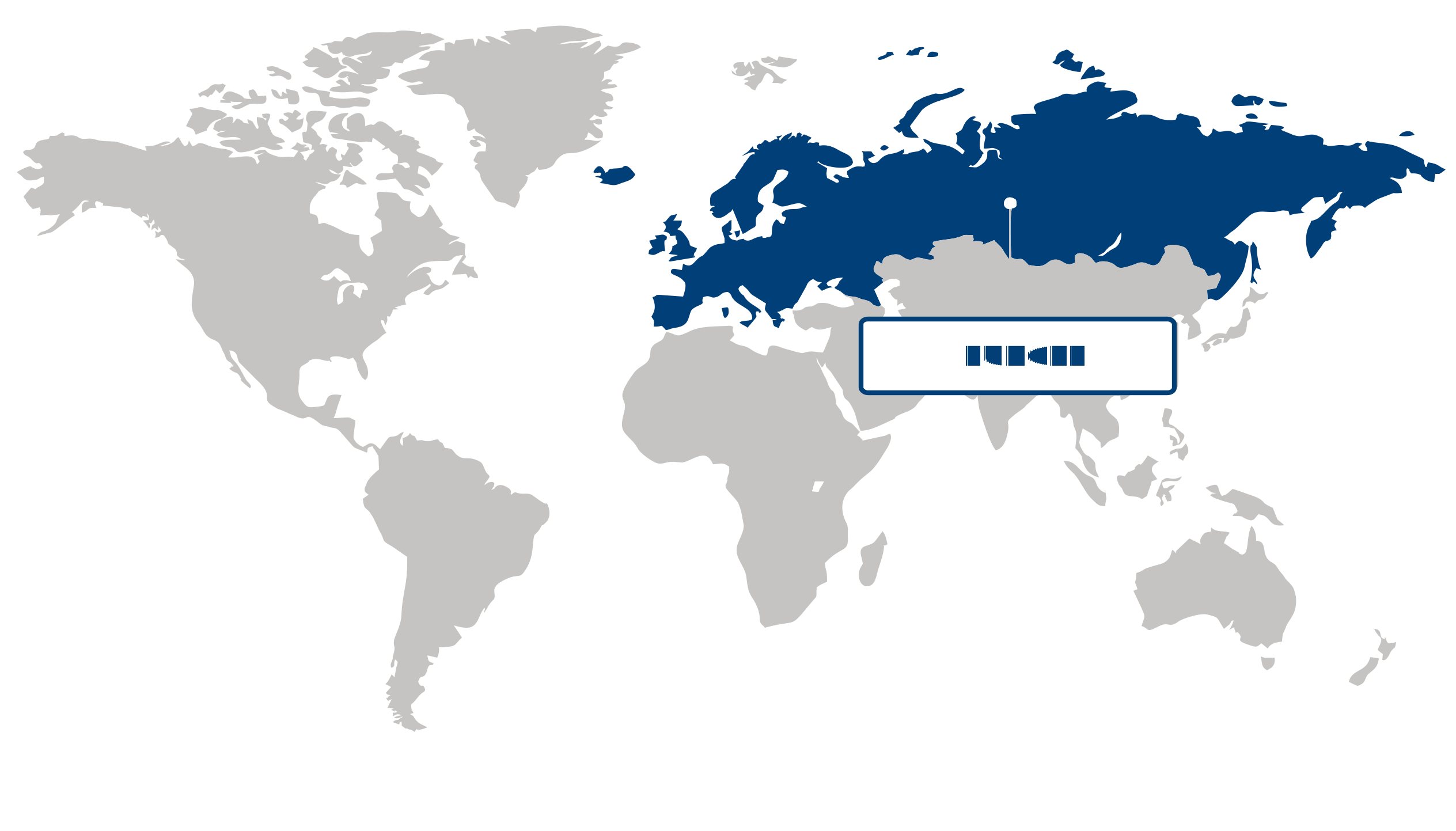
Europe (Largest Region)
Europe dominated the reverse factoring market with a share of 51.94% in 2026, reflecting the region’s mature financial ecosystem, established supplier networks, and strong emphasis on improving working capital efficiency. Reverse factoring has gained relevance among businesses seeking to strengthen supplier relationships while providing vendors with earlier access to payments through buyer-supported financing arrangements. The presence of sophisticated banking and financial services infrastructure, combined with widespread adoption of digital financial platforms, supports efficient implementation of these programs. European companies are also increasingly focused on supply chain resilience and liquidity management, encouraging the use of financing solutions that can optimize cash flows without placing excessive pressure on smaller suppliers.
Asia Pacific (Fastest-Growing Region)
Asia Pacific is projected to be the fastest-growing region in the reverse factoring market, supported by expanding manufacturing and trading activity, increasingly complex supply chains, and growing awareness of alternative working capital solutions. The region’s large base of suppliers and export-oriented businesses creates substantial demand for financing mechanisms that can improve liquidity and support continuity across supply networks. Digitalization of financial services is also making supply chain finance more accessible to businesses, particularly as enterprises adopt integrated platforms for procurement, payments, and financial management. Greater emphasis on supporting small and medium-sized suppliers, combined with efforts to modernize financial infrastructure, is expected to strengthen the adoption of reverse factoring across the region.
| Parameter | North America | Asia Pacific | Europe | Latin America | MEA |
|---|---|---|---|---|---|
| Innovation Hub i Scale Nascent Developing Advanced | |||||
| Cost-Sensitive Region i Scale Low Medium High | |||||
| Regulatory Environment i Scale Restrictive Neutral Supportive | |||||
| Demand Drivers i Scale Weak Moderate Strong | |||||
| Development Stage i Scale Emerging Developing Developed | |||||
| Adoption Rate i Scale Low Medium High | |||||
| New Entrants / Startups i Scale Sparse Moderate Dense | |||||
| Macro Indicators i Scale Weak Stable Strong |
Key Country Insights
United States 🇺🇸
Enterprise Working CapitalThe U.S. reverse factoring market supports large enterprises seeking stronger supplier relationships through improved payment flexibility. Financial institutions and technology providers continue enhancing digital platforms that simplify invoice processing and strengthen supply chain liquidity management.
Germany 🇩🇪
Industrial Supply FinancingGermany emphasizes reverse factoring solutions that reinforce financial stability across complex manufacturing supply chains. Businesses increasingly adopt digital financing platforms to improve supplier cash flow while maintaining disciplined procurement and payment practices.
Japan 🇯🇵
Supplier Payment OptimizationJapan applies reverse factoring to strengthen collaboration between major corporations and long-term supplier networks. Companies prioritize efficient financing arrangements that improve payment certainty while supporting continuity across established manufacturing ecosystems.
South Korea 🇰🇷
Digital Finance IntegrationSouth Korea advances reverse factoring through digital financial platforms that improve invoice verification and supplier financing efficiency. The market increasingly values automated workflows that accelerate payment processes across industrial and export-oriented supply chains.
France 🇫🇷
Procurement Finance AlignmentFrance adopts reverse factoring as part of broader procurement and financial process optimization strategies. Businesses increasingly seek financing solutions that enhance supplier confidence while improving visibility across corporate payment operations.
Italy 🇮🇹
SME Supply SupportItaly utilizes reverse factoring to improve financial flexibility for suppliers serving manufacturing and industrial customers. Companies increasingly value financing arrangements that strengthen commercial relationships while reducing payment-related operational pressures throughout supply chains.
Segment Leadership and Growth Trends
Reverse Factoring Market Share (%), by Financial institution, 2026
Go beyond the chart, access full insights & data tables
Request Free Sample ReportFinancial Institution Segment Analysis: Banks (Largest Segment) vs Non-banking Financial Institutions (Fastest-Growing Segment)
The banks segment dominated the reverse factoring market with a 73.92% share in 2026. Banks possess extensive financial resources, established credit assessment capabilities, and broad corporate client networks, making them the preferred providers of reverse factoring solutions. Their ability to offer competitive financing terms and manage large-scale supplier financing programs has contributed significantly to market leadership. Increasing demand for working capital optimization and supply chain financing solutions continues to reinforce the position of banks within the market.
The non-banking financial institutions segment is witnessing the fastest growth as businesses seek more flexible and specialized financing alternatives. These institutions are increasingly leveraging digital platforms and innovative financing models to serve a wider range of enterprises, including those with unique funding requirements. Growing demand for alternative financing channels and the expansion of fintech-enabled supply chain finance solutions are supporting the rapid development of this segment.
End Use Segment Analysis: Manufacturing (Largest Segment) vs Information Technology (Fastest-Growing Segment)
The manufacturing end-use segment accounted for the largest share of the reverse factoring market in 2026. Manufacturing companies often operate complex supply chains involving multiple suppliers, creating a strong need for efficient payment and financing mechanisms. Reverse factoring helps manufacturers improve supplier relationships, strengthen cash flow management, and enhance supply chain stability. The segment’s leadership is further supported by the ongoing need to optimize working capital across large-scale production networks.
The information technology end-use segment is emerging as the fastest-growing category due to the increasing complexity of technology supply chains and the growing demand for flexible financing arrangements. As technology companies expand operations and collaborate with diverse supplier ecosystems, reverse factoring solutions are becoming valuable tools for improving liquidity and supporting business continuity. Continued digital transformation across industries is also creating new opportunities for financing solutions tailored to the needs of technology-focused organizations.
Category Segment Analysis: Domestic (Largest Segment) vs International (Fastest-Growing Segment)
The domestic category represented the largest share of the reverse factoring market in 2026. Domestic reverse factoring programs benefit from simpler regulatory environments, familiar financial frameworks, and closer relationships between buyers, suppliers, and financing providers. These advantages facilitate implementation and encourage widespread adoption among businesses seeking to improve payment processes and supply chain efficiency within their home markets.
The international category is anticipated to be the fastest-growing segment as companies increasingly engage in cross-border trade and global supply chain activities. International reverse factoring solutions help businesses address payment challenges across multiple jurisdictions while improving liquidity for suppliers operating in different regions. The continued globalization of commerce and the expansion of international supplier networks are key factors driving growth in this segment.
| Segment | Sub-Segment | Largest Segment | Fastest Growing |
|---|---|---|---|
| Financial Institution | Banks, Non-banking Financial Institutions | Banks | Non-banking Financial Institutions |
| End Use | Manufacturing, Transport & Logistics, Information Technology, Healthcare, Construction, Others | Manufacturing | Information Technology |
| Category | Domestic, International | Domestic | International |
Competitive Landscape and Market Positioning
Leading companies in the reverse factoring market:
- JPMorgan Chase & Co. (USA)
- Citigroup, Inc. (USA)
- HSBC Holdings plc (United Kingdom)
- Bank of America Corporation (USA)
- Barclays plc (United Kingdom)
- Deutsche Bank AG (Germany)
- Axis Bank Ltd. (India)
- PrimeRevenue, Inc. (USA)
- Drip Capital, Inc. (USA)
- Standard Chartered plc (United Kingdom)
Competitive positioning is increasingly shaped by the ability to deliver financing platforms that integrate seamlessly with enterprise procurement and payment workflows while improving transparency for buyers, suppliers, and financial institutions. Providers are expanding beyond transaction financing by incorporating automation, real-time risk assessment, and digital onboarding capabilities that reduce operational complexity and accelerate working capital access. As supply chain resilience becomes a greater strategic priority, rivalry is shifting toward ecosystem breadth, interoperability with existing financial infrastructure, and the capacity to support complex multi-party financing environments across diverse industries.
| Company | Market Share | Company Revenue | Revenue CAGR (%) | Product Portfolio | Geographic Presence | Innovation / R&D Focus | Strategic Developments |
|---|---|---|---|---|---|---|---|
| JPMorgan Chase & Co. (USA) | |||||||
| Citigroup Inc. (USA) | |||||||
| HSBC Holdings plc (United Kingdom) | |||||||
| Bank of America Corporation (USA) | |||||||
| Barclays plc (United Kingdom) | |||||||
| Deutsche Bank AG (Germany) | |||||||
| Axis Bank Ltd. (India) | |||||||
| PrimeRevenue Inc. (USA) | |||||||
| Drip Capital Inc. (USA) | |||||||
| Standard Chartered plc (United Kingdom) |
Industry Development/News
| Company Name | Date | Key Development |
|---|---|---|
| Bangladesh Bank | Jun-26 | Bangladesh Bank established a comprehensive trade finance framework authorizing alternative corporate financing mechanisms beyond traditional letters of credit, providing formal regulatory infrastructure for supply chain finance and reverse factoring adoption. |
| FactorAvenue | Apr-26 | FactorAvenue commercialized a cloud-based, AI-powered software architecture engineered for factoring companies to automate corporate receivables finance operations and improve structural processing efficiency for reverse factoring transactions. |
| 121 Finance | Oct-24 | 121 Finance acquired AcceptMyInvoice.com to integrate its specialized trade credit technology, accelerate customer acquisition, and expand value-added services supporting domestic factoring and reverse factoring solutions specifically targeted toward MSMEs. |
| CredAble | Feb-24 | CredAble formed a strategic alliance with SBI Global Factors to deploy technology-driven domestic and export factoring, reverse factoring, and letter of credit bill discounting services, expanding digital supply chain finance infrastructure. |
| Bank of America | Sep-23 | Bank of America introduced CashPro Supply Chain Solutions as the cornerstone of a multi-year development roadmap designed to expand its technology-driven supply chain management and competitive reverse factoring offerings for global corporate clients. |
Customize Your Report
Explore examples of how this report can be tailored to different research needs, including custom segments, additional topics or chapters, and related reports. Click a section of the wheel or its numbered marker to explore the available options.
Reverse Factoring Market — Custom Segments
| Segment | Sub-Segment |
|---|---|
| Supplier Size | Micro & Small Enterprises, Medium Enterprises, Large Enterprises |
| Pricing Model | Transaction-Based Fees, Discount-Rate Based Pricing, Subscription-Based Pricing, Hybrid Pricing |
| Platform Delivery Model | Bank-Led Platforms, Fintech-Led Platforms, Enterprise-Integrated Platforms |
Reverse Factoring Market — Custom TOC
| Custom Chapter | Custom Details |
|---|---|
| Supplier Onboarding and Adoption Strategy |
|
| Buyer Working Capital Optimization |
|
| Platform-Led Supply Chain Finance Strategy |
|
Need a different cut of the data?
Request Custom ResearchWhat is the current revenue of the reverse factoring market?
How is the reverse factoring industry size expected to evolve during the forecast period?
Why are companies increasingly adopting reverse factoring solutions?
How is digital transformation accelerating the reverse factoring market?
Why do banks lead the reverse factoring market?
What is driving the growth of the international category in the reverse factoring market?
Why does Europe lead the reverse factoring market?
What is driving the fastest growth of reverse factoring in Asia Pacific?
Which companies are driving growth in the reverse factoring landscape?
Our Clients
"The report provided us with a clear direction, and the level of detail was beyond what we expected. I would definitely recommend their services to others."
Haier Appliances
"The collaboration with Fundamental Business Insights has added significant value to our decision-making process, and we look forward to continuing this partnership for our future market research requirements."
Luxottica Group S.p.A.
"The team at FBI delivered an exceptional research report. The insights on industry innovations were particularly impressive and added a lot of value to the overall report."
Nike
Our Research Team & Methodology
Every Fundamental Business Insights report is built by a dedicated vertical research team, validated through a structured primary-and-secondary methodology, and reviewed for accuracy before it reaches you.
Research Team Overview
Prepared by the Consumer Goods & Services Research Team
Delivery
Published
Demand
Available
Support
Trust & Compliance
Research Domains
10 coverage areasResearch Intelligence
| Source | Reference |
|---|---|
| International Organization for Standardization (ISO) | www.iso.org |
| ASTM International | www.astm.org |
| U.S. Consumer Product Safety Commission (CPSC) | www.cpsc.gov |
| European Commission – Consumer Safety | ec.europa.eu/safety-gate |
| Consumer Technology Association (CTA) | www.cta.tech |
| National Retail Federation (NRF) | nrf.com |
| World Retail Congress | www.worldretailcongress.com |
| World Travel & Tourism Council (WTTC) | wttc.org |
| UN Tourism | www.unwto.org |
| Personal Care Products Council (PCPC) | www.personalcarecouncil.org |
| Cosmetics Europe | cosmeticseurope.eu |
| International Housewares Association (IHA) | www.housewares.org |
| American Apparel & Footwear Association (AAFA) | www.aafaglobal.org |
| World Federation of the Sporting Goods Industry (WFSGI) | wfsgi.org |
| Juvenile Products Manufacturers Association (JPMA) | www.jpma.org |
| Pet Industry Joint Advisory Council (PIJAC) | pijac.org |
| International Council of Toy Industries (ICTI) | www.toy-icti.org |
| International Association of Amusement Parks and Attractions (IAAPA) | iaapa.org |
| Organisation for Economic Co-operation and Development (OECD) | www.oecd.org |
| World Bank Data | data.worldbank.org |
Research Workflow & Quality Assurance
Data Collection
Verified information gathered through primary and secondary research.
Data Triangulation
Cross-validation using multiple independent data sources.
Forecast Modelling
Market estimates developed using historical trends and analytical models.
Analyst Validation
Findings reviewed by domain experts for accuracy and consistency.
Editorial & Quality Review
Final editorial, quality, and compliance checks before publication.
Final Publication
Released after successful completion of the internal review process.
Report Coverage
📊 Market Assessment
- Market Size & Forecast
- Market Segmentation
- Regional Analysis
- Growth Drivers & Challenges
- Market Dynamics
🏢 Competitive Intelligence
- Competitive Landscape
- Company Profiles
- Competitive Benchmarking
- Mergers & Acquisitions
- Market Share Analysis or Key Company Strategies
🔍 Strategic Analysis
- Value Chain Analysis
- Porter's Five Forces
- PESTLE Analysis
- Pricing Trends
- Supply-Demand Analysis
🚀 Future Outlook
- Technology Landscape
- Regulatory Landscape
- Investment & Funding Landscape
- Emerging Opportunities
- Future Market Outlook
Have a question about this report or need a custom scope?
Request Customization