Medical Smart Rings Market Size & Growth Forecast 2027–2036, By Segments (Product, End-use, Application, Distribution Channel), Regional Demand Trends (North America, Asia Pacific, Europe), Key Country Insights (U.S., Japan, South Korea, Germany, France, Italy), and Competitive Landscape
Market Size and Growth Outlook
Medical Smart Rings Market size was valued at USD 502.4 million in 2026 and is anticipated to grow at a 20.05% CAGR from 2027 to 2036, reaching USD 3.12 billion by 2036. The industry revenue for 2027 is calculated at USD 587.21 million.
Get more details on this report
Request Free Sample ReportMedical Smart Rings Market Intelligence Snapshot
Regional Market Dynamics
- Asia Pacific held a 33.16% market share in 2026, supported by a large consumer base, increasing connected health monitoring adoption, and growing use of wearable devices for daily health tracking.
- Asia Pacific is forecast to expand at a 22.55% CAGR as preventive care awareness, app-linked health ecosystems, and demand for compact wearable monitoring devices continue to increase.
Segment Momentum
- Consumers accounted for 59.33% of the market in 2026, driven by strong demand for personal health awareness, self-monitoring, and daily wearable use that fits naturally into individual routines.
- Diagnostic Rings are gaining momentum because they support targeted clinical insight, earlier detection, and condition-specific monitoring, aligning with increasing demand for more medically relevant wearable functionality.
Market Expansion Drivers
- Rising demand for continuous non-invasive biometric health monitoring driving wearable adoption.
- Integration of AI and IoT sensors enhancing accuracy of real-time health tracking devices.
- Growing chronic disease prevalence increasing adoption of remote preventive health monitoring solutions.
Leading Market Participants
- Key players in the medical smart rings market include Ōura Health Oy (Finland), Sky Labs Inc. (South Korea), Circular SAS (France), Movano Inc. (United States), Ultrahuman Healthcare Pvt. Ltd. (India), Samsung Electronics Co., Ltd. (South Korea), Wellue Inc. (China), Bodimetrics Health Analytics, Inc. (United States), SleepOn Inc. (United States), Prevention Circulatory Technology s.r.o. (Czech Republic).
Global Market Forecast Snapshot
Market Outlook
- 2026 Market Size: USD 502.4 million
- 2027 Estimated Market Size: USD 587.21 million.
- Projected Market Size: USD 3.12 billion by 2036
- Growth Forecast: 20.05% CAGR (2027-2036)
Regional and Segment Outlook
- Leading Regional Market: Asia Pacific
- High-Growth Regional Hub: Asia Pacific
- Core Revenue Segment: Health Monitoring Rings (Product) | Consumers (End-use) | Chronic Disease Management (Application) | Online Retail (Distribution Channel)
- Emerging Opportunity Segment: Diagnostic Rings (Product) | Healthcare Providers (End-use) | Remote Patient Monitoring (Application) | Online Retail (Distribution Channel)
Market Growth Drivers and Industry Trends
Rising demand for continuous non-invasive biometric health monitoring driving wearable adoption
The medical smart rings market is gaining momentum as consumers and healthcare users increasingly seek continuous, non-invasive ways to monitor biometric health indicators without disrupting daily activities. Unlike intermittent measurements, smart rings can support ongoing health tracking through compact wearable formats, encouraging broader adoption among users prioritizing convenient and unobtrusive monitoring. This shift toward continuous personal health observation is strengthening demand for wearable devices that integrate health monitoring into everyday routines.
Integration of AI and IoT sensors enhancing accuracy of real-time health tracking devices
Integration of AI capabilities and IoT-enabled sensors is improving the functionality of the medical smart rings market by supporting more accurate and responsive real-time health tracking. Advanced sensing technologies can capture biometric information continuously, while AI can help interpret collected data and identify meaningful patterns. This combination enhances the practical value of smart rings for users seeking timely health insights and more intelligent wearable monitoring experiences.
Growing chronic disease prevalence increasing adoption of remote preventive health monitoring solutions
Rising chronic disease prevalence is encouraging greater use of remote and preventive monitoring technologies, creating favorable demand conditions for the medical smart rings market. Smart rings provide a convenient means of collecting health-related information outside conventional healthcare settings, supporting ongoing observation and enabling users to remain more engaged with their health status. Their compact design and continuous monitoring capabilities make them suitable for integrating preventive health tracking into regular routines.
| Growth Driver | Impact on CAGR | Regulatory Influence | Geographic Relevance | Adoption Rate | Impact Timeline |
|---|---|---|---|---|---|
| Rising demand for continuous non-invasive biometric health monitoring driving wearable adoption | 2.00% | Moderate | North America, Europe, Asia Pacific | High | Near Term |
| Integration of AI and IoT sensors enhancing accuracy of real-time health tracking devices | 1.80% | Moderate | North America, Asia Pacific | High | Mid Term |
| Growing chronic disease prevalence increasing adoption of remote preventive health monitoring solutions | 1.60% | High | North America, Europe | High | Near Term |
Unlock insights tailored to your business with our bespoke market research solutions.
Click to get your customized report now.
Regional Demand Dynamics
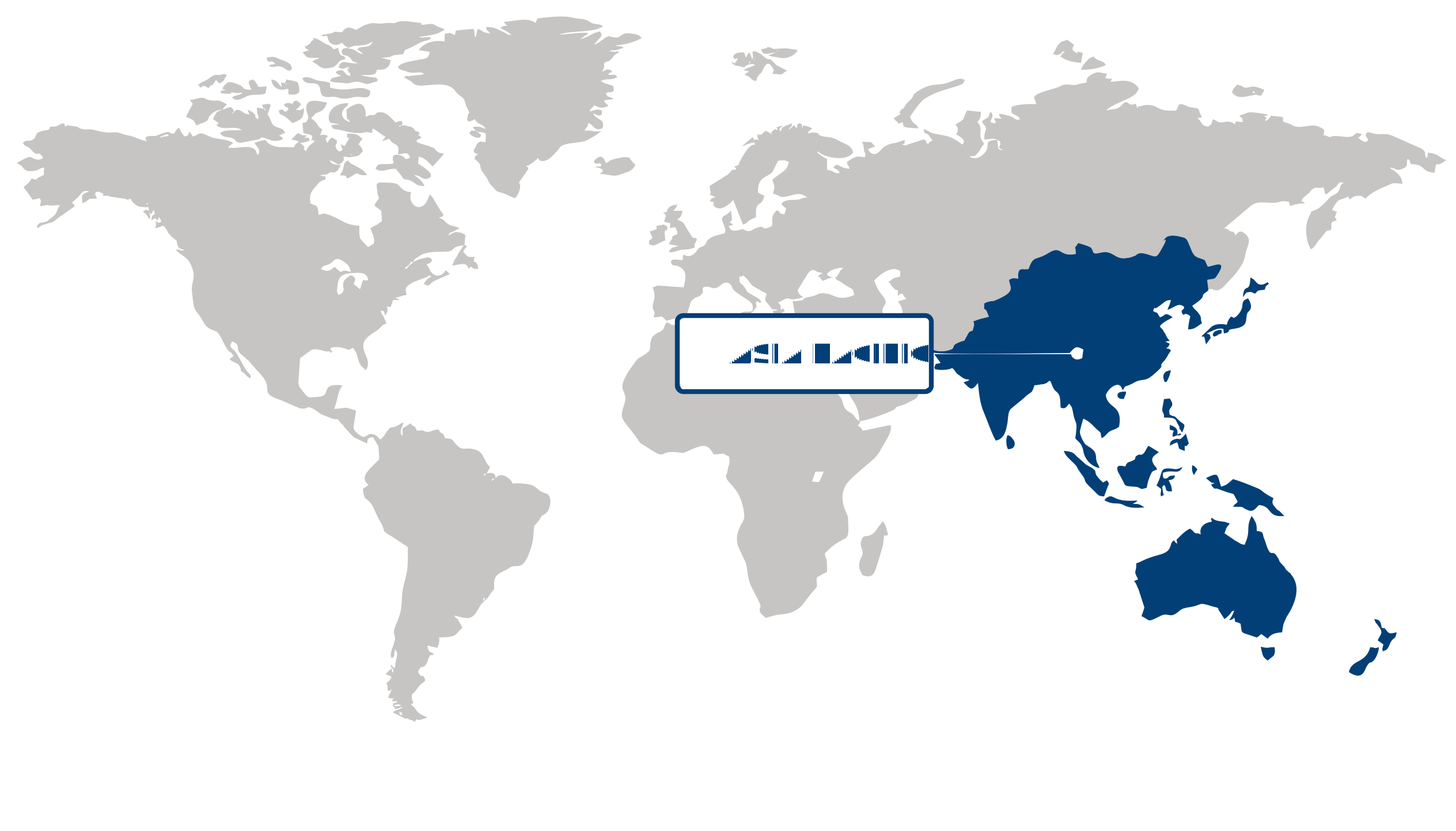
Asia Pacific (Largest & Fastest-Growing Region)
The medical smart rings market in Asia Pacific accounted for a 33.16% share in 2026, with the region also representing the fastest-growing market, supported by expanding digital healthcare ecosystems, rising health awareness, and increasing adoption of wearable monitoring technologies. Smart rings capable of tracking physiological indicators are gaining relevance as consumers and healthcare providers place greater emphasis on continuous, convenient health monitoring. Growing smartphone and connected-device penetration, expanding healthcare digitization, and improving access to remote care are creating a favorable environment for medical-grade wearable technologies. The region's large consumer base and increasing interest in preventive healthcare further support the integration of smart rings into personal health management and connected-care models.
| Parameter | North America | Asia Pacific | Europe | Latin America | MEA |
|---|---|---|---|---|---|
| Innovation Hub i Scale Nascent Developing Advanced | |||||
| Cost-Sensitive Region i Scale Low Medium High | |||||
| Regulatory Environment i Scale Restrictive Neutral Supportive | |||||
| Demand Drivers i Scale Weak Moderate Strong | |||||
| Development Stage i Scale Emerging Developing Developed | |||||
| Adoption Rate i Scale Low Medium High | |||||
| New Entrants / Startups i Scale Sparse Moderate Dense | |||||
| Macro Indicators i Scale Weak Stable Strong |
Key Country Insights
Germany 🇩🇪
Clinical Wearable ValidationGermany prioritizes medical smart rings that demonstrate reliable biometric measurement and compatibility with digital healthcare services. Companies in Germany are advancing clinically relevant wearable technologies to support long-term health monitoring and patient engagement.
France 🇫🇷
Preventive Health WearablesFrance emphasizes medical smart rings that encourage preventive healthcare and long-term wellness tracking. Healthcare technology providers in France are expanding wearable solutions that combine user-friendly design with secure health data management.
Italy 🇮🇹
Consumer Medical WearablesItaly focuses on medical smart rings that combine health monitoring functionality with premium wearable design. Companies in Italy increasingly target consumers seeking convenient biometric tracking while supporting integration with broader digital healthcare platforms.
Japan 🇯🇵
Miniaturized Health TechnologyJapan leverages expertise in compact electronics to develop medical smart rings with precise physiological monitoring capabilities. Healthcare technology companies in Japan focus on comfort, battery efficiency, and dependable health data collection for everyday use.
South Korea 🇰🇷
Digital Wellness InnovationSouth Korea is integrating medical smart rings with connected health ecosystems, mobile applications, and AI-enabled wellness platforms. Manufacturers in South Korea continue introducing feature-rich wearable devices that support preventive health management and lifestyle monitoring.
United States 🇺🇸
Connected Health MonitoringThe U.S. medical smart rings market emphasizes continuous health monitoring, digital wellness platforms, and integration with remote patient management systems. Developers in the U.S. continue enhancing sensor accuracy and clinical-grade capabilities for preventive healthcare applications.
Segment Leadership and Growth Trends
Medical Smart Rings Market Share (%), by Product, 2026
Go beyond the chart, access full insights & data tables
Request Free Sample ReportProduct Segment Analysis: Health Monitoring Rings (Largest Segment) vs Diagnostic Rings (Fastest-Growing Segment)
Health monitoring rings accounted for the largest share of the medical smart rings market at 57.96% in 2026, driven by growing consumer interest in continuous, convenient tracking of health and wellness indicators. These devices provide a discreet wearable format for monitoring personal health information, supporting users who increasingly prioritize preventive care and ongoing awareness of their physical condition. The convenience of passive monitoring and integration into everyday routines continues to strengthen demand for health monitoring rings.
Diagnostic rings are gaining traction as smart wearable technologies increasingly move beyond general wellness toward more clinically relevant applications. Their ability to support more targeted health assessment can enhance the value of wearable monitoring for users and healthcare professionals seeking accessible health information. Growing interest in early detection, remote care, and digitally enabled healthcare is encouraging further adoption of diagnostic-focused smart rings.
End-use Segment Analysis: Consumers (Largest Segment) vs Healthcare Providers (Fastest-Growing Segment)
Consumers held the largest share of the medical smart rings market, accounting for 59.33% in 2026, as individuals increasingly adopt wearable technologies for personal health awareness and preventive monitoring. Medical smart rings offer convenience, continuous data collection, and discreet form factors that fit easily into daily routines. Growing consumer engagement with digital wellness and personalized health management is supporting sustained demand for these devices.
Healthcare providers represent the fastest-growing end-use segment as connected wearable data becomes increasingly relevant to remote monitoring and digitally enabled patient management. Medical smart rings can support continuous observation outside conventional clinical settings, potentially improving access to health information between visits. The expansion of remote care models and growing interest in patient-centered monitoring are creating stronger opportunities for healthcare-provider adoption.
| Segment | Sub-Segment | Largest Segment | Fastest Growing |
|---|---|---|---|
| Product | Health Monitoring Rings, Diagnostic Rings, Multifunctional Rings | Health Monitoring Rings | Diagnostic Rings |
| End-use | Consumers, Healthcare Providers, Corporate Wellness Programs, Research Institutions | Consumers | Healthcare Providers |
| Application | Chronic Disease Management, Fitness and Wellness, Remote Patient Monitoring, Elderly Care, Women's Health, Occupational Health | Chronic Disease Management | Remote Patient Monitoring |
| Distribution Channel | Online Retail, Offline Retail | Online Retail | Online Retail |
Competitive Landscape and Market Positioning
Top players in the medical smart rings market:
1. ÅŒura Health Oy (Finland)
2. Sky Labs Inc. (South Korea)
3. Circular SAS (France)
4. Movano Inc. (United States)
5. Ultrahuman Healthcare Pvt. Ltd. (India)
6. Samsung Electronics Co. Ltd. (South Korea)
7. Wellue Inc. (China)
8. Bodimetrics Health Analytics Inc. (United States)
9. SleepOn Inc. (United States)
10. Prevention Circulatory Technology s.r.o. (Czech Republic)
In the medical smart rings market, wearable health monitoring technologies are enhancing continuous patient tracking and wellness insights. Innovation is focused on improving biometric accuracy and device miniaturization. New wearable solutions are expanding preventive healthcare capabilities. The medical smart rings market continues to evolve toward personalized and connected health monitoring systems.
| Company | Market Share | Company Revenue | Revenue CAGR (%) | Product Portfolio | Geographic Presence | Innovation / R&D Focus | Strategic Developments |
|---|---|---|---|---|---|---|---|
| Ōura Health Oy (Finland) | |||||||
| Sky Labs Inc. (South Korea) | |||||||
| Circular SAS (France) | |||||||
| Movano Inc. (United States) | |||||||
| Ultrahuman Healthcare Pvt. Ltd. (India) | |||||||
| Samsung Electronics Co. Ltd. (South Korea) | |||||||
| Wellue Inc. (China) | |||||||
| Bodimetrics Health Analytics Inc. (United States) | |||||||
| SleepOn Inc. (United States) | |||||||
| Prevention Circulatory Technology s.r.o. (Czech Republic). |
Industry Development/News
| Company Name | Date | Key Development |
|---|---|---|
| Samsung | Jul-24 | Samsung entered the smart rings market with the Galaxy Ring, integrating health monitoring capabilities such as heart rate and sleep tracking into its wearable ecosystem. The product extends Samsung’s connected health portfolio by linking smart ring data with its broader smartphone and wearable ecosystem, strengthening its position in consumer health monitoring devices. |
| Oura | Mar-24 | Oura expanded its distribution strategy by making its smart rings available on Amazon, moving beyond a direct-to-consumer model. This shift increases retail accessibility and broadens market reach, supporting greater adoption of wearable health monitoring devices and intensifying competitive dynamics in the smart ring ecosystem. |
| Bonatra | Aug-23 | Bonatra launched IoMT-enabled smart rings designed to support preventive health management through continuous monitoring of metrics such as sleep and readiness scores. The product integrates wearable tracking with doctor-guided wellness programs, strengthening the convergence of wearable hardware and digital health platforms in preventive care applications. |
Customize Your Report
Explore examples of how this report can be tailored to different research needs, including custom segments, additional topics or chapters, and related reports. Click a section of the wheel or its numbered marker to explore the available options.
Medical Smart Rings Market — Custom Segments
| Segment | Sub-Segment |
|---|---|
| Regulatory Classification | Wellness and Consumer Devices, Medical Devices, Clinical and Diagnostic Devices |
| Reimbursement and Coverage Model | Self-Pay, Insurance-Reimbursed, Employer- or Program-Sponsored |
| Pricing Model | One-Time Hardware Purchase, Hardware Plus Subscription, Subscription-Based Device Access |
Medical Smart Rings Market — Custom TOC
| Custom Chapter | Custom Details |
|---|---|
| Clinical Adoption and Care Pathway Integration |
|
| Wearable Health Data Ecosystem Evaluation |
|
| Remote Patient Monitoring Opportunity Assessment |
|
Need a different cut of the data?
Request Custom ResearchWhat is the current size of the medical smart rings market?
What is the projected value of the medical smart rings industry by 2036?
How is demand for continuous non-invasive health monitoring influencing adoption of medical smart rings?
How are AI-enabled sensors and chronic disease trends shaping the value proposition of medical smart rings?
Why are Consumers the largest end-use segment in the medical smart rings market?
Why are Diagnostic Rings the fastest-growing product segment in the medical smart rings market?
Why is Asia Pacific the leading market for medical smart rings?
What is fueling the rapid growth of the medical smart rings market in Asia Pacific?
Who are the leading players in the medical smart rings landscape?
Our Clients
"The team took the time to understand our specific business needs and delivered a report that was well aligned with our objectives. Their expertise and understanding of the industry were clearly reflected in the quality and relevance of the insights provided."
Siemens Healthcare
"Our experience in acquiring the research report has been excellent. The depth of analysis, and actionable insights provided have been extremely valuable in supporting our ongoing R&D efforts."
GC Biopharma
"The report offered a comprehensive view of the market trends. The in-depth segmentation and analysis of emerging opportunities gave us a better understanding of the market."
Medtronic
Our Research Team & Methodology
Every Fundamental Business Insights report is built by a dedicated vertical research team, validated through a structured primary-and-secondary methodology, and reviewed for accuracy before it reaches you.
Research Team Overview
Prepared by the Healthcare & Medical Devices Research Team
Delivery
Published
Demand
Available
Support
Trust & Compliance
Research Domains
10 coverage areasResearch Intelligence
| Source | Reference |
|---|---|
| World Health Organization (WHO) | www.who.int |
| U.S. Food & Drug Administration (FDA) | www.fda.gov |
| European Medicines Agency (EMA) | www.ema.europa.eu |
| Centers for Disease Control and Prevention (CDC) | www.cdc.gov |
| National Institutes of Health (NIH) | www.nih.gov |
| National Center for Biotechnology Information (NCBI) | www.ncbi.nlm.nih.gov |
| PubMed | pubmed.ncbi.nlm.nih.gov |
| ClinicalTrials.gov | clinicaltrials.gov |
| International Organization for Standardization (ISO) | www.iso.org |
| ASTM International | www.astm.org |
| Advanced Medical Technology Association (AdvaMed) | www.advamed.org |
| Medical Device Innovation Consortium (MDIC) | mdic.org |
| Biotechnology Innovation Organization (BIO) | www.bio.org |
| International Federation of Pharmaceutical Manufacturers & Associations (IFPMA) | www.ifpma.org |
| U.S. Pharmacopeia (USP) | www.usp.org |
| European Directorate for the Quality of Medicines & HealthCare (EDQM) | www.edqm.eu |
| World Organisation for Animal Health (WOAH) | www.woah.org |
| American Hospital Association (AHA) | www.aha.org |
| OECD Health | www.oecd.org/health |
| World Bank Data | data.worldbank.org |
Research Workflow & Quality Assurance
Data Collection
Verified information gathered through primary and secondary research.
Data Triangulation
Cross-validation using multiple independent data sources.
Forecast Modelling
Market estimates developed using historical trends and analytical models.
Analyst Validation
Findings reviewed by domain experts for accuracy and consistency.
Editorial & Quality Review
Final editorial, quality, and compliance checks before publication.
Final Publication
Released after successful completion of the internal review process.
Report Coverage
📊 Market Assessment
- Market Size & Forecast
- Market Segmentation
- Regional Analysis
- Growth Drivers & Challenges
- Market Dynamics
🏢 Competitive Intelligence
- Competitive Landscape
- Company Profiles
- Competitive Benchmarking
- Mergers & Acquisitions
- Market Share Analysis or Key Company Strategies
🔍 Strategic Analysis
- Value Chain Analysis
- Porter's Five Forces
- PESTLE Analysis
- Pricing Trends
- Supply-Demand Analysis
🚀 Future Outlook
- Technology Landscape
- Regulatory Landscape
- Investment & Funding Landscape
- Emerging Opportunities
- Future Market Outlook
Have a question about this report or need a custom scope?
Request Customization