Marine Salvage Services Market Size & Growth Forecast 2027–2036, By Segments (Services, End-user), Regional Demand Trends (North America, Asia Pacific, Europe), Key Country Insights (U.S., Japan, South Korea, Germany, France, Italy), and Competitive Landscape
Market Size and Growth Outlook
Marine Salvage Services Market size was estimated at USD 747.7 million in 2026 and is projected to grow at a 8.55% CAGR from 2027 to 2036, reaching USD 1.7 billion by 2036. The industry revenue for 2027 is calculated at USD 801.53 million.
Get more details on this report
Request Free Sample ReportMarine Salvage Services Market Intelligence Snapshot
Regional Market Dynamics
- Europe leads due to dense maritime trade routes, high port traffic, and a mature ecosystem of shipowners, insurers, and contractors supporting continuous salvage, recovery, and emergency response operations.
- Asia Pacific is expanding at 10.28% CAGR, driven by rising shipping volumes, growing fleet size, congested trade corridors, and increasing need for emergency response and wreck recovery services.
Segment Momentum
- Wreck removal leads with 42.4% share in 2026 due to regulatory compliance needs, navigational hazard clearance, and mandatory recovery operations for stranded or sunken vessels.
- Emergency response is growing fastest as rapid intervention during collisions, fires, or groundings helps limit damage, reduce losses, and improve overall salvage outcomes through early containment.
Market Expansion Drivers
- Increasing maritime trade and shipping incidents driving demand for specialized salvage operations.
- Adoption of underwater robotics and AI improving salvage efficiency and risk management.
- Expansion of port infrastructure in emerging economies supporting marine recovery service demand.
Leading Market Participants
- Key players in the marine salvage services market include Boskalis Westminster N.V. (Netherlands), SMIT Salvage BV (Netherlands), Donjon Marine Co., Inc. (USA), T&T Salvage LLC (USA), Boluda Towage & Salvage SL (Spain), United Salvage Pty Ltd (Australia), Fratelli Neri S.p.A. (Italy), African Marine Solutions Group (Pty) Ltd (South Africa), Hongkong Salvage & Towage Services Ltd (Hong Kong SAR China), Ocean Infinity Group Limited (United Kingdom).
Global Market Forecast Snapshot
Market Outlook
- 2026 Market Size: USD 747.7 million
- 2027 Estimated Market Size: USD 801.53 million.
- Projected Market Size: USD 1.7 billion by 2036
- Growth Forecast: 8.55% CAGR (2027-2036)
Regional and Segment Outlook
- Leading Regional Market: Europe
- High-Growth Regional Hub: Asia Pacific
- Core Revenue Segment: Wreck Removal (Services) | Private Ship Owners (End-user)
- Emerging Opportunity Segment: Emergency Response (Services) | Insurance Companies (End-user)
Market Growth Drivers and Industry Trends
Increasing maritime trade and shipping incidents driving demand for specialized salvage operations
Increasing maritime trade and shipping incidents are expected to drive the marine salvage services market by creating greater demand for specialized capabilities to recover damaged, stranded, or sunken vessels and cargo. Higher volumes of commercial shipping increase exposure to navigational accidents, collisions, groundings, equipment failures, and adverse weather conditions that can require rapid intervention. Salvage operators provide essential services such as vessel stabilization, wreck removal, cargo recovery, and emergency towing, while their specialized equipment and trained personnel enable complex operations in challenging marine environments.
Adoption of underwater robotics and AI improving salvage efficiency and risk management
The adoption of underwater robotics and AI will propel the marine salvage services market as advanced technologies allow operators to assess submerged assets and hazardous environments with greater precision before deploying personnel. Remotely operated vehicles, autonomous underwater systems, imaging technologies, and AI-assisted analysis can support seabed surveys, structural inspections, object identification, and recovery planning in locations where visibility, depth, or hazardous conditions create operational risks. These capabilities can reduce unnecessary human exposure, improve situational awareness, and help salvage teams determine appropriate recovery methods for damaged vessels and underwater assets.
Expansion of port infrastructure in emerging economies supporting marine recovery service demand
Expansion of port infrastructure in emerging economies is strengthening the marine salvage services market by increasing vessel traffic, cargo-handling activity, and the complexity of marine operations around developing ports. New terminals, deeper berths, expanded shipping channels, and increased cargo throughput can raise the need for emergency response capabilities covering vessel accidents, grounding events, obstruction removal, and other maritime disruptions. As port facilities become more integrated into regional and international trade networks, access to specialized salvage contractors and recovery equipment becomes increasingly important for maintaining navigational safety and minimizing operational interruptions.
| Growth Driver | Impact on CAGR | Regulatory Influence | Geographic Relevance | Adoption Rate | Impact Timeline |
|---|---|---|---|---|---|
| Increasing maritime trade and shipping incidents driving demand for specialized salvage operations | 2.10% | Moderate | North America, Asia Pacific | High | Near Term |
| Adoption of underwater robotics and AI improving salvage efficiency and risk management | 1.80% | Moderate | Europe, North America, Asia Pacific | Medium | Mid Term |
| Expansion of port infrastructure in emerging economies supporting marine recovery service demand | 1.50% | Low | Asia Pacific, Latin America, Middle East & Africa | Emerging | Long Term |
Explore Growth Opportunities
Request Free Sample ReportRegional Demand Dynamics
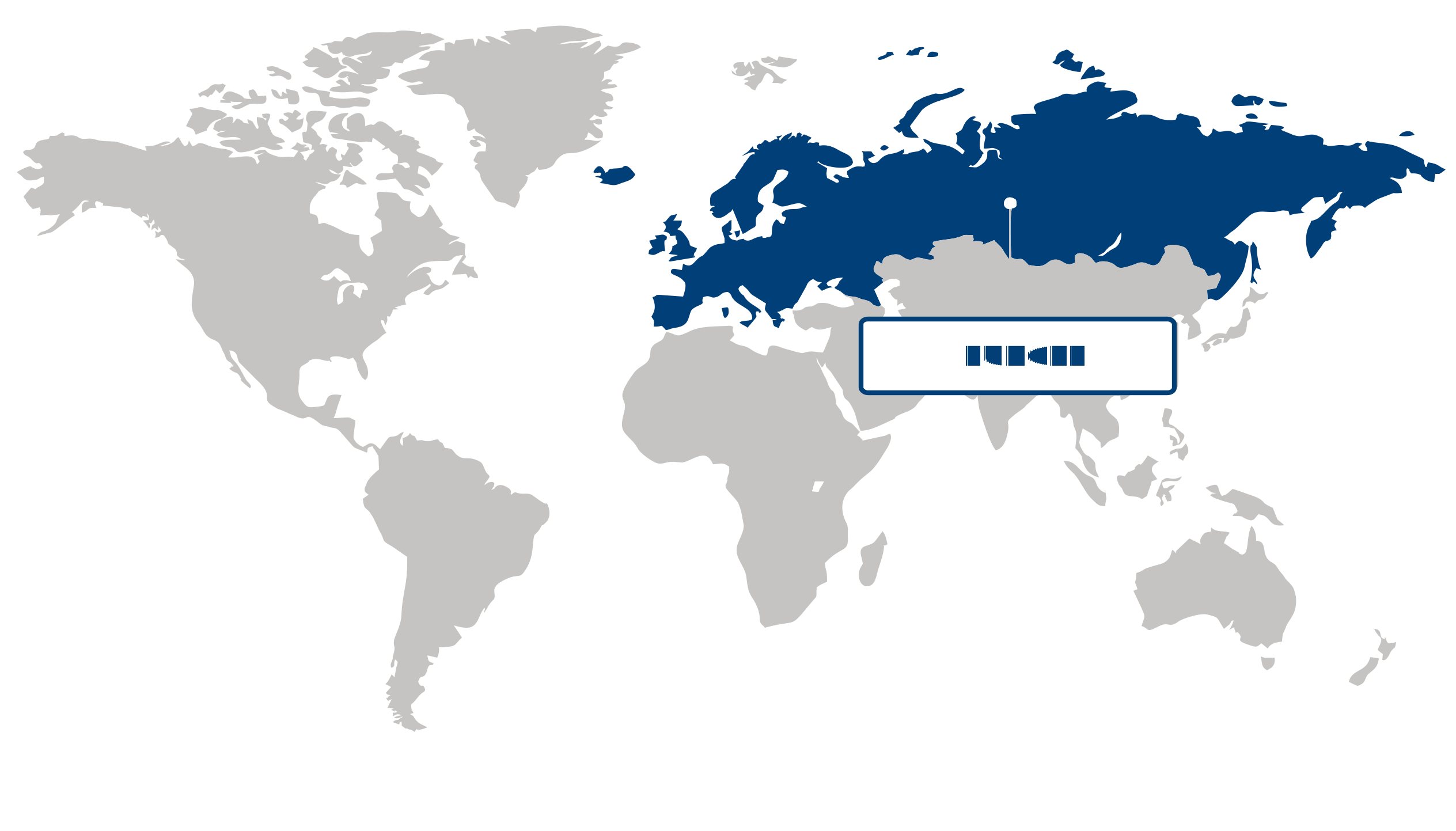
Europe (Largest Region)
Europe held the largest position in the marine salvage services market in 2026, supported by extensive maritime trade activity, established port infrastructure, and a mature ecosystem for vessel recovery and emergency response services. The region’s dense network of commercial shipping routes and major ports creates sustained demand for specialized salvage capabilities following vessel accidents, groundings, collisions, and other maritime incidents. Strong maritime safety frameworks and established operational expertise further support the region’s leading market position.
Asia Pacific (Fastest-Growing Region)
Asia Pacific is the fastest-growing region, driven by expanding maritime trade, increasing port activity, and the continued development of shipping and coastal infrastructure. Growing vessel traffic across major commercial waterways is creating greater requirements for emergency response, wreck removal, and recovery services. Investments in maritime infrastructure and improvements in regional marine safety capabilities are also strengthening the need for specialized salvage operations.
| Parameter | North America | Asia Pacific | Europe | Latin America | MEA |
|---|---|---|---|---|---|
| Innovation Hub i Scale Nascent Developing Advanced | |||||
| Cost-Sensitive Region i Scale Low Medium High | |||||
| Regulatory Environment i Scale Restrictive Neutral Supportive | |||||
| Demand Drivers i Scale Weak Moderate Strong | |||||
| Development Stage i Scale Emerging Developing Developed | |||||
| Adoption Rate i Scale Low Medium High | |||||
| New Entrants / Startups i Scale Sparse Moderate Dense | |||||
| Macro Indicators i Scale Weak Stable Strong |
Key Country Insights
Germany 🇩🇪
Port Operations SupportGermany emphasizes marine salvage services that protect busy ports and commercial shipping corridors. Operators prioritize efficient recovery planning, environmental compliance, and advanced marine engineering expertise to minimize operational disruption following maritime incidents.
France 🇫🇷
Environmental Protection FocusFrance prioritizes marine salvage services that combine vessel recovery with environmental protection for coastal waters and maritime trade. Companies strengthen response capabilities that align with regulatory expectations and responsible incident management practices.
Italy 🇮🇹
Mediterranean Maritime SupportItaly relies on marine salvage services to support commercial shipping, passenger traffic, and port operations across the Mediterranean. Service providers focus on flexible recovery expertise and coordinated emergency response to reduce operational interruptions after maritime accidents.
Japan 🇯🇵
Disaster Recovery ReadinessJapan integrates marine salvage services with maritime resilience planning for coastal infrastructure and commercial fleets. The country values technically advanced recovery solutions that support navigation safety and efficient post-incident vessel management.
South Korea 🇰🇷
Shipyard Service SynergySouth Korea connects marine salvage services with its extensive shipbuilding and commercial shipping industries. Operators expand technical capabilities for complex vessel recovery while supporting safe maritime operations across regional trade routes.
United States 🇺🇸
Coastal Response CapabilityThe U.S. maintains strong demand for marine salvage services across commercial shipping, offshore energy, and environmental response operations. Service providers invest in specialized recovery assets and rapid deployment capabilities to address increasingly complex maritime incidents.
Segment Leadership and Growth Trends
Marine Salvage Services Market Share (%), by Services, 2026
Go beyond the chart, access full insights & data tables
Request Free Sample ReportServices Segment Analysis: Wreck Removal (Largest Segment) vs Emergency Response (Fastest-Growing Segment)
The wreck removal segment accounted for the largest share of the marine salvage services market, representing 42.4% in 2026. Its leading position reflects the persistent need to remove sunken, stranded, or obstructive vessels that can threaten maritime navigation, port operations, and marine environments. Wreck removal requires specialized vessels, recovery equipment, underwater expertise, and coordinated project execution, making professional salvage providers essential for complex maritime incidents. Environmental protection requirements and the need to restore navigable waterways also support demand for organized wreck removal services, particularly where abandoned or damaged vessels create operational and ecological risks.
Emergency response is advancing at a faster pace as maritime stakeholders place greater emphasis on rapid intervention following accidents, vessel casualties, spills, and other unexpected incidents. The segment benefits from increasing attention to maritime safety, environmental protection, and operational continuity, where delays can amplify financial and ecological consequences. Specialized emergency teams capable of quickly mobilizing equipment, containment resources, and technical expertise are therefore becoming increasingly valuable. Growing expectations for coordinated incident management and stronger preparedness across maritime operations further support the expansion of emergency response services.
End-user Segment Analysis: Private Ship Owners (Largest Segment) vs Insurance Companies (Fastest-Growing Segment)
In the marine salvage services market, private ship owners held the largest share in 2026. Ship owners frequently require salvage assistance to address vessel damage, grounding, sinking, or other operational disruptions while protecting valuable maritime assets and restoring service as efficiently as possible. The complexity of marine recovery operations often requires specialized capabilities that cannot be handled through routine vessel maintenance resources. In addition, growing awareness of environmental liabilities and the operational consequences of maritime incidents encourages private owners to engage professional salvage providers for technically demanding recovery activities.
Insurance companies are emerging as the fastest-growing end-user segment as insurers increasingly play an active role in managing the financial and operational consequences of marine casualties. Salvage services can help insurers limit losses by facilitating timely vessel recovery, damage assessment, and mitigation of environmental or third-party liabilities. The growing complexity of maritime risks is also encouraging closer coordination among insurers, vessel operators, and salvage specialists. This focus on efficient claims resolution and loss mitigation is strengthening the role of insurance companies in the marine salvage services ecosystem.
| Segment | Sub-Segment | Largest Segment | Fastest Growing |
|---|---|---|---|
| Services | Wreck Removal, General Salvage, Emergency Response, Pollution Control, Cargo Recovery | Wreck Removal | Emergency Response |
| End-user | Private Ship Owners, Insurance Companies, Government Agencies, Shipping Companies | Private Ship Owners | Insurance Companies |
Unlock insights tailored to your business with our bespoke market research solutions.
Click to get your customized report now.
Competitive Landscape and Market Positioning
Top players in the marine salvage services market:
1. Boskalis Westminster N.V. (Netherlands)
2. SMIT Salvage BV (Netherlands)
3. Donjon Marine Co. Inc. (USA)
4. T&T Salvage LLC (USA)
5. Boluda Towage & Salvage SL (Spain)
6. United Salvage Pty Ltd (Australia)
7. Fratelli Neri S.p.A. (Italy)
8. African Marine Solutions Group (Pty) Ltd (South Africa)
9. Hongkong Salvage & Towage Services Ltd (Hong Kong SAR China)
10. Ocean Infinity Group Limited (United Kingdom)
The marine salvage services market is adapting to increasing maritime complexity through the adoption of advanced recovery equipment and digital monitoring systems. Service providers are emphasizing rapid response capabilities, environmental risk mitigation, and specialized salvage methodologies to strengthen operational effectiveness. Strategic investments in offshore technologies and emergency management infrastructure are also improving competitiveness across the sector.
| Company | Market Share | Company Revenue | Revenue CAGR (%) | Product Portfolio | Geographic Presence | Innovation / R&D Focus | Strategic Developments |
|---|---|---|---|---|---|---|---|
| Boskalis Westminster N.V. (Netherlands) | |||||||
| SMIT Salvage BV (Netherlands) | |||||||
| Donjon Marine Co. Inc. (USA) | |||||||
| T&T Salvage LLC (USA) | |||||||
| Boluda Towage & Salvage SL (Spain) | |||||||
| United Salvage Pty Ltd (Australia) | |||||||
| Fratelli Neri S.p.A. (Italy) | |||||||
| African Marine Solutions Group (Pty) Ltd (South Africa) | |||||||
| Hongkong Salvage & Towage Services Ltd (Hong Kong SAR China) | |||||||
| Ocean Infinity Group Limited (United Kingdom). |
Customize Your Report
Explore examples of how this report can be tailored to different research needs, including custom segments, additional topics or chapters, and related reports. Click a section of the wheel or its numbered marker to explore the available options.
Marine Salvage Services Market — Custom Segments
| Segment | Sub-Segment |
|---|---|
| Vessel Type | Commercial Cargo Vessels, Tankers, Passenger Vessels, Offshore & Specialized Vessels, Naval & Government Vessels, Recreational Vessels |
| Incident Type | Grounding, Collision, Sinking, Fire & Explosion, Machinery Failure, Storm & Weather Damage |
| Water Depth | Shallow Water, Intermediate Water, Deep Water |
Marine Salvage Services Market — Custom TOC
| Custom Chapter | Chapter Details |
|---|---|
| Offshore Salvage Demand Opportunity Mapping |
|
| Wreck Removal Project Pipeline Analysis |
|
| Marine Insurance Influence Assessment |
|
Need a different cut of the data?
Request Custom ResearchHow much is the marine salvage services market worth?
What is the expected industry size of marine salvage services by 2036?
How is rising maritime trade activity influencing demand for marine salvage services?
How are advanced technologies improving operational efficiency in marine salvage operations?
Why does wreck removal remain the largest service in marine salvage?
What is fueling growth in emergency response services?
Why does Europe lead the marine salvage services market?
What is fueling Asia Pacific growth in marine salvage services?
What are the key competitors in the marine salvage services landscape?
Our Clients
"The team surpassed our expectations with the report depth. The actionable insights provided proved crucial in navigating market challenges."
Tata Motors
"We found the report to be very informative. The expertise and attention to market nuances significantly influenced our business direction."
DENSO Corporation
"The consumer survey findings were quite good. We now have a clearer picture of the customer churning and retention strategy."
HL Mando
Our Research Team & Methodology
Every Fundamental Business Insights report is built by a dedicated vertical research team, validated through a structured primary-and-secondary methodology, and reviewed for accuracy before it reaches you.
Research Team Overview
Prepared by the Automotive & Transportation Research Team
Delivery
Published
Demand
Available
Support
Trust & Compliance
Research Intelligence
| Source | Reference |
|---|---|
| International Organization of Motor Vehicle Manufacturers (OICA) | www.oica.net |
| SAE International | www.sae.org |
| International Energy Agency (IEA) | www.iea.org |
| International Transport Forum (ITF) | www.itf-oecd.org |
| International Road Federation (IRF) | www.irf.global |
| International Organization for Standardization (ISO) | www.iso.org |
| United Nations Economic Commission for Europe (UNECE) | unece.org |
| National Highway Traffic Safety Administration (NHTSA) | www.nhtsa.gov |
| U.S. Department of Transportation (USDOT) | www.transportation.gov |
| European Automobile Manufacturers' Association (ACEA) | www.acea.auto |
| Society of Indian Automobile Manufacturers (SIAM) | www.siam.in |
| International Air Transport Association (IATA) | www.iata.org |
| International Civil Aviation Organization (ICAO) | www.icao.int |
| International Maritime Organization (IMO) | www.imo.org |
| International Union of Railways (UIC) | uic.org |
| American Public Transportation Association (APTA) | www.apta.com |
| International Federation of Robotics (IFR) | ifr.org |
| CharIN | www.charin.global |
| World Shipping Council | www.worldshipping.org |
| International Federation of Freight Forwarders Associations (FIATA) | fiata.org |
Research Workflow & Quality Assurance
Data Collection
Verified information gathered through primary and secondary research.
Data Triangulation
Cross-validation using multiple independent data sources.
Forecast Modelling
Market estimates developed using historical trends and analytical models.
Analyst Validation
Findings reviewed by domain experts for accuracy and consistency.
Editorial & Quality Review
Final editorial, quality, and compliance checks before publication.
Final Publication
Released after successful completion of the internal review process.
Report Coverage
📊 Market Assessment
- Market Size & Forecast
- Market Segmentation
- Regional Analysis
- Growth Drivers & Challenges
- Market Dynamics
🏢 Competitive Intelligence
- Competitive Landscape
- Company Profiles
- Competitive Benchmarking
- Mergers & Acquisitions
- Market Share Analysis or Key Company Strategies
🔍 Strategic Analysis
- Value Chain Analysis
- Porter's Five Forces
- PESTLE Analysis
- Pricing Trends
- Supply-Demand Analysis
🚀 Future Outlook
- Technology Landscape
- Regulatory Landscape
- Investment & Funding Landscape
- Emerging Opportunities
- Future Market Outlook
Have a question about this report or need a custom scope?
Request Customization