Incontinence Pads Market Size & Growth Forecast 2027–2036, By Segments (Product Type, Patient, Distribution Channel, End-use), Regional Demand Trends (North America, Asia Pacific, Europe), Key Country Insights (U.S., Japan, South Korea, Germany, France, Italy), and Competitive Landscape
Market Size and Growth Outlook
Incontinence Pads Market size was estimated at USD 8.5 billion in 2026 and is projected to grow at a 5.42% CAGR from 2027 to 2036, attaining USD 14.41 billion by 2036. The industry revenue for 2027 is calculated at USD 8.89 billion.
Get more details on this report
Request Free Sample ReportIncontinence Pads Market Intelligence Snapshot
Regional Market Dynamics
- Europe holds 46.11% share due to aging population, strong product availability across pharmacies and care channels, and established reimbursement and institutional healthcare usage.
- Asia Pacific’s 6.55% CAGR is driven by rising aging population, improved healthcare access, and growing adoption through e-commerce and modern retail distribution channels.
Segment Momentum
- Disposable Pads accounted for 88.64% of the market in 2026 due to their convenience, hygiene benefits, easy replacement, and suitability across home care, hospital, and long-term care settings.
- Male Incontinence Pads are the fastest-growing patient segment as demand rises for products designed specifically for male anatomy, improving comfort, fit, and daily-use performance.
Market Expansion Drivers
- Expanding geriatric population increasing urinary incontinence prevalence and hygiene product demand.
- Rising chronic mobility disorders and neurological conditions driving long-term absorbent product use.
- Growth of home healthcare and eldercare facilities boosting absorbent care product consumption.
Leading Market Participants
- Major players in the incontinence pads market include Essity Aktiebolag (publ) (Sweden), Kimberly-Clark Corporation (United States), Procter & Gamble Company (United States), Ontex Group NV (Belgium), Cardinal Health, Inc. (United States), Medline Industries, LP (United States), ABENA A/S (Denmark), Paul Hartmann AG (Germany), Unicharm Corporation (Japan), Domtar Corporation (United States).
Global Market Forecast Snapshot
Market Outlook
- 2026 Market Size: USD 8.5 billion
- 2027 Estimated Market Size: USD 8.89 billion.
- Projected Market Size: USD 14.41 billion by 2036
- Growth Forecast: 5.42% CAGR (2027-2036)
Regional and Segment Outlook
- Leading Regional Market: Europe
- High-Growth Regional Hub: Asia Pacific
- Core Revenue Segment: Disposable Pads (Product Type) | Female Incontinence Pads (Patient) | Offline Sales (Distribution Channel) | Hospitals (End-use)
- Emerging Opportunity Segment: Disposable Pads (Product Type) | Male Incontinence Pads (Patient) | Online Sales (Distribution Channel) | Homecare Settings (End-use)
Market Growth Drivers and Industry Trends
Expanding geriatric population increasing urinary incontinence prevalence and hygiene product demand
Population aging is increasing the number of individuals who may require support for age-related urinary incontinence and daily hygiene management. The incontinence pads market will benefit from this demographic shift as older consumers and caregivers increasingly seek convenient absorbent products that provide protection and support during routine activities. Greater awareness of personal hygiene and the importance of maintaining dignity and independence can also encourage consistent use of specialized continence products.
Rising chronic mobility disorders and neurological conditions driving long-term absorbent product use
Mobility limitations and neurological conditions can make bladder control and personal hygiene management more challenging, creating sustained requirements for absorbent care products. The incontinence pads market will be propelled by individuals who require long-term support as absorbent pads provide a practical solution for managing leakage during daily activities. Caregivers and healthcare professionals may also rely on these products to support hygiene and comfort for individuals with persistent functional limitations.
Growth of home healthcare and eldercare facilities boosting absorbent care product consumption
The increasing shift toward home-based care and the expansion of eldercare facilities are creating additional environments where continence management products are regularly required. The incontinence pads market will gain as caregivers and care providers seek dependable absorbent solutions for individuals requiring assistance with daily hygiene. Wider availability of organized homecare and residential eldercare services can support consistent product use while addressing the practical needs of individuals with recurring incontinence.
| Growth Driver | Impact on CAGR | Regulatory Influence | Geographic Relevance | Adoption Rate | Impact Timeline |
|---|---|---|---|---|---|
| Expanding geriatric population increasing urinary incontinence prevalence and hygiene product demand | 2.10% | Moderate | North America, Europe, Asia Pacific | High | Near Term |
| Rising chronic mobility disorders and neurological conditions driving long-term absorbent product use | 1.70% | Moderate | North America, Europe | High | Mid Term |
| Growth of home healthcare and eldercare facilities boosting absorbent care product consumption | 1.50% | Moderate | Asia Pacific, Europe | High | Near Term |
Unlock insights tailored to your business with our bespoke market research solutions.
Click to get your customized report now.
Regional Demand Dynamics
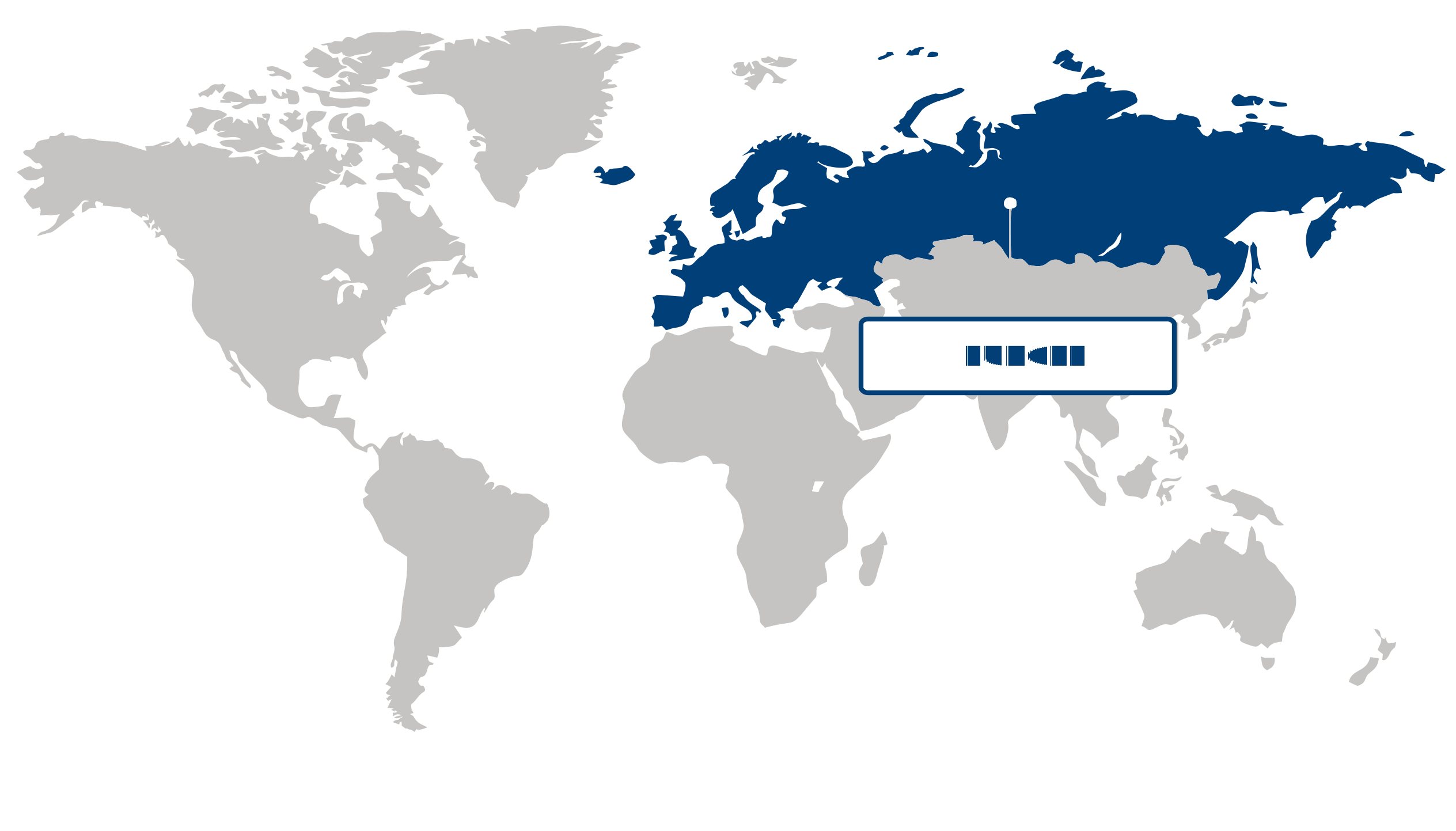
Europe (Largest Region)
Europe held the largest share of the incontinence pads market at 46.11% in 2026, supported by demographic trends, established healthcare systems, and comparatively high awareness of continence management solutions. An aging population is sustaining demand for absorbent hygiene products, while greater openness toward managing incontinence is encouraging consumers to seek products that provide comfort, discretion, and mobility. Strong healthcare infrastructure and access to specialized continence-care services further support product adoption, while well-developed retail and pharmacy networks facilitate consistent availability. Increasing attention to quality of life among older adults and demand for thinner, more comfortable, and user-friendly products are also contributing to the region’s established market position.
Asia Pacific (Fastest-Growing Region)
Asia Pacific is the fastest-growing regional market, supported by population aging, improving healthcare access, and increasing awareness of personal hygiene and continence management. Rising urbanization and changing household structures are encouraging greater reliance on commercially available absorbent hygiene products, particularly as consumers become more receptive to specialized solutions. Improvements in healthcare infrastructure and expanding retail and e-commerce networks are making incontinence pads increasingly accessible across emerging markets. In addition, growing awareness among caregivers and older consumers about maintaining independence, comfort, and daily mobility is supporting demand for more discreet and convenient products. Increasing disposable incomes and gradual shifts away from informal or traditional approaches to incontinence management are further creating favorable conditions for market expansion.
| Parameter | North America | Asia Pacific | Europe | Latin America | MEA |
|---|---|---|---|---|---|
| Innovation Hub i Scale Nascent Developing Advanced | |||||
| Cost-Sensitive Region i Scale Low Medium High | |||||
| Regulatory Environment i Scale Restrictive Neutral Supportive | |||||
| Demand Drivers i Scale Weak Moderate Strong | |||||
| Development Stage i Scale Emerging Developing Developed | |||||
| Adoption Rate i Scale Low Medium High | |||||
| New Entrants / Startups i Scale Sparse Moderate Dense | |||||
| Macro Indicators i Scale Weak Stable Strong |
Key Country Insights
Germany 🇩🇪
Clinical Comfort StandardsGermany prioritizes incontinence pads that deliver reliable absorbency, skin health protection, and consistent product performance. Healthcare providers and consumers in Germany increasingly select solutions that balance comfort with practical use across long-term and home care environments.
France 🇫🇷
Home Healthcare AlignmentFrance continues strengthening demand for incontinence pads through expanding home care services and greater attention to patient comfort. Healthcare providers in France increasingly recommend products that improve hygiene management while supporting dignity and ease of everyday use.
Italy 🇮🇹
Everyday Care AccessibilityItaly's incontinence pads market focuses on practical, reliable solutions suitable for home care, long-term care, and outpatient support. Consumers and care providers in Italy increasingly favor comfortable products that provide dependable absorbency while simplifying routine personal care.
Japan 🇯🇵
Aging Care SupportJapan's incontinence pads market reflects sustained demand for products tailored to an aging population seeking comfort and discretion. Manufacturers in Japan increasingly focus on thinner, highly absorbent designs that improve mobility and simplify daily personal care routines.
South Korea 🇰🇷
Premium Personal CareSouth Korea is expanding the use of premium incontinence pads that combine comfort, discreet wear, and enhanced skin-friendly materials. Consumers in South Korea increasingly prefer products that integrate advanced absorbent technologies with convenient everyday usability.
United States 🇺🇸
Discreet Care SolutionsThe U.S. incontinence pads market emphasizes discreet, comfortable products that support independent living across home care and institutional settings. Manufacturers in the U.S. continue improving absorbency, skin protection, and product variety to address diverse user requirements.
Segment Leadership and Growth Trends
Incontinence Pads Market Share (%), by Product Type, 2026
Go beyond the chart, access full insights & data tables
Request Free Sample ReportProduct Type Segment Analysis: Disposable Pads (Largest & Fastest-Growing Segment)
The disposable pads segment dominated the incontinence pads market with the largest share of 88.64% in 2026 while also representing the fastest-growing product type. Its strong position is supported by convenience, ease of use, and the ability to provide reliable protection without requiring cleaning or repeated handling. Disposable formats are particularly suited to consumers seeking straightforward incontinence management across home and care environments. Improvements in absorbent materials, leakage protection, odor control, and skin-friendly designs are further enhancing user comfort and product effectiveness. Increasing awareness of personal hygiene and the need for convenient continence-care solutions continue to reinforce adoption of disposable pads.
Patient Segment Analysis: Female Incontinence Pads (Largest Segment) vs Male Incontinence Pads (Fastest-Growing Segment)
Female incontinence pads held the largest share of 62.66% in 2026, reflecting the established demand for products designed around the anatomical and lifestyle requirements of women experiencing urinary incontinence. A broad range of absorbency levels, discreet designs, and comfort-oriented features supports their use across different daily activities and care needs. Greater awareness of available continence solutions is also encouraging more women to seek purpose-designed products rather than relying on generic absorbent materials. Continued product development focused on fit, skin protection, odor management, and discretion is helping sustain the segment's leading position.
The male incontinence pads segment is expanding at a faster pace as awareness of male-specific continence solutions increases and product availability improves. Tailored designs that accommodate male anatomy can provide better fit, comfort, and discretion, encouraging users to shift toward specialized products. Greater openness around male urinary health, combined with broader healthcare engagement and improved retail accessibility, is supporting adoption. Product innovation aimed at active lifestyles and discreet everyday use is further strengthening the growth prospects of male incontinence pads.
| Segment | Sub-Segment | Largest Segment | Fastest Growing |
|---|---|---|---|
| Product Type | Reusable Pads, Disposable Pads | Disposable Pads | Disposable Pads |
| Patient | Female Incontinence Pads, Male Incontinence Pads | Female Incontinence Pads | Male Incontinence Pads |
| Distribution Channel | Offline Sales, Online Sales | Offline Sales | Online Sales |
| End-use | Hospitals, Clinics, Long-term Care Facilities, Homecare Settings, Others | Hospitals | Homecare Settings |
Competitive Landscape and Market Positioning
Prominent players in the incontinence pads market:
1. Essity Aktiebolag (publ) (Sweden)
2. Kimberly-Clark Corporation (United States)
3. Procter & Gamble Company (United States)
4. Ontex Group NV (Belgium)
5. Cardinal Health Inc. (United States)
6. Medline Industries LP (United States)
7. ABENA A/S (Denmark)
8. Paul Hartmann AG (Germany)
9. Unicharm Corporation (Japan)
10. Domtar Corporation (United States)
The incontinence pads market is experiencing continuous product development centered on enhanced absorbency, skin-friendly materials, and discreet product designs aimed at improving user comfort and confidence. Rising awareness surrounding elderly care and personal hygiene, along with technological improvements in material engineering, is contributing to stronger product differentiation and broader consumer acceptance.
| Company | Market Share | Company Revenue | Revenue CAGR (%) | Product Portfolio | Geographic Presence | Innovation / R&D Focus | Strategic Developments |
|---|---|---|---|---|---|---|---|
| Essity Aktiebolag (publ) (Sweden) | |||||||
| Kimberly-Clark Corporation (United States) | |||||||
| Procter & Gamble Company (United States) | |||||||
| Ontex Group NV (Belgium) | |||||||
| Cardinal Health Inc. (United States) | |||||||
| Medline Industries LP (United States) | |||||||
| ABENA A/S (Denmark) | |||||||
| Paul Hartmann AG (Germany) | |||||||
| Unicharm Corporation (Japan) | |||||||
| Domtar Corporation (United States). |
Industry Development/News
| Company Name | Date | Key Development |
|---|---|---|
| Essity | Nov-25 | Essity entered into a definitive agreement to acquire Edgewell’s U.S. feminine care business for $340 million, a transaction completed in early 2026. This acquisition integrates established assets and manufacturing capabilities into Essity's personal care portfolio, strategically enhancing its market position and operational footprint in the North American absorbent hygiene and incontinence-adjacent segments. |
| Pura | Mar-25 | Pura advanced its NappiCycle initiative, a collaborative program focused on the collection and recycling of used absorbent hygiene products. By separating cellulose and plastic fibers for repurposing into industrial materials, the project explores scalable infrastructure solutions to reduce landfill dependency, addressing environmental challenges associated with the end-of-life management of disposable incontinence and hygiene products. |
| Georgia-Pacific Cellulose | Nov-24 | Georgia-Pacific Cellulose completed an $80 million investment at its Alabama River Cellulose mill to expand fluff pulp production capacity. This capacity increase addresses rising global demand for absorbent core materials used in adult incontinence pads, feminine hygiene, and baby diapers, strengthening the supply chain for manufacturers across the broader absorbent hygiene product sector. |
| Vyld | Jan-24 | Vyld secured seven-figure seed funding to advance the development and commercialization of seaweed-based absorbent hygiene products. The investment supports technical innovation in sustainable materials as alternatives to conventional synthetic components, targeting both period care and broader absorbent hygiene applications to address the growing market demand for biodegradable, regenerative product solutions. |
Customize Your Report
Explore examples of how this report can be tailored to different research needs, including custom segments, additional topics or chapters, and related reports. Click a section of the wheel or its numbered marker to explore the available options.
Incontinence Pads Market — Custom Segments
| Segment | Sub-Segment |
|---|---|
| Absorbency Level | Light Absorbency, Moderate Absorbency, Heavy Absorbency, Overnight/Maximum Absorbency |
| Incontinence Severity | Light Incontinence, Moderate Incontinence, Heavy Incontinence, Severe Incontinence |
| Material & Core Technology | Cellulose-Based Core, Superabsorbent Polymer Core, Hybrid Absorbent Core, Natural-Fiber-Based Core |
Incontinence Pads Market — Custom TOC
| Custom Chapter | Custom Details |
|---|---|
| Patient Care Pathway and Product Adoption Assessment |
|
| Long-Term Care and Institutional Procurement Analysis |
|
| Caregiver and Consumer Purchasing Behavior Analysis |
|
Need a different cut of the data?
Request Custom ResearchHow large is the incontinence pads market?
What is the expected industry size of incontinence pads by 2036?
How is population aging influencing demand patterns in the incontinence pads market?
Why is the expansion of home healthcare strengthening incontinence pad procurement?
Why do disposable pads lead the incontinence pads market?
What is contributing to the growth of male incontinence pads in the market?
Why does Europe lead the incontinence pads market?
What drives fastest growth in Asia Pacific incontinence pads market?
Who holds a significant market share in the incontinence pads landscape?
Our Clients
"The team took the time to understand our specific business needs and delivered a report that was well aligned with our objectives. Their expertise and understanding of the industry were clearly reflected in the quality and relevance of the insights provided."
Siemens Healthcare
"Our experience in acquiring the research report has been excellent. The depth of analysis, and actionable insights provided have been extremely valuable in supporting our ongoing R&D efforts."
GC Biopharma
"The report offered a comprehensive view of the market trends. The in-depth segmentation and analysis of emerging opportunities gave us a better understanding of the market."
Medtronic
Our Research Team & Methodology
Every Fundamental Business Insights report is built by a dedicated vertical research team, validated through a structured primary-and-secondary methodology, and reviewed for accuracy before it reaches you.
Research Team Overview
Prepared by the Healthcare & Medical Devices Research Team
Delivery
Published
Demand
Available
Support
Trust & Compliance
Research Domains
10 coverage areasResearch Intelligence
| Source | Reference |
|---|---|
| World Health Organization (WHO) | www.who.int |
| U.S. Food & Drug Administration (FDA) | www.fda.gov |
| European Medicines Agency (EMA) | www.ema.europa.eu |
| Centers for Disease Control and Prevention (CDC) | www.cdc.gov |
| National Institutes of Health (NIH) | www.nih.gov |
| National Center for Biotechnology Information (NCBI) | www.ncbi.nlm.nih.gov |
| PubMed | pubmed.ncbi.nlm.nih.gov |
| ClinicalTrials.gov | clinicaltrials.gov |
| International Organization for Standardization (ISO) | www.iso.org |
| ASTM International | www.astm.org |
| Advanced Medical Technology Association (AdvaMed) | www.advamed.org |
| Medical Device Innovation Consortium (MDIC) | mdic.org |
| Biotechnology Innovation Organization (BIO) | www.bio.org |
| International Federation of Pharmaceutical Manufacturers & Associations (IFPMA) | www.ifpma.org |
| U.S. Pharmacopeia (USP) | www.usp.org |
| European Directorate for the Quality of Medicines & HealthCare (EDQM) | www.edqm.eu |
| World Organisation for Animal Health (WOAH) | www.woah.org |
| American Hospital Association (AHA) | www.aha.org |
| OECD Health | www.oecd.org/health |
| World Bank Data | data.worldbank.org |
Research Workflow & Quality Assurance
Data Collection
Verified information gathered through primary and secondary research.
Data Triangulation
Cross-validation using multiple independent data sources.
Forecast Modelling
Market estimates developed using historical trends and analytical models.
Analyst Validation
Findings reviewed by domain experts for accuracy and consistency.
Editorial & Quality Review
Final editorial, quality, and compliance checks before publication.
Final Publication
Released after successful completion of the internal review process.
Report Coverage
📊 Market Assessment
- Market Size & Forecast
- Market Segmentation
- Regional Analysis
- Growth Drivers & Challenges
- Market Dynamics
🏢 Competitive Intelligence
- Competitive Landscape
- Company Profiles
- Competitive Benchmarking
- Mergers & Acquisitions
- Market Share Analysis or Key Company Strategies
🔍 Strategic Analysis
- Value Chain Analysis
- Porter's Five Forces
- PESTLE Analysis
- Pricing Trends
- Supply-Demand Analysis
🚀 Future Outlook
- Technology Landscape
- Regulatory Landscape
- Investment & Funding Landscape
- Emerging Opportunities
- Future Market Outlook
Have a question about this report or need a custom scope?
Request Customization