Grain Oriented Electrical Steel Market Size & Forecasts 2026-2035, By Segments (Type, Application, End-user), Growth Opportunities, Innovation Landscape, Regulatory Shifts, Strategic Regional Insights (U.S., Japan, China, South Korea, UK, Germany, France), and Competitive Dynamics (POSCO, Nippon Steel, JFE Steel, Baoshan Iron & Steel, Hitachi Metals)
Market Size and Growth Outlook
Grain Oriented Electrical Steel Market size is predicted to expand from USD 1.39 billion in 2025 to USD 2.63 billion by 2035, with growth underpinned by a CAGR above 6.6% between 2026 and 2035. The industry revenue outlook for 2026 is USD 1.47 billion.
Get more details on this report
Request Free Sample ReportGrain Oriented Electrical Steel Market Intelligence Snapshot
Regional Market Dynamics
Segment Momentum
Market Expansion Drivers
Leading Market Participants
Global Market Forecast Snapshot
Market Outlook
Regional and Segment Outlook
Market Growth Drivers and Industry Trends
The rapid scale-up of EV manufacturing reshapes demand patterns for the grain oriented electrical steel market because traction motors and power electronics create persistent demand for high-permeability core materials. OEMs such as Tesla and Volkswagen have announced production ramps and the International Energy Agency highlights sustained transport electrification, signaling long-term upstream needs. Established steelmakers and laminators can secure long-term supply contracts and co-develop EV-optimized laminations; new entrants can capture niche grades, localized supply or closed-loop recycling services. With factory expansions and OEM qualification pipelines already underway, supplier integration and certification will become decisive competitive levers.
Smart Grid and Energy-Efficient Transformer Adoption
Expansion of smart grids and utility-led efficiency programs increases specification stringency in the grain oriented electrical steel market as buyers demand lower-loss transformer cores. Deployments and product initiatives from Siemens Energy and ABB, alongside U.S. Department of Energy Grid Modernization activities, demonstrate institutional procurement toward higher-efficiency transformers. Incumbents can differentiate via tighter process controls, system-level warranties and scale manufacturing; specialty mills and service providers can win through rapid qualification, custom coatings or retrofit solutions. Observable regulatory nudges and utility RFPs are accelerating supplier consolidation around efficiency-capable technologies.
Development of High-Grade Silicon Steel Alloys
Material innovation in silicon steel chemistry and processing is raising performance expectations across the grain oriented electrical steel market by reducing core losses and improving magnetic domain control. Product developments and pilot announcements from Nippon Steel, JFE Steel and ArcelorMittal illustrate commercial pathways to higher-grade alloys and advanced coatings. Large integrated producers can monetize proprietary grades and scale advantages, while startups and specialty mills can compete via licensing, bespoke alloys or targeted service offerings for premium transformer and EV motor segments. Publicized pilot plants and commercial rollouts indicate material innovation will increasingly govern supplier selection and product roadmaps.
Industry Restraints:
Supply Chain Concentration and Raw Material Dependency
The GOES market is constrained by a narrow supplier base and reliance on specialized inputs, which creates single‑point vulnerabilities and limits responsiveness to demand shifts. World Steel Association production data highlights East Asian dominance, with major producers such as Nippon Steel Corporation and China Baowu Group controlling significant high‑grade electrical steel capacity; their capacity announcements and technology investments (Nippon Steel Corporation press releases; China Baowu Group statements) reinforce supplier stickiness. For incumbents this preserves pricing power but raises operational risk for transformer-makers and utilities; new entrants face high capital intensity and long technology development cycles. Expect continued strategic vertical partnerships and sourcing diversification as buyers and smaller suppliers hedge against concentration over the near to medium term.
Energy and Environmental Compliance Costs
Rising energy prices and tightening decarbonization rules materially raise production costs and restrict market expansion for GOES. The European Commission’s Green Deal initiatives and Carbon Border Adjustment Mechanism increase compliance complexity and potential cost pass‑through, while the International Energy Agency documents elevated industrial energy price volatility that hit steelmakers’ margins. ArcelorMittal and other producers have publicly cited energy costs and emission constraints as drivers of operational adjustments (ArcelorMittal corporate disclosures). Larger firms are positioned to absorb or invest in low‑carbon routes, whereas smaller mills face closure or consolidation risk; regulatory and energy trends will continue to force capital allocation toward low‑loss, low‑carbon capacity in the near to medium term.
| Growth Driver | Impact on CAGR | Regulatory Influence | Geographic Relevance | Adoption Rate | Impact Timeline |
|---|---|---|---|---|---|
| Electric vehicle (EV) production increase | 1.60% | Short term (≤ 2 yrs) | Asia Pacific, Europe; Spillover: North America | Medium | Fast |
| Smart grid and energy-efficient transformer adoption | 1.50% | Medium term (2–5 yrs) | Europe, North America; Spillover: Asia Pacific | Medium | Moderate |
| Development of high-grade silicon steel alloys | 1.00% | Long term (5+ yrs) | Asia Pacific, Europe; Spillover: North America | High | Slow |
Explore Growth Opportunities
Request Free Sample ReportRegional Demand Dynamics
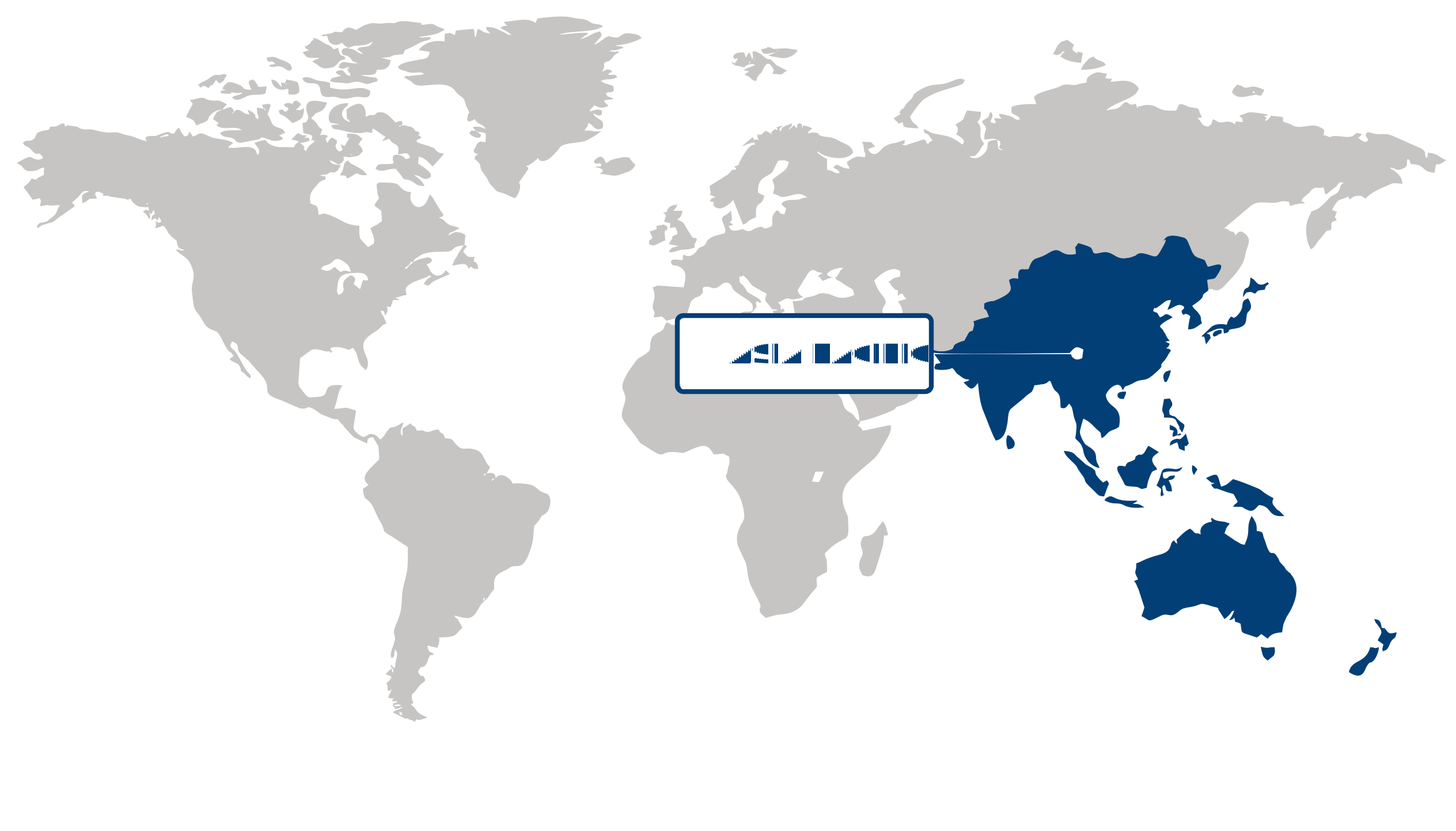
Asia Pacific captured approximately 67% of the grain oriented electrical steel market in 2025, establishing the region as the largest center of demand driven by its dominance in transformer manufacturing and rapid power‑grid buildout. This leadership reflects concentrated manufacturing capacity—suppliers such as JFE Steel and Nippon Steel produce high‑grade GOES used in utility transformers—paired with large infrastructure programs like China State Grid Corporation’s UHV projects and policy support from Japan’s Ministry of Economy, Trade and Industry (METI) for grid resilience and efficiency. Demand is shaped by electrification of industry, renewable integration, and utilities upgrading aging fleets, creating a competitive environment that favors vertically integrated producers and advanced processing capabilities. Looking ahead, continued grid expansion and transformer replacements across the region will sustain aftermarket and OEM demand, presenting opportunities for premium GOES grades, local upstream investment, and technology partnerships.
Japan is positioned as a pivotal hub in Asia Pacific; the grain oriented electrical steel market in Japan is characterized by high‑performance product requirements and advanced transformer R&D. Domestic transformer and electrical equipment firms—Mitsubishi Electric, Toshiba, and Hitachi ABB Power Grids—drive demand for very low‑loss steel, while steelmakers such as Nippon Steel and JFE Steel focus on thin‑gauge, high‑magnetic‑flux products. METI’s energy efficiency initiatives and frequent utility tendering for low‑loss equipment further incentivize premium grades and precision manufacturing. Strategically, Japan’s emphasis on quality and R&D reinforces regional premium supply chains and creates exportable technology and process know‑how that complements larger volume markets in Asia Pacific.
China anchors Asia Pacific’s growth; the grain oriented electrical steel market in China is dominated by scale requirements from massive grid expansion and domestic transformer production. China State Grid Corporation’s ongoing UHV transmission rollout and the output of major transformer manufacturers such as TBEA and XD Group generate substantial demand for GOES, while large steel producers including China Baowu scale production to meet both utility and OEM needs. Government‑led infrastructure programs and localized supply chains compress lead times and lower costs, encouraging domestic integration from steelmaking to transformer assembly. For investors and strategists, China’s combination of volume, localized procurement practices, and continued transmission investment makes it the principal market for capacity expansion and cost‑competitive manufacturing within the region.
Europe Market Analysis:
Europe emerged as the fastest-growing region at a CAGR of 8.6% in the grain oriented electrical steel market, propelled by widespread modernization of aging electrical infrastructure and a rapid shift toward renewable energy integration. Policy packages such as the European Commission’s REPowerEU and grid investment priorities in ENTSO‑E’s Ten‑Year Network Development Plan are accelerating upgrades of transformers and distribution networks across member states. Manufacturers and system integrators including Siemens Energy and ABB have announced significant transformer and grid-equipment contracts supporting these upgrades, while national funding mechanisms are de-risking large capital projects. Demand is therefore moving from spot procurement to long-term supply partnerships, increasing requirements for higher-permeability steels and tighter supply-chain reliability. These dynamics create near-term volume growth and medium-term product-innovation opportunities for firms that can align capacity, technical specs, and sustainability credentials with EU decarbonization programs.
Germany is the region’s industrial backbone and a primary consumer in the grain oriented electrical steel market, where modernization and renewable integration concentrate demand. Germany’s Energiewende and grid-expansion mandates from the Federal Ministry for Economic Affairs and Climate Action (BMWK), together with network planning by the Bundesnetzagentur, are driving large-scale transformer replacements and new high-capacity substations. OEMs such as Siemens Energy and domestic steel suppliers are responding with localized manufacturing and tighter vertical integration to meet industrial and utility clients’ specifications. Procurement behavior favors long-term contracts and certified low‑loss laminations, while workforce capabilities in advanced steel processing and transformer engineering support rapid technology adoption. Strategic implication: Germany’s project pipeline anchors European demand and offers partners scale advantages if they can meet certification and delivery timelines.
France plays a strategic role in the grain oriented electrical steel market, driven by centralized grid-operator investments and the need to balance nuclear baseload with expanding renewables. Réseau de Transport d’Électricité (RTE) has published investment plans emphasizing reinforcement and smart-grid elements, and the Ministry for the Ecological Transition’s multiannual energy plan (PPE) steers capacity additions that require upgraded transformers and distribution equipment. EDF’s ongoing asset management and modernization programs further underpin demand for low-loss electrical steels tailored to grid stability and load-following applications. French procurement often emphasizes lifecycle performance and regulatory compliance, favoring suppliers with demonstrable technical validation and circular‑steel credentials. As a result, France offers a stable procurement environment where technology-differentiated products and sustainability-aligned suppliers can secure long-duration contracts that complement broader European growth.
North America Market Trends:
Held a commanding share in North America, the grain oriented electrical steel market benefits from a concentrated manufacturing base, integrated supply chains, and persistent demand from utilities and heavy industry; these structural strengths are reinforced by cross-border trade flows and targeted capital spending. Evidence includes U.S. Department of Energy initiatives on grid modernization and resilience and North American Electric Reliability Corporation (NERC) findings that prioritize transformer reliability, while producers such as Cleveland-Cliffs (AK Steel) and global equipment suppliers like Siemens Energy and General Electric underline capacity and product investments in the region. Logistics and workforce tightness have raised operational focus on nearshoring and digital process improvements, creating opportunities to supply higher‑value, low‑loss steel grades to regional OEMs and utilities seeking efficiency gains.
The United States is the primary market within North America for the grain oriented electrical steel market, driven by accelerated grid upgrades, electrification of transport and industry, and utility replacement cycles. U.S. demand signals are visible in Department of Energy funding streams for transmission projects and NERC assessments calling for transformer modernization, while manufacturers such as General Electric and Siemens Energy cite U.S. orders and service contracts that elevate requirements for low-loss electrical steel; Cleveland-Cliffs’ product focus further links domestic steel supply to those orders. Strategically, U.S. procurement and policy momentum concentrates investment and innovation in the region, making the country the pivotal conduit for market expansion across North America.
| Parameter | North America | Asia Pacific | Europe | Latin America | MEA |
|---|---|---|---|---|---|
| Innovation Hub i Scale Nascent Developing Advanced | |||||
| Cost-Sensitive Region i Scale Low Medium High | |||||
| Regulatory Environment i Scale Restrictive Neutral Supportive | |||||
| Demand Drivers i Scale Weak Moderate Strong | |||||
| Development Stage i Scale Emerging Developing Developed | |||||
| Adoption Rate i Scale Low Medium High | |||||
| New Entrants / Startups i Scale Sparse Moderate Dense | |||||
| Macro Indicators i Scale Weak Stable Strong |
Segment Leadership and Growth Trends
Grain Oriented Electrical Steel Market Share (%), by Type, 2026
Go beyond the chart, access full insights & data tables
Request Free Sample ReportConventional represented largest share of the grain oriented electrical steel market in 2025, supported by cost-effectiveness and stable performance in mainstream transformer applications. This leadership reflects proven material economics and widespread adoption by transformer OEMs—Siemens Energy and ABB product literature underscore conventional GOES reliability in distribution and power transformers—while manufacturers and utilities favor established supply chains and predictable lifecycle performance. Customer preference for low-risk, serviceable cores and manufacturers’ scale advantages reinforce competitive dynamics, creating strategic openings for incumbents to expand aftermarket services and for niche suppliers to compete on incremental efficiency or specialty coatings. Given ongoing grid upgrades and utility asset renewal, conventional GOES should remain central in the near to medium term.
Analysis by Application
Transformers dominated the grain oriented electrical steel market in 2025 as rising global investments in power transmission and distribution infrastructure accelerated demand for transformer cores. Leadership here is directly tied to infrastructure spending—reports and policy signals from the International Energy Agency and World Bank-backed grid programs emphasize transformer replacement and expansion—while National Grid and the U.S. Department of Energy digital grid initiatives highlight operational drivers for lower-loss cores. Demand patterns favor suppliers that can deliver consistent quality at scale, and digitalization of transformer monitoring opens services-led revenue for OEMs such as General Electric and ABB; smaller firms can capture retrofit and niche high-efficiency opportunities. Continued regulatory pressure to reduce system losses and capital programs in transmission will sustain transformer demand.
Analysis by End-user
Energy held largest share of the grain oriented electrical steel market in 2025 because increasing electricity demand and grid modernization projects prioritized investment in transformer and substation equipment. The International Energy Agency and the U.S. Energy Information Administration both signal rising power demand and utility modernization, and utility announcements from National Grid and major state-owned transmission operators underscore procurement momentum for reliable core materials. Utilities’ sustainability priorities and long asset lifecycles favor proven GOES grades, creating strategic advantages for established suppliers with service networks and for new entrants offering lifecycle optimization, digital monitoring, or lower-loss variants. As electrification and renewable integration proceed, utility-driven requirements will keep this segment strategically important through the near to medium term.
| Segment | Sub-Segment | Largest Segment | Fastest Growing |
|---|---|---|---|
| Type | High Magnetic Strength, Conventional | ||
| Application | Transformers, Motors, Inductors | ||
| End-user | Energy, Automotive, Electronics, Industrial |
Unlock insights tailored to your business with our bespoke market research solutions.
Click to get your customized report now.
Competitive Landscape and Market Positioning
The competitive landscape is defined by differentiated moves from these ten incumbents that reinforce technical leadership and market reach. Several have deepened technical capabilities through intensified material development, pilot process lines and closer engagement with equipment manufacturers, while others have rebalanced production footprints to serve local demand and secure critical contracts. A pattern of targeted tie-ups and portfolio reconfiguration has elevated premium, low-loss offerings and coated-sheet capabilities, putting a premium on product performance and service integration; firms that combine scale with targeted product enhancements are tightening positions in utility and industrial end-markets.
Strategic / Actionable Recommendations for Regional Players
North America: Strengthen relationships with transformer and renewable equipment OEMs and regional utilities to capture retrofit and grid modernization work, while adopting advanced process control and digital quality-assurance tools to raise yield on low-loss grades and shorten qualification cycles.
Asia Pacific: Capitalize on proximity to rapidly renewing distribution networks by co-developing application-specific grades with large OEMs, pairing capacity investments with targeted process upgrades and localized service footprints to defend share against global suppliers.
Europe: Differentiate through ultra-low-loss and sustainability-focused offerings by partnering with system integrators and recycling/value-recovery specialists, and by integrating precision heat-treatment and coating innovations to meet stringent efficiency and circularity expectations.
| Company | Market Share | Company Revenue | Revenue CAGR (%) | Product Portfolio | Geographic Presence | Innovation / R&D Focus | Strategic Developments |
|---|---|---|---|---|---|---|---|
| No companies available. | |||||||
Customize Your Report
Explore examples of how this report can be tailored to different research needs, including custom segments, additional topics or chapters, and related reports. Click a section of the wheel or its numbered marker to explore the available options.
Grain Oriented Electrical Steel Market — Custom Segments
| Segment | Sub-Segment |
|---|---|
| No segment data available. | |
Grain Oriented Electrical Steel Market — Custom TOC
| Custom Chapter | Chapter Details | ||
|---|---|---|---|
| No custom TOC data available. | |||
Need a different cut of the data?
Request Custom ResearchWhat is the market valuation of grain oriented electrical steel?
What are the growth projections for the grain oriented electrical steel industry?
What is the leading region in terms of grain oriented electrical steel market share?
Which geography represents the strongest growth trajectory for the grain oriented electrical steel sector?
How does conventional segment fare in the grain oriented electrical steel industry?
What share does transformers segment hold in the grain oriented electrical steel sector as of 2025?
Where is the energy segment seeing the strongest adoption within the grain oriented electrical steel industry?
Which companies dominate the grain oriented electrical steel landscape?
Our Clients
"The report helped us understand emerging consumer trends in our product category. It clarified where to focus innovation for the next product launch."
LyondellBasell
"The regional forecast section was incredibly useful. We were able to identify two new potential partners in Europe thanks to the vendor mapping you included."
SABIC
"We appreciated how actionable the recommendations were. It guided us to improve supply chain resilience."
Olin Corporation
Our Research Team & Methodology
Every Fundamental Business Insights report is built by a dedicated vertical research team, validated through a structured primary-and-secondary methodology, and reviewed for accuracy before it reaches you.
Research Team Overview
Prepared by the Chemicals & Materials Research Team
Delivery
Published
Demand
Available
Support
Trust & Compliance
Research Intelligence
| Source | Reference |
|---|---|
| American Chemistry Council (ACC) | www.americanchemistry.com |
| European Chemical Industry Council (Cefic) | cefic.org |
| International Council of Chemical Associations (ICCA) | icca-chem.org |
| European Chemicals Agency (ECHA) | echa.europa.eu |
| U.S. Environmental Protection Agency (EPA) | www.epa.gov |
| ASTM International | www.astm.org |
| International Organization for Standardization (ISO) | www.iso.org |
| National Institute of Standards and Technology (NIST) | www.nist.gov |
| Plastics Industry Association (PLASTICS) | www.plasticsindustry.org |
| European Biplastics | www.european-bioplastics.org |
| The Adhesive and Sealant Council (ASC) | www.ascouncil.org |
| National Association of Corrosion Engineers (AMPP) | www.ampp.org |
| Society of Plastics Engineers (SPE) | www.4spe.org |
| International Fertilizer Association (IFA) | www.fertilizer.org |
| CropLife International | croplife.org |
| Packaging Europe | packagingeurope.com |
| Flexible Packaging Association (FPA) | www.flexpack.org |
| Battery Council International (BCI) | batterycouncil.org |
| International Copper Association (ICA) | internationalcopper.org |
| World Steel Association | worldsteel.org |
Research Workflow & Quality Assurance
Data Collection
Verified information gathered through primary and secondary research.
Data Triangulation
Cross-validation using multiple independent data sources.
Forecast Modelling
Market estimates developed using historical trends and analytical models.
Analyst Validation
Findings reviewed by domain experts for accuracy and consistency.
Editorial & Quality Review
Final editorial, quality, and compliance checks before publication.
Final Publication
Released after successful completion of the internal review process.
Report Coverage
📊 Market Assessment
- Market Size & Forecast
- Market Segmentation
- Regional Analysis
- Growth Drivers & Challenges
- Market Dynamics
🏢 Competitive Intelligence
- Competitive Landscape
- Company Profiles
- Competitive Benchmarking
- Mergers & Acquisitions
- Market Share Analysis or Key Company Strategies
🔍 Strategic Analysis
- Value Chain Analysis
- Porter's Five Forces
- PESTLE Analysis
- Pricing Trends
- Supply-Demand Analysis
🚀 Future Outlook
- Technology Landscape
- Regulatory Landscape
- Investment & Funding Landscape
- Emerging Opportunities
- Future Market Outlook
Have a question about this report or need a custom scope?
Request Customization