Food Packaging Equipment Market Size & Growth Forecast 2027–2036, By Segments (Equipment Type, Application), Regional Demand Trends (North America, Asia Pacific, Europe), Key Country Insights (U.S., Japan, South Korea, Germany, France, Italy), and Competitive Landscape
Market Size and Growth Outlook
Food Packaging Equipment Market size was valued at USD 19.5 billion in 2026 and is anticipated to grow at a 5.51% CAGR from 2027 to 2036, attaining USD 33.34 billion by 2036. The industry revenue for 2027 is estimated at USD 20.4 billion.
Get more details on this report
Request Free Sample ReportFood Packaging Equipment Market Intelligence Snapshot
Regional Market Dynamics
- Asia Pacific held a 40.17% market share in 2026, supported by extensive food processing capacity, continued investment in high-volume packaging lines, and demand for efficient, consistent packaging operations.
- Europe is projected to grow at a 6.1% CAGR, fueled by modernization of food manufacturing facilities, automation upgrades, retrofit activity, and demand for reliable, compliance-focused packaging equipment.
Segment Momentum
- Form-Fill-Seal held a 30.35% share in 2026 because it integrates forming, filling, and sealing into one continuous process, helping manufacturers improve throughput, reduce handling, and maintain consistent package integrity.
- Convenience food is the fastest-growing application as manufacturers invest in packaging systems that support efficient production, product protection, and handling for a growing range of easy-to-store and ready-to-prepare foods.
Market Expansion Drivers
- Rising packaged and convenience food consumption increasing demand for automated packaging equipment.
- Growing food safety and hygiene compliance requirements accelerating modernization of packaging operations.
- Expansion of sustainable packaging initiatives driving investment in recyclable-material compatible equipment.
Leading Market Participants
- Major players in the food packaging equipment market include Tetra Pak International S.A. (Switzerland), Syntegon Technology GmbH (Germany), Krones AG (Germany), Coesia S.p.A. (Italy), IMA Group (Italy), Multivac Sepp Haggenmüller SE & Co. KG (Germany), Ishida Co., Ltd. (Japan), Sidel Group (France), ProMach Inc. (United States).
Global Market Forecast Snapshot
Market Outlook
- 2026 Market Size: USD 19.5 billion
- 2027 Estimated Market Size: USD 20.4 billion.
- Projected Market Size: USD 33.34 billion by 2036
- Growth Forecast: 5.51% CAGR (2027-2036)
Regional and Segment Outlook
- Leading Regional Market: Asia Pacific
- High-Growth Regional Hub: Europe
- Core Revenue Segment: Form-Fill-Seal (Equipment Type) | Bakery & Confectionary (Application)
- Emerging Opportunity Segment: Cartoning (Equipment Type) | Convenience Food (Application)
Market Growth Drivers and Industry Trends
Rising packaged and convenience food consumption increasing demand for automated packaging equipment
Rising consumption of packaged meals, ready-to-eat products, snacks, beverages, and other convenience foods will drive the food packaging equipment market by increasing the need for efficient and scalable production systems. Food manufacturers are under pressure to handle higher production volumes while maintaining consistent packaging quality, product presentation, and throughput across increasingly diverse product formats. Automated equipment supports these requirements by integrating functions such as filling, sealing, labeling, wrapping, and inspection with reduced dependence on manual intervention. Automation also enables processors to respond more efficiently to frequent product changes and packaging variations, particularly where production lines serve multiple product categories. As convenience-oriented food consumption expands, manufacturers are increasingly investing in packaging systems capable of maintaining reliable operations across demanding production environments.
Growing food safety and hygiene compliance requirements accelerating modernization of packaging operations
Stricter emphasis on food safety, hygiene, contamination prevention, and traceability is encouraging manufacturers to modernize packaging operations, strengthening the food packaging equipment market. Packaging machinery designed with hygienic construction, automated handling, controlled product contact, and easier cleaning procedures can help processors reduce contamination risks during critical stages of production. Modern equipment can also incorporate inspection and monitoring capabilities that support quality control while limiting unnecessary human contact with packaged products. For food manufacturers, upgrading older packaging lines provides an opportunity to align production processes with evolving hygiene expectations while improving operational consistency. The need to maintain controlled and sanitary packaging environments is therefore encouraging investment in equipment with improved automation, cleaning accessibility, and process control features.
Expansion of sustainable packaging initiatives driving investment in recyclable-material compatible equipment
The food packaging equipment market is gaining momentum from the shift toward packaging formats designed to reduce environmental impact and improve recyclability. Food manufacturers are increasingly evaluating recyclable films, lightweight structures, mono-material solutions, and other packaging formats that can meet sustainability objectives without compromising product protection. These materials can differ in sealing behavior, rigidity, thickness, and processing characteristics from conventional packaging substrates, creating a need for machinery capable of handling changing material specifications with precision. Equipment manufacturers are consequently developing and adapting systems with flexible sealing, forming, dosing, and material-handling capabilities to accommodate evolving packaging designs. Investment in machinery compatible with new sustainable substrates is becoming an important consideration for processors seeking to modernize production lines while supporting changing packaging strategies.
| Growth Driver | Impact on CAGR | Regulatory Influence | Geographic Relevance | Adoption Rate | Impact Timeline |
|---|---|---|---|---|---|
| Rising packaged and convenience food consumption increasing demand for automated packaging equipment | 2.00% | Moderate | Asia Pacific, North America, Europe | High | Near Term |
| Growing food safety and hygiene compliance requirements accelerating modernization of packaging operations | 1.70% | High | Europe, North America | High | Mid Term |
| Expansion of sustainable packaging initiatives driving investment in recyclable-material compatible equipment | 1.50% | High | Europe, Asia Pacific | Emerging | Long Term |
Unlock insights tailored to your business with our bespoke market research solutions.
Click to get your customized report now.
Regional Demand Dynamics
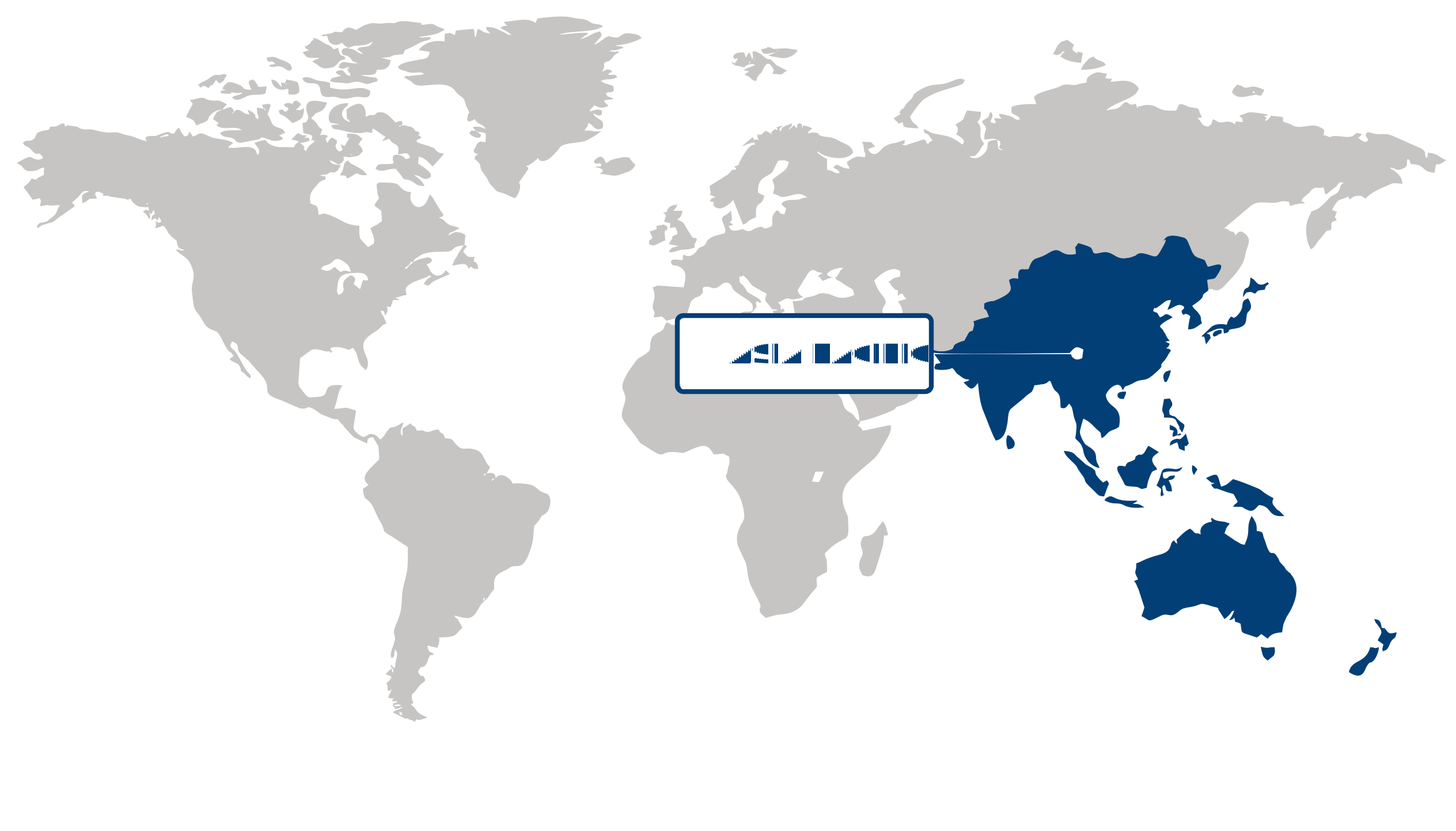
Asia Pacific (Largest Region)
Holding the largest share of the food packaging equipment market, Asia Pacific accounted for 40.17% in 2026. Rapid expansion of food processing and packaged food manufacturing is creating sustained demand for automated filling, sealing, labeling, and inspection equipment across the region. Growing urban populations, evolving consumer preferences, and the expansion of organized retail and food delivery are encouraging producers to improve packaging efficiency and product shelf life. Investments in manufacturing modernization and greater adoption of automated packaging systems are further strengthening regional demand as food producers seek higher throughput and more consistent quality.
Europe (Fastest-Growing Region)
Europe is the fastest-growing region, supported by strong emphasis on packaging efficiency, food safety, sustainability, and automation. Regulatory pressure surrounding packaging waste and resource efficiency is encouraging food manufacturers to adopt equipment capable of supporting material optimization and more sustainable packaging formats. Advanced manufacturing capabilities and the increasing integration of smart controls, robotics, and digital monitoring are also improving operational efficiency, creating opportunities for technologically advanced packaging equipment across the region.
| Parameter | North America | Asia Pacific | Europe | Latin America | MEA |
|---|---|---|---|---|---|
| Innovation Hub i Scale Nascent Developing Advanced | |||||
| Cost-Sensitive Region i Scale Low Medium High | |||||
| Regulatory Environment i Scale Restrictive Neutral Supportive | |||||
| Demand Drivers i Scale Weak Moderate Strong | |||||
| Development Stage i Scale Emerging Developing Developed | |||||
| Adoption Rate i Scale Low Medium High | |||||
| New Entrants / Startups i Scale Sparse Moderate Dense | |||||
| Macro Indicators i Scale Weak Stable Strong |
Key Country Insights
Germany 🇩🇪
Engineering Efficiency PlatformGermany emphasizes advanced packaging equipment with high precision, energy efficiency, and seamless production integration. Manufacturers continue refining automated systems that support complex food processing operations and sustainable packaging objectives.
France 🇫🇷
Sustainable Packaging TransitionFrance prioritizes food packaging equipment compatible with recyclable and resource-efficient packaging materials. Equipment investments increasingly support manufacturers adapting production lines to evolving sustainability and packaging performance expectations.
Italy 🇮🇹
Flexible Production EquipmentItaly emphasizes versatile packaging equipment capable of handling varied food formats and shorter production runs. Manufacturers in Italy increasingly modernize packaging operations to improve efficiency while maintaining product presentation quality.
Japan 🇯🇵
Compact Processing SolutionsJapan focuses on space-efficient food packaging equipment designed for high reliability and operational consistency. Companies in Japan invest in automation that supports diverse packaged food categories while optimizing limited manufacturing space.
South Korea 🇰🇷
Smart Packaging SystemsSouth Korea advances smart packaging equipment featuring digital monitoring and adaptable production capabilities. Food manufacturers increasingly adopt connected machinery to improve operational visibility and support rapidly changing packaging requirements.
United States 🇺🇸
Automation Investment FocusThe U.S. market prioritizes automated food packaging equipment that improves throughput, labor efficiency, and production flexibility. Equipment suppliers increasingly deliver integrated digital solutions to help processors accommodate diverse packaging formats.
Segment Leadership and Growth Trends
Food Packaging Equipment Market Share (%), by Equipment Type, 2026
Go beyond the chart, access full insights & data tables
Request Free Sample ReportEquipment Type Segment Analysis: Form-Fill-Seal (Largest Segment) vs Cartoning (Fastest-Growing Segment)
The form-fill-seal segment led the food packaging equipment market with a 30.35% share in 2026, supported by its ability to integrate packaging operations into a continuous process that can improve production efficiency and consistency. Form-fill-seal equipment is widely suited to packaging food products in flexible formats while helping manufacturers maintain controlled filling, sealing, and product handling operations. Rising demand for convenient packaged foods, efficient production workflows, and consistent packaging quality continues to reinforce the segment's importance.
Cartoning is the fastest-growing equipment type, benefiting from increasing demand for organized, protective, and visually appealing secondary packaging across food categories. Cartoning equipment can automate the placement of products into cartons while improving handling efficiency and packaging consistency. Growing emphasis on automation, shelf-ready presentation, product protection, and efficient material use is encouraging food manufacturers to expand their adoption of automated cartoning solutions.
Application Segment Analysis: Bakery & Confectionary (Largest Segment) vs Convenience Food (Fastest-Growing Segment)
In the food packaging equipment market, the bakery & confectionary segment held the largest share at 26.46% in 2026, reflecting the diverse packaging requirements of products such as baked goods, sweets, and other prepared treats. These products often require packaging that protects freshness, maintains product appearance, and supports efficient handling throughout distribution and retail. Increasing demand for packaged bakery and confectionery products is encouraging manufacturers to adopt automated equipment capable of delivering consistent and efficient packaging.
Convenience food represents the fastest-growing application segment, driven by changing consumer preferences toward products that offer ease of preparation, portability, and quick consumption. Manufacturers are increasingly adopting automated packaging systems capable of handling varied product formats while maintaining hygiene, consistency, and production efficiency. The expansion of ready-to-eat and ready-to-prepare food offerings is therefore creating stronger demand for flexible and high-efficiency packaging equipment.
| Segment | Sub-Segment | Largest Segment | Fastest Growing |
|---|---|---|---|
| Equipment Type | Form-Fill-Seal, Filling & Dosing, Cartoning, Case Packing, Wrapping & Bundling, Others | Form-Fill-Seal | Cartoning |
| Application | Bakery & Confectionary, Dairy Products, Fruits, Nuts & Vegetables, Meat, Poultry & Seafood, Convenience Food, Others | Bakery & Confectionary | Convenience Food |
Competitive Landscape and Market Positioning
Prominent players in the food packaging equipment market:
1. Tetra Pak International S.A. (Switzerland)
2. Syntegon Technology GmbH (Germany)
3. Krones AG (Germany)
4. Coesia S.p.A. (Italy)
5. IMA Group (Italy)
6. Multivac Sepp Haggenmüller SE & Co. KG (Germany)
7. Ishida Co. Ltd. (Japan)
8. Sidel Group (France)
9. ProMach Inc. (United States)
Sustainability-driven innovation is significantly influencing the food packaging equipment market as manufacturers adopt energy-efficient systems and automation technologies to optimize packaging operations. Demand for eco-friendly packaging processes is encouraging the integration of smart controls, waste reduction mechanisms, and flexible production capabilities. Additionally, advancements in high-speed machinery are supporting the evolving requirements of food processing facilities seeking improved throughput and compliance standards.
| Company | Market Share | Company Revenue | Revenue CAGR (%) | Product Portfolio | Geographic Presence | Innovation / R&D Focus | Strategic Developments |
|---|---|---|---|---|---|---|---|
| Tetra Pak International S.A. (Switzerland) | |||||||
| Syntegon Technology GmbH (Germany) | |||||||
| Krones AG (Germany) | |||||||
| Coesia S.p.A. (Italy) | |||||||
| IMA Group (Italy) | |||||||
| Multivac Sepp Haggenmüller SE & Co. KG (Germany) | |||||||
| Ishida Co. Ltd. (Japan) | |||||||
| Sidel Group (France) | |||||||
| ProMach Inc. (United States). |
Industry Development/News
| Company Name | Date | Key Development |
|---|---|---|
| Amcor | Apr-26 | Amcor, in partnership with Metsä Group and G. Mondini, developed an integrated fiber-based tray system for protein and chilled ready meals. Demonstrated on G. Mondini’s Trave Streamline machinery, the solution incorporates a lightweight barrier liner. This collaboration highlights a strategic focus on aligning material science with equipment innovation to improve packaging sustainability and efficiency in food processing operations. |
| Sacmi Packaging & Chocolate | Dec-25 | Sacmi acquired a 65% stake in Groupe Emballage Technologies to enhance its secondary packaging capabilities, particularly for the chocolate and confectionery sectors. This strategic consolidation of primary and secondary packaging expertise aims to broaden the company's portfolio of integrated solutions and improve automated packaging efficiency for food manufacturers. |
| ULMA Packaging | Mar-25 | ULMA launched the TFX thermoforming series designed for automated forming, filling, and sealing. These systems provide enhanced flexibility and efficiency for fresh, processed, and ready-to-eat food applications. The introduction underscores a market-wide shift toward higher levels of equipment automation, stricter hygiene standards, and operational performance improvements to meet evolving food industry requirements. |
| Oliver Packaging and Equipment Co | Nov-24 | Monomoy Capital Partners acquired Oliver Packaging and Equipment Co., a manufacturer of food packaging systems and bakery equipment. This ownership change provides the capital and strategic oversight required to support the company’s next phase of operational development and expansion in automated packaging solutions, strengthening its competitive positioning in the food processing machinery landscape. |
| Eastman | Apr-24 | Eastman partnered with SEE to introduce a lightweight, compostable food tray aimed at replacing traditional polystyrene foam in protein packaging. This initiative demonstrates the commercialization of sustainable material alternatives that require compatibility with existing packaging equipment, reflecting industry efforts to transition toward environmentally responsible packaging systems while maintaining functional food protection and shelf-life standards. |
| ProMach | Feb-24 | ProMach expanded its food and pet food packaging equipment portfolio by acquiring Zacmi. The acquisition integrates Zacmi’s specialized seaming and pasteurization technologies into ProMach’s broader processing and packaging machinery offerings. This move enhances the company’s ability to provide end-to-end integrated solutions, strengthening its market presence in high-volume food and pet food manufacturing environments. |
Customize Your Report
Explore examples of how this report can be tailored to different research needs, including custom segments, additional topics or chapters, and related reports. Click a section of the wheel or its numbered marker to explore the available options.
Food Packaging Equipment Market — Custom Segments
| Segment | Sub-Segment |
|---|---|
| Packaging Material Compatibility | Flexible Films, Paper & Paperboard, Rigid Plastics, Glass & Metal |
| Packaging Format | Pouches & Sachets, Trays & Cups, Bottles & Containers, Cartons & Boxes, Bags & Wraps |
| Packaging Line Integration | Standalone Equipment, Modular Packaging Lines, Integrated End-of-Line Systems, Fully Automated Packaging Lines |
Food Packaging Equipment Market — Custom TOC
| Custom Chapter | Custom Details |
|---|---|
| Packaging Line Automation Maturity Assessment |
|
| Sustainable Packaging Transition Opportunity Analysis |
|
| Aftermarket Services and Equipment Lifecycle Strategy |
|
Need a different cut of the data?
Request Custom ResearchWhat is the market valuation of food packaging equipment?
What is the projected value of the food packaging equipment industry by 2036?
How is rising demand for convenience foods influencing automation investment in the food packaging equipment market?
Why are hygiene and sustainability requirements accelerating equipment upgrades in the food packaging equipment market?
Why is Form-Fill-Seal the leading equipment type in the food packaging equipment market?
Why is convenience food the fastest-growing application in the food packaging equipment market?
Why is Asia Pacific the largest food packaging equipment market?
What is driving growth in Europe's food packaging equipment market?
Which companies dominate the food packaging equipment landscape?
Our Clients
"The team at Fundamental Business Insights & Consulting demonstrated a commitment to excellence, not only in the quality of the report but also in their client-centric approach."
FANUC
"The level of detail in the market segmentation provided were particularly noteworthy. The detailed country-level insights were also very helpful."
B&R Industrial Automation GmbH
"The consultant took the time to understand our specific business objectives, ensuring that the reports were tailored to address our unique challenges and opportunities."
KUKA SE & Co. KGaA
Our Research Team & Methodology
Every Fundamental Business Insights report is built by a dedicated vertical research team, validated through a structured primary-and-secondary methodology, and reviewed for accuracy before it reaches you.
Research Team Overview
Prepared by the Industrial Automation & Equipment Research Team
Delivery
Published
Demand
Available
Support
Trust & Compliance
Research Domains
10 coverage areasResearch Intelligence
| Source | Reference |
|---|---|
| International Society of Automation (ISA) | www.isa.org |
| International Organization for Standardization (ISO) | www.iso.org |
| National Institute of Standards and Technology (NIST) | www.nist.gov |
| IEEE | www.ieee.org |
| VDMA (German Mechanical Engineering Industry Association) | www.vdma.org |
| Association for Advancing Automation (A3) | www.automate.org |
| International Federation of Robotics (IFR) | ifr.org |
| ASME (American Society of Mechanical Engineers) | www.asme.org |
| ASHRAE | www.ashrae.org |
| American Society of Heating, Refrigerating and Air-Conditioning Engineers (ASHRAE) | www.ashrae.org |
| Material Handling Industry (MHI) | www.mhi.org |
| OSHA (Occupational Safety and Health Administration) | www.osha.gov |
| National Fire Protection Association (NFPA) | www.nfpa.org |
| ASTM International | www.astm.org |
| International Electrotechnical Commission (IEC) | www.iec.ch |
| Open Process Automation Forum (The Open Group) | www.opengroup.org/open-process-automation-forum |
| AGMA (American Gear Manufacturers Association) | www.agma.org |
| Association of Equipment Manufacturers (AEM) | www.aem.org |
| Food and Agriculture Organization (FAO) | www.fao.org |
| International Labour Organization (ILO) | www.ilo.org |
Research Workflow & Quality Assurance
Data Collection
Verified information gathered through primary and secondary research.
Data Triangulation
Cross-validation using multiple independent data sources.
Forecast Modelling
Market estimates developed using historical trends and analytical models.
Analyst Validation
Findings reviewed by domain experts for accuracy and consistency.
Editorial & Quality Review
Final editorial, quality, and compliance checks before publication.
Final Publication
Released after successful completion of the internal review process.
Report Coverage
📊 Market Assessment
- Market Size & Forecast
- Market Segmentation
- Regional Analysis
- Growth Drivers & Challenges
- Market Dynamics
🏢 Competitive Intelligence
- Competitive Landscape
- Company Profiles
- Competitive Benchmarking
- Mergers & Acquisitions
- Market Share Analysis or Key Company Strategies
🔍 Strategic Analysis
- Value Chain Analysis
- Porter's Five Forces
- PESTLE Analysis
- Pricing Trends
- Supply-Demand Analysis
🚀 Future Outlook
- Technology Landscape
- Regulatory Landscape
- Investment & Funding Landscape
- Emerging Opportunities
- Future Market Outlook
Have a question about this report or need a custom scope?
Request Customization