Food Grade Lubricants Market Size & Forecasts 2026-2035, By Segments (Type of Oil, Type Of Application), Growth Opportunities, Innovation Landscape, Regulatory Shifts, Strategic Regional Insights (U.S., Japan, China, South Korea, UK, Germany, France), and Competitive Dynamics (Klüber Lubrication, Fuchs Petrolub, Dow Chemical, Shell, ExxonMobil)
Market Size and Growth Outlook
Food Grade Lubricants Market size is forecasted to reach USD 861.96 million by 2035, rising from USD 426.08 million in 2025, at a CAGR of more than 7.3% between 2026 and 2035. In 2026, revenue is projected at USD 453.31 million.
Get more details on this report
Request Free Sample ReportFood Grade Lubricants Market Intelligence Snapshot
Regional Market Dynamics
Segment Momentum
Market Expansion Drivers
Leading Market Participants
Global Market Forecast Snapshot
Market Outlook
Regional and Segment Outlook
Market Growth Drivers and Industry Trends
The food grade lubricants market is increasingly shaped by hygiene and contamination-avoidance priorities among large food manufacturers and retailers. Regulators such as the U.S. Food and Drug Administration (FDA) continue to enforce rigorous food-contact substance guidance, while certification bodies like NSF International (NSF) drive procurement toward H1-registered and ISO 21469-compliant products; Nestlé and Unilever emphasize hygienic production in their sustainability and manufacturing reports. Established suppliers can monetize comprehensive certified portfolios and integrated service contracts; newcomers can win share by specializing in niche certifications or rapid local supply. Given sustained regulatory scrutiny and buyer scrutiny, procurement is shifting toward certified, end-to-end service offerings rather than commodity oils.
Technological advancements in lubricant formulations
Innovations in synthetic, biodegradable and low-toxicity chemistries are redefining the food grade lubricants market: manufacturers such as Klüber Lubrication and FUCHS have publicized NSF H1 and biodegradable product launches that extend equipment life and simplify compliance, while standards bodies like the International Organization for Standardization (ISO) underpin new hygiene benchmarks. These formulation advances reduce downtime and total cost of ownership, creating premium pricing opportunities for incumbents with R&D scale and partnership potential for OEMs; agile entrants can differentiate via customized, certified blends and formulation-as-a-service models. Observed investment in certified synthetics and lifecycle-focused offerings indicates procurement will increasingly favor performance- and sustainability-led specifications.
Expansion of the food processing industry in emerging markets
Growth of processing capacity in Asia, Africa and Latin America — documented in Food and Agriculture Organization of the United Nations (FAO) analyses and World Bank urbanization data — is lifting demand in the food grade lubricants market as local processors scale packaging and automation. Multinationals’ regional investment programs, reflected in Nestlé’s and Cargill’s public statements about capacity expansion, increase demand for locally sourced, certified lubricants and aftermarket support. Incumbents can leverage distribution networks and service infrastructure to capture volume and retrofit opportunities; new entrants can undercut via localized supply, rapid certification support and maintenance services. Continued industrialization and localized food manufacturing activity point to structurally higher demand for certified, service-backed lubrication solutions.
Industry Restraints:
Regulatory Compliance Burdens
Stringent, overlapping food-safety and chemical regulations materially slow product development and market entry by forcing reformulation, protracted testing, and costly certification. U.S. Food and Drug Administration (FDA) food-contact requirements and NSF International H1 registration criteria are routine gating factors for sales into North American processors, while European Commission Regulation (EC) No 1935/2004 and European Chemicals Agency (ECHA) REACH controls restrict permissible additives and require documentation. These rules raise fixed costs for compliance and create approval lead times that favor incumbent suppliers with regulatory teams. For new entrants and niche formulators the result is delayed revenues and higher customer due diligence. Expect continued tightening around traceability and toxicology in the near to medium term, preserving advantage for compliant, well‑capitalized players and keeping barriers high for smaller innovators.
Feedstock and Additive Supply Constraints
Dependence on refined base oils and a narrow set of approved specialty additives constrains product availability and margin stability, as demonstrated by S&P Global reporting on base‑oil supply tightness and the International Energy Agency (IEA) analysis of crude‑market volatility. United Nations Conference on Trade and Development (UNCTAD) documentation of pandemic‑era logistics bottlenecks highlights persistent distribution fragility for chemical inputs. The practical effect is juggling specification requirements against intermittent raw‑material availability, pressuring formulators and OEMs. Vertically integrated manufacturers (for example, major refiners and chemical producers) gain sourcing resilience, while independent blenders and startups face procurement risk and margin erosion. Over the next few years these constraints will encourage greater supplier consolidation, strategic inventorying, and partnerships to secure qualified feedstocks.
| Growth Driver | Impact on CAGR | Regulatory Influence | Geographic Relevance | Adoption Rate | Impact Timeline |
|---|---|---|---|---|---|
| Rising demand for food-grade lubricants in processing and packaging | 2.50% | Short term (≤ 2 yrs) | North America, Europe | Medium | Fast |
| Technological advancements in lubricant formulations | 2.00% | Medium term (2–5 yrs) | Asia Pacific, Europe | Medium | Moderate |
| Expansion of the food processing industry in emerging markets | 2.80% | Long term (5+ yrs) | Asia Pacific, Latin America | Low | Moderate |
Unlock insights tailored to your business with our bespoke market research solutions.
Click to get your customized report now.
Regional Demand Dynamics
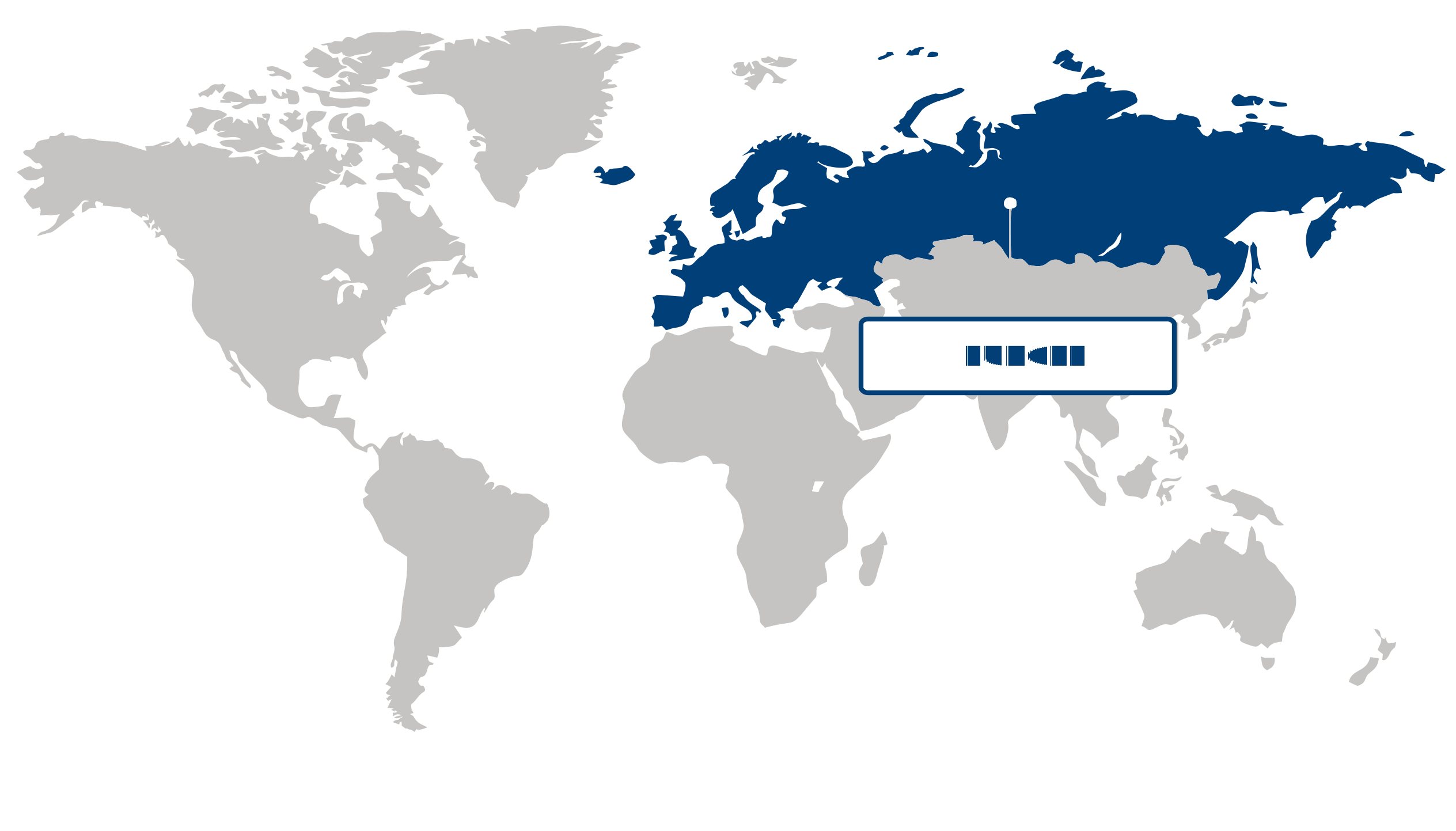
Europe captured approximately 39.21% of the global food grade lubricants market in 2025, underpinned by robust regulatory frameworks and widespread adoption of H1-certified products across food processing chains. The region’s leadership is driven by the European Commission’s food hygiene rules (Regulation (EC) No 852/2004), risk assessments from the European Food Safety Authority (EFSA), and industry guidance from the European Hygienic Engineering & Design Group (EHEDG), all of which raise barrier-to-entry for noncertified formulations and favor suppliers with NSF/ISO-aligned H1 portfolios. Suppliers such as Klüber Lubrication and Fuchs Petrolub publicly emphasize H1 ranges for EU processors, illustrating commercial alignment with regulators. Given continued investment in hygienic upgrades, sustainability-focused replacements for mineral oils, and digital maintenance practices, Europe remains a high-opportunity region for differentiated, certified food-grade lubricant offerings.
Germany anchors the Europe food grade lubricants market as a manufacturing and testing hub where stringent national oversight and large-scale food processors converge. Federal bodies such as the Federal Ministry of Food and Agriculture (BMEL) and the Federal Institute for Risk Assessment (BfR) reinforce EU-level standards, while German suppliers (for example Klüber Lubrication and Fuchs Petrolub) maintain extensive H1-certified portfolios tailored to automotive-adjacent and heavy food-processing environments. This creates concentrated demand for certified, high-performance biodegradable formulations and validation services; international suppliers can leverage Germany-based partnerships and technical centers to certify products and win specification inclusion across European OEMs and processors.
France plays a pivotal role in the Europe food grade lubricants market through its large dairy, bakery and processed-food sectors and active national safety oversight. Agencies including the French Agency for Food, Environmental and Occupational Health & Safety (ANSES) and the Ministère de l'Agriculture et de l'Alimentation influence procurement standards, while major processors such as Danone and Lactalis prioritize hygiene, traceability and sustainability in their supply chains. That combination favors lubricants that carry H1 certification, clear technical documentation and demonstrable biodegradability; strategic entry via service agreements, joint trials and supply continuity programs with French processors can accelerate broader European adoption and reinforce regional leadership.
Asia Pacific Market Analysis:
The Asia Pacific food grade lubricants market emerged as the fastest-growing region, registering a robust CAGR of 8.76% driven by the modernization of food processing facilities and rising hygiene standards. Rapid capital expenditure across processing lines and certified hygienic retrofits is creating steady replacement cycles for non-food-grade oils with NSF H1, EU/Regulation-compliant and biodegradable alternatives; this trend is reinforced by regional adoption of Codex Alimentarius Commission guidelines (FAO/WHO) and strengthened inspections by agencies such as the State Administration for Market Regulation. Investments in automation and traceability, together with growing retail and export quality requirements, are widening opportunity windows for formulation innovation, contamination-control services and OEM partnerships across the region.
Japan's food grade lubricants market plays a compliance-led, high-value role where modernization emphasizes precision automation and rigorous hygiene. Japan’s Ministry of Health, Labour and Welfare (MHLW) standards and Ministry of Economy, Trade and Industry (METI) programs such as the Robot Revolution Initiative are accelerating equipment upgrades that demand NSF- and JIS-compatible lubricants and documented supply-chain safety. Large domestic food manufacturers and machinery OEMs require traceable material specifications and long-life synthetic chemistries, creating channels for value-added technical services and certified lubricant changeover programs. Strategic implication: targeting certified partnerships with Japanese OEMs and certifying to MHLW/METI-endorsed standards will unlock premium deployment and service contracts.
China's food grade lubricants market is a scale-driven modernization hotspot where plant upgrades and stricter enforcement under the Food Safety Law (administered by the State Administration for Market Regulation) are expanding demand for compliant lubricants. Policy pushes such as the State Council’s industrial modernization initiatives and accelerated cold-chain/logistics investment are prompting large processors and contract manufacturers to adopt FDA-, NSF- and GB-standard lubricants while retailers and exporters insist on documented hygiene controls. This environment favors suppliers that can deliver local supply continuity, technical training, and compatibility certifications; strategically, establishing on-the-ground technical teams and regulatory-compliant documentation will convert volume modernization projects into long-term regional footprints.
North America Market Trends:
Maintained a substantial share in the food grade lubricants market, North America combines a large, concentrated food and beverage manufacturing base with rigorous certification and procurement practices that sustain steady demand for compliant and sustainable lubricants. Demand patterns favor NSF International H1–listed products and documented food-contact safety, as reflected in NSF International listings and U.S. Food and Drug Administration (FDA) Food Contact Notifications; major suppliers such as Klüber Lubrication and ExxonMobil have highlighted regional product launches and H1 portfolios in their press releases. Logistics resilience around distribution hubs, buyer-driven sustainability commitments from PepsiCo and Nestlé, and ongoing plant modernization across the region create durable opportunities for differentiated, certified lubricant solutions. This mix of compliance intensity and modernization suggests continued commercial upside for suppliers who can meet certification and sustainability requirements.
The U.S. remains the primary engine in the food grade lubricants market within North America, driven by scale of processing, centralized procurement by large CPGs, and early adoption of predictive maintenance that raises demand for long-life, food-safe formulations. U.S. Food and Drug Administration (FDA) guidance and USDA procurement standards increase buyer emphasis on documented safety, while procurement and sustainability reports from PepsiCo and Kraft Heinz illustrate how corporate purchasing funnels favor certified suppliers; suppliers such as ExxonMobil and Shell Lubricants have emphasized U.S.-focused product offerings in corporate communications. Strategically, the U.S. role amplifies regional opportunity by acting as a reference market for approvals, large-volume contracts, and technology-driven lubricant specifications that other North American customers will replicate.
| Parameter | North America | Asia Pacific | Europe | Latin America | MEA |
|---|---|---|---|---|---|
| Innovation Hub i Scale Nascent Developing Advanced | |||||
| Cost-Sensitive Region i Scale Low Medium High | |||||
| Regulatory Environment i Scale Restrictive Neutral Supportive | |||||
| Demand Drivers i Scale Weak Moderate Strong | |||||
| Development Stage i Scale Emerging Developing Developed | |||||
| Adoption Rate i Scale Low Medium High | |||||
| New Entrants / Startups i Scale Sparse Moderate Dense | |||||
| Macro Indicators i Scale Weak Stable Strong |
Segment Leadership and Growth Trends
Food Grade Lubricants Market Share (%), by Type of Oil, 2026
Go beyond the chart, access full insights & data tables
Request Free Sample ReportSynthetic oil dominated the food grade lubricants market in 2025 as the largest share, driven by superior thermal stability and longer service life that reduce downtime and total cost of ownership in high-temperature food processing applications. Suppliers such as Klüber Lubrication and ExxonMobil highlight extended drain intervals in product literature, and NSF International’s H1 listings for synthetic formulations reinforce regulatory acceptance; combined with operators’ shift toward predictive maintenance and consolidated supplier contracts, this underpins adoption. The segment allows incumbents to monetize service and certification-led offerings while new entrants can differentiate with bio-based synthetics, and ongoing equipment modernization and hygiene-focused uptime priorities support its near- to medium-term relevance.
Analysis by Type Of Application
Food represented largest share of the food grade lubricants market in 2025, propelled by strict hygiene requirements in food processing and manufacturing that prioritize sanitary, non-toxic lubricants and traceable supply chains. Regulatory drivers such as the U.S. Food and Drug Administration’s Food Safety Modernization Act (FDA FSMA) and European Commission Regulation (EC) No 1935/2004, together with NSF International H1 certification expectations, have prompted processors to standardize approved lubricants; suppliers such as SKF and Fuchs see rising demand for HACCP- and audit-ready solutions. This creates strategic openings for established firms to bundle certification, training and digital monitoring, and for challengers to win share with biodegradable or IoT-enabled products, while compliance and automation trends sustain the segment’s importance.
| Segment | Sub-Segment | Largest Segment | Fastest Growing |
|---|---|---|---|
| Type of Oil | Mineral Oil, Synthetic Oil | ||
| Type Of Application | Food, Pharmaceuticals & Cosmetics, Beverages, Others |
Competitive Landscape and Market Positioning
Competition in the food grade lubricants arena is shaped by product refinement, closer downstream engagement, and selective consolidation among incumbents. Established oil majors and chemical firms reinforce supply reliability and broad portfolio breadth while specialty players intensify application-specific innovation and technical support. Cross-sector linkages with equipment OEMs and food processors accelerate acceptance of tailored formulations and testing protocols, and a visible emphasis on regulatory-aligned formulations, biodegradability, and contamination control is steering R&D priorities and customer-facing services.
Strategic / Actionable Recommendations for Regional Players
North America: Build on local additive and formulation know-how by deepening cooperative relationships with processors and equipment suppliers to co-develop application-specific fluids and testing regimes. Strengthen field service and condition-monitoring offerings to convert technical differentiation into procurement preference, and prioritize traceability and certification readiness to respond to procurement and audit requirements.
Asia Pacific: Expand route-to-market through distribution partnerships and localized formulation adjustments for tropical operating environments and diverse processing standards. Combine hands-on technical support with bundled offerings alongside OEMs to lower adoption friction, and leverage digital sales and documentation to accelerate approvals among regional food manufacturers.
Europe: Differentiate through low-environmental-impact and readily certifiable fluids, aligning formulations with prevailing food-safety audit frameworks and circularity expectations. Collaborate with additive and packaging specialists to reduce life-cycle impact, and use joint validation with certification bodies and major processors to elevate acceptance of sustainable, high-performance replacements.
| Company | Market Share | Company Revenue | Revenue CAGR (%) | Product Portfolio | Geographic Presence | Innovation / R&D Focus | Strategic Developments |
|---|---|---|---|---|---|---|---|
| No companies available. | |||||||
Industry Development/News
| Company Name | Date | Key Development |
|---|
Customize Your Report
Explore examples of how this report can be tailored to different research needs, including custom segments, additional topics or chapters, and related reports. Click a section of the wheel or its numbered marker to explore the available options.
Food Grade Lubricants Market — Custom Segments
| Segment | Sub-Segment |
|---|---|
| No segment data available. | |
Food Grade Lubricants Market — Custom TOC
| Custom Chapter | Custom Details | ||
|---|---|---|---|
| No custom TOC data available. | |||
Need a different cut of the data?
Request Custom ResearchHow much revenue does the food grade lubricants market generate?
How is the food grade lubricants industry size expected to evolve during the forecast period?
Which part of the world represents the largest segment of the food grade lubricants market?
In which region is the food grade lubricants sector expanding at the quickest pace?
How much is the synthetic oil segment expected to grow in the food grade lubricants industry beyond 2025?
What factors give food segment a competitive edge in the food grade lubricants sector?
What are the prominent companies operating in the food grade lubricants landscape?
Our Clients
"The report provided a thorough look at market trends, technological advancements, and the competitive landscape. The depth of insights was really valuable."
ITC Limited
"We would highly recommend Fundamental Business Insights & Consulting to anyone looking for reliable, detailed, and comprehensive market research in the Food industry."
Tyson Foods
"The clarity and presentation of the information were commendable. The report was delivered timely, which made the overall experience smooth and convenient."
Mondelēz International
Our Research Team & Methodology
Every Fundamental Business Insights report is built by a dedicated vertical research team, validated through a structured primary-and-secondary methodology, and reviewed for accuracy before it reaches you.
Research Team Overview
Prepared by the Food & Beverage Research Team
Delivery
Published
Demand
Available
Support
Trust & Compliance
Research Domains
10 coverage areasResearch Intelligence
| Source | Reference |
|---|---|
| Food and Agriculture Organization (FAO) | www.fao.org |
| World Health Organization (WHO) | www.who.int |
| U.S. Food & Drug Administration (FDA) | www.fda.gov |
| European Food Safety Authority (EFSA) | www.efsa.europa.eu |
| U.S. Department of Agriculture (USDA) | www.usda.gov |
| Codex Alimentarius Commission | www.fao.org/fao-who-codexalimentarius |
| International Organization for Standardization (ISO) | www.iso.org |
| AOAC INTERNATIONAL | www.aoac.org |
| Institute of Food Technologists (IFT) | www.ift.org |
| International Dairy Foods Association (IDFA) | www.idfa.org |
| International Sweeteners Association (ISA) | www.sweeteners.org |
| International Probiotics Association (IPA) | internationalprobiotics.org |
| Good Food Institute (GFI) | gfi.org |
| American Feed Industry Association (AFIA) | www.afia.org |
| International Feed Industry Federation (IFIF) | ifif.org |
| Specialty Food Association (SFA) | www.specialtyfood.com |
| Brewers Association | www.brewersassociation.org |
| International Bottled Water Association (IBWA) | bottledwater.org |
| International Alliance for Dietary/Food Supplement Associations (IADSA) | www.iadsa.org |
| OECD Agriculture & Food | www.oecd.org/agriculture |
Research Workflow & Quality Assurance
Data Collection
Verified information gathered through primary and secondary research.
Data Triangulation
Cross-validation using multiple independent data sources.
Forecast Modelling
Market estimates developed using historical trends and analytical models.
Analyst Validation
Findings reviewed by domain experts for accuracy and consistency.
Editorial & Quality Review
Final editorial, quality, and compliance checks before publication.
Final Publication
Released after successful completion of the internal review process.
Report Coverage
📊 Market Assessment
- Market Size & Forecast
- Market Segmentation
- Regional Analysis
- Growth Drivers & Challenges
- Market Dynamics
🏢 Competitive Intelligence
- Competitive Landscape
- Company Profiles
- Competitive Benchmarking
- Mergers & Acquisitions
- Market Share Analysis or Key Company Strategies
🔍 Strategic Analysis
- Value Chain Analysis
- Porter's Five Forces
- PESTLE Analysis
- Pricing Trends
- Supply-Demand Analysis
🚀 Future Outlook
- Technology Landscape
- Regulatory Landscape
- Investment & Funding Landscape
- Emerging Opportunities
- Future Market Outlook
Have a question about this report or need a custom scope?
Request Customization