Extruded Polystyrene Insulation Materials Market Size & Forecasts 2026-2035, By Segments (Type, End-user, Distribution Channel, Application), Growth Opportunities, Innovation Landscape, Regulatory Shifts, Strategic Regional Insights (U.S., Japan, China, South Korea, UK, Germany, France), and Competitive Dynamics (Owens Corning, Dow, BASF, Kingspan, XPS Foam Board Solutions)
Market Size and Growth Outlook
Extruded Polystyrene Insulation Materials Market size is likely to expand from USD 7.08 billion in 2025 to USD 12.21 billion by 2035, posting a CAGR above 5.6% across 2026-2035. The industry’s revenue potential for 2026 is USD 7.43 billion.
Get more details on this report
Request Free Sample ReportExtruded Polystyrene Insulation Materials Market Intelligence Snapshot
Regional Market Dynamics
Segment Momentum
Market Expansion Drivers
Leading Market Participants
Global Market Forecast Snapshot
Market Outlook
Regional and Segment Outlook
Market Growth Drivers and Industry Trends
Stronger building codes, urbanization and retrofit incentives documented by the International Energy Agency and the European Commission are elevating demand for thermal envelope solutions, making the extruded polystyrene insulation materials market central to compliance and cost‑of‑operation strategies. The U.S. Department of Energy’s building efficiency initiatives and municipal retrofit programs create predictable procurement pipelines; established manufacturers can leverage scale and supply‑chain integration to bid on large projects, while new entrants can differentiate with localized manufacturing or systemized installation services. Given observable policy tightening and program funding, material specification upgrades and modular supply models will increasingly shape procurement decisions.
Expansion in Cold Storage and Industrial Applications
Rising investment in temperature‑controlled logistics, highlighted by Lineage Logistics’ capacity expansion announcements and USDA analyses on cold‑chain needs, is driving demand for moisture‑resistant, high‑compressive insulation, positioning the extruded polystyrene insulation materials market as a solution for industrial flooring and freezer claddings. Logistics operators and food processors seeking lower energy use create opportunities for incumbents to offer integrated insulated panel systems and long‑term supply contracts, while entrants can compete with prefabricated panels, regional installation services, or performance warranties. Observable corporate rollouts of new storage facilities indicate sustained procurement of specialized insulation products.
Development of High‑Performance Extruded Polystyrene Materials
Product innovation from manufacturers such as Dow and Owens Corning, and evolving test methods from ASTM International, are improving thermal performance, compressive strength and environmental footprints, advancing the extruded polystyrene insulation materials market toward higher‑value applications. Initiatives to adopt lower‑GWP blowing agents and enhanced formulations reported in supplier technical releases enable premium positioning; incumbents can monetize R&D through branded systems and specification partnerships, while agile entrants may capture niche segments with recycled content or retrofit‑friendly boards. As standards and supplier disclosures converge, procurement will favor validated, higher‑performance XPS solutions.
Industry Restraints:
Blowing Agent and Carbon-Intensity Regulations
Tighter controls on high‑GWP blowing agents and rising product carbon scrutiny materially constrain extruded polystyrene (XPS) producers by raising compliance costs, forcing technical reformulations, and accelerating capital expenditure on new lines. Regulatory drivers include the Kigali Amendment to the Montreal Protocol, the European Commission’s F‑gas Regulation (EU No 517/2014), the US EPA SNAP program, and California Air Resources Board restrictions; manufacturers such as Dow and BASF have publicly announced transitions to low‑GWP alternatives and investment in next‑generation solutions. Strategically, incumbents with scale and R&D budgets can absorb reformulation costs and secure supply of approved agents, while smaller producers and new entrants face higher barriers and time‑to‑market risk. In the near to medium term, ongoing phasedown schedules and lifecycle carbon disclosure expectations will keep upward pressure on costs and favor vertically integrated or well‑capitalized players that can commercialize compliant XPS formulations.
Fire-Safety and External-Wall Code Restrictions
Enhanced fire performance requirements and bans on combustible external-wall materials restrict XPS adoption in critical building segments, compressing demand and reshaping specification practices. Post‑Grenfell regulatory responses—most notably actions by the UK Ministry of Housing, Communities & Local Government, expanded test scrutiny under NFPA 285 in the US, and evolving Euroclass (EN 13501‑1) assessments—have prompted tighter procurement criteria and insurer reluctance to accept combustible insulation on high‑rise facades. Manufacturers face increased product testing, liability exposure, and potential product delistings; established firms with certified, fire‑tested systems maintain market access while new entrants encounter costly certification hurdles. Expect sustained regulatory vigilance and procurement conservatism over the next several years, driving substitution toward non‑combustible solutions, integrated tested assemblies, and greater emphasis on third‑party certification as prerequisites for large projects.
| Growth Driver | Impact on CAGR | Regulatory Influence | Geographic Relevance | Adoption Rate | Impact Timeline |
|---|---|---|---|---|---|
| Rising construction and insulation demand | 1.80% | Short term (≤ 2 yrs) | North America, Europe; Spillover: Asia Pacific | Medium | Fast |
| Expansion in cold storage and industrial applications | 1.50% | Medium term (2–5 yrs) | Europe, Asia Pacific | Low | Moderate |
| Development of high-performance extruded polystyrene materials | 1.20% | Long term (5+ yrs) | North America, Europe | Low | Slow |
Unlock insights tailored to your business with our bespoke market research solutions.
Click to get your customized report now.
Regional Demand Dynamics
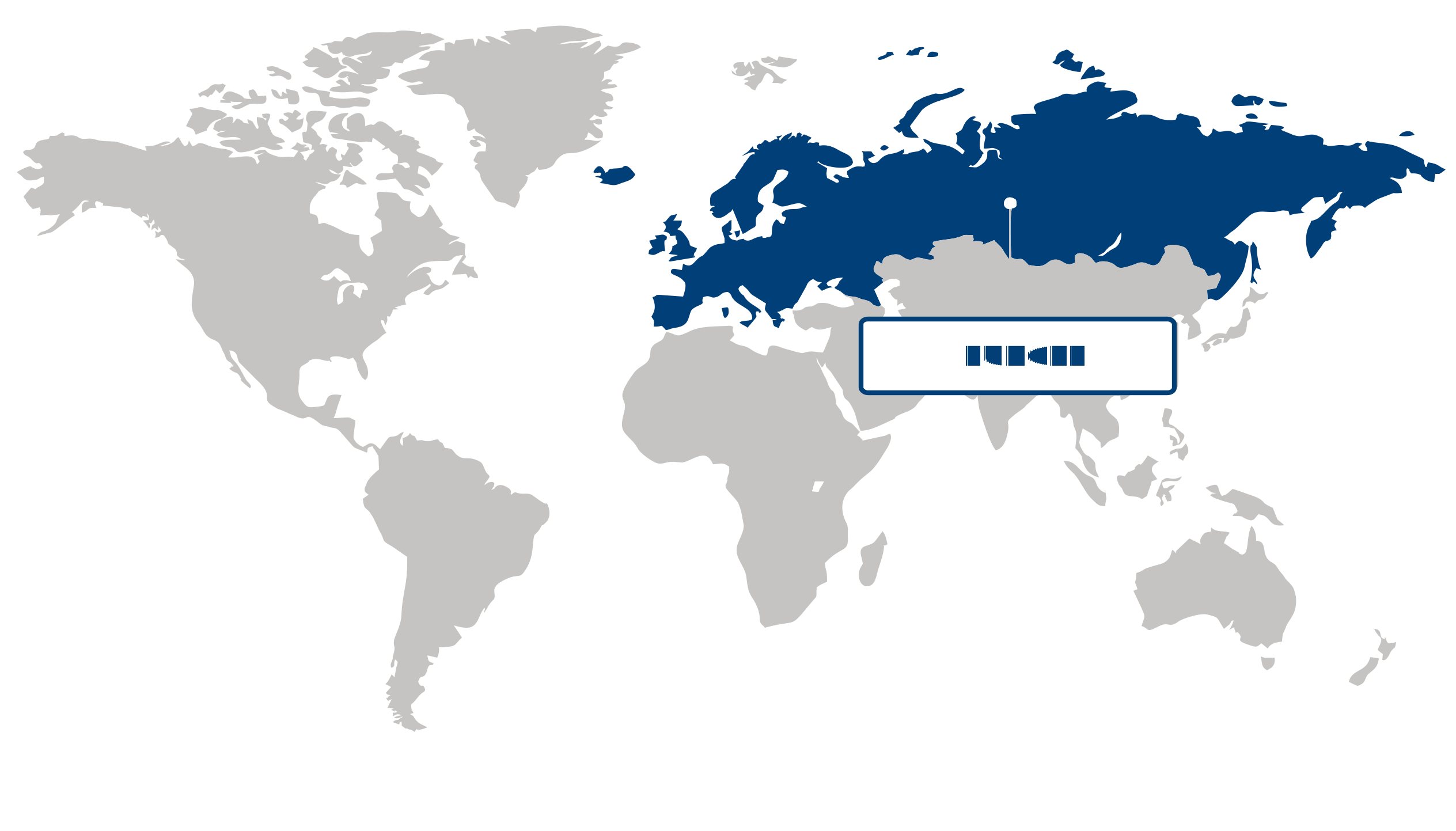
Europe captured more than 35% of the extruded polystyrene insulation materials market in 2025 and is the largest regional market, led primarily by strict building energy codes and government-led green building initiatives that elevate demand for high-performance thermal products. European Commission initiatives such as the Energy Performance of Buildings Directive (EPBD), the Renovation Wave and the European Green Deal have tightened minimum performance requirements and created renovation funding pipelines, while national programs amplify uptake—examples include KfW financing in Germany and MaPrimeRénov' in France. These policy levers, coupled with active commitments from manufacturers like Saint-Gobain and Kingspan Group, create clear near-term demand and supply-side incentives for capacity expansion and product innovation across Europe, making the region a high-opportunity market for investors and manufacturers.
The extruded polystyrene insulation materials market in Germany anchors Europe’s market through stringent national implementation and sizable retrofit financing that accelerate specification of XPS in both residential and commercial projects. Germany’s Gebäudeenergiegesetz (GEG) raises envelope performance requirements, and KfW’s energy-efficient construction and renovation loan programs materially lower customer payback hurdles; manufacturers such as Jackon have expanded domestic capacity to serve this pipeline. For strategists, Germany’s regulatory stringency, deep contractor networks and financing architecture mean it will remain a proving ground for higher-value, low-GWP XPS formulations and modular supply-chain efficiencies that can be replicated across Europe.
The extruded polystyrene insulation materials market in France is positioned as a pivotal growth hub driven by aggressive retrofit subsidies and updated construction standards that favor lower-energy envelopes. France’s RE2020 regulatory framework and support mechanisms like MaPrimeRénov', overseen with technical guidance from Agence de la transition écologique (ADEME), shift new-build and renovation specs toward thicker, higher-performing insulation; Saint-Gobain’s French operations have publicly emphasized product portfolios aligned to RE2020. This combination of regulation, incentives and incumbent manufacturing capability makes France a strategic market for piloting recyclable XPS solutions and scaling circularity initiatives that reinforce Europe-wide growth.
Asia Pacific Market Analysis:
Asia Pacific emerged as the fastest-growing region in the extruded polystyrene insulation materials market, registering a CAGR of 7.2% driven by accelerating urbanization and large-scale infrastructure development projects. Rapid city expansion and transport, energy and industrial construction programs are increasing demand for high-performance thermal insulation in both new build and retrofit scopes; the World Bank and the Asian Development Bank document growing urban infrastructure financing across the region while the National Development and Reform Commission of China and Japan’s Ministry of Land, Infrastructure, Transport and Tourism (MLIT) have prioritized building upgrades and energy efficiency. These dynamics, combined with rising preference for prefabricated systems and tighter local energy codes, create near-term commercial corridors for XPS suppliers focused on scalable manufacturing and local logistics partnerships, making the region particularly attractive for investment in capacity and value-added product development.
Japan occupies a technology-led role in the extruded polystyrene insulation materials market, where stringent energy-efficiency standards and a substantial retrofit pipeline shape product specification and purchase behavior. Japan’s Ministry of the Environment and MLIT have promoted higher thermal performance in national building guidelines and retrofit incentives for aging housing stock, pushing demand toward thinner, higher-R-value XPS boards compatible with limited urban construction footprints. Buyers favor certified, high-durability products for seismic-resilient design and long service life, prompting manufacturers to emphasize quality control and local technical support. Strategically, Japan’s emphasis on premium, code-compliant solutions offers a testing ground for advanced XPS formulations and value-added services that can be scaled regionally.
China is the demand engine in the extruded polystyrene insulation materials market, where urbanization rates and mega-project pipelines create large-volume, specification-driven procurement. Data from the National Bureau of Statistics of China and guidance from the Ministry of Housing and Urban-Rural Development (MOHURD) show continued investment in urban housing, affordable housing, transport corridors and energy-efficiency upgrades—programs that explicitly require improved insulation performance and encourage prefabrication. Local manufacturing scale, proximity to polystyrene feedstock and aggressive public-sector procurement lower delivered costs and accelerate adoption, while central directives from the State Council and NDRC sustain infrastructure spending. For investors and suppliers, China offers scale-led margin opportunities and the chance to optimize regional supply chains to serve neighboring Asian markets.
North America Market Trends:
North America held a commanding share of the extruded polystyrene insulation materials market, driven by robust residential and commercial activity and a sizable retrofit pipeline that together raise demand for high-performing insulation. International Code Council (ICC) updates to the International Energy Conservation Code (IECC) and data from the U.S. Department of Energy signal tougher energy-efficiency expectations, while Natural Resources Canada initiatives and the Government of Canada’s Greener Homes Grant have accelerated retrofit uptake; National Association of Home Builders (NAHB) data confirm persistent construction volumes. These combined procurement and specification shifts, supported by improving logistics at major ports, make the region attractive for higher-spec XPS deployments and long-term supplier investment.
The U.S. represented the regional growth engine for the extruded polystyrene insulation materials market, characterized by a dense manufacturing base, rapid product innovation, and concentrated distribution networks. Recent Dow Inc. press releases and Owens Corning press releases detail moves toward lower-GWP blowing agents and higher-strength formulations for commercial and infrastructure use, while the U.S. Green Building Council (USGBC) influences specification trends toward premium boards; American Chemistry Council analyses and Port of Los Angeles throughput data underscore resin availability and logistics pressures. Strategic implication: U.S. scale, innovation, and distribution create a platform for suppliers to expand premium XPS offerings across North America.
| Parameter | North America | Asia Pacific | Europe | Latin America | MEA |
|---|---|---|---|---|---|
| Innovation Hub i Scale Nascent Developing Advanced | |||||
| Cost-Sensitive Region i Scale Low Medium High | |||||
| Regulatory Environment i Scale Restrictive Neutral Supportive | |||||
| Demand Drivers i Scale Weak Moderate Strong | |||||
| Development Stage i Scale Emerging Developing Developed | |||||
| Adoption Rate i Scale Low Medium High | |||||
| New Entrants / Startups i Scale Sparse Moderate Dense | |||||
| Macro Indicators i Scale Weak Stable Strong |
Segment Leadership and Growth Trends
Extruded Polystyrene Insulation Materials Market Share (%), by Type, 2026
Go beyond the chart, access full insights & data tables
Request Free Sample ReportStandard XPS Boards represented largest share in the extruded polystyrene insulation materials market in 2025 as the leading type by market share and remain central among segments due to their cost-effective thermal performance for building envelopes. Leadership is rooted in adoption by builders and specifiers seeking high R-value per thickness and moisture resistance for below-grade and cavity applications, a preference echoed in technical guidance from the U.S. Department of Energy and product literature from Saint-Gobain; these sources note durability and retrofit suitability. Supply-chain advantages, installation labor efficiencies, and contractor familiarity reinforce competitive positioning. Established manufacturers can scale standardized production and system offerings, while smaller firms can capture retrofit and niche specialty-board opportunities. Continued relevance is expected as energy codes tighten and building owners prioritize lifecycle savings and resilience.
Analysis by End-user
Residential held largest share in the extruded polystyrene insulation materials market in 2025 as the dominant end-user segment driven by sustained housing construction and tightening energy-efficiency regulations across jurisdictions. Growth reflects homeowner demand for lower operating costs and improved comfort, plus policy drivers such as the International Energy Agency’s emphasis on building efficiency and guidelines cited by the National Association of Home Builders; these factors favor segments that balance cost and performance. Demographic trends toward single-family renovations, modular housing practices, and preference for low-maintenance solutions further underpin uptake. For incumbents, partnering with homebuilders and offering specification support is a strategic advantage; entrants can target retrofit services and direct-to-consumer distribution. The segment should remain central near-term as codes and retrofit programs accelerate demand for energy-saving insulation.
Analysis by Distribution Channel
Distributors/Wholesalers dominated the extruded polystyrene insulation materials market in 2025 as the primary distribution segment because extensive networks streamline availability and specification across construction supply chains. Firms such as Ferguson and Wolseley, and manufacturer-distributor models employed by Saint-Gobain, illustrate how broad branch networks, trade credit, and technical sales teams enable fast project fulfillment and contractor trust—factors highlighted in trade communications from those organizations. This channel benefits from logistics scale, inventory pooling, and digital ordering advances that reduce lead times and support multiple segments simultaneously. Established distributors can expand value-added services and private-label assortments; smaller players can differentiate via localized service and digital storefronts. Given continuing supply-chain emphasis on speed, service, and integrated procurement, the distributor/wholesaler channel is likely to retain prominence in the near to medium term.
| Segment | Sub-Segment | Largest Segment | Fastest Growing |
|---|---|---|---|
| Type | Standard XPS Boards, High-Density XPS Boards | ||
| End-user | Residential, Commercial, Industrial, Infrastructure | ||
| Distribution Channel | Direct Sales, Distributors/Wholesalers, Retail, Online | ||
| Application | Roof Insulation, Wall Insulation, Floor Insulation, Foundation Insulation, Cavity Wall Insulation |
Competitive Landscape and Market Positioning
The competitive environment is characterized by active capacity realignment, product differentiation, and targeted investments in application-specific performance. Several firms have broadened product suites to address low-thermal-conductivity formulations and enhanced moisture resistance, while others have reinforced upstream feedstock and downstream logistics to secure continuity of supply. Cross-company development programs and expanded pilot manufacturing have accelerated adoption of lower-impact blowing agents and higher recycled-content boards, prompting peers to sharpen technical roadmaps and commercial offerings. These moves collectively raise entry thresholds for smaller players and push customers to weigh total-system value—service, certification, and lifecycle attributes—alongside unit price.
Strategic / Actionable Recommendations for Regional Players
In markets with mature construction codes and a large retrofit opportunity set, prioritize closer alignment with national contractors and specification groups to accelerate uptake in renovation pipelines. Strengthen local production near major urban centres to reduce lead times, introduce boards optimized for retrofit scenarios (thin-profiles with high R-value), and deploy digital specification tools that integrate with common design platforms to capture early-stage demand.
Where rapid urbanization and price sensitivity dominate, focus on scalable manufacturing improvements and selective product premiumization. Form practical supply relationships with panel and modular builders, pilot automation and process controls to lower unit costs while maintaining consistent XPS properties, and introduce climate-appropriate formulations that address moisture and thermal bridging in dense urban envelopes.
In jurisdictions with stringent environmental requirements and deep retrofit incentives, emphasize material circularity and performance certification. Collaborate with certifying bodies and recycling partners to demonstrate post-consumer content and low-GWP production routes, develop premium high-performance boards for deep-energy-retrofit and high-spec commercial envelopes, and align technical dossiers with national green-building frameworks to secure specification preference.
| Company | Market Share | Company Revenue | Revenue CAGR (%) | Product Portfolio | Geographic Presence | Innovation / R&D Focus | Strategic Developments |
|---|---|---|---|---|---|---|---|
| No companies available. | |||||||
Industry Development/News
| Company Name | Date | Key Development |
|---|
Customize Your Report
Explore examples of how this report can be tailored to different research needs, including custom segments, additional topics or chapters, and related reports. Click a section of the wheel or its numbered marker to explore the available options.
Extruded Polystyrene Insulation Materials Market — Custom Segments
| Segment | Sub-Segment |
|---|---|
| No segment data available. | |
Extruded Polystyrene Insulation Materials Market — Custom TOC
| Custom Chapter | Custom Details | ||
|---|---|---|---|
| No custom TOC data available. | |||
Need a different cut of the data?
Request Custom ResearchHow big is the extruded polystyrene insulation materials market?
How will the extruded polystyrene insulation materials industry grow in terms of size and CAGR by 2035?
Which region shows the largest market footprint in the extruded polystyrene insulation materials market?
In which region is the extruded polystyrene insulation materials sector expanding at the quickest pace?
Why is the standard XPS boards segment leading in the extruded polystyrene insulation materials industry?
Why does residential sub-segment dominate the end-user segment of extruded polystyrene insulation materials sector?
How much is the Distributors/Wholesalers segment expected to grow in the extruded polystyrene insulation materials industry beyond 2025?
What factors give wall insulation segment a competitive edge in the extruded polystyrene insulation materials sector?
Who are the major participants shaping the extruded polystyrene insulation materials landscape?
Our Clients
"Your insights on workforce structures were spot-on. The analysis on mid-to-senior level roles validated some of our hiring decisions and highlighted gaps."
Ateliers De France
"The report gave us insights on competitors in the market. It helped our team refine our bidding strategy for upcoming contracts."
Clark Construction
"The reports provided a deep dive into market trends, and competitive landscape. The strategic insights and recommendations have been very helpful."
Rudolph and Sletten
Our Research Team & Methodology
Every Fundamental Business Insights report is built by a dedicated vertical research team, validated through a structured primary-and-secondary methodology, and reviewed for accuracy before it reaches you.
Research Team Overview
Prepared by the Construction & Manufacturing Research Team
Delivery
Published
Demand
Available
Support
Trust & Compliance
Research Domains
10 coverage areasResearch Intelligence
| Source | Reference |
|---|---|
| International Organization for Standardization (ISO) | www.iso.org |
| ASTM International | www.astm.org |
| National Institute of Standards and Technology (NIST) | www.nist.gov |
| International Code Council (ICC) | www.iccsafe.org |
| American Concrete Institute (ACI) | www.concrete.org |
| American Institute of Steel Construction (AISC) | www.aisc.org |
| Construction Industry Institute (CII) | www.construction-institute.org |
| Associated General Contractors of America (AGC) | www.agc.org |
| Association of Equipment Manufacturers (AEM) | www.aem.org |
| Building Owners and Managers Association (BOMA) | www.boma.org |
| American Society of Civil Engineers (ASCE) | www.asce.org |
| National Ready Mixed Concrete Association (NRMCA) | www.nrmca.org |
| International Facility Management Association (IFMA) | www.ifma.org |
| World Green Building Council (WorldGBC) | worldgbc.org |
| International Federation of Consulting Engineers (FIDIC) | fidic.org |
| International Labour Organization (ILO) | www.ilo.org |
| American Society of Mechanical Engineers (ASME) | www.asme.org |
| Society of Manufacturing Engineers (SME) | www.sme.org |
| National Association of Home Builders (NAHB) | www.nahb.org |
| European Construction Industry Federation (FIEC) | www.fiec.eu |
Research Workflow & Quality Assurance
Data Collection
Verified information gathered through primary and secondary research.
Data Triangulation
Cross-validation using multiple independent data sources.
Forecast Modelling
Market estimates developed using historical trends and analytical models.
Analyst Validation
Findings reviewed by domain experts for accuracy and consistency.
Editorial & Quality Review
Final editorial, quality, and compliance checks before publication.
Final Publication
Released after successful completion of the internal review process.
Report Coverage
📊 Market Assessment
- Market Size & Forecast
- Market Segmentation
- Regional Analysis
- Growth Drivers & Challenges
- Market Dynamics
🏢 Competitive Intelligence
- Competitive Landscape
- Company Profiles
- Competitive Benchmarking
- Mergers & Acquisitions
- Market Share Analysis or Key Company Strategies
🔍 Strategic Analysis
- Value Chain Analysis
- Porter's Five Forces
- PESTLE Analysis
- Pricing Trends
- Supply-Demand Analysis
🚀 Future Outlook
- Technology Landscape
- Regulatory Landscape
- Investment & Funding Landscape
- Emerging Opportunities
- Future Market Outlook
Have a question about this report or need a custom scope?
Request Customization