Elemental Boron Market Size & Forecasts 2026-2035, By Segments (Type, Application), Growth Opportunities, Innovation Landscape, Regulatory Shifts, Strategic Regional Insights (U.S., Japan, China, South Korea, UK, Germany, France), and Competitive Dynamics (RT Advanced Materials, Borregaard, Boron Products, UCF Advanced Materials, Boron Tech)
Market Size and Growth Outlook
Elemental Boron Market size is predicted to expand from USD 62.45 million in 2025 to USD 94.23 million by 2035, with growth underpinned by a CAGR above 4.2% between 2026 and 2035. The industry revenue outlook for 2026 is USD 64.69 million.
Get more details on this report
Request Free Sample ReportElemental Boron Market Intelligence Snapshot
Regional Market Dynamics
Segment Momentum
Market Expansion Drivers
Leading Market Participants
Global Market Forecast Snapshot
Market Outlook
Regional and Segment Outlook
Market Growth Drivers and Industry Trends
Expansion in aerospace and defense applications: Accelerating adoption of ceramic matrix composites and boron-containing fibers in propulsion and structural subsystems is increasing demand drivers for the elemental boron market, supported by public and private procurement. GE Aviation and Rolls-Royce press releases on CMC component development, Boeing’s composite aircraft programs, and U.S. Department of Defense investments in lightweight armor and materials research all signal sustained technical adoption. Incumbent suppliers can pursue long-term supply contracts and certification pathways, while new entrants can target qualification services and tier‑2 component niches. With demonstrated flight- and defense-grade use cases and procurement commitments, boron-enabled materials are transitioning from R&D to qualified platforms.
Development of specialty boron products for advanced materials: Growth in tailored boron chemistries—high-purity powders, boron nitride nanotubes, and specialty precursors—is reshaping the elemental boron market toward higher-value applications, as firms and researchers demand application-specific specifications. Companies such as Rio Tinto Borax and Eti Maden are investing in product diversification, while American Elements and research teams at Oak Ridge National Laboratory report advanced boron derivatives for electronics and thermal management. Incumbents can capture margin uplift by advancing purity and service capabilities; startups can differentiate through proprietary chemistries or toll-manufacturing. Observed investments in specialty product lines and collaborative R&D agreements point to continued segmentation of boron supply into commodity and specialty channels.
Industry Restraints:
Geopolitical Concentration and Export Dependency: The elemental boron market is constrained by a concentrated supply base—Turkey’s state miner Eti Maden controls a dominant share of global borate reserves while Rio Tinto Borates and a small number of producers supply other markets—creating exposure to export policy shifts and trade disruptions. The U.S. Geological Survey (USGS) highlights Turkey’s reserve dominance and production share, underscoring single-source risk. For incumbent producers, control of feedstock enables pricing power and contract leverage; for new entrants and downstream manufacturers, securing long-term offtake or investing in vertically integrated assets becomes essential. Given ongoing resource nationalism and the strategic positioning of Eti Maden reported by USGS, concentration-driven supply tightness and premium sourcing requirements are likely to remain a material constraint in the near to medium term.
High Energy Intensity and Environmental Compliance Costs: Production and refinement of elemental boron require energy-intensive processing and strict handling protocols, elevating operating costs and capital expenditure for emissions control and waste management. The International Energy Agency (IEA) documents high energy demands in mineral-processing sectors, and Rio Tinto’s sustainability disclosures describe capital allocation to decarbonization and operational-efficiency upgrades at its Boron assets. Regulatory oversight, including registration and substance assessment under the European Chemicals Agency (ECHA) REACH framework, increases compliance burdens for producers and formulators. Strategically, established firms must balance retrofit CAPEX and margin compression while entrants face higher barriers-to-entry; these cost and compliance pressures will continue to shape investment decisions and technology adoption over the coming years.
| Growth Driver | Impact on CAGR | Regulatory Influence | Geographic Relevance | Adoption Rate | Impact Timeline |
|---|---|---|---|---|---|
| Rising demand in high-performance ceramics and composites | 0.80% | Short term (≤ 2 yrs) | Asia Pacific, Europe | Medium | Moderate |
| Expansion in aerospace and defense applications | 0.60% | Medium term (2–5 yrs) | North America, Europe | Low | Moderate |
| Development of specialty boron products for advanced materials | 0.40% | Long term (5+ yrs) | Asia Pacific, North America | Low | Slow |
Explore Growth Opportunities
Request Free Sample ReportRegional Demand Dynamics
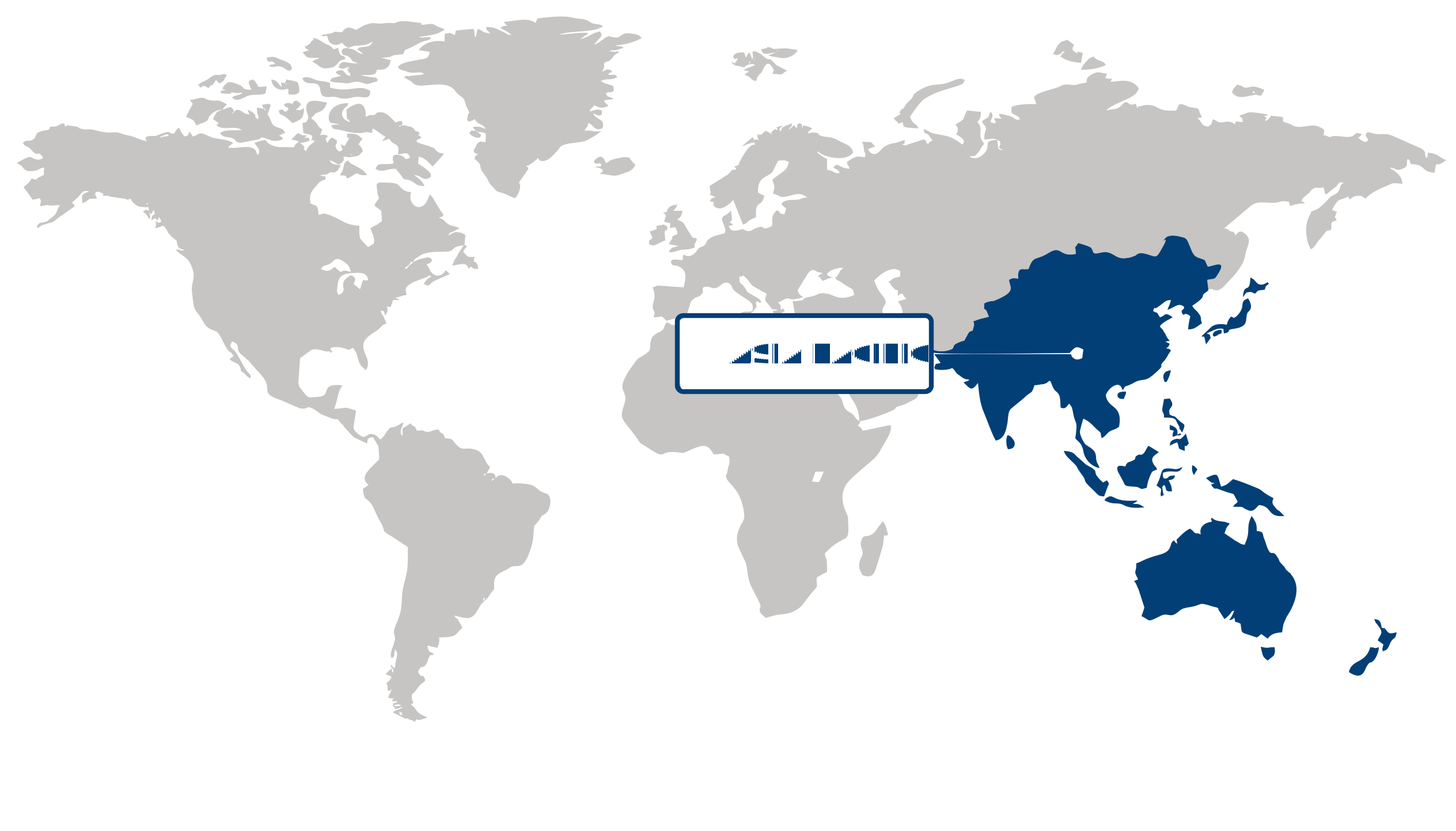
Asia Pacific captured approximately 39% of the elemental boron market in 2025, making it the largest regional market; this leadership is rooted in robust industrialization and the very high volumes of ceramic and glass production concentrated in China and India. Strong manufacturing throughput reported by the China National Bureau of Statistics and expansionist trade and manufacturing data from the Ministry of Commerce & Industry, Government of India underpin steady downstream demand, while World Bank indicators of industrial investment show persistent capital flows into materials processing. Ongoing plant upgrades, tighter emissions requirements for glass and ceramics, and rising demand for higher-quality feedstock are increasing procurement professionalization and supplier consolidation. These factors create durable, near-term procurement and premium-supply opportunities for elemental boron producers and service providers across the region.
China anchors the Asia Pacific landscape for the elemental boron market, where scale in glass and ceramic output drives bulk demand and shapes pricing and logistics. China National Bureau of Statistics production figures and policy signals from the Ministry of Industry and Information Technology point to continued capacity in glass, ceramics and related refractories; major downstream players such as Xinyi Glass Holdings and China National Building Material Group illustrate the concentration of consumption and vertically integrated sourcing. As manufacturers pursue efficiency and lower-emission furnaces, procurement is shifting toward reliable, higher-purity boron supplies and closer supplier partnerships, strengthening domestic sourcing and import optimization—an axis that reinforces Asia Pacific’s leading share.
Japan is positioned as a pivotal hub in Asia Pacific for the elemental boron market, where demand is less about volume than high-purity, specification-driven applications. Policy and industrial R&D activity reported by the Ministry of Economy, Trade and Industry (METI) and materials work at the National Institute for Materials Science (NIMS) support specialty uses in electronic materials, advanced glass and high-performance alloys; corporations such as AGC Inc. and Shin-Etsu Chemical exemplify downstream requirements for tight quality control and traceability. Japan’s premium market dynamics favor suppliers that can deliver certified, ultra-pure boron and technical service, offering a complementary commercial pathway to the high-volume opportunities in Greater China and reinforcing the region’s overall investor appeal.
Europe Market Analysis:
Europe emerged as the fastest-growing region in the elemental boron market, registering a CAGR of 4.8%; growth is being driven by rising demand for specialized agricultural micronutrients and expanding advanced-ceramic applications. Adoption of boron-containing foliar and soil micronutrients is accelerating under the European Commission’s Farm to Fork agenda and precision-agriculture programs, while electrification and electronics demand—highlighted by the European Automobile Manufacturers Association (ACEA)—is increasing need for high-performance ceramics. Companies and research bodies active in the region, including Yara International (micronutrient portfolios) and CeramTec (advanced ceramics), along with supportive industrial policy signals from the European Commission, provide concrete evidence of sustained demand. Forward-looking, Europe’s integrated agri-tech and advanced-materials ecosystems create repeatable commercial pathways for boron suppliers and specialty formulators seeking scale and higher-margin applications.
elemental boron market in Germany functions as a manufacturing and innovation hub, anchored by advanced-ceramics producers and precision-farming uptake. German firms such as CeramTec and research organizations like Fraunhofer IKTS are investing in high-performance ceramic components for automotive, energy and semiconductor equipment, while the Bundesministerium für Ernährung und Landwirtschaft’s push for sustainable inputs supports micronutrient adoption. Germany’s dense OEM supply chains and skilled workforce shorten commercialization cycles for boron-enabled solutions and favor close supplier partnerships—advantageous for firms targeting product qualification and tier-one contracts. Strategically, Germany’s role accelerates regional technical validation and downstream volume adoption.
elemental boron market in France is driven by specialty-chemicals and construction-materials demand, with large domestic players and policy support shaping uptake. French companies such as Saint-Gobain and Arkema participate in advanced-materials value chains that use boron-enhanced ceramics and composites, while direction from the Ministère de l’Agriculture et de l’Alimentation and national research centers sustains trials of micronutrient formulations. France’s strong domestic formulation capability and export-oriented industrial clusters enable rapid scaling of new boron-based products, reinforcing Europe’s broader opportunity to move up the value chain from commodity supply toward specialty applications.
North America Market Trends:
The elemental boron market in North America held a significant share driven by concentration of end-use manufacturing and resilient industrial demand across electronics, aerospace, and specialty chemicals; the U.S. Department of Energy has emphasized domestic supply-chain resilience for critical materials, the U.S. Geological Survey documents regional consumption and trade patterns that underscore import–export sensitivities, and the Environmental Protection Agency’s evolving chemical-management guidance is prompting suppliers to invest in cleaner processing and waste-handling practices. Together these forces have tightened supplier networks and elevated the value of integrated processing, creating near-term logistical frictions but clear openings for recycling, localized purification, and premium-value boron products as manufacturers and policymakers align on strategic materials security. The region’s regulatory clarity and buyer base position North America to capture higher-margin segments and attract investment in midstream capability.
The United States serves as the primary hub within the elemental boron market for production, technology adoption, and downstream conversion, anchored by Rio Tinto Borates’ long-running operations in Boron, California and corroborated by U.S. Geological Survey reporting on domestic output and trade. Strong industrial R&D and procurement activity—highlighted by Department of Energy initiatives to shore up critical-material supply chains—support adoption of higher-purity boron for semiconductor doping, advanced composites, and specialty alloys, while workforce availability in key manufacturing clusters sustains scale-up. Strategic implication: U.S. capacity and policy support amplify North American opportunity by lowering import exposure and enabling investment in purification, recycling, and application-specific boron products that serve regional high-value markets.
| Parameter | North America | Asia Pacific | Europe | Latin America | MEA |
|---|---|---|---|---|---|
| Innovation Hub i Scale Nascent Developing Advanced | |||||
| Cost-Sensitive Region i Scale Low Medium High | |||||
| Regulatory Environment i Scale Restrictive Neutral Supportive | |||||
| Demand Drivers i Scale Weak Moderate Strong | |||||
| Development Stage i Scale Emerging Developing Developed | |||||
| Adoption Rate i Scale Low Medium High | |||||
| New Entrants / Startups i Scale Sparse Moderate Dense | |||||
| Macro Indicators i Scale Weak Stable Strong |
Segment Leadership and Growth Trends
Elemental Boron Market Share (%), by Type, 2026
Go beyond the chart, access full insights & data tables
Request Free Sample ReportAmorphous boron held largest share in the elemental boron market in 2025, driven by its higher reactivity and broad applicability across metallurgical processing and high‑energy fuel research. Its reactivity and powder form make it the preferred choice for sintering, powder metallurgy and energetic additives—applications referenced in the USGS Mineral Commodity Summaries and in materials research from NASA and the Air Force Research Laboratory—helping alloy producers and defense contractors scale adoption. Shifts in customer preference toward versatile feedstocks, investments in powder production, and tighter material performance standards have reinforced market leadership while sustainability-focused process improvements and digital supply‑chain traceability create entry points for specialists. Established producers gain scale advantages; emerging players can pursue niche fuel and additive markets. Ongoing R&D and defense interest indicate the segment will remain strategically important in the near to medium term.
Analysis by Application
Metallurgy represented largest share in the elemental boron market in 2025, supported by growing demand for high‑strength alloys and specialty metals across automotive, infrastructure and industrial sectors. Boron microalloying’s ability to enhance strength and hardenability—documented in the USGS Mineral Commodity Summaries and technical discussions by WorldAutoSteel and ArcelorMittal—has made it integral to hot‑stamped steels and specialty alloy formulations. Demand patterns favoring lightweighting, supply‑chain moves toward advanced metallurgical grades, and regulatory drivers such as European Commission CO2 standards have accelerated adoption, while producers pursue greener processes and digital quality controls. This creates strategic margins for integrated metalmakers and differentiated openings for agile specialty suppliers. Given continued emphasis on efficiency, safety and decarbonization in manufacturing, metallurgy will remain a core application for elemental boron in the near to medium term.
| Segment | Sub-Segment | Largest Segment | Fastest Growing |
|---|---|---|---|
| Type | Amorphous Boron, Crystalline Boron | ||
| Application | Metallurgy, Automotive, Aerospace and Defense, Ceramics, Other Applications |
Unlock insights tailored to your business with our bespoke market research solutions.
Click to get your customized report now.
Competitive Landscape and Market Positioning
The competitive landscape is defined by targeted expansion of technical capabilities, deeper ties into customer development, and stepped-up investment in higher-purity and application-specific offerings. Several incumbents have broadened their production and processing capabilities while forming cross-border technical partnerships and customer co-development arrangements to accelerate qualification in demanding sectors. Parallel emphasis on pilot-scale demonstrations, enhanced analytical controls, and application support has pushed smaller players to focus on niche, high-value grades while larger firms leverage broader chemical portfolios to offer integrated solutions. These dynamics are fostering faster adoption of specialty boron grades and sharpening differentiation around quality, traceability, and supply continuity.
Strategic / Actionable Recommendations for Regional Players
North America: Prioritize closer engagement with advanced manufacturers and research institutions to co-develop ultra-high-purity grades and application-specific formulations, while strengthening bilateral supply relationships to secure feedstock and shorten qualification timelines. Investing selectively in analytical capabilities and pilot processing will help convert engineering partnerships into repeatable commercial contracts.
Asia Pacific: Leverage regional scale and downstream partnerships to accelerate volume adoption in electronics and energy storage supply chains, pairing process automation with localized collaborations to lower unit costs and speed product introductions. Focus on licensing or joint development arrangements to access proprietary purification technologies and fast-track market entry.
Europe: Differentiate through sustainability credentials, tighter end-to-end traceability, and recycling or circular-material flows tied to industrial customers with exacting standards. Forge cross-industry collaborations with specialty chemical and automotive suppliers to tailor chemistries for regulatory compliance and advanced mobility applications.
| Company | Market Share | Company Revenue | Revenue CAGR (%) | Product Portfolio | Geographic Presence | Innovation / R&D Focus | Strategic Developments |
|---|---|---|---|---|---|---|---|
| No companies available. | |||||||
Industry Development/News
| Company Name | Date | Key Development |
|---|
Customize Your Report
Explore examples of how this report can be tailored to different research needs, including custom segments, additional topics or chapters, and related reports. Click a section of the wheel or its numbered marker to explore the available options.
Elemental Boron Market — Custom Segments
| Segment | Sub-Segment |
|---|---|
| No segment data available. | |
Elemental Boron Market — Custom TOC
| Custom Chapter | Custom Details | ||
|---|---|---|---|
| No custom TOC data available. | |||
Need a different cut of the data?
Request Custom ResearchHow much revenue does the elemental boron market generate?
What are the growth projections for the elemental boron industry?
What is the leading region in terms of elemental boron market share?
Who is driving the fastest regional growth in the elemental boron sector?
Where is the amorphous boron segment seeing the strongest adoption within the elemental boron industry?
When did metallurgy sub-segment emerge as the largest sub-segment in the application segment of elemental boron sector?
What are the prominent companies operating in the elemental boron landscape?
Our Clients
"The report helped us understand emerging consumer trends in our product category. It clarified where to focus innovation for the next product launch."
LyondellBasell
"The regional forecast section was incredibly useful. We were able to identify two new potential partners in Europe thanks to the vendor mapping you included."
SABIC
"We appreciated how actionable the recommendations were. It guided us to improve supply chain resilience."
Olin Corporation
Our Research Team & Methodology
Every Fundamental Business Insights report is built by a dedicated vertical research team, validated through a structured primary-and-secondary methodology, and reviewed for accuracy before it reaches you.
Research Team Overview
Prepared by the Chemicals & Materials Research Team
Delivery
Published
Demand
Available
Support
Trust & Compliance
Research Intelligence
Research Workflow & Quality Assurance
Data Collection
Verified information gathered through primary and secondary research.
Data Triangulation
Cross-validation using multiple independent data sources.
Forecast Modelling
Market estimates developed using historical trends and analytical models.
Analyst Validation
Findings reviewed by domain experts for accuracy and consistency.
Editorial & Quality Review
Final editorial, quality, and compliance checks before publication.
Final Publication
Released after successful completion of the internal review process.
Report Coverage
📊 Market Assessment
- Market Size & Forecast
- Market Segmentation
- Regional Analysis
- Growth Drivers & Challenges
- Market Dynamics
🏢 Competitive Intelligence
- Competitive Landscape
- Company Profiles
- Competitive Benchmarking
- Mergers & Acquisitions
- Market Share Analysis or Key Company Strategies
🔍 Strategic Analysis
- Value Chain Analysis
- Porter's Five Forces
- PESTLE Analysis
- Pricing Trends
- Supply-Demand Analysis
🚀 Future Outlook
- Technology Landscape
- Regulatory Landscape
- Investment & Funding Landscape
- Emerging Opportunities
- Future Market Outlook
Have a question about this report or need a custom scope?
Request Customization