Chocolate Confectionery Market Size & Growth Forecast 2027–2036, By Segments (Type, Distribution Channel, Product), Regional Demand Trends (North America, Asia Pacific, Europe), Key Country Insights (U.S., Japan, South Korea, Germany, France, Italy), and Competitive Landscape
Market Size and Growth Outlook
Chocolate Confectionery Market size was around USD 230 billion in 2026 and is slated to grow at a 6.37% CAGR from 2027 to 2036, exceeding USD 426.5 billion by 2036. The industry revenue for 2027 is estimated at USD 242.33 billion.
Get more details on this report
Request Free Sample ReportChocolate Confectionery Market Intelligence Snapshot
Regional Market Dynamics
- Europe held a 34.45% share in 2026, supported by established consumption patterns, strong retail networks, premium product segments, and consistent demand for indulgence and gifting formats.
- Asia Pacific is expected to expand at a 7.35% CAGR, driven by wider retail access, digital commerce growth, and rising consumer interest in packaged confectionery.
Segment Momentum
- Milk chocolate accounted for 59.43% of the market in 2026 due to its broad consumer appeal, strong retail presence, and versatility across everyday, seasonal, and impulse-purchase confectionery products.
- Online is the fastest-growing distribution channel because it offers convenient access to wider product selections, gifting options, premium offerings, and direct engagement with digital promotions.
Market Expansion Drivers
- Rising consumer preference for premium, indulgent chocolate products driving category expansion.
- Increasing demand for healthier and functional chocolate variants including dark and vegan options.
- Growth of e-commerce and modern retail channels enhancing global chocolate accessibility.
Leading Market Participants
- Leading players in the chocolate confectionery market include The Hershey Company (USA), Ferrero International S.A. (Luxembourg), Chocoladefabriken Lindt & Sprüngli AG (Switzerland), Mars, Incorporated (USA), Mondelez International, Inc. (USA), Nestlé S.A. (Switzerland), Barry Callebaut AG (Switzerland), LOTTE Corporation (South Korea), Meiji Holdings Co., Ltd. (Japan), Ezaki Glico Co., Ltd. (Japan).
Global Market Forecast Snapshot
Market Outlook
- 2026 Market Size: USD 230 billion
- 2027 Estimated Market Size: USD 242.33 billion.
- Projected Market Size: USD 426.5 billion by 2036
- Growth Forecast: 6.37% CAGR (2027-2036)
Regional and Segment Outlook
- Leading Regional Market: Europe
- High-Growth Regional Hub: Asia Pacific
- Core Revenue Segment: Milk (Type) | Supermarkets & Hypermarkets (Distribution Channel) | Molded Bars (Product)
- Emerging Opportunity Segment: Dark (Type) | Online (Distribution Channel) | Chips & Bites (Product)
Market Growth Drivers and Industry Trends
Rising consumer preference for premium, indulgent chocolate products driving category expansion
Increasing consumer willingness to purchase higher-quality and indulgent treats will drive the chocolate confectionery market growth as chocolate increasingly serves both everyday snacking and premium consumption occasions. Consumers are showing greater interest in products differentiated by flavor combinations, cocoa quality, craftsmanship, packaging, and distinctive sensory experiences. Premium positioning also enables manufacturers to address gifting, celebrations, and personal indulgence, where consumers may prioritize perceived quality and uniqueness over basic product functionality. Expanding assortments across specialty chocolates, filled products, and other elevated formats provide retailers with additional opportunities to attract consumers seeking more sophisticated confectionery experiences.
Increasing demand for healthier and functional chocolate variants including dark and vegan options
The shift toward health-conscious consumption will propel the chocolate confectionery market growth by encouraging manufacturers to develop products that combine indulgence with nutritional or lifestyle-oriented attributes. Dark chocolate appeals to consumers seeking higher cocoa content, while vegan formulations accommodate growing demand for plant-based alternatives and consumers avoiding conventional dairy ingredients. Product development is also moving toward formulations that address preferences for simpler ingredients, reduced sugar, and other perceived wellness benefits. This diversification enables chocolate manufacturers to reach consumers who may limit traditional confectionery consumption but remain interested in products aligned with their dietary preferences.
Growth of e-commerce and modern retail channels enhancing global chocolate accessibility
Expansion of digital commerce and organized retail will boost the chocolate confectionery market demand by increasing product availability across geographic markets and consumer segments. E-commerce platforms allow consumers to discover a broader range of domestic and international chocolate products, compare product characteristics, and purchase specialty offerings that may not be widely stocked in local stores. Modern retail formats also provide greater shelf space and product visibility for premium, seasonal, and differentiated chocolate categories. Improved distribution through these channels supports convenient purchasing while allowing manufacturers to reach consumers beyond traditional physical retail networks.
| Growth Driver | Impact on CAGR | Regulatory Influence | Geographic Relevance | Adoption Rate | Impact Timeline |
|---|---|---|---|---|---|
| Rising consumer preference for premium, indulgent chocolate products driving category expansion | 1.60% | Low | Europe, North America | High | Near Term |
| Increasing demand for healthier and functional chocolate variants including dark and vegan options | 1.50% | Moderate | North America, Asia Pacific | High | Mid Term |
| Growth of e-commerce and modern retail channels enhancing global chocolate accessibility | 1.30% | Low | Asia Pacific, Europe | Medium | Mid Term |
Unlock insights tailored to your business with our bespoke market research solutions.
Click to get your customized report now.
Regional Demand Dynamics
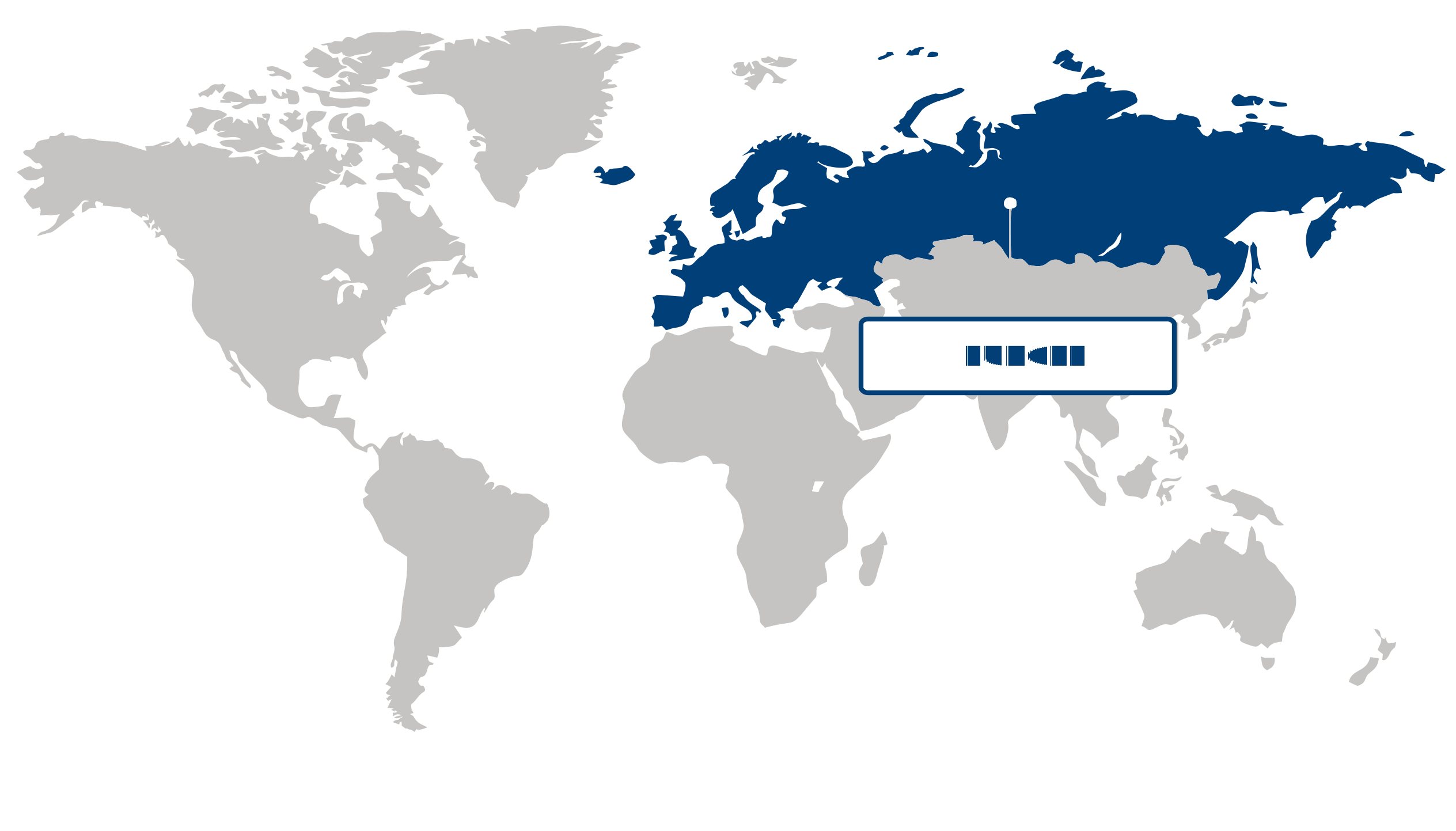
Europe (Largest Region)
In the chocolate confectionery market, Europe held the largest share of 34.45% in 2026, supported by the region’s well-established confectionery culture, strong consumer familiarity with premium chocolate products, and broad availability across supermarkets, specialty stores, convenience outlets, and online channels. Demand is further reinforced by continued interest in premium, artisanal, organic, and sustainably sourced chocolate, as consumers increasingly seek differentiated products and higher-quality ingredients. Established food-processing capabilities, sophisticated retail infrastructure, and ongoing product innovation across formats and flavors also strengthen Europe’s position in the global market.
Asia Pacific (Fastest-Growing Region)
Asia Pacific is emerging as the fastest-growing region, driven by rising disposable incomes, urbanization, and changing consumer preferences toward indulgent and premium packaged foods. Expanding modern retail and e-commerce networks are improving access to international and premium chocolate products, while younger consumers are increasingly embracing chocolate as an everyday snack as well as a gifting product. Growing exposure to global food trends, increasing product localization, and greater availability of varied formats and flavor profiles are expected to support continued demand across major markets in the region.
| Parameter | North America | Asia Pacific | Europe | Latin America | MEA |
|---|---|---|---|---|---|
| Innovation Hub i Scale Nascent Developing Advanced | |||||
| Cost-Sensitive Region i Scale Low Medium High | |||||
| Regulatory Environment i Scale Restrictive Neutral Supportive | |||||
| Demand Drivers i Scale Weak Moderate Strong | |||||
| Development Stage i Scale Emerging Developing Developed | |||||
| Adoption Rate i Scale Low Medium High | |||||
| New Entrants / Startups i Scale Sparse Moderate Dense | |||||
| Macro Indicators i Scale Weak Stable Strong |
Key Country Insights
Germany 🇩🇪
Quality Chocolate HeritageGermany emphasizes chocolate confectionery with high-quality ingredients, traditional craftsmanship, and product consistency. Producers continue introducing premium recipes, sustainable cocoa sourcing, and specialty product lines that appeal to both domestic and export markets.
France 🇫🇷
Artisan Premium SelectionFrance values chocolate confectionery that reflects premium quality, refined taste, and artisanal production techniques. Manufacturers strengthen premium assortments, ethically sourced ingredients, and specialty retail offerings to meet discerning consumer expectations.
Italy 🇮🇹
Gourmet Chocolate CraftItaly focuses on chocolate confectionery that combines traditional recipes with premium ingredients and regional specialties. Producers expand artisanal collections, gifting assortments, and innovative flavor profiles while maintaining strong emphasis on product authenticity and quality.
Japan 🇯🇵
Seasonal Product InnovationJapan's chocolate confectionery market is characterized by limited-edition flavors, attractive packaging, and seasonal product launches. Companies tailor premium offerings and gifting formats to align with changing consumer preferences and cultural purchasing occasions.
South Korea 🇰🇷
Trend-Led ConfectionerySouth Korea encourages chocolate confectionery innovation through premium ingredients, distinctive flavors, and visually appealing packaging. Brands respond to evolving consumer tastes with limited-edition products and convenient snack formats across modern retail channels.
United States 🇺🇸
Premium Indulgence DemandThe U.S. chocolate confectionery market is driven by consumer interest in premium products, seasonal offerings, and innovative flavor combinations. Manufacturers expand clean-label ingredients, portion-controlled formats, and premium gifting ranges to meet evolving purchasing preferences.
Segment Leadership and Growth Trends
Chocolate Confectionery Market Share (%), by Type, 2026
Go beyond the chart, access full insights & data tables
Request Free Sample ReportType Segment Analysis: Milk (Largest Segment) vs Dark (Fastest-Growing Segment)
Milk chocolate represented the largest type segment in the chocolate confectionery market, accounting for 59.43% in 2026. Its broad consumer appeal is supported by a smooth texture, creamy taste, and balanced sweetness that make it suitable for a wide range of confectionery products. Milk chocolate is widely incorporated into bars, filled chocolates, molded products, and other formats, providing manufacturers with extensive opportunities for product development. Its familiarity among consumers and versatility across different confectionery categories continue to reinforce its leading position.
Dark chocolate is the fastest-growing type segment as consumers increasingly show interest in chocolate products associated with richer flavor profiles and perceived wellness attributes. The higher cocoa content and distinctive taste of dark chocolate appeal to consumers seeking more premium and differentiated confectionery experiences. Product innovation around cocoa intensity, flavor combinations, and premium positioning is further expanding its appeal. Growing consumer interest in sophisticated chocolate offerings is therefore supporting increased demand for dark chocolate.
Distribution Channel Segment Analysis: Supermarkets & Hypermarkets (Largest Segment) vs Online (Fastest-Growing Segment)
Supermarkets & hypermarkets accounted for the largest share of the chocolate confectionery market, representing 43.88% in 2026. These retail formats provide consumers with broad product selections, convenient access, and the ability to compare brands, pack sizes, flavors, and price points within a single shopping trip. Their extensive retail presence and prominent placement of confectionery products support impulse purchases as well as planned buying. The combination of convenience and product variety continues to make supermarkets and hypermarkets important channels for chocolate confectionery distribution.
Online is the fastest-growing distribution channel as digital commerce expands consumer access to a broader selection of chocolate products. Online platforms allow shoppers to compare products, discover specialty offerings, read reviews, and purchase confectionery from home. Digital channels are particularly useful for premium, niche, and gift-oriented chocolate products that may have limited availability through conventional retail outlets. Improving delivery convenience and increasingly sophisticated online product discovery are supporting the continued expansion of this channel.
| Segment | Sub-Segment | Largest Segment | Fastest Growing |
|---|---|---|---|
| Type | Milk, Dark, White | Milk | Dark |
| Distribution Channel | Supermarkets & Hypermarkets, Convenience Stores, Online, Others | Supermarkets & Hypermarkets | Online |
| Product | Boxed, Molded Bars, Chips & Bites, Truffles & Cups, Others | Molded Bars | Chips & Bites |
Competitive Landscape and Market Positioning
Key companies in the chocolate confectionery market:
1. The Hershey Company (USA)
2. Ferrero International S.A. (Luxembourg)
3. Chocoladefabriken Lindt & Sprüngli AG (Switzerland)
4. Mars Incorporated (USA)
5. Mondelez International Inc. (USA)
6. Nestlé S.A. (Switzerland)
7. Barry Callebaut AG (Switzerland)
8. LOTTE Corporation (South Korea)
9. Meiji Holdings Co. Ltd. (Japan)
10. Ezaki Glico Co. Ltd. (Japan)
The chocolate confectionery market is witnessing growing demand for premium flavors, healthier ingredients, and ethically sourced cocoa products that align with evolving consumer preferences. Manufacturers are expanding portfolios with sugar-reduced variants, functional chocolates, and artisanal offerings to strengthen market differentiation. Sustainability initiatives focused on responsible sourcing and environmentally conscious production are also influencing innovation within the chocolate confectionery market.
| Company | Market Share | Company Revenue | Revenue CAGR (%) | Product Portfolio | Geographic Presence | Innovation / R&D Focus | Strategic Developments |
|---|---|---|---|---|---|---|---|
| The Hershey Company (USA) | |||||||
| Ferrero International S.A. (Luxembourg) | |||||||
| Chocoladefabriken Lindt & Sprüngli AG (Switzerland) | |||||||
| Mars Incorporated (USA) | |||||||
| Mondelez International Inc. (USA) | |||||||
| Nestlé S.A. (Switzerland) | |||||||
| Barry Callebaut AG (Switzerland) | |||||||
| LOTTE Corporation (South Korea) | |||||||
| Meiji Holdings Co. Ltd. (Japan) | |||||||
| Ezaki Glico Co. Ltd. (Japan). |
Industry Development/News
| Company Name | Date | Key Development |
|---|---|---|
| Mars | May-26 | Mars is undertaking a major capital investment program, including a £190 million upgrade to its UK production facility in Slough and additional enhancements across its European manufacturing sites. This initiative aims to increase production capacity, improve operational efficiency, and strengthen the supply chain to support long-term growth and rising global demand for chocolate confectionery. |
| Ferrero | May-26 | Ferrero has entered an exclusive global partnership with Netflix to launch a new range of Wonka-branded products across chocolate, sugar confectionery, ice cream, and cereals. This collaboration leverages entertainment-driven storytelling and media synergies to differentiate its product portfolio and drive consumer engagement, with products arriving in U.S. and European markets this autumn. |
| Cargill | Apr-26 | Cargill has completed a significant expansion of its edible oil production facilities in Port Klang, Malaysia, to bolster supply capacity for confectionery and bakery applications. The investment strengthens the company's manufacturing footprint in the region and supports the scaling of ingredient availability to meet increasing global demand for chocolate and related confectionery products. |
| Ferrara Candy Company | Oct-25 | Ferrara Candy Company, a Ferrero-affiliated entity, finalized the acquisition of CPK Group from Eurazeo. This transaction adds iconic brands, including Terry’s Chocolate, Carambar, and Lutti, to Ferrara’s portfolio. The integration of CPK’s four French production sites significantly expands Ferrara’s manufacturing capabilities and strengthens its competitive positioning within the European chocolate and confectionery market. |
| Barry Callebaut | Jul-21 | Barry Callebaut acquired the Europe Chocolate Company (ECC), a specialized Belgian manufacturer of industrial chocolate products. This strategic acquisition enhanced the company's B2B specialties portfolio and production capabilities, allowing it to better serve customer demand for customized chocolate ingredients and differentiated confectionery offerings within the European market. |
Customize Your Report
Explore examples of how this report can be tailored to different research needs, including custom segments, additional topics or chapters, and related reports. Click a section of the wheel or its numbered marker to explore the available options.
Chocolate Confectionery Market — Custom Segments
| Segment | Sub-Segment |
|---|---|
| Consumer Age Group | Children, Teenagers & Young Adults, Adults, Seniors |
| Consumption Occasion | Everyday Snacking, Gifting & Celebrations, Seasonal & Festive Consumption, Indulgence & Treating |
| Product Formulation & Positioning | Sugar-Free & Reduced-Sugar, Vegan & Plant-Based, Functional & Fortified, Conventional Formulations |
Chocolate Confectionery Market — Custom TOC
| Custom Chapter | Custom Details |
|---|---|
| Premiumization and Consumer Trading-Up Analysis |
|
| Cocoa Sourcing Risk and Sustainability Assessment |
|
| White Space Opportunity Mapping by Product Format |
|
Need a different cut of the data?
Request Custom ResearchHow big is the chocolate confectionery market?
How is the chocolate confectionery industry projected to perform over the next decade?
How are premiumization trends reshaping growth in the chocolate confectionery market?
How are health-focused preferences and retail expansion influencing the chocolate confectionery market?
Why does milk chocolate lead the chocolate confectionery market?
How is the online channel gaining momentum in the chocolate confectionery market?
What supports Europe’s leadership in the chocolate confectionery market?
Where are new growth opportunities emerging in the chocolate confectionery market?
Who are the major participants shaping the chocolate confectionery landscape?
Our Clients
"The report provided a thorough look at market trends, technological advancements, and the competitive landscape. The depth of insights was really valuable."
ITC Limited
"We would highly recommend Fundamental Business Insights & Consulting to anyone looking for reliable, detailed, and comprehensive market research in the Food industry."
Tyson Foods
"The clarity and presentation of the information were commendable. The report was delivered timely, which made the overall experience smooth and convenient."
Mondelēz International
Our Research Team & Methodology
Every Fundamental Business Insights report is built by a dedicated vertical research team, validated through a structured primary-and-secondary methodology, and reviewed for accuracy before it reaches you.
Research Team Overview
Prepared by the Food & Beverage Research Team
Delivery
Published
Demand
Available
Support
Trust & Compliance
Research Domains
10 coverage areasResearch Intelligence
| Source | Reference |
|---|---|
| Food and Agriculture Organization (FAO) | www.fao.org |
| World Health Organization (WHO) | www.who.int |
| U.S. Food & Drug Administration (FDA) | www.fda.gov |
| European Food Safety Authority (EFSA) | www.efsa.europa.eu |
| U.S. Department of Agriculture (USDA) | www.usda.gov |
| Codex Alimentarius Commission | www.fao.org/fao-who-codexalimentarius |
| International Organization for Standardization (ISO) | www.iso.org |
| AOAC INTERNATIONAL | www.aoac.org |
| Institute of Food Technologists (IFT) | www.ift.org |
| International Dairy Foods Association (IDFA) | www.idfa.org |
| International Sweeteners Association (ISA) | www.sweeteners.org |
| International Probiotics Association (IPA) | internationalprobiotics.org |
| Good Food Institute (GFI) | gfi.org |
| American Feed Industry Association (AFIA) | www.afia.org |
| International Feed Industry Federation (IFIF) | ifif.org |
| Specialty Food Association (SFA) | www.specialtyfood.com |
| Brewers Association | www.brewersassociation.org |
| International Bottled Water Association (IBWA) | bottledwater.org |
| International Alliance for Dietary/Food Supplement Associations (IADSA) | www.iadsa.org |
| OECD Agriculture & Food | www.oecd.org/agriculture |
Research Workflow & Quality Assurance
Data Collection
Verified information gathered through primary and secondary research.
Data Triangulation
Cross-validation using multiple independent data sources.
Forecast Modelling
Market estimates developed using historical trends and analytical models.
Analyst Validation
Findings reviewed by domain experts for accuracy and consistency.
Editorial & Quality Review
Final editorial, quality, and compliance checks before publication.
Final Publication
Released after successful completion of the internal review process.
Report Coverage
📊 Market Assessment
- Market Size & Forecast
- Market Segmentation
- Regional Analysis
- Growth Drivers & Challenges
- Market Dynamics
🏢 Competitive Intelligence
- Competitive Landscape
- Company Profiles
- Competitive Benchmarking
- Mergers & Acquisitions
- Market Share Analysis or Key Company Strategies
🔍 Strategic Analysis
- Value Chain Analysis
- Porter's Five Forces
- PESTLE Analysis
- Pricing Trends
- Supply-Demand Analysis
🚀 Future Outlook
- Technology Landscape
- Regulatory Landscape
- Investment & Funding Landscape
- Emerging Opportunities
- Future Market Outlook
Have a question about this report or need a custom scope?
Request Customization