Carbon Nanotubes Market Size & Forecasts 2026-2035, By Segments (Product, Application), Growth Opportunities, Innovation Landscape, Regulatory Shifts, Strategic Regional Insights (U.S., Japan, China, South Korea, UK, Germany, France), and Competitive Dynamics (Tuball, Arkema, Nanocyl, OCSiAl, Showa Denko)
Market Size and Growth Outlook
Carbon Nanotubes Market size is likely to expand from USD 12.48 billion in 2025 to USD 28.22 billion by 2035, posting a CAGR above 8.5% across 2026-2035. The industry’s revenue potential for 2026 is USD 13.41 billion.
Get more details on this report
Request Free Sample ReportCarbon Nanotubes Market Intelligence Snapshot
Regional Market Dynamics
Segment Momentum
Market Expansion Drivers
Leading Market Participants
Global Market Forecast Snapshot
Market Outlook
Regional and Segment Outlook
Market Growth Drivers and Industry Trends
The drive for higher energy density, faster charging and flexible form factors is moving carbon nanotubes market adoption from lab to OEM supply chains: Tesla, Samsung Electronics and LG Energy Solution have all signalled R&D roadmaps focusing on advanced electrode and conductive additives, while the U.S. Department of Energy supports next‑generation battery materials programs. This trend elevates opportunities for CNT producers to partner as qualified material suppliers to battery cell makers and for electronics firms to license tailored CNT inks. Expect nearer‑term commercial traction through supplier qualification programs and joint development agreements rather than speculative end‑market shifts.
Growth in composite materials and aerospace
Aerospace and high‑performance composites demand lighter, stronger materials, a requirement emphasized by Boeing and Airbus in sustainability and fleet‑fuel‑efficiency statements; suppliers like Hexcel Corporation and Toray Industries are actively pursuing novel reinforcements. These industry signals are catalyzing uptake in the carbon nanotubes market for resin toughening and multifunctional structures, creating strategic openings for established composite suppliers to integrate CNT‑enhanced prepregs and for startups offering niche CNT dispersion technologies to win Tier‑1 contracts. Certification pathways with the Federal Aviation Administration (FAA) and collaboration with OEMs will shape realistic commercialization timetables.
Technological innovations in CNT synthesis
Advances in continuous CVD processes, purity control and alignment techniques documented by Rice University research and publications from the Massachusetts Institute of Technology, alongside coordinated support under the National Nanotechnology Initiative, are lowering barriers to scale. These technical improvements reposition the carbon nanotubes market from specialty research volumes toward industrial supply, presenting licensing, equipment sales and process‑engineering partnerships as key opportunities for incumbents and new entrants. Observable outcomes include increased patenting and pilot fabs; commercialization will likely follow visible milestones in reproducibility and integration with existing manufacturing lines.
Industry Restraints:
High Production Costs and Scalability Challenges — Capital-intensive synthesis, post‑processing and batch variability keep unit costs high, limiting carbon nanotube (CNT) penetration into volume applications such as automotive and large-format composites. Producers must invest heavily in continuous CVD, purification and dispersion technologies, creating operational inefficiencies that slow adoption. Evidence: major manufacturers such as OCSiAl (TUBALL) and Nanocyl have publicly announced capacity expansions and multi‑year investments to reach ton‑scale production, underscoring persistent scale-up costs. Strategic implications: incumbent producers with deep pockets can consolidate market share by lowering costs, while smaller entrants face high capital barriers and long payback periods; OEMs delay specification until supply and quality are assured. Forward view: incremental cost declines are likely as scale and process optimization proceed, but capital intensity will keep broader commoditization limited in the near to medium term.
Regulatory and Occupational Health Constraints — Persistent scientific uncertainty about inhalation toxicity and environmental fate generates uneven regulatory regimes and elevated compliance burdens that constrain market growth. Authoritative bodies such as the U.S. National Institute for Occupational Safety and Health (NIOSH) have issued a 2013 Current Intelligence Bulletin identifying pulmonary risks and recommended exposure limits, while the U.S. Environmental Protection Agency (EPA), European Chemicals Agency (ECHA) and OECD continue to evaluate and regulate nanomaterials, raising testing and reporting obligations. Strategic implications: manufacturers face higher testing, labeling and insurance costs; end‑users in regulated sectors (medical, consumer goods) postpone integration, favoring safer alternative materials. Forward view: tightening regulation and harmonized exposure guidelines are likely over the next several years, increasing upfront compliance costs but ultimately enabling safer, wider adoption once standards and controls mature.
| Growth Driver | Impact on CAGR | Regulatory Influence | Geographic Relevance | Adoption Rate | Impact Timeline |
|---|---|---|---|---|---|
| Rising adoption in electronics and energy storage | 3.00% | Short term (≤ 2 yrs) | Asia Pacific, North America; Spillover: Europe | Medium | Fast |
| Growth in composite materials and aerospace | 2.50% | Medium term (2–5 yrs) | Europe, North America | Medium | Moderate |
| Technological innovations in CNT synthesis | 3.00% | Long term (5+ yrs) | Asia Pacific, Europe | Low | Slow |
Unlock insights tailored to your business with our bespoke market research solutions.
Click to get your customized report now.
Regional Demand Dynamics
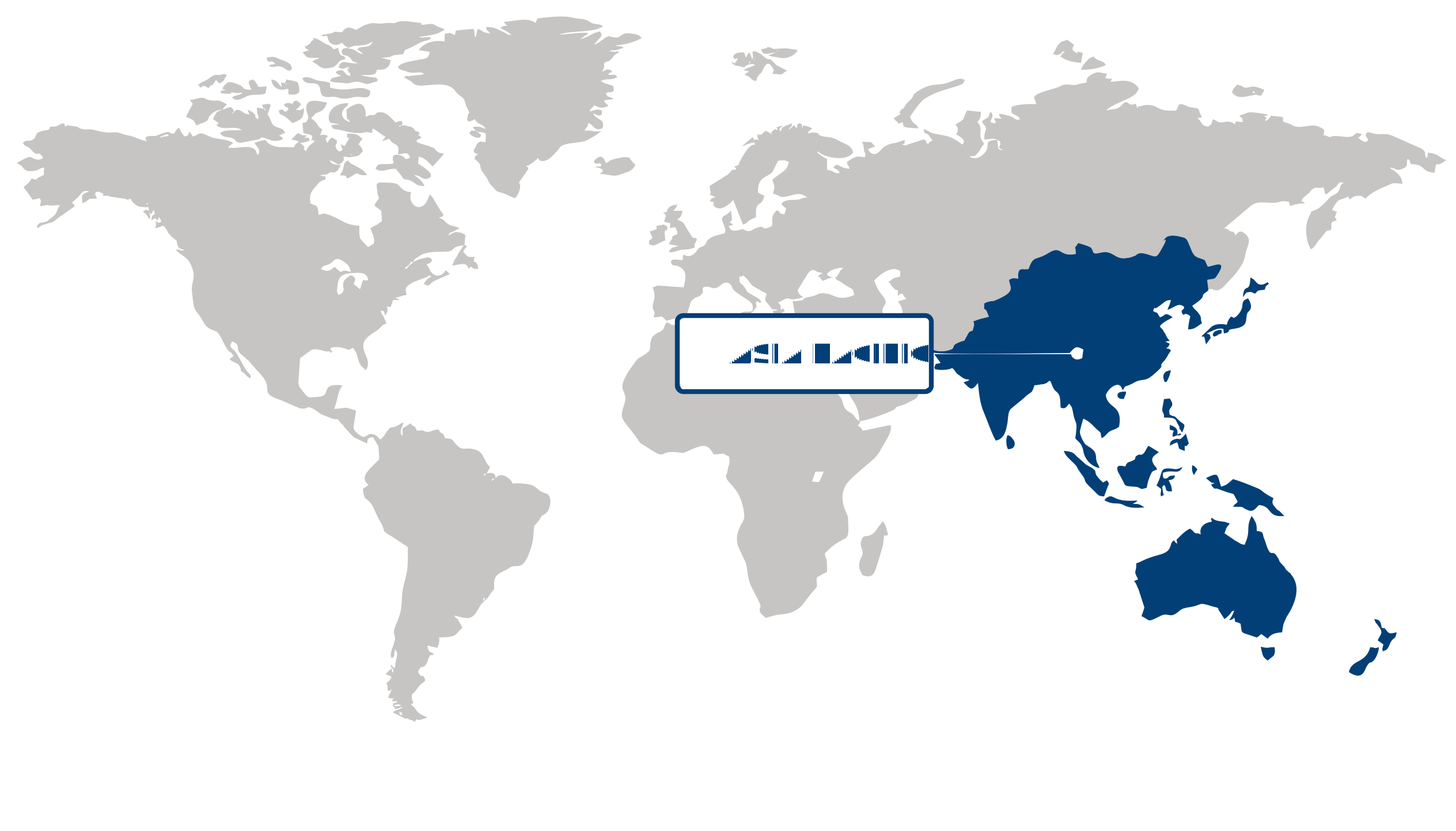
Asia Pacific captured approximately 38.8% of the global carbon nanotubes market in 2025, making it the largest regional market. The region’s lead is rooted in its dominance of lithium‑ion battery production and electronics manufacturing — visible in Contemporary Amperex Technology Co. Limited (CATL) production expansions, Panasonic’s battery supply agreements, and Foxconn Technology Group’s electronics output — and reinforced by industrial policy from the Ministry of Industry and Information Technology of the People's Republic of China (MIIT) and Japan’s Ministry of Economy, Trade and Industry (METI). Signals from the International Energy Agency (IEA) and project funding by the New Energy and Industrial Technology Development Organization (NEDO) are accelerating adoption of CNTs in conductive additives, EMI shielding and lightweight composites. Together, scale, policy support and corporate R&D create substantial commercial opportunity for differentiated CNT products tied to batteries and electronics across the region.
Japan is positioned as a pivotal hub in the Asia Pacific carbon nanotubes market, leveraging advanced materials research and tier‑one electronics and battery suppliers. Evidence includes Panasonic’s battery technology partnerships, NEDO‑funded nano‑materials initiatives and materials research at RIKEN that feed high‑value CNT uses in sensors, flexible electronics and performance composites. Strong OEM procurement patterns and METI’s technology roadmaps are smoothing commercialization pathways for application‑specific CNT grades. Strategic implication: Japan’s emphasis on high‑performance, niche CNT applications complements regional volume production and attracts partnerships for premium battery and electronics integration.
China anchors the Asia Pacific carbon nanotubes market through scale in battery cell manufacturing and electronics assembly, where Contemporary Amperex Technology Co. Limited (CATL), BYD and large device makers drive demand for conductive additives and advanced electrode materials. Policy support from the Ministry of Industry and Information Technology of the People's Republic of China and corporate capacity expansions by Foxconn Technology Group enable rapid commercialization and cost reduction for CNTs, while Shenzhen and Guangdong manufacturing clusters speed prototyping and supply‑chain integration. Strategic implication: China’s volume capabilities and industrial backing make it the primary arena for scaling lower‑cost CNT grades and embedding them into high‑volume lithium‑ion and consumer electronics platforms, reinforcing regional leadership.
North America Market Analysis:
North America emerged as the fastest-growing region in the carbon nanotubes market, registering a robust CAGR of 11.9% driven by massive R&D investments in aerospace composites and advanced medical nanotechnology. Public and private funding streams—from the National Nanotechnology Initiative (NNI) and National Institutes of Health (NIH) to targeted programs at NASA and DARPA—have accelerated materials development and scale-up, while university centers such as Rice University and industry players have converted lab advances into application-focused prototypes. Regulatory engagement and procurement interest from defense agencies, along with corporates exploring lightweight CNT-reinforced composites, are shifting buyer preferences toward higher-performance, premium-priced materials. Given sustained federal research funding and active industry–academic collaboration, North America is well positioned to commercialize CNT-enabled systems across aerospace and medical device segments. The region therefore offers strong near-term opportunities for investors and partners seeking technology-led adoption and supply-chain anchoring.
The U.S. acts as the primary innovation hub in the carbon nanotubes market, concentrating the region’s aerospace and biomedical R&D that underpins commercial adoption. Federal agencies—NIH (including the National Cancer Institute’s nanotechnology initiatives), the National Nanotechnology Initiative, NASA materials programs, DARPA, the Department of Energy, and the Air Force Research Laboratory—provide grant and contract funding that de-risks scale-up; at the same time, research institutions such as Rice University and corporate research groups at Boeing and Lockheed Martin collaborate on CNT-reinforced composites and prototyping. This ecosystem shapes procurement preferences, accelerates clinical and flight-test validations, and shortens commercialization timelines, making U.S. advancements a force-multiplier for North American market growth and an on-ramp for regional supply-chain investment.
Europe Market Trends:
Europe held a commanding share of the carbon nanotubes market, supported by a combination of industrial-scale demand, concentrated R&D capabilities, and evolving regulatory scrutiny that together facilitate commercialization. Evidence includes OCSiAl’s European production footprint and corporate press releases showing volume expansion, project collaborations at Fraunhofer-Gesellschaft translating lab innovations into pilot manufacturing, Horizon Europe funding calls from the European Commission prioritizing advanced materials, and safety assessments and guidance from the European Chemicals Agency (ECHA) prompting compliant formulations. These dynamics have shifted buyer preferences toward certified suppliers and lifecycle-aware materials, creating opportunities for vertically integrated players and specialized service providers across supply chains.
Germany serves as a leading hub in the carbon nanotubes market, driven by large-scale industrial adoption and manufacturing know-how. Fraunhofer-Gesellschaft projects linking CNTs to automotive and energy applications, statements from BASF SE on advanced materials initiatives, and funding streams from the German Federal Ministry of Education and Research (BMBF) illustrate how Germany converts research into production-ready solutions. This ecosystem accelerates uptake in automotive composites and battery additives, making Germany a focal point for scaling and qualification activities that strengthen Europe-wide supply reliability.
France plays a strategic role in the carbon nanotubes market, emphasizing high-value research, specialty chemistries, and early-stage commercialization. Research programs at CEA and CNRS, plus product development and technical briefings from Arkema, show France’s strength in tailored CNT chemistries and composite formulations for aerospace, electronics, and niche industrial uses. The country’s research-to-industry pathways and specialty materials producers provide pipeline technologies for broader European deployment, offering strategic entry points for investors targeting differentiated, higher-margin applications.
| Parameter | North America | Asia Pacific | Europe | Latin America | MEA |
|---|---|---|---|---|---|
| Innovation Hub i Scale Nascent Developing Advanced | |||||
| Cost-Sensitive Region i Scale Low Medium High | |||||
| Regulatory Environment i Scale Restrictive Neutral Supportive | |||||
| Demand Drivers i Scale Weak Moderate Strong | |||||
| Development Stage i Scale Emerging Developing Developed | |||||
| Adoption Rate i Scale Low Medium High | |||||
| New Entrants / Startups i Scale Sparse Moderate Dense | |||||
| Macro Indicators i Scale Weak Stable Strong |
Segment Leadership and Growth Trends
Carbon Nanotubes Market Share (%), by Product, 2026
Go beyond the chart, access full insights & data tables
Request Free Sample ReportMWCNTs dominated the carbon nanotubes market among product segments in 2025, holding the largest product share as industrial users favored multi-walled forms. This leadership stems from lower production costs and broader applicability across composites, conductive inks, and thermal management, directly aligning with the cited growth driver for MWCNTs and reflected in supply-chain scale-ups by producers such as OCSiAl and Nanocyl (Showa Denko). Customer preference for cost-performance balance, manufacturers’ moves to integrate CNTs into existing polymer processing, and clearer regulatory guidance from the U.S. Environmental Protection Agency have reinforced adoption. Established firms gain margin leverage through volume, while startups can capture niche, high-value applications; ongoing process optimization and industrial qualification mean MWCNT segments should remain central through the near to medium term.
Analysis by Application
Electrical & Electronics represented largest share of the carbon nanotubes market among application segments in 2025, driven by rapid adoption of conductive nanomaterials in advanced devices. The segment’s lead reflects demand for CNT-enabled interconnects, EMI shielding, and flexible electronics, supported by research and demonstrations from IBM and peer-reviewed coverage in Nature Nanotechnology showing performance gains in CNT-based devices. Market uptake is also shaped by electronics manufacturers’ miniaturization priorities, supply-chain partnerships to secure high-purity material, and standards activity that eases qualification. This creates strategic openings for incumbents to embed CNTs into product roadmaps and for nimble entrants to supply differentiated formulations; as device scaling and materials integration continue, the Electrical & Electronics segment is likely to retain strategic relevance in the near to medium term.
| Segment | Sub-Segment | Largest Segment | Fastest Growing |
|---|---|---|---|
| Product | MWCNTs, SWCNTs | ||
| Application | Polymers, Energy, Electrical & Electronics, Others |
Competitive Landscape and Market Positioning
The competitive environment is shaped by differentiated approaches to capability building and market access. Several suppliers are broadening their footprints by integrating upstream production with downstream application partners and by deepening technical collaborations with OEMs and formulators; others are sharpening product positioning through refined purity grades, surface functionalization, and tailored dispersion technologies that respond to electrical, mechanical, and thermal performance requirements. Investment in pilot facilities, joint development with energy storage and aerospace customers, and catalog expansion toward application-ready forms are accelerating adoption and pressuring peers to match application validation, quality control, and supply reliability to maintain commercial relevance.
Strategic / Actionable Recommendations for Regional Players
North America: Leverage strong university-industry networks and advanced manufacturing incentives to co-develop CNT-enabled solutions with battery, semiconductor, and defense end users. Prioritize partnerships that combine scale-up expertise with targeted formulation capabilities, and emphasize pilot demonstrations that reduce adoption risk for large OEMs while protecting IP pathways.
Asia Pacific: Capitalize on regional manufacturing scale and close proximity to EV, electronics, and chemicals value chains by optimizing cost-to-performance through process automation and high-throughput synthesis. Seek deeper commercial linkages with battery and electronics manufacturers and position product ranges around cost-competitive, application-ready dispersions and conductive additives.
Europe: Differentiate through high-performance, regulatory-compliant materials and sustainability credentials for aerospace and automotive systems. Align with system integrators and certification bodies to accelerate qualification cycles for premium composite and EMI/thermal management applications, and pursue collaborative development with material houses to embed CNTs into circular, high-value product platforms.
| Company | Market Share | Company Revenue | Revenue CAGR (%) | Product Portfolio | Geographic Presence | Innovation / R&D Focus | Strategic Developments |
|---|---|---|---|---|---|---|---|
| No companies available. | |||||||
Industry Development/News
| Company Name | Date | Key Development |
|---|
Customize Your Report
Explore examples of how this report can be tailored to different research needs, including custom segments, additional topics or chapters, and related reports. Click a section of the wheel or its numbered marker to explore the available options.
Carbon Nanotubes Market — Custom Segments
| Segment | Sub-Segment |
|---|---|
| No segment data available. | |
Carbon Nanotubes Market — Custom TOC
| Custom Chapter | Custom Details | ||
|---|---|---|---|
| No custom TOC data available. | |||
Need a different cut of the data?
Request Custom ResearchWhat is the market size of carbon nanotubes?
How will the carbon nanotubes industry grow in terms of size and CAGR by 2035?
Which region shows the largest market footprint in the carbon nanotubes market?
What is the fastest growing region in the carbon nanotubes sector?
Why is the MWCNTs segment leading in the carbon nanotubes industry?
Why does electrical & electronics sub-segment dominate the application segment of carbon nanotubes sector?
Which organizations are considered leaders in the carbon nanotubes landscape?
Our Clients
"The report helped us understand emerging consumer trends in our product category. It clarified where to focus innovation for the next product launch."
LyondellBasell
"The regional forecast section was incredibly useful. We were able to identify two new potential partners in Europe thanks to the vendor mapping you included."
SABIC
"We appreciated how actionable the recommendations were. It guided us to improve supply chain resilience."
Olin Corporation
Our Research Team & Methodology
Every Fundamental Business Insights report is built by a dedicated vertical research team, validated through a structured primary-and-secondary methodology, and reviewed for accuracy before it reaches you.
Research Team Overview
Prepared by the Chemicals & Materials Research Team
Delivery
Published
Demand
Available
Support
Trust & Compliance
Research Domains
10 coverage areasResearch Intelligence
| Source | Reference |
|---|---|
| American Chemistry Council (ACC) | www.americanchemistry.com |
| European Chemical Industry Council (Cefic) | cefic.org |
| International Council of Chemical Associations (ICCA) | icca-chem.org |
| European Chemicals Agency (ECHA) | echa.europa.eu |
| U.S. Environmental Protection Agency (EPA) | www.epa.gov |
| ASTM International | www.astm.org |
| International Organization for Standardization (ISO) | www.iso.org |
| National Institute of Standards and Technology (NIST) | www.nist.gov |
| Plastics Industry Association (PLASTICS) | www.plasticsindustry.org |
| European Biplastics | www.european-bioplastics.org |
| The Adhesive and Sealant Council (ASC) | www.ascouncil.org |
| National Association of Corrosion Engineers (AMPP) | www.ampp.org |
| Society of Plastics Engineers (SPE) | www.4spe.org |
| International Fertilizer Association (IFA) | www.fertilizer.org |
| CropLife International | croplife.org |
| Packaging Europe | packagingeurope.com |
| Flexible Packaging Association (FPA) | www.flexpack.org |
| Battery Council International (BCI) | batterycouncil.org |
| International Copper Association (ICA) | internationalcopper.org |
| World Steel Association | worldsteel.org |
Research Workflow & Quality Assurance
Data Collection
Verified information gathered through primary and secondary research.
Data Triangulation
Cross-validation using multiple independent data sources.
Forecast Modelling
Market estimates developed using historical trends and analytical models.
Analyst Validation
Findings reviewed by domain experts for accuracy and consistency.
Editorial & Quality Review
Final editorial, quality, and compliance checks before publication.
Final Publication
Released after successful completion of the internal review process.
Report Coverage
📊 Market Assessment
- Market Size & Forecast
- Market Segmentation
- Regional Analysis
- Growth Drivers & Challenges
- Market Dynamics
🏢 Competitive Intelligence
- Competitive Landscape
- Company Profiles
- Competitive Benchmarking
- Mergers & Acquisitions
- Market Share Analysis or Key Company Strategies
🔍 Strategic Analysis
- Value Chain Analysis
- Porter's Five Forces
- PESTLE Analysis
- Pricing Trends
- Supply-Demand Analysis
🚀 Future Outlook
- Technology Landscape
- Regulatory Landscape
- Investment & Funding Landscape
- Emerging Opportunities
- Future Market Outlook
Have a question about this report or need a custom scope?
Request Customization