Carbon Fiber Construction Repair Market Size & Growth Forecast 2027–2036, By Segments (Raw Material, Product Type, Application), Regional Demand Trends (North America, Asia Pacific, Europe), Key Country Insights (U.S., Japan, South Korea, Germany, France, Italy), and Competitive Landscape
Market Size and Growth Outlook
Carbon Fiber Construction Repair Market size was over USD 121.97 Million in 2026 and is likely to grow at 10.92% CAGR between 2027 and 2036, surpassing USD 343.84 Million by 2036. The industry revenue for 2027 is estimated at USD 133.5 Million.
Get more details on this report
Request Free Sample ReportCarbon Fiber Construction Repair Market Intelligence Snapshot
Regional Market Dynamics
- Asia Pacific led in 2026 due to rapid urban development, infrastructure investment, aging concrete structures, and growing demand for efficient structural rehabilitation.
- Infrastructure resilience, structural safety, lifecycle cost management, improving construction expertise, and urbanization are expanding adoption across bridges, buildings, industrial facilities, and infrastructure assets.
Segment Momentum
- Primary materials accounted for 73.25% of the market in 2026 and also led growth because carbon fiber composites, resins, and reinforcing materials are essential for structural strengthening, rehabilitation, and durability enhancement projects.
- Carbon fiber fabric is the fastest-growing product type due to its flexibility, ease of installation, and effectiveness in reinforcing columns, beams, and retrofit applications while improving structural performance.
Market Expansion Drivers
- Increasing infrastructure repair demand driving adoption of high-strength carbon fiber solutions
- Growing focus on sustainable and durable construction materials accelerating retrofit applications
- Rising structural aging in civil infrastructure boosting advanced rehabilitation material usage
Leading Market Participants
- Major players in the carbon fiber construction repair market include Sika AG (Switzerland), Mapei S.p.A. (Italy), Fosroc International Limited (United Kingdom), Master Builders Solutions (Germany), Toray Industries, Inc. (Japan), Mitsubishi Chemical Group Corporation (Japan), S&P Clever Reinforcement Company AG (Switzerland), BASF SE (Germany), Simpson Strong-Tie Company Inc. (United States), Fyfe Co. LLC (United States)
Global Market Forecast Snapshot
Market Outlook
- 2026 Market Size: USD 121.97 Million
- 2027 Estimated Market Size: USD 133.5 Million
- Projected Market Size: USD 343.84 Million by 2036
- Growth Forecast: 10.92% CAGR (2027-2036)
Regional and Segment Outlook
- Leading Regional Market: Asia Pacific
- High-Growth Regional Hub: Asia Pacific
- Core Revenue Segment: Primary Materials (Raw Material) | Rebar (Product Type) | Infrastructure (Application)
- Emerging Opportunity Segment: Primary Materials (Raw Material) | Fabric (Product Type) | Infrastructure (Application)
Market Growth Drivers and Industry Trends
Increasing infrastructure repair demand driving adoption of high-strength carbon fiber solutions
Growing requirements to restore bridges, buildings, tunnels, and transportation infrastructure are encouraging the use of advanced reinforcement materials capable of extending structural service life without extensive reconstruction. The carbon fiber construction repair market growth is driven by increasing preference for high-strength repair systems that provide excellent load-bearing performance while adding minimal weight to existing structures. Engineers and asset owners are selecting carbon fiber reinforcement for projects requiring rapid installation, corrosion resistance, and effective strengthening of concrete and masonry components under demanding operating conditions.
Growing focus on sustainable and durable construction materials accelerating retrofit applications
Infrastructure owners are placing greater emphasis on extending the usable life of existing assets rather than replacing them entirely, supporting broader adoption of long-lasting repair materials. This emphasis will propel the carbon fiber construction repair market growth because retrofit solutions using carbon fiber help minimize material consumption, reduce construction disruption, and improve long-term structural performance. The combination of durability, resistance to environmental degradation, and compatibility with diverse rehabilitation techniques makes these materials well suited for modernization projects across residential, commercial, and public infrastructure.
Rising structural aging in civil infrastructure boosting advanced rehabilitation material usage
Many transportation networks, utility structures, and public facilities are experiencing progressive deterioration after decades of continuous operation, creating sustained demand for efficient rehabilitation solutions. Within this environment, the carbon fiber construction repair market will benefit from increasing adoption of advanced strengthening materials that address cracking, load capacity limitations, and structural fatigue without significantly altering existing designs. Carbon fiber systems are widely utilized in rehabilitation projects where installation efficiency, flexibility, and compatibility with complex structural geometries are important considerations during repair execution.
| Growth Driver | Impact on CAGR | Regulatory Influence | Geographic Relevance | Adoption Rate | Impact Timeline |
|---|---|---|---|---|---|
| Increasing infrastructure repair demand driving adoption of high-strength carbon fiber solutions | 2.2% | High | North America, Europe | High | Near Term |
| Growing focus on sustainable and durable construction materials accelerating retrofit applications | 2% | High | Asia Pacific, Europe | High | Mid Term |
| Rising structural aging in civil infrastructure boosting advanced rehabilitation material usage | 1.7% | High | North America, Asia Pacific | Medium | Mid Term |
Unlock insights tailored to your business with our bespoke market research solutions.
Click to get your customized report now.
Regional Demand Dynamics
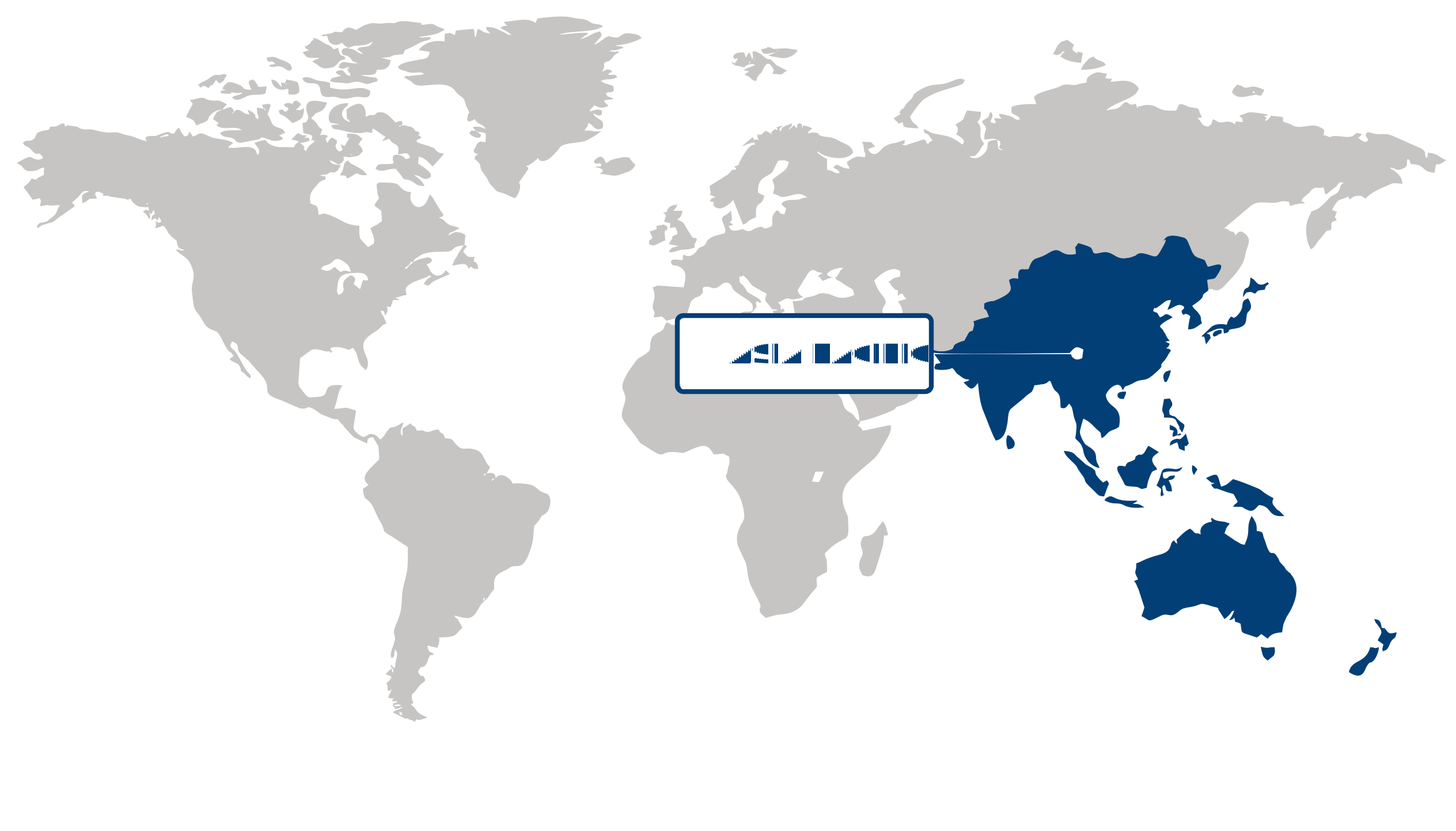
Asia Pacific (Largest & Fastest-Growing Region)
Asia Pacific dominated the carbon fiber construction repair market in 2026 and also represented the fastest-growing regional market, supported by rapid urban development, expanding infrastructure investment, and the increasing need to maintain aging concrete structures. The region's extensive construction activity is generating demand for efficient repair and strengthening technologies that can extend structural service life without requiring major reconstruction. Carbon fiber-based solutions offer advantages such as high strength, lightweight characteristics, corrosion resistance, and relatively efficient installation, making them suitable for bridges, buildings, industrial facilities, and other infrastructure assets. Increasing attention to infrastructure resilience, structural safety, and lifecycle cost management is encouraging engineers and asset owners to adopt advanced composite repair methods. Furthermore, growing urbanization and industrialization are creating a broader base of infrastructure requiring rehabilitation, while improving technical expertise and construction practices are supporting wider adoption of carbon fiber repair technologies across the region.
| Parameter | North America | Asia Pacific | Europe | Latin America | MEA |
|---|---|---|---|---|---|
| Innovation Hub i Scale Nascent Developing Advanced | |||||
| Cost-Sensitive Region i Scale Low Medium High | |||||
| Regulatory Environment i Scale Restrictive Neutral Supportive | |||||
| Demand Drivers i Scale Weak Moderate Strong | |||||
| Development Stage i Scale Emerging Developing Developed | |||||
| Adoption Rate i Scale Low Medium High | |||||
| New Entrants / Startups i Scale Sparse Moderate Dense | |||||
| Macro Indicators i Scale Weak Stable Strong |
Key Country Insights
United States 🇺🇸
Infrastructure Reinforcement SolutionsThe U.S. carbon fiber construction repair market is supported by bridge, commercial building, and transportation infrastructure rehabilitation projects. Contractors increasingly adopt carbon fiber systems to improve structural performance while minimizing disruption during repair and strengthening activities.
Germany 🇩🇪
Engineered Retrofit ApplicationsGermany applies carbon fiber repair systems across industrial facilities and aging infrastructure where structural reinforcement must preserve existing assets. Engineering firms prioritize durable, lightweight solutions that simplify installation and extend service performance.
Japan 🇯🇵
Seismic Strengthening PriorityJapan utilizes carbon fiber construction repair materials to enhance structural resilience in buildings exposed to seismic activity. Project developers emphasize lightweight reinforcement methods that improve safety while reducing construction complexity and downtime during refurbishment.
South Korea 🇰🇷
Urban Asset RehabilitationSouth Korea integrates carbon fiber repair technologies into renovation projects for commercial buildings, transport infrastructure, and public facilities. Demand centers on efficient strengthening methods that support long-term structural reliability without extensive reconstruction.
France 🇫🇷
Heritage Structure PreservationFrance increasingly applies carbon fiber reinforcement to preserve aging infrastructure and historically significant buildings with minimal structural alteration. Engineering specialists focus on repair techniques that combine durability with efficient installation across diverse construction projects.
Italy 🇮🇹
Structural Restoration ExpertiseItaly's carbon fiber construction repair market supports restoration of infrastructure and architecturally significant buildings requiring discreet reinforcement. Contractors favor lightweight composite systems that enhance structural integrity while maintaining existing design characteristics.
Segment Leadership and Growth Trends
Carbon Fiber Construction Repair Market Share (%), by Raw Material, 2026
Go beyond the chart, access full insights & data tables
Request Free Sample ReportRaw Material Segment Analysis: Primary Materials (Largest & Fastest-Growing Segment)
The primary materials segment dominated the carbon fiber construction repair market, accounting for 73.25% of the market share in 2026, and is also expected to record the fastest growth during the forecast period. Its strong position is driven by the essential role of carbon fiber composites, resins, and reinforcing materials in structural rehabilitation, strengthening, and durability enhancement projects. Increasing emphasis on extending the operational life of aging infrastructure, improving structural performance, and adopting high-strength repair solutions continues to reinforce demand for primary materials. As investment in infrastructure rehabilitation and advanced construction technologies expands, the segment is expected to maintain both its market leadership and growth momentum.
Product Type Segment Analysis: Rebar (Largest Segment) vs Fabric (Fastest-Growing Segment)
The rebar segment held the largest share of 47.06% in 2026 owing to its extensive use in strengthening reinforced concrete structures and improving long-term structural integrity. Carbon fiber rebar offers advantages such as corrosion resistance, high tensile strength, and reduced maintenance requirements, making it an attractive solution for repair projects involving bridges, buildings, and other critical infrastructure. Growing emphasis on durable reinforcement systems further supports its widespread adoption.
The carbon fiber construction repair market is expected to witness the fastest growth in the fabric segment over the forecast period. Carbon fiber fabrics provide excellent flexibility and adaptability for wrapping columns, beams, and irregular structural components while delivering effective load-bearing reinforcement. Their ease of installation, compatibility with retrofit applications, and ability to improve seismic and structural performance are expected to drive increasing demand across a broad range of repair projects.
Application Segment Analysis: Infrastructure (Largest & Fastest-Growing Segment)
Infrastructure represented the largest application segment in the carbon fiber construction repair market, accounting for 42.77% in 2026, and is also projected to grow at the fastest pace over the forecast period. The segment benefits from increasing rehabilitation of bridges, tunnels, highways, and public utility structures that require durable and lightweight reinforcement solutions. Rising investments in infrastructure modernization, combined with the need to extend the service life of aging assets while minimizing maintenance disruptions, continue to accelerate the adoption of carbon fiber repair technologies across large-scale civil engineering projects.
| Segment | Sub-Segment | Largest Segment | Fastest Growing |
|---|---|---|---|
| Raw Material | Primary Materials, Auxiliary Materials | Primary Materials | Primary Materials |
| Product Type | Rebar, Fabric, Plate, Others | Rebar | Fabric |
| Application | Residential Buildings, Commercial Buildings, Infrastructure, Industrial | Infrastructure | Infrastructure |
Competitive Landscape and Market Positioning
Major players in the carbon fiber construction repair market:
- Sika AG (Switzerland)
- Mapei S.p.A. (Italy)
- Fosroc International Limited (United Kingdom)
- Master Builders Solutions (Germany)
- Toray Industries, Inc. (Japan)
- Mitsubishi Chemical Group Corporation (Japan)
- S&P Clever Reinforcement Company AG (Switzerland)
- BASF SE (Germany)
- Simpson Strong-Tie Company, Inc. (United States)
- Fyfe Co. LLC (United States)
Demand for durable and minimally disruptive infrastructure rehabilitation is changing how suppliers compete within the carbon fiber construction repair market. Market participants are increasingly focused on delivering integrated repair systems that combine high-performance reinforcement materials with engineering support, installation guidance, and long-term structural reliability. As project owners place greater emphasis on lifecycle performance and regulatory compliance, technical expertise and application-specific solutions have become stronger competitive differentiators than material supply alone. This environment also creates opportunities for specialized providers capable of adapting repair methodologies to diverse structural conditions and regional construction standards.
| Company | Market Share | Company Revenue | Revenue CAGR (%) | Product Portfolio | Geographic Presence | Innovation / R&D Focus | Strategic Developments |
|---|---|---|---|---|---|---|---|
| Sika AG (Switzerland) | |||||||
| Mapei S.p.A. (Italy) | |||||||
| Fosroc International Limited (United Kingdom) | |||||||
| Master Builders Solutions (Germany) | |||||||
| Toray Industries Inc. (Japan) | |||||||
| Mitsubishi Chemical Group Corporation (Japan) | |||||||
| S&P Clever Reinforcement Company AG (Switzerland) | |||||||
| BASF SE (Germany) | |||||||
| Simpson Strong-Tie Company Inc. (United States) | |||||||
| Fyfe Co. LLC (United States) |
Industry Development/News
| Company Name | Date | Key Development |
|---|---|---|
| FOSROC Inc. | Jun-23 | FOSROC Inc. entered into a joint venture with Chemtech, a leading construction chemicals manufacturer in Egypt, to expand its operational reach and strengthen its commercial presence in the regional construction sector. |
| Sika | May-23 | Sika completed the acquisition of MBCC Group to expand its geographic footprint across all regions and reinforce its comprehensive range of products and services spanning the entire construction life cycle. |
| Mapei Group | Sep-22 | Mapei Group acquired ProfilPas, a leading manufacturer and seller of construction materials and accessories, to enhance its product portfolio and strengthen its market positioning in the construction sector. |
| Mitsubishi Chemical Corporation | Sep-22 | Mitsubishi Chemical Corporation partnered with the Ibaraki Prefecture governance body to establish a circular industrial complex in the Kashima coastal industrial zone, aiming to develop a carbon-neutral industrial base. |
Customize Your Report
Explore examples of how this report can be tailored to different research needs, including custom segments, additional topics or chapters, and related reports. Click a section of the wheel or its numbered marker to explore the available options.
Carbon Fiber Construction Repair Market — Custom Segments
| Segment | Sub-Segment |
|---|---|
| Repair Technique | Externally Bonded Reinforcement, Near-Surface Mounted Reinforcement, Carbon Fiber Wrapping & Jacketing, Crack Injection & Surface Repair |
| Damage Type | Cracking, Corrosion & Rebar Deterioration, Structural Overloading, Seismic Damage, Impact & Other Physical Damage |
| Structural Element | Beams, Columns, Slabs, Walls, Bridges & Other Infrastructure Elements |
Carbon Fiber Construction Repair Market — Custom TOC
| Custom Chapter | Custom Details |
|---|---|
| Infrastructure Repair Adoption Roadmap |
|
| Carbon Fiber Repair vs. Conventional Methods |
|
| Infrastructure Retrofit Opportunity Mapping |
|
Need a different cut of the data?
Request Custom ResearchWhat is the market size of carbon fiber construction repair?
How is the carbon fiber construction repair industry expected to grow over the next 10 years?
Why is carbon fiber gaining adoption in infrastructure repair projects?
How are sustainability priorities influencing the carbon fiber construction repair market?
Why do primary materials lead the carbon fiber construction repair market?
Which product type is growing the fastest in the carbon fiber construction repair market?
Why does Asia Pacific lead the carbon fiber construction repair market?
What is driving adoption of carbon fiber repair solutions across Asia Pacific?
Which organizations are considered leaders in the carbon fiber construction repair landscape?
Our Clients
"Your insights on workforce structures were spot-on. The analysis on mid-to-senior level roles validated some of our hiring decisions and highlighted gaps."
Ateliers De France
"The report gave us insights on competitors in the market. It helped our team refine our bidding strategy for upcoming contracts."
Clark Construction
"The reports provided a deep dive into market trends, and competitive landscape. The strategic insights and recommendations have been very helpful."
Rudolph and Sletten
Our Research Team & Methodology
Every Fundamental Business Insights report is built by a dedicated vertical research team, validated through a structured primary-and-secondary methodology, and reviewed for accuracy before it reaches you.
Research Team Overview
Prepared by the Construction & Manufacturing Research Team
Delivery
Published
Demand
Available
Support
Trust & Compliance
Research Domains
10 coverage areasResearch Intelligence
| Source | Reference |
|---|---|
| International Organization for Standardization (ISO) | www.iso.org |
| ASTM International | www.astm.org |
| National Institute of Standards and Technology (NIST) | www.nist.gov |
| International Code Council (ICC) | www.iccsafe.org |
| American Concrete Institute (ACI) | www.concrete.org |
| American Institute of Steel Construction (AISC) | www.aisc.org |
| Construction Industry Institute (CII) | www.construction-institute.org |
| Associated General Contractors of America (AGC) | www.agc.org |
| Association of Equipment Manufacturers (AEM) | www.aem.org |
| Building Owners and Managers Association (BOMA) | www.boma.org |
| American Society of Civil Engineers (ASCE) | www.asce.org |
| National Ready Mixed Concrete Association (NRMCA) | www.nrmca.org |
| International Facility Management Association (IFMA) | www.ifma.org |
| World Green Building Council (WorldGBC) | worldgbc.org |
| International Federation of Consulting Engineers (FIDIC) | fidic.org |
| International Labour Organization (ILO) | www.ilo.org |
| American Society of Mechanical Engineers (ASME) | www.asme.org |
| Society of Manufacturing Engineers (SME) | www.sme.org |
| National Association of Home Builders (NAHB) | www.nahb.org |
| European Construction Industry Federation (FIEC) | www.fiec.eu |
Research Workflow & Quality Assurance
Data Collection
Verified information gathered through primary and secondary research.
Data Triangulation
Cross-validation using multiple independent data sources.
Forecast Modelling
Market estimates developed using historical trends and analytical models.
Analyst Validation
Findings reviewed by domain experts for accuracy and consistency.
Editorial & Quality Review
Final editorial, quality, and compliance checks before publication.
Final Publication
Released after successful completion of the internal review process.
Report Coverage
📊 Market Assessment
- Market Size & Forecast
- Market Segmentation
- Regional Analysis
- Growth Drivers & Challenges
- Market Dynamics
🏢 Competitive Intelligence
- Competitive Landscape
- Company Profiles
- Competitive Benchmarking
- Mergers & Acquisitions
- Market Share Analysis or Key Company Strategies
🔍 Strategic Analysis
- Value Chain Analysis
- Porter's Five Forces
- PESTLE Analysis
- Pricing Trends
- Supply-Demand Analysis
🚀 Future Outlook
- Technology Landscape
- Regulatory Landscape
- Investment & Funding Landscape
- Emerging Opportunities
- Future Market Outlook
Have a question about this report or need a custom scope?
Request Customization