Biodegradable Plastic Additives Market Size & Growth Forecast 2027–2036, By Segments (Application, Form Type), Regional Demand Trends (North America, Asia Pacific, Europe), Key Country Insights (U.S., Japan, South Korea, Germany, France, Italy), and Competitive Landscape
Market Size and Growth Outlook
Biodegradable Plastic Additives Market size stood at USD 3.1 billion in 2026 and is predicted to grow at a 8.27% CAGR from 2027 to 2036, surpassing USD 6.86 billion by 2036. The industry revenue for 2027 is assessed at USD 3.32 billion.
Get more details on this report
Request Free Sample ReportBiodegradable Plastic Additives Market Intelligence Snapshot
Regional Market Dynamics
- Europe leads biodegradable plastic additives market due to mature regulatory frameworks, strong sustainability standards and widespread adoption across packaging and consumer applications driven by compliance requirements.
- Asia Pacific is projected 10.4% CAGR driven by rising manufacturing activity, expanding industrial output and growing adoption of biodegradable plastics across cost-sensitive high-volume sectors enabling scalable production.
Segment Momentum
- Plasticizers held a 54.08% share in 2026 because they improve flexibility, processability, and handling performance, supporting routine manufacturing requirements across a broad range of biodegradable plastic products.
- Property extenders are growing fastest as manufacturers seek to expand the functional performance range of biodegradable plastics, enabling broader application suitability in more demanding operating environments.
Market Expansion Drivers
- Strict environmental regulations accelerating adoption of biodegradable plastic enhancement additives globally.
- Expanding sustainable packaging demand in e-commerce driving biodegradable additive integration.
- High production cost and limited composting infrastructure influencing gradual market penetration rates.
Leading Market Participants
- Top players in the biodegradable plastic additives market include BASF SE (Germany), Avient Corporation (United States), Clariant AG (Switzerland), Evonik Industries AG (Germany), Dow Inc. (United States), LANXESS AG (Germany), Solvay S.A. (Belgium), DIC Corporation (Japan), Emery Oleochemicals Group (Malaysia), Greenchemicals S.r.l. (Italy).
Global Market Forecast Snapshot
Market Outlook
- 2026 Market Size: USD 3.1 billion
- 2027 Estimated Market Size: USD 3.32 billion.
- Projected Market Size: USD 6.86 billion by 2036
- Growth Forecast: 8.27% CAGR (2027-2036)
Regional and Segment Outlook
- Leading Regional Market: Europe
- High-Growth Regional Hub: Asia Pacific
- Core Revenue Segment: Plasticizers (Application) | Property Modifiers (Form Type)
- Emerging Opportunity Segment: Flame Retardants (Application) | Property Extenders (Form Type)
Market Growth Drivers and Industry Trends
Strict environmental regulations accelerating adoption of biodegradable plastic enhancement additives globally
Stricter environmental regulations targeting plastic waste and the environmental impact of conventional plastics are encouraging manufacturers to explore materials and additives that support improved biodegradability, thereby strengthening biodegradable plastic additives market growth. Regulatory requirements can influence packaging design, material selection, waste management practices, and the use of plastic products across consumer and industrial applications. As producers seek to comply with evolving sustainability standards while maintaining required material performance, additives that enhance the functional characteristics of biodegradable polymers are gaining greater relevance. This regulatory pressure is also encouraging investment in formulation development and material solutions designed for applications where environmental performance is increasingly important.
Expanding sustainable packaging demand in e-commerce driving biodegradable additive integration
Growing preference for environmentally responsible packaging is creating additional opportunities for the biodegradable plastic additives market, particularly as e-commerce expands the volume and diversity of packaging used for product protection and delivery. Packaging manufacturers are seeking solutions that can provide the required flexibility, durability, processability, and appearance while supporting sustainability objectives. Biodegradable additives can be incorporated into suitable polymer formulations to improve material performance and facilitate the development of packaging alternatives aligned with changing consumer and business preferences. Increased attention to packaging waste across shipping, retail, and fulfillment activities is further encouraging manufacturers to evaluate biodegradable material solutions for bags, films, protective packaging, and other applications.
High production cost and limited composting infrastructure influencing gradual market penetration rates
High manufacturing costs and insufficient composting infrastructure remain important factors shaping the pace of biodegradable plastic additives market adoption. Producing biodegradable formulations can involve higher material, processing, and formulation expenses compared with established conventional plastic solutions, creating cost considerations for manufacturers and end users. In addition, the environmental benefits of biodegradable materials can depend on access to suitable collection, treatment, and composting systems, which are not uniformly available across regions. Limited infrastructure can therefore restrict effective end-of-life management and make businesses more cautious about large-scale adoption, particularly in applications where conventional plastics continue to offer established processing and disposal pathways.
| Growth Driver | Impact on CAGR | Regulatory Influence | Geographic Relevance | Adoption Rate | Impact Timeline |
|---|---|---|---|---|---|
| Strict environmental regulations accelerating adoption of biodegradable plastic enhancement additives globally | 2.30% | High | Europe, North America | High | Near Term |
| Expanding sustainable packaging demand in e-commerce driving biodegradable additive integration | 2.00% | High | Asia Pacific, Europe | High | Near Term |
| High production cost and limited composting infrastructure influencing gradual market penetration rates | 1.50% | High | Global | Emerging | Long Term |
Unlock insights tailored to your business with our bespoke market research solutions.
Click to get your customized report now.
Regional Demand Dynamics
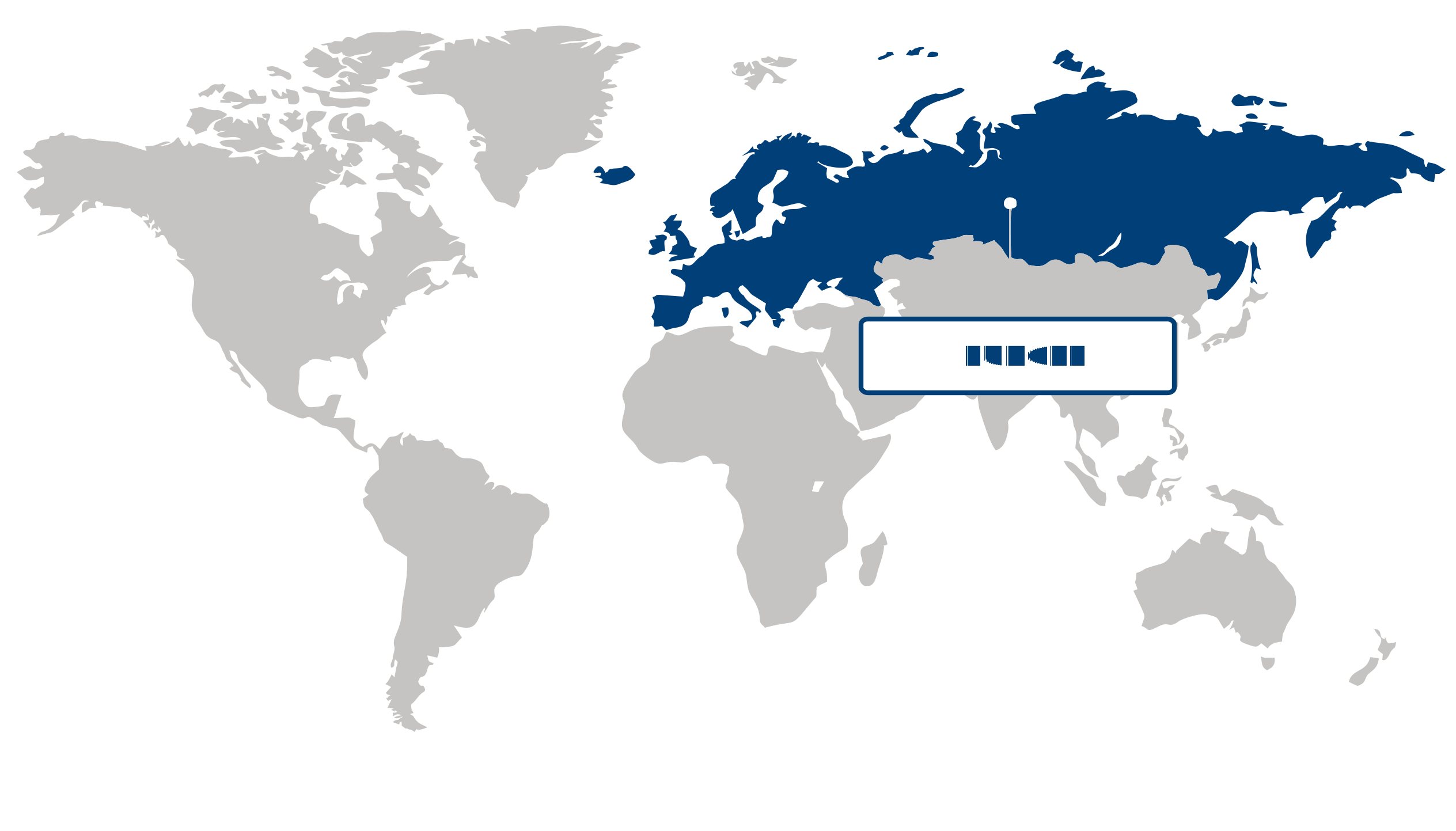
Europe (Largest Region)
Europe maintained the largest position in the biodegradable plastic additives market in 2026, supported by strong environmental priorities, established waste-management systems, and increasing demand for materials with improved end-of-life characteristics. Manufacturers are incorporating biodegradable additives into plastic products to address sustainability objectives and respond to growing consumer preference for environmentally responsible packaging and products. Regulatory attention toward plastic waste reduction and the broader transition toward circular material systems are also encouraging investment in biodegradable and compostable formulations.
Asia Pacific (Fastest-Growing Region)
Asia Pacific is the fastest-growing region, driven by expanding packaging consumption, rapid industrialization, and increasing awareness of plastic pollution. Growing demand for sustainable alternatives is encouraging manufacturers to explore additives that can improve the biodegradability of plastic products without compromising functional performance. Improvements in waste-management infrastructure, increasing environmental policy initiatives, and the expansion of sustainable packaging production are creating additional opportunities for biodegradable plastic additive adoption across the region.
| Parameter | North America | Asia Pacific | Europe | Latin America | MEA |
|---|---|---|---|---|---|
| Innovation Hub i Scale Nascent Developing Advanced | |||||
| Cost-Sensitive Region i Scale Low Medium High | |||||
| Regulatory Environment i Scale Restrictive Neutral Supportive | |||||
| Demand Drivers i Scale Weak Moderate Strong | |||||
| Development Stage i Scale Emerging Developing Developed | |||||
| Adoption Rate i Scale Low Medium High | |||||
| New Entrants / Startups i Scale Sparse Moderate Dense | |||||
| Macro Indicators i Scale Weak Stable Strong |
Key Country Insights
Germany 🇩🇪
Circular Packaging InnovationGermany emphasizes biodegradable plastic additives that align with circular economy initiatives and sustainable packaging development. Material suppliers in Germany are expanding collaborations with packaging manufacturers to improve compostability and processing efficiency.
France 🇫🇷
Eco-Packaging TransitionFrance is encouraging wider use of biodegradable plastic additives in packaging solutions designed to reduce environmental impact. Companies in France are working with material developers to improve compostable product performance while meeting evolving sustainability requirements.
Italy 🇮🇹
Specialty Compound ApplicationsItaly focuses on biodegradable additive formulations for packaging, agricultural films, and consumer goods requiring improved environmental performance. Material producers in Italy are enhancing specialty compound capabilities to meet changing customer and regulatory expectations.
Japan 🇯🇵
Functional Polymer DevelopmentJapan prioritizes biodegradable additives that maintain product quality while improving environmental performance. Manufacturers in Japan are focusing on material innovation that supports high-performance packaging, consumer goods, and industrial plastic applications.
South Korea 🇰🇷
Advanced Resin EnhancementSouth Korea is integrating biodegradable additives into specialty polymer production to address sustainability expectations across packaging and consumer products. Domestic manufacturers are increasing product development efforts to balance durability, processing efficiency, and environmental compatibility.
United States 🇺🇸
Sustainable Materials AdoptionThe U.S. biodegradable plastic additives market benefits from growing demand for environmentally responsible packaging and consumer products. Manufacturers in the U.S. are integrating advanced additive technologies to improve material performance while supporting sustainability objectives across multiple industries.
Segment Leadership and Growth Trends
Biodegradable Plastic Additives Market Share (%), by Application, 2026
Go beyond the chart, access full insights & data tables
Request Free Sample ReportApplication Segment Analysis: Plasticizers (Largest Segment) vs Flame Retardants (Fastest-Growing Segment)
Plasticizers accounted for the largest share of the biodegradable plastic additives market in 2026, representing 54.08% of the market, supported by their critical role in improving flexibility, processability, and durability across biodegradable polymer formulations. As manufacturers seek to expand the usability of biodegradable plastics beyond basic packaging applications, plasticizers help address performance limitations associated with stiffness and brittleness in bio-based materials. Their importance is particularly pronounced in applications requiring easier processing and improved product handling, while increasing emphasis on material efficiency and sustainable product design continues to support demand for additives compatible with biodegradable polymer systems.
Flame retardants are emerging as the fastest-growing application segment, reflecting rising attention to fire safety requirements in biodegradable plastic products used across applications where resistance to ignition and flame propagation is important. The broader adoption of sustainable polymers is increasing the need to balance environmental attributes with functional performance, encouraging the development and use of additives that can provide enhanced fire resistance without undermining biodegradability objectives. This trend is further supported by growing product-performance expectations and the expansion of biodegradable plastics into more technically demanding applications, creating opportunities for advanced flame-retardant formulations.
Form Type Segment Analysis: Property Modifiers (Largest Segment) vs Property Extenders (Fastest-Growing Segment)
Property modifiers held the largest position in the biodegradable plastic additives market in 2026, reflecting their broad role in tailoring the mechanical, thermal, processing, and functional characteristics of biodegradable polymers. The need to overcome performance gaps between conventional plastics and sustainable alternatives makes property modification particularly important for producers seeking to improve material suitability for diverse end-use applications. As biodegradable plastics are increasingly engineered for demanding processing conditions and product specifications, additives that enhance targeted material characteristics can help manufacturers achieve more consistent performance while maintaining the sustainability objectives of the underlying polymer.
Property extenders represent the fastest-growing form type, supported by increasing efforts to optimize biodegradable plastic formulations while improving material efficiency and processing economics. Their growing adoption is associated with manufacturers' focus on achieving desirable formulation characteristics and extending the practical utility of biodegradable polymers across a wider range of products. As sustainability-driven material substitution expands, demand for additive solutions that can support formulation flexibility and maintain acceptable product performance is expected to strengthen, particularly where producers are seeking scalable alternatives to conventional plastic systems.
| Segment | Sub-Segment | Largest Segment | Fastest Growing |
|---|---|---|---|
| Application | Plasticizers, Flame Retardants, Impact Modifiers, Antioxidants, Antimicrobials, UV Stabilizers, Others | Plasticizers | Flame Retardants |
| Form Type | Property Modifiers, Property Extenders, Property Stabilizers, Processing Aids | Property Modifiers | Property Extenders |
Competitive Landscape and Market Positioning
Major players in the biodegradable plastic additives market:
1. BASF SE (Germany)
2. Avient Corporation (United States)
3. Clariant AG (Switzerland)
4. Evonik Industries AG (Germany)
5. Dow Inc. (United States)
6. LANXESS AG (Germany)
7. Solvay S.A. (Belgium)
8. DIC Corporation (Japan)
9. Emery Oleochemicals Group (Malaysia)
10. Greenchemicals S.r.l. (Italy)
The biodegradable plastic additives market is shaped by environmental regulations and sustainability-driven material innovation. New additive formulations are being developed to enhance decomposition efficiency. Research efforts are focused on improving compatibility with various polymer systems. Collaborative development initiatives are also accelerating eco-friendly material adoption across industries.
| Company | Market Share | Company Revenue | Revenue CAGR (%) | Product Portfolio | Geographic Presence | Innovation / R&D Focus | Strategic Developments |
|---|---|---|---|---|---|---|---|
| BASF SE (Germany) | |||||||
| Avient Corporation (United States) | |||||||
| Clariant AG (Switzerland) | |||||||
| Evonik Industries AG (Germany) | |||||||
| Dow Inc. (United States) | |||||||
| LANXESS AG (Germany) | |||||||
| Solvay S.A. (Belgium) | |||||||
| DIC Corporation (Japan) | |||||||
| Emery Oleochemicals Group (Malaysia) | |||||||
| Greenchemicals S.r.l. (Italy). |
Industry Development/News
| Company Name | Date | Key Development |
|---|---|---|
| Baerlocher USA / Innoleics | Mar-24 | Baerlocher USA entered a distribution partnership with Innoleics to commercialize a portfolio of bio-based plasticizers in the U.S. flexible PVC market. The agreement expands Baerlocher’s sustainable additives offering and strengthens its positioning in bio-based formulation solutions targeting evolving regulatory and sustainability requirements in plastics processing. |
| BASF | Sep-23 | BASF launched biomass-balance plastic additives designed to replace fossil feedstock with renewable raw materials. The initial products, including Irganox 1076 FD BMBcert and 1010 BMBcert, are certified under ISCC PLUS via TÜV Nord, reflecting a shift toward sustainable additive formulations aligned with circular plastics and reduced carbon-intensity material inputs. |
| BASF | Oct-22 | BASF introduced a biomass balance plastic additives range designed to replace fossil-based feedstocks with renewable raw materials. Products such as Irganox 1010 BMBcert and Irganox 1076 BMBcert are certified by TÜV Nord under ISCC PLUS standards, supporting the company’s transition toward lower-carbon additive solutions for plastics applications. |
| Cargill Inc. / Croda International Plc | Dec-21 | Cargill announced an agreement to acquire Croda International’s performance technologies and industrial chemicals business, expanding its bioindustrial and sustainable materials footprint. The transaction enhances Cargill’s capabilities in supplying greener ingredient solutions to industrial manufacturers transitioning toward bio-based and lower-impact chemical inputs. |
| REPI / Novosystems GmbH | Mar-21 | REPI acquired Novosystems GmbH to strengthen its portfolio in liquid colorants and additive solutions for plastics applications. The acquisition expands REPI’s geographic footprint across Northern and Central Europe while enhancing its position in high-performance polymer additives, including polyurethane and plastics processing segments. |
| BASF SE / Security Matters | Apr-20 | BASF partnered with Security Matters to advance circular economy capabilities in plastics through digital and physical tracking technologies. The collaboration supports improved recycling traceability and waste sorting processes, strengthening BASF’s broader strategy in sustainable plastics additives and lifecycle management solutions. |
| Clariant / Floreon | Mar-20 | Clariant and Floreon formed a collaboration to enhance biopolymer performance by integrating Clariant’s additive technologies with Floreon’s materials. The initiative aims to expand application potential for biopolymers in manufacturing, supporting broader adoption of bio-based materials in plastics applications through improved functional performance. |
Customize Your Report
Explore examples of how this report can be tailored to different research needs, including custom segments, additional topics or chapters, and related reports. Click a section of the wheel or its numbered marker to explore the available options.
Biodegradable Plastic Additives Market — Custom Segments
| Segment | Sub-Segment |
|---|---|
| Biodegradability Mechanism | Hydro-biodegradable Additives, Oxo-biodegradable Additives, Enzyme-Based Additives, Microbial-Biodegradable Additives |
| Polymer Compatibility | Polyethylene-Based Polymers, Polypropylene-Based Polymers, Polyester-Based Polymers, Polystyrene-Based Polymers, Other Polymer Systems |
| Source Origin | Bio-Based Sources, Fossil-Based Sources, Hybrid Bio-Based/Fossil-Based Sources |
Biodegradable Plastic Additives Market — Custom TOC
| Custom Chapter | Custom Details |
|---|---|
| Regulatory Impact on Additive Adoption |
|
| Sustainable Packaging Transition Assessment |
|
| Additive Performance and Application Trend Mapping |
|
Need a different cut of the data?
Request Custom ResearchWhat is the current revenue of the biodegradable plastic additives market?
How much is the biodegradable plastic additives industry expected to grow by 2036?
How are environmental regulations and e-commerce packaging growth shaping demand for biodegradable plastic additives market?
Why are cost pressures and limited composting infrastructure slowing adoption in the biodegradable plastic additives market?
Why are plasticizers the largest application segment in the biodegradable plastic additives market?
Why are property extenders the fastest-growing form type in the biodegradable plastic additives market?
Why does Europe lead the biodegradable plastic additives market?
Why is Asia Pacific the fastest-growing biodegradable plastic additives market?
Which companies are driving growth in the biodegradable plastic additives landscape?
Our Clients
"The report helped us understand emerging consumer trends in our product category. It clarified where to focus innovation for the next product launch."
LyondellBasell
"The regional forecast section was incredibly useful. We were able to identify two new potential partners in Europe thanks to the vendor mapping you included."
SABIC
"We appreciated how actionable the recommendations were. It guided us to improve supply chain resilience."
Olin Corporation
Our Research Team & Methodology
Every Fundamental Business Insights report is built by a dedicated vertical research team, validated through a structured primary-and-secondary methodology, and reviewed for accuracy before it reaches you.
Research Team Overview
Prepared by the Chemicals & Materials Research Team
Delivery
Published
Demand
Available
Support
Trust & Compliance
Research Domains
10 coverage areasResearch Intelligence
| Source | Reference |
|---|---|
| American Chemistry Council (ACC) | www.americanchemistry.com |
| European Chemical Industry Council (Cefic) | cefic.org |
| International Council of Chemical Associations (ICCA) | icca-chem.org |
| European Chemicals Agency (ECHA) | echa.europa.eu |
| U.S. Environmental Protection Agency (EPA) | www.epa.gov |
| ASTM International | www.astm.org |
| International Organization for Standardization (ISO) | www.iso.org |
| National Institute of Standards and Technology (NIST) | www.nist.gov |
| Plastics Industry Association (PLASTICS) | www.plasticsindustry.org |
| European Biplastics | www.european-bioplastics.org |
| The Adhesive and Sealant Council (ASC) | www.ascouncil.org |
| National Association of Corrosion Engineers (AMPP) | www.ampp.org |
| Society of Plastics Engineers (SPE) | www.4spe.org |
| International Fertilizer Association (IFA) | www.fertilizer.org |
| CropLife International | croplife.org |
| Packaging Europe | packagingeurope.com |
| Flexible Packaging Association (FPA) | www.flexpack.org |
| Battery Council International (BCI) | batterycouncil.org |
| International Copper Association (ICA) | internationalcopper.org |
| World Steel Association | worldsteel.org |
Research Workflow & Quality Assurance
Data Collection
Verified information gathered through primary and secondary research.
Data Triangulation
Cross-validation using multiple independent data sources.
Forecast Modelling
Market estimates developed using historical trends and analytical models.
Analyst Validation
Findings reviewed by domain experts for accuracy and consistency.
Editorial & Quality Review
Final editorial, quality, and compliance checks before publication.
Final Publication
Released after successful completion of the internal review process.
Report Coverage
📊 Market Assessment
- Market Size & Forecast
- Market Segmentation
- Regional Analysis
- Growth Drivers & Challenges
- Market Dynamics
🏢 Competitive Intelligence
- Competitive Landscape
- Company Profiles
- Competitive Benchmarking
- Mergers & Acquisitions
- Market Share Analysis or Key Company Strategies
🔍 Strategic Analysis
- Value Chain Analysis
- Porter's Five Forces
- PESTLE Analysis
- Pricing Trends
- Supply-Demand Analysis
🚀 Future Outlook
- Technology Landscape
- Regulatory Landscape
- Investment & Funding Landscape
- Emerging Opportunities
- Future Market Outlook
Have a question about this report or need a custom scope?
Request Customization