Automotive Hydraulics System Market Size & Growth Forecast 2027–2036, By Segments (Sales Channel, Off-Highway Vehicles, On-Highway Vehicles, Application, Component), Regional Demand Trends (North America, Asia Pacific, Europe), Key Country Insights (U.S., Japan, South Korea, Germany, France, Italy), and Competitive Landscape
Market Size and Growth Outlook
Automotive Hydraulics System Market size was valued at USD 50.5 billion in 2026 and is anticipated to grow at a 3.14% CAGR from 2027 to 2036, exceeding USD 68.8 billion by 2036. The industry revenue for 2027 is estimated at USD 51.83 billion.
Get more details on this report
Request Free Sample ReportAutomotive Hydraulics System Market Intelligence Snapshot
Regional Market Dynamics
- Asia Pacific held a 35.19% market share in 2026, supported by large-scale vehicle production, strong OEM networks, cost-efficient manufacturing, and consistent replacement demand across automotive applications.
- North America is projected to grow at a 4.56% CAGR, driven by demand for advanced vehicle systems, replacement activity, and continued investment in durable, high-value automotive components.
Segment Momentum
- OEM holds a 63.34% share due to factory-fit integration, strong supplier alignment, and standardized procurement within vehicle manufacturing programs requiring consistent performance and assembly-line efficiency.
- Construction Equipment is the fastest-growing segment due to high hydraulic intensity in excavators, loaders, and cranes, where performance-critical operations depend heavily on advanced fluid power systems.
Market Expansion Drivers
- Rising commercial vehicle production increasing demand for advanced hydraulic systems.
- Integration of sensors and electronic controls enhancing hydraulic system efficiency.
- Growing adoption of electric-hydraulic hybrid systems improving vehicle performance efficiency.
Leading Market Participants
- Leading players in the automotive hydraulics system market include Robert Bosch GmbH (Germany), ZF Friedrichshafen AG (Germany), Schaeffler AG (Germany), JTEKT Corporation (Japan), Nexteer Automotive Group Ltd. (United States), BorgWarner Inc. (United States), Hitachi Astemo, Ltd. (Japan), Continental AG (Germany), Denso Corporation (Japan).
Global Market Forecast Snapshot
Market Outlook
- 2026 Market Size: USD 50.5 billion
- 2027 Estimated Market Size: USD 51.83 billion.
- Projected Market Size: USD 68.8 billion by 2036
- Growth Forecast: 3.14% CAGR (2027-2036)
Regional and Segment Outlook
- Leading Regional Market: Asia Pacific
- High-Growth Regional Hub: North America
- Core Revenue Segment: OEM (Sales Channel) | Agriculture Equipment (Off-Highway Vehicles) | Passenger Cars (On-Highway Vehicles) | Brakes (Application) | Master Cylinder (Component)
- Emerging Opportunity Segment: Aftermarket (Sales Channel) | Construction Equipment (Off-Highway Vehicles) | Light Commercial Vehicles (On-Highway Vehicles) | Clutch (Application) | Slave Cylinder (Component)
Market Growth Drivers and Industry Trends
Rising commercial vehicle production increasing demand for advanced hydraulic systems
Higher commercial vehicle production is creating stronger requirements across the automotive hydraulics system market because trucks, buses, construction vehicles, and other heavy-duty platforms rely on hydraulic technologies for functions requiring substantial force and controlled movement. Hydraulic systems are widely used in braking, steering, lifting, suspension, and auxiliary applications where efficient power transmission is essential. Increasing logistics activity, infrastructure development, and demand for specialized commercial vehicles are encouraging manufacturers to equip new platforms with capable hydraulic components that can withstand demanding operating conditions. The need for reliable performance under heavy loads is also increasing attention toward system durability, responsiveness, and integration within modern commercial vehicle architectures.
Integration of sensors and electronic controls enhancing hydraulic system efficiency
The incorporation of sensors, electronic controls, and intelligent monitoring capabilities is advancing the automotive hydraulics system market by enabling hydraulic functions to operate with greater precision and responsiveness. Sensors can monitor parameters such as pressure, temperature, load, and system condition, allowing electronic control units to adjust hydraulic operation according to real-time vehicle requirements. This integration can reduce unnecessary energy use, improve response characteristics, and support more accurate control of braking, steering, and auxiliary functions. The combination of mechanical hydraulic power with electronic intelligence is also creating opportunities for condition monitoring and more sophisticated vehicle control strategies, particularly in commercial and specialized automotive applications.
Growing adoption of electric-hydraulic hybrid systems improving vehicle performance efficiency
The growing use of electric-hydraulic hybrid architectures is opening new opportunities in the automotive hydraulics system market as vehicle manufacturers seek to combine the high force capability of hydraulics with the controllability and efficiency of electric systems. Electrically driven hydraulic pumps and electronically managed hydraulic circuits can provide power when required rather than relying on continuous mechanical operation, helping improve energy utilization in suitable applications. Such configurations are particularly relevant for vehicles with demanding auxiliary functions, where hydraulic power remains advantageous but conventional power delivery can create efficiency losses. Hybrid system development is consequently encouraging innovation in pump design, electronic control, energy management, and hydraulic component integration.
| Growth Driver | Impact on CAGR | Regulatory Influence | Geographic Relevance | Adoption Rate | Impact Timeline |
|---|---|---|---|---|---|
| Rising commercial vehicle production increasing demand for advanced hydraulic systems | 1.70% | Moderate | Asia Pacific, North America | High | Mid Term |
| Integration of sensors and electronic controls enhancing hydraulic system efficiency | 1.60% | Moderate | Europe, Asia Pacific | Medium | Mid Term |
| Growing adoption of electric-hydraulic hybrid systems improving vehicle performance efficiency | 1.40% | Moderate | Europe, North America | Emerging | Long Term |
Unlock insights tailored to your business with our bespoke market research solutions.
Click to get your customized report now.
Regional Demand Dynamics
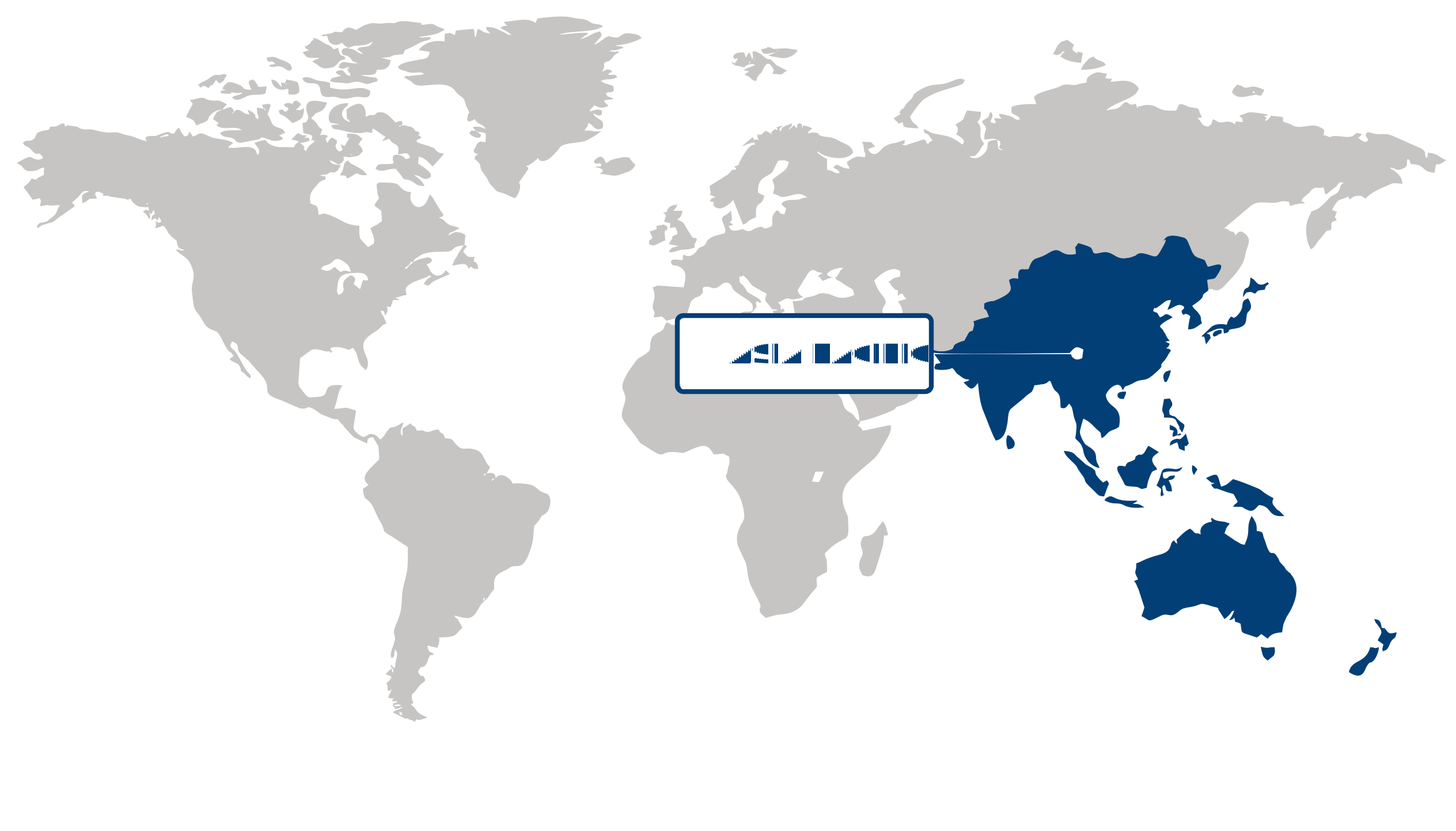
Asia Pacific (Largest Region)
The Asia Pacific automotive hydraulics system market accounted for 35.19% of the global market in 2026, reflecting the region's extensive automotive manufacturing base and strong demand for hydraulic systems across commercial and passenger vehicles. Continued vehicle production, industrial development, and expansion of transportation infrastructure support applications requiring reliable hydraulic power and control. The presence of established component manufacturing ecosystems and increasing adoption of advanced vehicle technologies further contributes to regional demand, while investments in manufacturing automation are improving production capabilities.
North America (Fastest-Growing Region)
North America is the fastest-growing region, supported by ongoing vehicle manufacturing activity, demand for commercial transportation, and increasing focus on vehicle performance and operational efficiency. Hydraulic systems remain important across applications requiring controlled force, durability, and reliable power transmission, particularly in larger vehicles and specialized automotive equipment. Modernization of manufacturing facilities and greater integration of advanced control technologies are also encouraging improvements in hydraulic system design, creating opportunities for suppliers focused on efficiency, reliability, and system optimization.
| Parameter | North America | Asia Pacific | Europe | Latin America | MEA |
|---|---|---|---|---|---|
| Innovation Hub i Scale Nascent Developing Advanced | |||||
| Cost-Sensitive Region i Scale Low Medium High | |||||
| Regulatory Environment i Scale Restrictive Neutral Supportive | |||||
| Demand Drivers i Scale Weak Moderate Strong | |||||
| Development Stage i Scale Emerging Developing Developed | |||||
| Adoption Rate i Scale Low Medium High | |||||
| New Entrants / Startups i Scale Sparse Moderate Dense | |||||
| Macro Indicators i Scale Weak Stable Strong |
Key Country Insights
Germany 🇩🇪
Precision Engineering FocusGermany prioritizes high-performance automotive hydraulics systems that align with stringent engineering and manufacturing standards. German suppliers continue refining hydraulic technologies that enhance vehicle control, production quality, and integration with advanced mobility platforms.
France 🇫🇷
Efficient Mobility ApplicationsFrance encourages automotive hydraulics system development that supports efficient vehicle operation and industrial sustainability objectives. French manufacturers are integrating hydraulic technologies into specialized automotive applications requiring dependable performance and operational consistency.
Italy 🇮🇹
Specialty Component ExpertiseItaly maintains strong capabilities in specialized automotive hydraulics components for passenger vehicles, performance vehicles, and industrial mobility applications. Italian manufacturers focus on customized hydraulic solutions that balance precision engineering with flexible production requirements.
Japan 🇯🇵
Compact System InnovationJapan focuses on compact, lightweight automotive hydraulics systems designed to improve vehicle efficiency and manufacturing flexibility. Japanese manufacturers emphasize precision components that support reliability while accommodating evolving passenger and commercial vehicle requirements.
South Korea 🇰🇷
Advanced Manufacturing AlignmentSouth Korea is strengthening automotive hydraulics system adoption through highly automated vehicle manufacturing and supplier collaboration. Companies in South Korea are investing in advanced hydraulic solutions that complement modern production processes and evolving vehicle technologies.
United States 🇺🇸
Commercial Vehicle IntegrationThe U.S. automotive hydraulics system market emphasizes durable hydraulic components for commercial vehicles, off-highway equipment, and specialty automotive applications. Manufacturers in the U.S. are prioritizing improved system efficiency, reliability, and compatibility with advanced vehicle architectures.
Segment Leadership and Growth Trends
Automotive Hydraulics System Market Share (%), by Sales Channel, 2026
Go beyond the chart, access full insights & data tables
Request Free Sample ReportSales Channel Segment Analysis: OEM (Largest Segment) vs Aftermarket (Fastest-Growing Segment)
The OEM segment led the automotive hydraulics system market with a 63.34% share in 2026, supported by the integration of hydraulic systems directly into vehicle manufacturing and original equipment specifications. OEM-supplied hydraulic components benefit from compatibility with vehicle designs, established quality requirements, and coordinated integration with other mechanical systems. Continued vehicle production and demand for reliable hydraulic functions across automotive applications sustain the segment's strong position.
The aftermarket segment is gaining pace as vehicle owners and fleet operators increasingly prioritize maintenance, component replacement, and restoration of hydraulic system performance. Demand is supported by the need to extend vehicle operating life and maintain the reliability of hydraulic components after initial vehicle sales. Expanding repair and maintenance activity, combined with greater attention to vehicle uptime and operating efficiency, is supporting the aftermarket segment.
Off-Highway Vehicles Segment Analysis: Agriculture Equipment (Largest Segment) vs Construction Equipment (Fastest-Growing Segment)
Agriculture equipment held the largest share of the off-highway vehicle segment of the automotive hydraulics system market in 2026, reflecting the extensive use of hydraulic systems for lifting, steering, implement control, and other demanding agricultural functions. Hydraulic technology provides the force, precision, and controllability required across a wide range of agricultural machinery. Mechanization of farming activities and continued demand for efficient equipment operation are supporting sustained hydraulic system adoption in agriculture.
Construction equipment is experiencing faster momentum as modern machinery increasingly relies on hydraulic systems for precise movement, high-force applications, and efficient control of operating functions. Excavation, lifting, material handling, and other construction activities require dependable hydraulic performance under demanding operating conditions. Increasing construction activity and continued equipment modernization are creating favorable conditions for greater adoption of automotive hydraulic systems in construction machinery.
| Segment | Sub-Segment | Largest Segment | Fastest Growing |
|---|---|---|---|
| Sales Channel | OEM, Aftermarket | OEM | Aftermarket |
| Off-Highway Vehicles | Agriculture Equipment, Construction Equipment | Agriculture Equipment | Construction Equipment |
| On-Highway Vehicles | Passenger Cars, Light Commercial Vehicles, Heavy Commercial Vehicles | Passenger Cars | Light Commercial Vehicles |
| Application | Brakes, Clutch, Suspension, Tappets | Brakes | Clutch |
| Component | Master Cylinder, Slave Cylinder, Reservoir, Hose | Master Cylinder | Slave Cylinder |
Competitive Landscape and Market Positioning
Key companies in the automotive hydraulics system market:
1. Robert Bosch GmbH (Germany)
2. ZF Friedrichshafen AG (Germany)
3. Schaeffler AG (Germany)
4. JTEKT Corporation (Japan)
5. Nexteer Automotive Group Ltd. (United States)
6. BorgWarner Inc. (United States)
7. Hitachi Astemo Ltd. (Japan)
8. Continental AG (Germany)
9. Denso Corporation (Japan)
The automotive hydraulics system market is evolving with increased integration of electronically controlled hydraulic mechanisms. Improvements in system responsiveness and energy efficiency are supporting broader automotive performance enhancements. New solution developments are aligning with electrification and hybrid vehicle trends. The automotive hydraulics system market continues to adapt through enhanced control precision and system optimization.
| Company | Market Share | Company Revenue | Revenue CAGR (%) | Product Portfolio | Geographic Presence | Innovation / R&D Focus | Strategic Developments |
|---|---|---|---|---|---|---|---|
| Robert Bosch GmbH (Germany) | |||||||
| ZF Friedrichshafen AG (Germany) | |||||||
| Schaeffler AG (Germany) | |||||||
| JTEKT Corporation (Japan) | |||||||
| Nexteer Automotive Group Ltd. (United States) | |||||||
| BorgWarner Inc. (United States) | |||||||
| Hitachi Astemo Ltd. (Japan) | |||||||
| Continental AG (Germany) | |||||||
| Denso Corporation (Japan). |
Industry Development/News
| Company Name | Date | Key Development |
|---|---|---|
| Continental | Mar-26 | Continental expanded its Changchun facility in China with a EUR 120 million investment to increase electro-hydraulic brake production capacity for electric vehicles. The expansion incorporates automation and AI-based inspection systems, positioning the company to meet rapidly growing EV brake demand in China and strengthen its regional manufacturing footprint. |
| Bosch | Feb-26 | Bosch partnered with NVIDIA to develop centralized vehicle computing architectures integrating brake-by-wire and steer-by-wire systems. The collaboration combines Bosch hydraulic braking technologies with NVIDIA DRIVE Orin to support ASIL-D safety requirements and targets production readiness for premium EV platforms using zonal architecture. |
| ZF | Jan-26 | ZF acquired Israeli startup Impedance Sciences for USD 180 million to advance electric brake-by-wire technologies. The acquisition supports development of hydraulic-free braking systems that reduce vehicle weight, improve brake force control, and enable enhanced vehicle dynamics for next-generation electrified mobility platforms. |
| Hitachi Astemo | Nov-25 | Hitachi Astemo entered a partnership with BYD to co-develop next-generation electro-hydraulic braking systems integrating regenerative braking and automated driving functions. The collaboration targets production in China by Q3 2027 and is positioned as a large-scale supply agreement supporting EV braking system demand. |
Customize Your Report
Explore examples of how this report can be tailored to different research needs, including custom segments, additional topics or chapters, and related reports. Click a section of the wheel or its numbered marker to explore the available options.
Automotive Hydraulics System Market — Custom Segments
| Segment | Sub-Segment |
|---|---|
| Vehicle Electrification Level | Internal Combustion Engine Vehicles, Hybrid Electric Vehicles, Plug-in Hybrid Electric Vehicles, Battery Electric Vehicles |
| Hydraulic Fluid Type | Mineral-Based Fluids, Synthetic Fluids, Bio-Based Fluids |
| Hydraulic System Architecture | Open-Center Systems, Closed-Center Systems, Electro-Hydraulic Systems, Integrated Hydraulic Systems |
Automotive Hydraulics System Market — Custom TOC
| Custom Chapter | Custom Details |
|---|---|
| Vehicle Electrification Impact and Hydraulic System Evolution |
|
| Commercial Vehicle Demand and Application Opportunities |
|
| Aftermarket Opportunity and Supply Chain Localization |
|
Need a different cut of the data?
Request Custom ResearchHow much revenue does the automotive hydraulics system market generate?
How is the automotive hydraulics system industry size expected to evolve during the forecast period?
How is rising commercial vehicle production shaping demand in the automotive hydraulics system market?
How is electronic integration transforming hydraulic system design and functionality in vehicles?
Why does OEM distribution dominate the automotive hydraulics system market?
What is driving growth in Construction Equipment within off-highway vehicles?
Why does Asia Pacific dominate the automotive hydraulics system market?
What is supporting North America's growth in the automotive hydraulics system market?
What are the prominent companies operating in the automotive hydraulics system landscape?
Our Clients
"The team surpassed our expectations with the report depth. The actionable insights provided proved crucial in navigating market challenges."
Tata Motors
"We found the report to be very informative. The expertise and attention to market nuances significantly influenced our business direction."
DENSO Corporation
"The consumer survey findings were quite good. We now have a clearer picture of the customer churning and retention strategy."
HL Mando
Our Research Team & Methodology
Every Fundamental Business Insights report is built by a dedicated vertical research team, validated through a structured primary-and-secondary methodology, and reviewed for accuracy before it reaches you.
Research Team Overview
Prepared by the Automotive & Transportation Research Team
Delivery
Published
Demand
Available
Support
Trust & Compliance
Research Domains
10 coverage areasResearch Intelligence
| Source | Reference |
|---|---|
| International Organization of Motor Vehicle Manufacturers (OICA) | www.oica.net |
| SAE International | www.sae.org |
| International Energy Agency (IEA) | www.iea.org |
| International Transport Forum (ITF) | www.itf-oecd.org |
| International Road Federation (IRF) | www.irf.global |
| International Organization for Standardization (ISO) | www.iso.org |
| United Nations Economic Commission for Europe (UNECE) | unece.org |
| National Highway Traffic Safety Administration (NHTSA) | www.nhtsa.gov |
| U.S. Department of Transportation (USDOT) | www.transportation.gov |
| European Automobile Manufacturers' Association (ACEA) | www.acea.auto |
| Society of Indian Automobile Manufacturers (SIAM) | www.siam.in |
| International Air Transport Association (IATA) | www.iata.org |
| International Civil Aviation Organization (ICAO) | www.icao.int |
| International Maritime Organization (IMO) | www.imo.org |
| International Union of Railways (UIC) | uic.org |
| American Public Transportation Association (APTA) | www.apta.com |
| International Federation of Robotics (IFR) | ifr.org |
| CharIN | www.charin.global |
| World Shipping Council | www.worldshipping.org |
| International Federation of Freight Forwarders Associations (FIATA) | fiata.org |
Research Workflow & Quality Assurance
Data Collection
Verified information gathered through primary and secondary research.
Data Triangulation
Cross-validation using multiple independent data sources.
Forecast Modelling
Market estimates developed using historical trends and analytical models.
Analyst Validation
Findings reviewed by domain experts for accuracy and consistency.
Editorial & Quality Review
Final editorial, quality, and compliance checks before publication.
Final Publication
Released after successful completion of the internal review process.
Report Coverage
📊 Market Assessment
- Market Size & Forecast
- Market Segmentation
- Regional Analysis
- Growth Drivers & Challenges
- Market Dynamics
🏢 Competitive Intelligence
- Competitive Landscape
- Company Profiles
- Competitive Benchmarking
- Mergers & Acquisitions
- Market Share Analysis or Key Company Strategies
🔍 Strategic Analysis
- Value Chain Analysis
- Porter's Five Forces
- PESTLE Analysis
- Pricing Trends
- Supply-Demand Analysis
🚀 Future Outlook
- Technology Landscape
- Regulatory Landscape
- Investment & Funding Landscape
- Emerging Opportunities
- Future Market Outlook
Have a question about this report or need a custom scope?
Request Customization