Architectural Lighting Market Size & Growth Forecast 2027–2036, By Segments (Application, End Use, Component, Source), Regional Demand Trends (North America, Asia Pacific, Europe), Key Country Insights (U.S., Japan, South Korea, Germany, France, Italy), and Competitive Landscape
Market Size and Growth Outlook
Architectural Lighting Market size was valued at USD 11.5 billion in 2026 and is anticipated to grow at a 5.89% CAGR from 2027 to 2036, surpassing USD 20.38 billion by 2036. The industry revenue for 2027 is assessed at USD 12.07 billion.
Get more details on this report
Request Free Sample ReportArchitectural Lighting Market Intelligence Snapshot
Regional Market Dynamics
- Asia Pacific leads due to large-scale construction activity, strong urban expansion, and rising demand for design-led and energy-efficient lighting in commercial and residential projects.
- Growth is reinforced by sustained infrastructure development and urbanization, with an 8.93% CAGR driven by continuous new builds and renovation-focused lighting upgrades.
Segment Momentum
- Indoor applications held a 72.96% share in 2026 due to consistent demand across commercial, residential, hospitality, and public buildings where lighting supports ambience, functionality, and design integration.
- Residential demand is growing fastest as homeowners and developers increasingly use architectural lighting to enhance aesthetics, comfort, mood, and the overall quality of living spaces.
Market Expansion Drivers
- Rapid urbanization and smart city projects increasing demand for energy-efficient architectural lighting systems.
- Expanding adoption of LED technology improving operational efficiency and long-term infrastructure sustainability.
- Integration of AI and IoT-enabled human-centric lighting accelerating smart building modernization initiatives.
Leading Market Participants
- Top players in the architectural lighting market include Acuity Brands, Inc. (United States), Cree Lighting (United States), Delta Light (Belgium), Current Lighting Solutions (United States), GVA Lighting, Inc. (Canada), Hubbell Incorporated (United States), OSRAM GmbH (Germany), Signify Holding (Netherlands), Zumtobel Group AG (Austria), Seoul Semiconductor Co., Ltd. (South Korea).
Global Market Forecast Snapshot
Market Outlook
- 2026 Market Size: USD 11.5 billion
- 2027 Estimated Market Size: USD 12.07 billion.
- Projected Market Size: USD 20.38 billion by 2036
- Growth Forecast: 5.89% CAGR (2027-2036)
Regional and Segment Outlook
- Leading Regional Market: Asia Pacific
- High-Growth Regional Hub: Asia Pacific
- Core Revenue Segment: Indoor (Application) | Commercial (End Use) | Ballasts (Component) | Light-Emitting Diode (LED) (Source)
- Emerging Opportunity Segment: Outdoor (Application) | Residential (End Use) | Lamps (Component) | High-Intensity Discharge (HID) (Source)
Market Growth Drivers and Industry Trends
Rapid urbanization and smart city projects increasing demand for energy-efficient architectural lighting systems
Rapid urbanization is creating new opportunities for the architectural lighting market as cities invest in modern public spaces, commercial developments, transportation facilities, and smart city infrastructure. Architectural lighting systems are increasingly incorporated into building facades, streetscapes, public areas, and landmark projects to combine illumination with aesthetic and functional requirements. The development of digitally managed urban environments further encourages the use of efficient lighting systems that can be integrated into broader infrastructure networks.
Expanding adoption of LED technology improving operational efficiency and long-term infrastructure sustainability
The growing adoption of LED technology is supporting the architectural lighting market by providing lighting solutions with improved energy efficiency, longer operating life, and greater design flexibility. LED systems can be incorporated into diverse architectural applications while enabling better control over brightness, color, and lighting patterns. Their lower energy requirements and reduced maintenance needs make them suitable for projects where building owners and infrastructure planners are seeking to improve operational performance and support long-term sustainability objectives.
Integration of AI and IoT-enabled human-centric lighting accelerating smart building modernization initiatives
Integration of AI and IoT technologies is transforming the architectural lighting market by enabling lighting systems to respond dynamically to occupancy, environmental conditions, and user requirements. Human-centric lighting can adjust illumination according to changing conditions, while connected controls provide building operators with greater visibility over lighting performance and energy use. These capabilities are becoming increasingly relevant to smart building modernization as property developers and facility managers integrate lighting with broader intelligent building management systems.
| Growth Driver | Impact on CAGR | Regulatory Influence | Geographic Relevance | Adoption Rate | Impact Timeline |
|---|---|---|---|---|---|
| Rapid urbanization and smart city projects increasing demand for energy-efficient architectural lighting systems | 2.00% | High | Asia Pacific, Middle East | High | Near Term |
| Expanding adoption of LED technology improving operational efficiency and long-term infrastructure sustainability | 1.80% | Moderate | North America, Europe | High | Mid Term |
| Integration of AI and IoT-enabled human-centric lighting accelerating smart building modernization initiatives | 1.50% | Moderate | Europe, Asia Pacific | Emerging | Long Term |
Unlock insights tailored to your business with our bespoke market research solutions.
Click to get your customized report now.
Regional Demand Dynamics
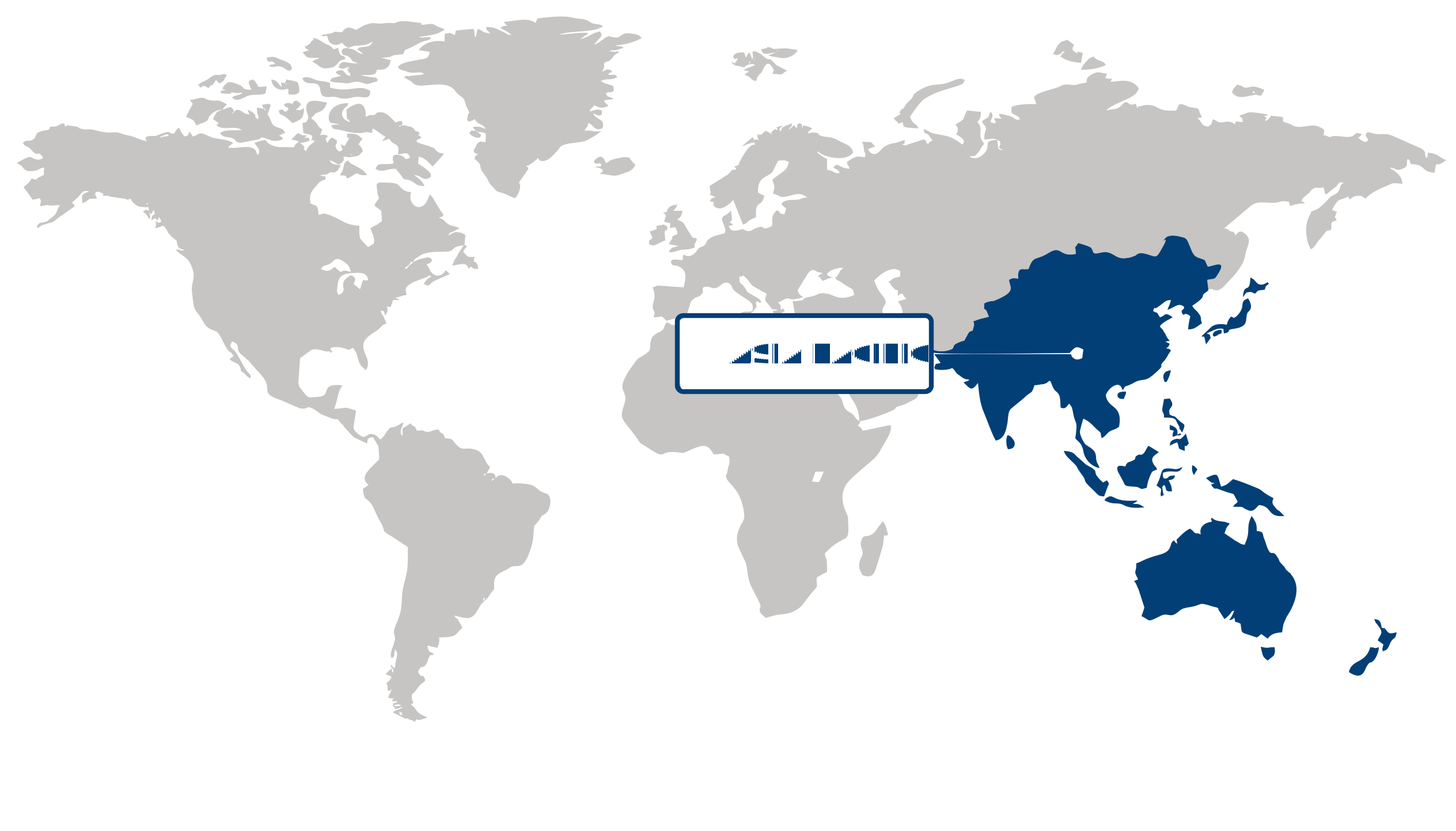
Asia Pacific (Largest & Fastest-Growing Region)
Asia Pacific held the largest share of the architectural lighting market in 2026 and is also the fastest-growing region, driven by extensive urban development and continued investment in residential, commercial, and public infrastructure. Rapid construction activity is increasing demand for lighting solutions that combine visual appeal, energy efficiency, and functional performance. The modernization of cities and growing emphasis on sustainable building practices are further supporting adoption. In addition, rising disposable incomes and increasing investment in hospitality, retail, and premium real estate are contributing to stronger demand for advanced architectural lighting across the region.
| Parameter | North America | Asia Pacific | Europe | Latin America | MEA |
|---|---|---|---|---|---|
| Innovation Hub i Scale Nascent Developing Advanced | |||||
| Cost-Sensitive Region i Scale Low Medium High | |||||
| Regulatory Environment i Scale Restrictive Neutral Supportive | |||||
| Demand Drivers i Scale Weak Moderate Strong | |||||
| Development Stage i Scale Emerging Developing Developed | |||||
| Adoption Rate i Scale Low Medium High | |||||
| New Entrants / Startups i Scale Sparse Moderate Dense | |||||
| Macro Indicators i Scale Weak Stable Strong |
Key Country Insights
Germany 🇩🇪
Sustainable Building IlluminationGermany emphasizes architectural lighting solutions that support sustainable construction and high-performance building standards. Demand centers on energy-efficient luminaires and intelligent lighting controls that complement modern architectural designs.
France 🇫🇷
Heritage and Modern IntegrationFrance balances architectural lighting demand between contemporary developments and renovation of historic buildings. Designers increasingly adopt efficient lighting technologies that preserve architectural character while meeting modern performance expectations.
Italy 🇮🇹
Design-Focused IlluminationItaly emphasizes architectural lighting that complements premium interior and exterior design across hospitality, retail, and cultural spaces. Project developers increasingly select flexible lighting systems that combine visual appeal with energy-conscious operation.
Japan 🇯🇵
Human-Centric Lighting DesignJapan advances architectural lighting by emphasizing visual comfort, energy optimization, and adaptable indoor environments. Architects and developers increasingly specify lighting systems that balance aesthetics with functional performance across residential and commercial projects.
South Korea 🇰🇷
Urban Lighting InnovationSouth Korea expands architectural lighting applications across commercial developments, smart buildings, and urban infrastructure. The market increasingly favors digitally controlled lighting solutions that improve design flexibility and building efficiency.
United States 🇺🇸
Smart Lighting IntegrationThe U.S. prioritizes architectural lighting systems that combine energy efficiency with intelligent controls for commercial and public spaces. Designers and building owners increasingly integrate connected lighting technologies to enhance occupant experience and operational flexibility.
Segment Leadership and Growth Trends
Architectural Lighting Market Share (%), by Application, 2026
Go beyond the chart, access full insights & data tables
Request Free Sample ReportApplication Segment Analysis: Indoor (Largest Segment) vs Outdoor (Fastest-Growing Segment)
The indoor segment dominated the architectural lighting market with a 72.96% share in 2026, driven by its extensive use across offices, retail spaces, hospitality facilities, educational institutions, healthcare settings, and other built environments. Indoor architectural lighting plays a central role in improving visual comfort, supporting functional requirements, and enhancing the aesthetic character of interior spaces. Growing emphasis on energy efficiency, intelligent lighting controls, and human-centric design is further supporting demand for advanced indoor lighting solutions.
The outdoor segment is expected to be the fastest-growing application segment, supported by increasing investment in urban infrastructure, public spaces, commercial developments, and architectural façade illumination. Outdoor lighting is increasingly being used to improve safety, visibility, and the visual appeal of buildings and surrounding environments. The expansion of smart city initiatives and the adoption of connected, energy-efficient lighting systems are also encouraging the deployment of more sophisticated outdoor architectural lighting solutions.
End Use Segment Analysis: Commercial (Largest Segment) vs Residential (Fastest-Growing Segment)
Holding a 53.55% share in 2026, the commercial segment accounted for the largest portion of the market. Demand is supported by the broad application of architectural lighting in offices, retail establishments, hotels, restaurants, entertainment venues, and other commercial properties where lighting contributes to both functionality and customer experience. Building renovations and new commercial construction, combined with the need to reduce energy consumption and create distinctive interior and exterior environments, continue to reinforce the segment's strong position.
The residential segment is anticipated to be the fastest-growing end-use segment as homeowners increasingly prioritize lighting that combines aesthetics, energy efficiency, and greater control over living environments. In the architectural lighting market, rising adoption of smart home technologies is supporting demand for connected and customizable lighting systems. Growing interest in home renovation, premium interior design, and outdoor living spaces is also expanding the use of architectural lighting across residential properties.
| Segment | Sub-Segment | Largest Segment | Fastest Growing |
|---|---|---|---|
| Application | Indoor, Outdoor | Indoor | Outdoor |
| End Use | Commercial, Residential, Industrial, Others | Commercial | Residential |
| Component | Lamp Holders, Ballasts, Lamps, Lenses/Shades, Trims, Wiring, Reflectors, Others | Ballasts | Lamps |
| Source | Incandescent Lights, Fluorescent Lights, Light-Emitting Diode (LED), High-Intensity Discharge (HID), Others | Light-Emitting Diode (LED) | High-Intensity Discharge (HID) |
Competitive Landscape and Market Positioning
Major players in the architectural lighting market:
1. Acuity Brands Inc. (United States)
2. Cree Lighting (United States)
3. Delta Light (Belgium)
4. Current Lighting Solutions (United States)
5. GVA Lighting Inc. (Canada)
6. Hubbell Incorporated (United States)
7. OSRAM GmbH (Germany)
8. Signify Holding (Netherlands)
9. Zumtobel Group AG (Austria)
10. Seoul Semiconductor Co. Ltd. (South Korea)
The architectural lighting market is experiencing strong momentum toward energy-efficient lighting systems and intelligent control solutions. Market activity is increasingly centered on smart illumination technologies, aesthetic customization, and environmentally sustainable product designs. Demand for connected lighting infrastructure across commercial and urban spaces is encouraging continuous innovation in the sector.
| Company | Market Share | Company Revenue | Revenue CAGR (%) | Product Portfolio | Geographic Presence | Innovation / R&D Focus | Strategic Developments |
|---|---|---|---|---|---|---|---|
| Acuity Brands Inc. (United States) | |||||||
| Cree Lighting (United States) | |||||||
| Delta Light (Belgium) | |||||||
| Current Lighting Solutions (United States) | |||||||
| GVA Lighting Inc. (Canada) | |||||||
| Hubbell Incorporated (United States) | |||||||
| OSRAM GmbH (Germany) | |||||||
| Signify Holding (Netherlands) | |||||||
| Zumtobel Group AG (Austria) | |||||||
| Seoul Semiconductor Co. Ltd. (South Korea). |
Industry Development/News
| Company Name | Date | Key Development |
|---|---|---|
| Jaquar Group | May-26 | Jaquar Group announced plans to scale its architectural and outdoor lighting business by investing in a new manufacturing facility. The expansion strategy includes broadening its technical product portfolio and growing export operations throughout the Middle East and Africa, supported by a new display showroom in Dubai. |
| SGM Lighting | Dec-25 | SGM Lighting entered an exclusive distribution partnership with ACT Entertainment across the United States and Canada. The strategic agreement covers the commercialization and distribution of its newly launched PALCO family of entertainment and touring wash lights to strengthen its architectural market reach. |
| Lutron | Jun-25 | Lutron acquired Orluna LED Technologies, representing its first corporate acquisition outside of North America. The strategic transaction expands Lutron’s premium product lineup by integrating Orluna’s high-end architectural LED lighting solutions and specialist technical capabilities. |
| Zumtobel Group | Dec-24 | Zumtobel Group acquired UK-based LED lighting manufacturer AC/DC to strengthen its competitive positioning in the architectural facade and hospitality segments. The acquisition integrates AC/DC's specialized, high-efficiency LED product lines into Zumtobel's global commercial specification and project distribution network. |
| iGuzzini | Jun-24 | iGuzzini launched the Newfo Spot and Filorail Track system, delivering an ultra-compact smart lighting infrastructure solution. The commercialized product line enhances architectural design efficiency and structural integration flexibility through virtually invisible mechanical profiles. |
| Panasonic | Feb-24 | Panasonic expanded its architectural and commercial lighting manufacturing capacity by opening a new production facility in Daman, India. The plant scales up the domestic manufacturing footprint to fulfill escalating market demand for sustainable and energy-efficient lighting technologies. |
Customize Your Report
Explore examples of how this report can be tailored to different research needs, including custom segments, additional topics or chapters, and related reports. Click a section of the wheel or its numbered marker to explore the available options.
Architectural Lighting Market — Custom Segments
| Segment | Sub-Segment |
|---|---|
| Lighting Function | Ambient Lighting, Accent Lighting, Task Lighting, Decorative Lighting |
| Control System | Conventional Controls, Dimming Controls, Automated Lighting Controls, Connected & IoT-enabled Controls |
| Building Type | Office & Commercial Buildings, Hospitality & Leisure, Retail & Shopping, Institutional Buildings, Residential Buildings |
Architectural Lighting Market — Custom TOC
| Custom Chapter | Custom Details |
|---|---|
| Smart Building Lighting Adoption Outlook |
|
| Lighting Retrofit Opportunity Assessment |
|
| Lighting Specification and Influencer Ecosystem Analysis |
|
Need a different cut of the data?
Request Custom ResearchWhat is the market size of architectural lighting?
How will the architectural lighting industry grow in terms of size and CAGR by 2036?
Why are smart city initiatives influencing investment in the architectural lighting market?
How is intelligent lighting changing modernization strategies in commercial buildings?
Why does indoor lighting dominate the architectural lighting market?
Why is residential the fastest-growing end-use segment in the architectural lighting market?
Why does Asia Pacific dominate the architectural lighting market?
How is growth sustained in the Asia Pacific architectural lighting market?
Which organizations are considered leaders in the architectural lighting landscape?
Our Clients
"Your insights on workforce structures were spot-on. The analysis on mid-to-senior level roles validated some of our hiring decisions and highlighted gaps."
Ateliers De France
"The report gave us insights on competitors in the market. It helped our team refine our bidding strategy for upcoming contracts."
Clark Construction
"The reports provided a deep dive into market trends, and competitive landscape. The strategic insights and recommendations have been very helpful."
Rudolph and Sletten
Our Research Team & Methodology
Every Fundamental Business Insights report is built by a dedicated vertical research team, validated through a structured primary-and-secondary methodology, and reviewed for accuracy before it reaches you.
Research Team Overview
Prepared by the Construction & Manufacturing Research Team
Delivery
Published
Demand
Available
Support
Trust & Compliance
Research Domains
10 coverage areasResearch Intelligence
| Source | Reference |
|---|---|
| International Organization for Standardization (ISO) | www.iso.org |
| ASTM International | www.astm.org |
| National Institute of Standards and Technology (NIST) | www.nist.gov |
| International Code Council (ICC) | www.iccsafe.org |
| American Concrete Institute (ACI) | www.concrete.org |
| American Institute of Steel Construction (AISC) | www.aisc.org |
| Construction Industry Institute (CII) | www.construction-institute.org |
| Associated General Contractors of America (AGC) | www.agc.org |
| Association of Equipment Manufacturers (AEM) | www.aem.org |
| Building Owners and Managers Association (BOMA) | www.boma.org |
| American Society of Civil Engineers (ASCE) | www.asce.org |
| National Ready Mixed Concrete Association (NRMCA) | www.nrmca.org |
| International Facility Management Association (IFMA) | www.ifma.org |
| World Green Building Council (WorldGBC) | worldgbc.org |
| International Federation of Consulting Engineers (FIDIC) | fidic.org |
| International Labour Organization (ILO) | www.ilo.org |
| American Society of Mechanical Engineers (ASME) | www.asme.org |
| Society of Manufacturing Engineers (SME) | www.sme.org |
| National Association of Home Builders (NAHB) | www.nahb.org |
| European Construction Industry Federation (FIEC) | www.fiec.eu |
Research Workflow & Quality Assurance
Data Collection
Verified information gathered through primary and secondary research.
Data Triangulation
Cross-validation using multiple independent data sources.
Forecast Modelling
Market estimates developed using historical trends and analytical models.
Analyst Validation
Findings reviewed by domain experts for accuracy and consistency.
Editorial & Quality Review
Final editorial, quality, and compliance checks before publication.
Final Publication
Released after successful completion of the internal review process.
Report Coverage
📊 Market Assessment
- Market Size & Forecast
- Market Segmentation
- Regional Analysis
- Growth Drivers & Challenges
- Market Dynamics
🏢 Competitive Intelligence
- Competitive Landscape
- Company Profiles
- Competitive Benchmarking
- Mergers & Acquisitions
- Market Share Analysis or Key Company Strategies
🔍 Strategic Analysis
- Value Chain Analysis
- Porter's Five Forces
- PESTLE Analysis
- Pricing Trends
- Supply-Demand Analysis
🚀 Future Outlook
- Technology Landscape
- Regulatory Landscape
- Investment & Funding Landscape
- Emerging Opportunities
- Future Market Outlook
Have a question about this report or need a custom scope?
Request Customization