5G Services Market Size & Growth Forecast 2027–2036, By Segments (Communication Type, Vertical), Regional Demand Trends (North America, Asia Pacific, Europe), Key Country Insights (U.S., Japan, South Korea, Germany, France, Italy), and Competitive Landscape
Market Size and Growth Outlook
5G Services Market size stood at USD 315.8 billion in 2026 and is predicted to grow at a 27.55% CAGR from 2027 to 2036, attaining USD 3.6 trillion by 2036. The industry revenue for 2027 is calculated at USD 389.07 billion.
Get more details on this report
Request Free Sample Report5G Services Market Intelligence Snapshot
Regional Market Dynamics
- Asia Pacific leads with 43.78% share due to large mobile subscriber bases, extensive 5G rollout, and sustained telecom investment enabling dense urban and wide coverage networks.
- Asia Pacific’s 62.78% CAGR is driven by transition from coverage expansion to high-value services, increasing enterprise connectivity demand, and rapid adoption of bandwidth-intensive digital applications.
Segment Momentum
- Enhanced Mobile Broadband (eMBB) held a 41.77% market share in 2026, driven by strong demand for high-speed mobile data, widespread smartphone usage, video consumption, and operators' focus on network capacity and user experience.
- Manufacturing is the fastest-growing vertical because producers increasingly deploy 5G for low-latency, reliable connectivity that improves coordination between machines, systems, and industrial assets, supporting measurable operational gains.
Market Expansion Drivers
- Rising enterprise demand for ultra-low latency connectivity accelerating advanced 5G service adoption.
- Expanding telecom and government investments driving large-scale standalone 5G infrastructure deployment.
- Increasing private 5G network deployments supporting industrial automation and smart manufacturing transformation.
Leading Market Participants
- Major players in the 5G services market include China Mobile Limited (China), Verizon Communications Inc. (United States), AT&T Inc. (United States), Deutsche Telekom AG (Germany), Vodafone Group Plc (United Kingdom), China Telecom Corporation Limited (China), SK Telecom Co., Ltd. (South Korea), NTT DOCOMO, Inc. (Japan), T-Mobile US, Inc. (United States), Bharti Airtel Limited (India).
Global Market Forecast Snapshot
Market Outlook
- 2026 Market Size: USD 315.8 billion
- 2027 Estimated Market Size: USD 389.07 billion.
- Projected Market Size: USD 3.6 trillion by 2036
- Growth Forecast: 27.55% CAGR (2027-2036)
Regional and Segment Outlook
- Leading Regional Market: Asia Pacific
- High-Growth Regional Hub: Asia Pacific
- Core Revenue Segment: Enhanced Mobile Broadband (eMBB) (Communication Type) | Enterprises (Vertical)
- Emerging Opportunity Segment: Massive Machine-Type Communications(mMTC) (Communication Type) | Manufacturing (Vertical)
Market Growth Drivers and Industry Trends
Rising enterprise demand for ultra-low latency connectivity accelerating advanced 5G service adoption
Enterprises are increasingly seeking connectivity that can support time-sensitive applications, distributed operations, and data-intensive digital workflows, creating strong momentum for the 5G services market. Ultra-low latency capabilities enable faster communication between connected devices, systems, and cloud environments, making advanced 5G services relevant to applications requiring rapid data exchange and responsive network performance. This is particularly important for organizations deploying connected equipment, real-time monitoring, remote operations, and other digital processes where delays can affect operational efficiency.
Expanding telecom and government investments driving large-scale standalone 5G infrastructure deployment
Continued investment by telecommunications providers and public-sector stakeholders is supporting the development of dedicated 5G infrastructure with greater network flexibility and performance capabilities. The 5G services market will benefit as standalone networks enable operators to deliver advanced connectivity features without relying on legacy network architectures. Infrastructure expansion also provides a foundation for broader enterprise and consumer service availability, while government participation can support deployment in strategically important areas and accelerate network modernization.
Increasing private 5G network deployments supporting industrial automation and smart manufacturing transformation
Manufacturers and industrial operators are adopting private wireless networks to connect machinery, sensors, autonomous systems, and other operational assets with greater control over network performance. Private deployments will propel the 5G services market as industrial facilities use high-speed, reliable connectivity to support automation, real-time equipment monitoring, robotics, and coordinated production workflows. The ability to configure network resources around specific operational requirements also makes private 5G increasingly relevant to factories pursuing more connected and digitally managed manufacturing environments.
| Growth Driver | Impact on CAGR | Regulatory Influence | Geographic Relevance | Adoption Rate | Impact Timeline |
|---|---|---|---|---|---|
| Rising enterprise demand for ultra-low latency connectivity accelerating advanced 5G service adoption | 2.00% | Moderate | Asia Pacific, North America | High | Near Term |
| Expanding telecom and government investments driving large-scale standalone 5G infrastructure deployment | 1.80% | High | Asia Pacific, Europe | High | Mid Term |
| Increasing private 5G network deployments supporting industrial automation and smart manufacturing transformation | 1.50% | Moderate | North America, Asia Pacific | Emerging | Mid Term |
Unlock insights tailored to your business with our bespoke market research solutions.
Click to get your customized report now.
Regional Demand Dynamics
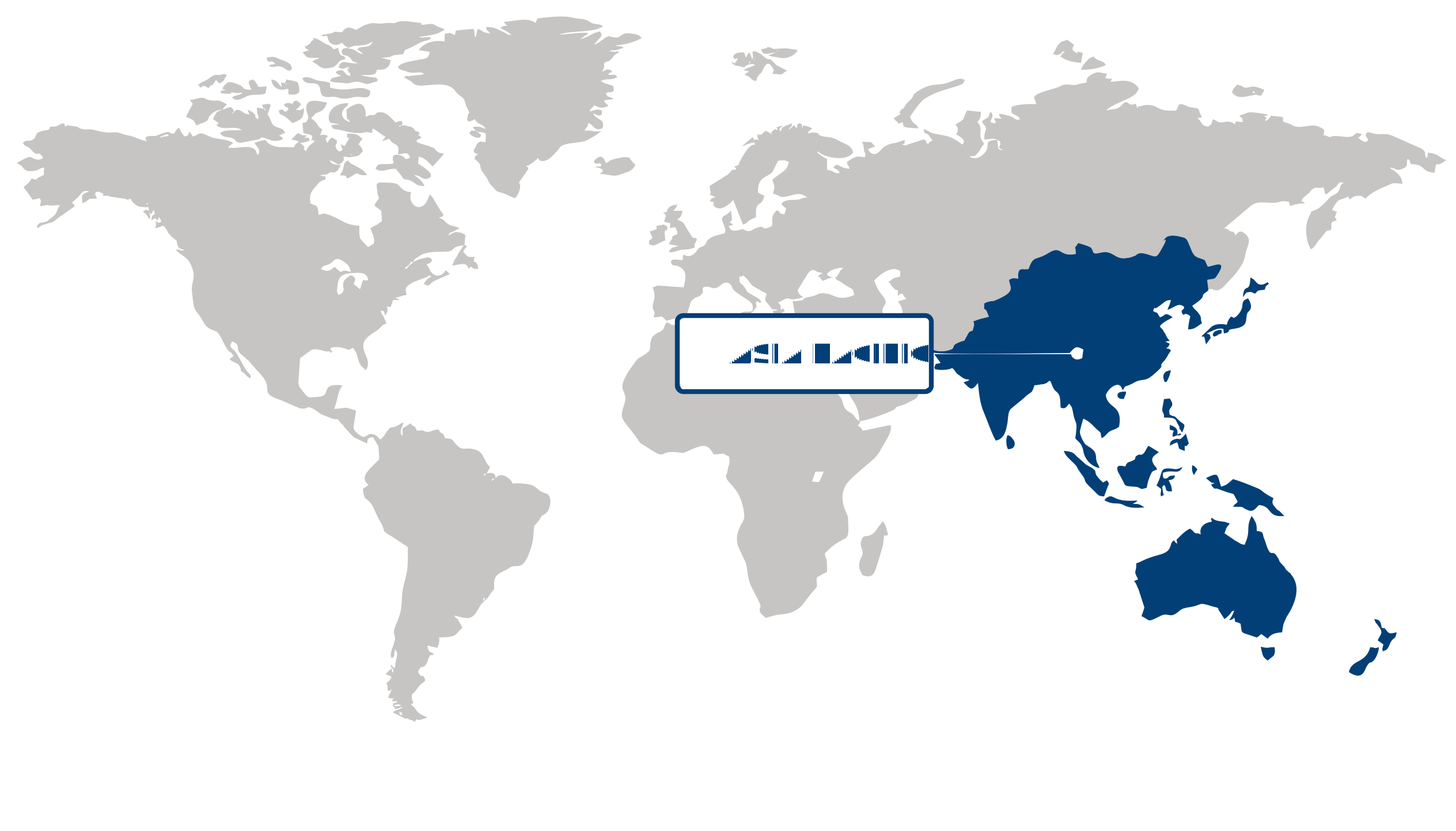
Asia Pacific (Largest & Fastest-Growing Region)
The 5G services market was led by Asia Pacific, which accounted for a 43.78% share in 2026, while also representing the fastest-growing regional market. The region’s strong position is supported by rapid digital transformation, expanding mobile connectivity, and sustained investment in next-generation telecommunications infrastructure. High smartphone penetration, rising demand for high-speed data services, and growing adoption of connected devices are encouraging operators and enterprises to expand 5G networks. In addition, the development of smart cities, industrial automation, cloud-based services, and connected transportation is creating broader use cases for 5G beyond conventional mobile communications. Supportive government initiatives, spectrum development, and efforts to strengthen digital infrastructure are further reinforcing regional demand, while increasing enterprise adoption of low-latency and high-capacity connectivity is expected to sustain the region’s growth momentum.
| Parameter | North America | Asia Pacific | Europe | Latin America | MEA |
|---|---|---|---|---|---|
| Innovation Hub i Scale Nascent Developing Advanced | |||||
| Cost-Sensitive Region i Scale Low Medium High | |||||
| Regulatory Environment i Scale Restrictive Neutral Supportive | |||||
| Demand Drivers i Scale Weak Moderate Strong | |||||
| Development Stage i Scale Emerging Developing Developed | |||||
| Adoption Rate i Scale Low Medium High | |||||
| New Entrants / Startups i Scale Sparse Moderate Dense | |||||
| Macro Indicators i Scale Weak Stable Strong |
Key Country Insights
Germany 🇩🇪
Industrial Network AdoptionGermany advances 5G services through industrial connectivity initiatives supporting smart manufacturing and factory automation. German enterprises increasingly deploy private 5G networks to improve production efficiency, real-time monitoring, and connected industrial operations.
France 🇫🇷
Public Sector ConnectivityFrance promotes 5G services through expanding digital infrastructure for public services, enterprises, and regional connectivity initiatives. French telecom providers increasingly support smart city projects, industrial modernization, and secure communications across diverse economic sectors.
Italy 🇮🇹
Regional Network ModernizationItaly strengthens 5G services by expanding network modernization across urban and industrial regions. Italian operators continue supporting enterprise connectivity, digital manufacturing initiatives, and enhanced mobile broadband services that improve business and consumer digital experiences.
Japan 🇯🇵
Smart Infrastructure DeploymentJapan integrates 5G services into smart infrastructure, connected mobility, and advanced digital services. Japanese network operators continue enhancing service capabilities that support intelligent transportation, industrial automation, and next-generation consumer applications.
South Korea 🇰🇷
Advanced Digital EcosystemSouth Korea continues expanding sophisticated 5G service offerings across consumer, enterprise, and industrial environments. South Korean operators increasingly develop innovative applications in immersive media, connected manufacturing, and intelligent urban infrastructure to broaden commercial adoption.
United States 🇺🇸
Enterprise Connectivity ExpansionThe U.S. prioritizes 5G service deployment for enterprise digital transformation, private wireless networks, and advanced cloud-enabled applications. U.S. telecom providers continue expanding coverage while supporting industrial automation, connected devices, and low-latency business services across multiple sectors.
Segment Leadership and Growth Trends
5G Services Market Share (%), by Communication Type, 2026
Go beyond the chart, access full insights & data tables
Request Free Sample ReportCommunication Type Segment Analysis: Enhanced Mobile Broadband (eMBB) (Largest Segment) vs Massive Machine-Type Communications(mMTC) (Fastest-Growing Segment)
Enhanced mobile broadband (eMBB) held the largest share of the 5G services market in 2026 at 41.77%, reflecting strong demand for higher-speed and more reliable mobile connectivity. The segment benefits from the continued growth of data-intensive activities such as high-definition content consumption, cloud-based applications, immersive digital experiences, and connected-device usage. 5G-enabled broadband services provide improved network capacity and responsiveness, supporting both consumer and enterprise connectivity requirements and strengthening eMBB as a foundational 5G service category.
Massive machine-type Communications(mMTC) is the fastest-growing communication type, propelled by the increasing deployment of connected devices across industrial, commercial, and infrastructure environments. Its ability to support large populations of connected devices makes it well suited to applications involving sensors, monitoring systems, smart infrastructure, and automated operations. As organizations expand internet of things deployments and seek more efficient machine connectivity, mMTC is gaining importance as a key enabler of large-scale device communication and increasingly connected operational ecosystems.
Vertical Segment Analysis: Enterprises (Largest Segment) vs Manufacturing (Fastest-Growing Segment)
The enterprises segment represented the largest share of the 5G services market in 2026, supported by the growing adoption of advanced connectivity to improve communication, digital collaboration, automation, and access to data-intensive applications. Enterprises are increasingly evaluating 5G as an infrastructure layer for modernizing operations and supporting connected devices, cloud services, and real-time applications. Enhanced network performance and the ability to support diverse connectivity requirements make 5G increasingly relevant across organizations seeking more responsive and digitally integrated business environments.
Manufacturing is experiencing the fastest growth as industrial organizations increasingly deploy connected equipment, automated production systems, sensors, and real-time monitoring technologies. 5G can support low-latency communication and reliable connectivity across complex production environments, enabling manufacturers to strengthen operational visibility and coordinate connected machinery more effectively. The broader shift toward smart factories, industrial automation, and digitally managed production is therefore creating expanding opportunities for 5G services within manufacturing applications.
| Segment | Sub-Segment | Largest Segment | Fastest Growing |
|---|---|---|---|
| Communication Type | Fixed Wireless Access (FWA), Enhanced Mobile Broadband (eMBB), Ultra-Reliable and Low-Latency Communications(uRLLC), Massive Machine-Type Communications(mMTC) | Enhanced Mobile Broadband (eMBB) | Massive Machine-Type Communications(mMTC) |
| Vertical | Consumer, Enterprises, Manufacturing, Public Safety, Healthcare & Social Work, Media & Entertainment, Energy & Utility, IT & Telecom, Transportation & Logistics, Aerospace & Defense, BFSI, Government, Others | Enterprises | Manufacturing |
Competitive Landscape and Market Positioning
Prominent players in the 5G services market:
1. China Mobile Limited (China)
2. Verizon Communications Inc. (United States)
3. AT&T Inc. (United States)
4. Deutsche Telekom AG (Germany)
5. Vodafone Group Plc (United Kingdom)
6. China Telecom Corporation Limited (China)
7. SK Telecom Co. Ltd. (South Korea)
8. NTT DOCOMO Inc. (Japan)
9. T-Mobile US Inc. (United States)
10. Bharti Airtel Limited (India)
The 5G services market is expanding with ultra-fast connectivity solutions that enable advanced digital applications across industries. Increased network densification is improving coverage and service reliability. The 5G services market is also driven by growing adoption of IoT and real-time communication technologies.
| Company | Market Share | Company Revenue | Revenue CAGR (%) | Product Portfolio | Geographic Presence | Innovation / R&D Focus | Strategic Developments |
|---|---|---|---|---|---|---|---|
| China Mobile Limited (China) | |||||||
| Verizon Communications Inc. (United States) | |||||||
| AT&T Inc. (United States) | |||||||
| Deutsche Telekom AG (Germany) | |||||||
| Vodafone Group Plc (United Kingdom) | |||||||
| China Telecom Corporation Limited (China) | |||||||
| SK Telecom Co. Ltd. (South Korea) | |||||||
| NTT DOCOMO Inc. (Japan) | |||||||
| T-Mobile US Inc. (United States) | |||||||
| Bharti Airtel Limited (India). |
Industry Development/News
| Company Name | Date | Key Development |
|---|---|---|
| Jazz | May-26 | Jazz announced plans to scale its commercial 5G rollout to 1,000 network sites by mid-August, following the conclusion of Pakistan's spectrum auction. This expansion is a critical step in the operator’s strategy to accelerate the deployment of next-generation mobile connectivity and establish a robust commercial 5G service foundation within the country. |
| Turkcell | Apr-26 | Turkcell launched commercial 5G services nationwide across Turkey’s provincial centers. This market entry marks a significant transition in the country's telecommunications landscape, providing widespread access to advanced mobile broadband services and signaling a major shift toward high-speed, next-generation connectivity for consumer and business users. |
| Vodafone Idea | Mar-26 | Vodafone Idea announced an accelerated 5G rollout strategy targeting coverage across 90 cities in India. The initiative involves strategic partnerships with Ericsson, Nokia, and Samsung to deploy advanced network infrastructure, aiming to significantly enhance network capacity and service quality for both consumer and enterprise users across a broader geographic footprint. |
| Zong | Mar-26 | Zong became the first operator to commercially launch 5G services in Pakistan, achieving coverage across more than 16 major cities. This strategic milestone represents the initial phase of widespread 5G adoption in the country, establishing Zong's position as a first-mover in the deployment of next-generation mobile network infrastructure. |
| 3 Sweden | Jan-26 | 3 Sweden deployed a standalone 5G network using Ericsson’s core technology. This transition to a dedicated 5G core architecture enhances the operator's network capabilities, facilitating more efficient data processing and enabling the delivery of advanced, low-latency connectivity services that differentiate its competitive offering in the Swedish telecommunications market. |
| M1 | Jun-25 | M1 launched Southeast Asia’s first commercial 5G RedCap network tailored for enterprise customers. By optimizing connectivity for IoT and industrial applications, the deployment broadens the commercial use cases for 5G, demonstrating a strategic focus on integrating high-performance mobile infrastructure into specialized industrial and enterprise digital transformation workflows. |
| Bharti Airtel | Feb-25 | Bharti Airtel partnered with Ericsson to deploy advanced 5G Core technology, initiating the transition to a full-scale 5G Standalone network in India. This deployment enables the monetization of network assets through features like network slicing and API exposure, providing a foundation for launching differentiated 5G use cases for enterprise and consumer segments. |
| Nokia | Aug-24 | Nokia secured a contract to build a 5G mobile core network for Next-Gen InfraCo in Ghana. This infrastructure project is essential for the country’s nationwide 5G rollout, highlighting Nokia’s strategic role in providing the foundational technology required to support large-scale, next-generation mobile service commercialization in emerging African markets. |
| Samsung Electronics | May-24 | Samsung Electronics and O2 Telefónica launched a virtualized and Open RAN 5G network in Germany. This collaboration advances the adoption of flexible, software-defined network architectures, enabling more agile infrastructure management and improved service deployment capabilities as operators transition toward next-generation network standards. |
| Cisco | Feb-24 | Cisco and DISH Wireless completed a proof-of-concept trial for a hybrid cloud-based 5G network slicing solution. This initiative targets the acceleration of enterprise-focused 5G services by demonstrating the scalability and operational efficiency of cloud-native infrastructure, providing a roadmap for operators to offer customizable, high-performance network segments to specialized business customers. |
Customize Your Report
Explore examples of how this report can be tailored to different research needs, including custom segments, additional topics or chapters, and related reports. Click a section of the wheel or its numbered marker to explore the available options.
5G Services Market — Custom Segments
| Segment | Sub-Segment |
|---|---|
| Deployment Model | Public 5G Networks, Private 5G Networks, Hybrid 5G Networks |
| Network Ownership | Mobile Network Operators, Enterprise-Owned Networks, Neutral Host Networks |
| Pricing Model | Subscription-Based, Usage-Based, Service-Level-Based, Bundled Pricing |
5G Services Market — Custom TOC
| Custom Chapter | Custom Details |
|---|---|
| Enterprise 5G Adoption Readiness Assessment |
|
| Private 5G Deployment Opportunity Mapping |
|
| 5G Monetization Strategy Benchmarking |
|
Need a different cut of the data?
Request Custom ResearchHow much revenue does the 5G services market generate?
What is the forecasted size of the 5G services industry?
How are enterprise connectivity needs reshaping service adoption in the 5G services market?
How are standalone and private 5G deployments influencing market growth strategies?
Why does Enhanced Mobile Broadband (eMBB) lead the 5G services market?
Why is Manufacturing the fastest-growing vertical in the 5G services market?
Why does Asia Pacific lead the 5G services market in 2026?
How is Asia Pacific driving the fastest growth in 5G services?
What are the prominent companies operating in the 5G services landscape?
Our Clients
"The team demonstrated a great understanding of our business needs, and the reports were tailored to address our specific concerns and objectives."
Infosys
"The report was up-to-date with the latest industry trends and technological advancements. The detailed competitive landscape analysis was quite helpful."
Zebra Technologies
"The data presented in the report was accurate and well-researched. I also found the market dynamics section particularly useful."
Arlo Technologies
Our Research Team & Methodology
Every Fundamental Business Insights report is built by a dedicated vertical research team, validated through a structured primary-and-secondary methodology, and reviewed for accuracy before it reaches you.
Research Team Overview
Prepared by the Smart Technologies Research Team
Delivery
Published
Demand
Available
Support
Trust & Compliance
Research Domains
10 coverage areasResearch Intelligence
| Source | Reference |
|---|---|
| National Institute of Standards and Technology (NIST) | www.nist.gov |
| International Organization for Standardization (ISO) | www.iso.org |
| Institute of Electrical and Electronics Engineers (IEEE) | www.ieee.org |
| Internet Engineering Task Force (IETF) | www.ietf.org |
| World Wide Web Consortium (W3C) | www.w3.org |
| Cloud Security Alliance (CSA) | cloudsecurityalliance.org |
| Open Source Initiative (OSI) | opensource.org |
| Linux Foundation | www.linuxfoundation.org |
| FinOps Foundation | www.finops.org |
| PCI Security Standards Council | www.pcisecuritystandards.org |
| SWIFT | www.swift.com |
| Financial Stability Board (FSB) | www.fsb.org |
| GSMA | www.gsma.com |
| International Telecommunication Union (ITU) | www.itu.int |
| OWASP Foundation | owasp.org |
| MITRE | www.mitre.org |
| World Economic Forum (WEF) | www.weforum.org |
| OECD Digital Economy | www.oecd.org/digital |
| World Bank Data | data.worldbank.org |
| U.S. Census Bureau | www.census.gov |
Research Workflow & Quality Assurance
Data Collection
Verified information gathered through primary and secondary research.
Data Triangulation
Cross-validation using multiple independent data sources.
Forecast Modelling
Market estimates developed using historical trends and analytical models.
Analyst Validation
Findings reviewed by domain experts for accuracy and consistency.
Editorial & Quality Review
Final editorial, quality, and compliance checks before publication.
Final Publication
Released after successful completion of the internal review process.
Report Coverage
📊 Market Assessment
- Market Size & Forecast
- Market Segmentation
- Regional Analysis
- Growth Drivers & Challenges
- Market Dynamics
🏢 Competitive Intelligence
- Competitive Landscape
- Company Profiles
- Competitive Benchmarking
- Mergers & Acquisitions
- Market Share Analysis or Key Company Strategies
🔍 Strategic Analysis
- Value Chain Analysis
- Porter's Five Forces
- PESTLE Analysis
- Pricing Trends
- Supply-Demand Analysis
🚀 Future Outlook
- Technology Landscape
- Regulatory Landscape
- Investment & Funding Landscape
- Emerging Opportunities
- Future Market Outlook
Have a question about this report or need a custom scope?
Request Customization